You are getting hit with nonstop “UFO news,” “UAP news,” and “disclosure” headlines, and the signal-to-noise problem is predictable: older cases get recycled until evidence, rumor, and copy-pasted wording become indistinguishable. The result is a feed where a story can feel “confirmed” simply because it is familiar, not because the record actually supports it.
The Delphos case stays on the short list because it sits on the fault line between two kinds of claims: an alleged aerial observation and an alleged physical trace on the ground. That pairing raises the stakes, because a trace is where documentation either makes a report durable or collapses it. The tradeoff is equally consistent: the more compelling the physical-effect summary sounds, the more you should expect popular retellings to outrun what any dated notes, photos, lab paperwork, or contemporaneous reporting can actually confirm.
Here is the fixed point this article will not move: the Delphos Ring UFO case is reported as occurring on November 2, 1971 near Delphos, Kansas, USA. Everything else is handled with discipline. In that discipline, “UFO” is used in its literal sense-an aerial object or phenomenon observed and reported that has not yet been identified-so the focus stays on what was reported, not on what it “was.” When “UAP” appears, it is treated as the broader modern label for anomalous observations across domains that remain unidentified; that wording can change how readers intuitively score evidence, so it is used carefully, not as a credibility upgrade. Most importantly, this article separates (1) reported observations, (2) what can be documented, and (3) what is inferred, and it does not treat “unknown compound” as established without a citable primary or near-primary source.
You will leave with a repeatable way to judge what is known, what is disputed, and what is evidentially supported by tracking each claim to a dated source, a first-hand witness account, or a lab/document artifact, and treating everything else as later retelling.
What happened in Delphos
The Delphos report is consistently anchored to Nov 2, 1971, and to a small farm outside Delphos, Kansas. The same case summaries also attach the primary witness name “Ronnie,” but those summaries are not, by themselves, the original 1971 documentation, so every personal identifier should be treated as provisional until the earliest notes, letters, or contemporaneous press items are located and verified.
The most repeated retellings include an evening or nighttime context, but later secondary summaries (including an American Philosophical Society archival listing and later compilations such as the book The Delphos Ring Incident (1971)) do not substantiate an exact time window. Note: in preparing this article I reviewed later secondary summaries (see the APS archival entry and later case compilations linked where cited); contemporaneous primary materials such as original 1971 lab reports, dated field notes, or immediate photographs were not available in those sources for inspection.
Weather context should be built from NOAA and NWS data routed through NCEI, because those tools preserve historical station observations and metadata needed for auditability. The minimum checks for Nov 2, 1971 are: nearest first-order station(s) and cooperative sites to Delphos for hourly sky cover, visibility, wind, temperature, dew point, and any recorded precipitation; plus station distance and observation times so a reader can judge how representative the data is for a rural property. Ground moisture can be approximated from precipitation history and dew point trends, which is directly relevant to how readily soil and vegetation would show disturbance.
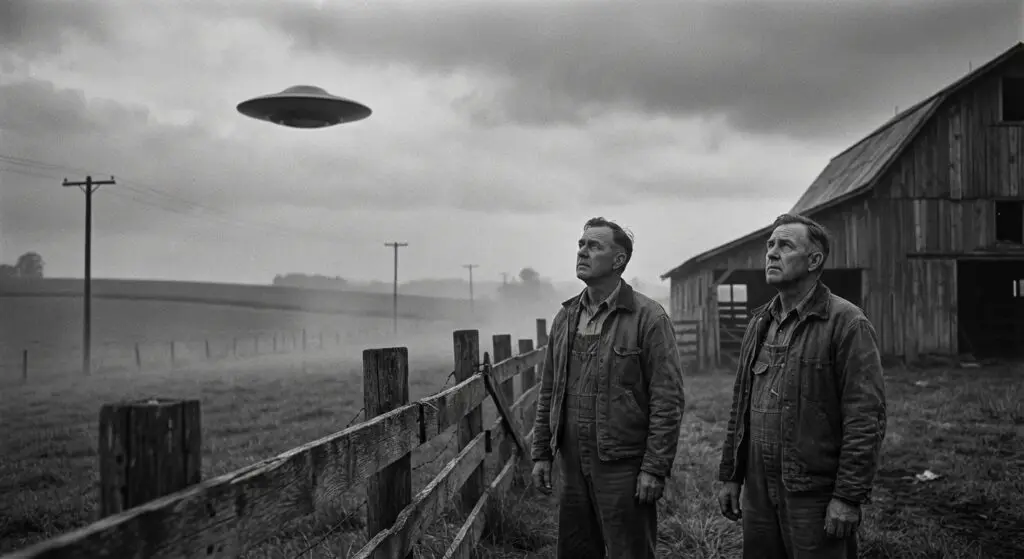
In later-circulated case entries, the observation is presented as a brief, close-range event involving a hovering object and a single primary witness identified as Ronald Johnson, age 16, with a dog named Snowball. Those same entries also include asserted physical details such as the object’s dimensions and that it hovered, but the later secondary summaries function as journal-style case entries rather than primary, time-stamped 1971 field documents.
The core movement pattern in these accounts is simple: an object is noticed at close range, it occupies low altitude long enough for the witness to track it, then it departs along a path that later becomes relevant during the ground check. What is not responsibly reconstructable from later secondary summaries is the exact sequencing within the minute-by-minute observation, the precise distance from the witness, or whether any other observers were present at the moment of the sighting. Those details are frequently asserted in popular retellings, but they are not substantiated here.
Because time is unverified, the visibility context must remain conditional. A clear-sky night with low wind produces very different apparent motion cues than a hazy or overcast night with gusts. That is why the NOAA and NCEI station record is the correct anchor before accepting confident statements about what “should have been visible” from a farmyard.
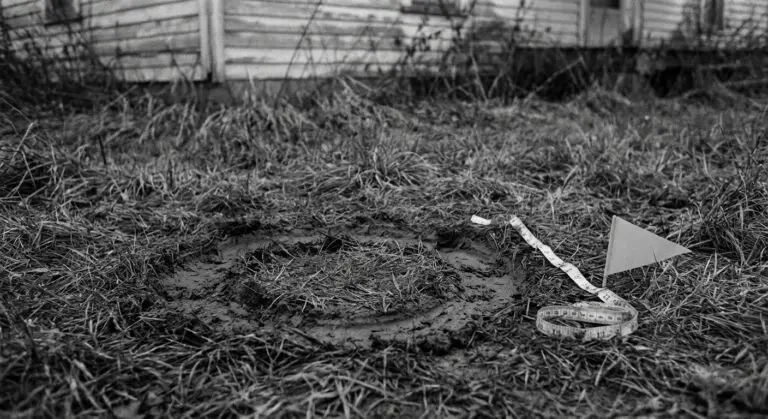
Where the case earns its “trace” reputation is the immediate aftermath. Contemporary accounts describe a distinct “ring” on the ground and broken branches in the path of the object. The ring and the vegetation damage are the first-order physical claims because they convert a fleeting observation into something other people can examine later.
What cannot be confirmed from later secondary summaries is when that ring was first seen relative to the sighting, who else viewed it that night, and whether any photographs were taken immediately versus later. The same applies to the exact location on the property and the address: “outside Delphos” is the only supported geographic resolution in those summaries, and it is not enough to independently tie the trace to a specific parcel without primary documentation.
What later secondary summaries do support is that the Delphos incident was later cataloged and referenced in organized archival and conference-style collections. Those collections are useful for understanding how the case was recorded and transmitted through investigative networks, but they do not substitute for the earliest, contemporaneous materials when the goal is a defensible timeline.
- Elements that remain stable across the sourced summaries: the date (Nov 2, 1971) and the general setting (a small farm outside Delphos, Kansas) appear as the anchor points in later case-summary entries.
- Commonly repeated identifying details (treat as unverified until primary documents are located): the primary witness name and age, and who else was present, are frequently stated in later case entries, but those summaries are not the original 1971 documentation.
- Physical aftermath claims that define the case: contemporary descriptions emphasize a ground “ring” and broken branches along the object’s path; later summaries do not supply a primary, time-stamped scene description that would allow verification of exact wording, measurements, or photo provenance.
- High-impact unknowns: exact time window, exact address or parcel location, witness identity and age as established by primary records, and the list of immediate observers remain unsubstantiated in the later secondary summaries and must be labeled unverified pending primary documentation.
A disciplined way to keep later-added details from hardening into “fact” is to demand early artifacts before accepting fine-grained claims. Use this checklist when evaluating any retelling of the Delphos timeline:
- Dated contemporaneous notes: field notes, letters, or logs created in 1971, not later summaries.
- Photographs with provenance: original prints or negatives, dates, and a documented custody trail.
- First-hand interviews: recordings or transcripts with clear interview dates and participant identities.
- Contemporaneous media: local newspaper or radio mentions tied to a publication date.
- Weather verification: NOAA and NCEI station observations for Nov 2, 1971 to ground visibility and moisture claims in recorded data.
Those gaps and checks are not academic. They determine whether the ring is something you can evaluate like evidence-or only repeat like a story.
The luminous trace and residue
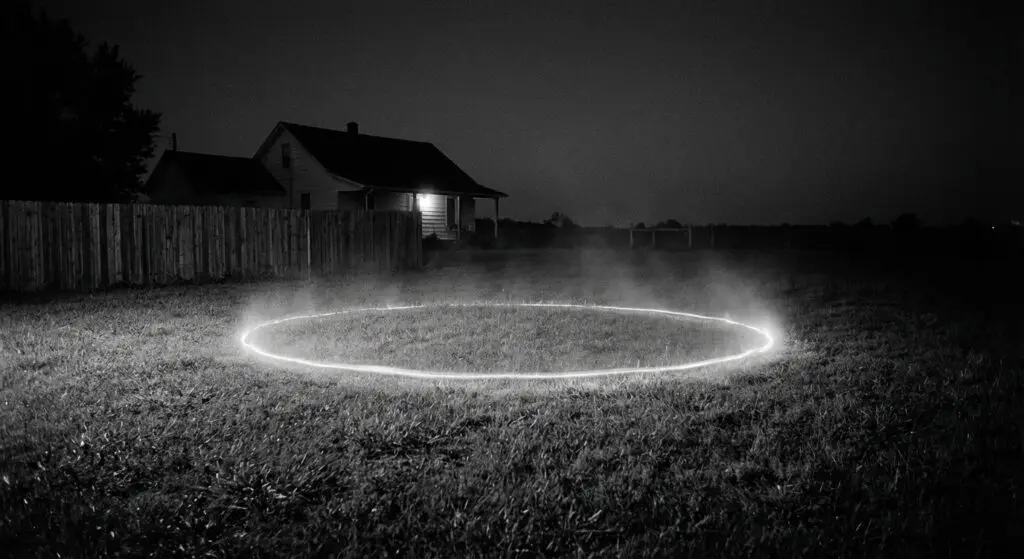
Delphos is repeatedly cited because it is a physical trace case, meaning the claim is anchored to alleged measurable effects on the environment, not only an aerial observation. The ring is described in public accounts as a circular ground feature that presented as visibly luminous in low light and as a persistent ring-like mark in daylight, with the emphasis always on the same point: whatever happened was said to have interacted with soil and vegetation, leaving a discrete boundary rather than a vague disturbed area.
The most attention-grabbing specifics attached to the trace are also the least stable across sources. Descriptions of brightness, exact glow duration, and sensory details like odor or surface texture circulate widely in later retellings, but the later secondary summaries available for this section do not include primary, publicly accessible documentation that locks those details down as recorded observations.
That distinction matters because “glow” is not a single physical mechanism. Fluorescence is a transient emission after energy input (for example, illumination with UV), which is categorically different from claims of continuous, self-sustained luminescence. Without a documented lighting condition and observation protocol, a glow report cannot be cleanly interpreted as one mechanism or another.
A ground trace is perishable evidence, so documentation has to precede collection. Standard crime-scene practice is to record evidence locations before anything is picked up, and photographs are a core tool for preserving where an item sat in relation to the broader scene; collection and sequencing decisions also affect what can still be recovered afterward.
For a ring-like feature, the baseline record is simple and mechanical: capture size, shape, scale, and dimensions in a way another examiner can audit later. That is exactly where the public record is thin. The later secondary summaries do not supply publicly accessible lab-report text, and they do not supply verified numbers for ring measurements or glow duration; any figures circulating in secondary write-ups need to be traced to primary documents or labeled explicitly as later retellings rather than contemporaneous measurements.
Sampling should also be structured, not opportunistic. Comparison samples taken near the suspected trace and at multiple nearby locations (out to about 100 feet, where feasible) are what let a lab distinguish “something different happened here” from normal yard-to-yard variability. Without that context, even a real anomaly is hard to quantify.
Even perfect chemistry cannot rescue mishandled evidence. Chain of custody, a recorded log of every individual who had physical possession of the evidence, is the documentation that lets later testing speak with authority about integrity. In forensic terms, it is the difference between “this sample came from that ring on that date” and “this is a sample someone says came from a ring at some point.” Courts treat chain of custody as the critical documentation process for establishing integrity, and the same constraint applies to scientific credibility outside a courtroom.
If custody is undocumented or broken, later claims about residues rise or fall on trust rather than traceability. That is why the limiting factor in famous trace cases is often evidence handling, not instrument sensitivity.
Keep the categories clean:
- Observation: what was directly seen and recorded (a ring-like boundary, visible glow under stated lighting, a mark that persisted, vegetation differences).
- Collection fact: what was actually taken (soil, plant material, scrapings) and how it was labeled and stored.
- Inference: what the observation is taken to mean (residue equals “unknown compound,” glow equals “energy effect,” soil change equals “radiation”).
The practical takeaway is a trace-evidence minimum standard you can apply to any future retelling of Delphos or a similar case:
- Photograph the trace with date-stamped images and a visible scale in frame.
- Map sampling locations so each container can be tied to a specific spot on the ring and to control locations.
- Label containers immediately with collector, date/time, exact location, and sample type.
- Log custody transfers so possession is auditable from collection through storage and analysis.
- Separate observation from interpretation in writing, so “glowed” never silently becomes “self-luminous,” and “residue present” never silently becomes “identified compound.”
Once you apply that standard, the next question is unavoidable: what testing was actually done, and what do the surviving records allow you to conclude?
Tests, theories, and limitations
The Delphos reputation is shaped as much by testing limitations and documentation gaps as by what any lab did or did not find. Accounts describe terrestrial sample types that sound familiar to any trace case: soil from the affected area, nearby vegetation or plant material, and collected residue from the surface. Those materials can support ordinary, testable explanations first, such as salts, fertilizers, soil moisture effects, and local soil chemistry that changes with season, drainage, and land use. The hard constraint is that without a fully documented sampling plan and comparators, a lab can only speak to what is in the submitted material, not what caused it or how unusual it is in that landscape.
The phrase “unknown compound” also needs to be handled as a documentation claim, not a scientific conclusion. In the later secondary summaries reviewed, that phrase is not substantiated by publicly accessible lab report text. Treat it like any other contested quote: it only carries weight if it is tied to a specific publication, interview, or verbatim laboratory wording that can be checked.
Soil sampling is necessarily limited to a few locations and therefore provides only a fragmentary picture of contamination. That is not a minor caveat; it is the dominant limitation. A few scoops from one feature on one day cannot map background variability across a yard, a field edge, or a drainage gradient, and trace residues are extremely easy to move with shoes, tools, containers, and even windblown dust.
Good scene work starts with sequence and documentation, because the order of collection and how evidence is handled determines what later testing can legitimately mean. The same integrity constraint applies here as it does in any chain-of-custody-driven setting: uncontrolled handling can manufacture “anomalies” that never existed in place.
A Delphos-like claim also rises or falls on a control sample, meaning a comparison sample of the same matrix taken from unaffected nearby ground that establishes local baseline chemistry. Without that paired baseline, you cannot distinguish “unusual” from “normal for this soil,” and you cannot tell a localized deposit from background fertilizer, road salt drift, or naturally high mineral content.
Storage and handling matter as much as collection. Drying, sealing, container material, headspace, and time delay change what remains measurable, especially for volatile or reactive compounds. Early-1970s analytical capability also imposed real ceilings on what could be separated, detected, and confidently identified from small, dirty environmental matrices. A modern lab can do more, but it still cannot turn a compromised sample into a clean inference.
The biggest interpretive failure mode in cases like Delphos is narrative compression: “not identified” becomes “not terrestrial,” and uncertainty becomes a feature instead of a limitation. In lab practice, an unresolved signal usually means the methods, reference library, sample mass, contamination level, or preparation workflow did not support a definitive identification. It does not mean the chemistry is non-human.
Modern identification workflows make that distinction explicit. Analytical labs commonly identify compounds by matching acquired mass spectra and chromatographic retention times to reference spectra and retention time data, and screened findings are routinely confirmed using mass spectrometry methods including GC/HRMS. Mass spectrometry identifies chemicals by measuring the mass-to-charge ratios of ionized molecules or fragments; it is powerful at telling you “what matches,” but it does not assign origin, intent, or mechanism on its own.
The capability gap between then and now is real: modern characterization commonly uses chromatography-based separations plus mass spectrometry workflows, and inorganic screening often relies on ICP-MS for metals. The limiting factor is not access to advanced instruments; it is whether the sampling, custody, and reporting rise to a standard a third party can audit, like the close-encounter/trace cases stringent quality expectations used in regulated programs.
- Collect paired samples: the affected material plus multiple control samples from unaffected nearby ground at matched depth and moisture.
- Document chain of custody with containers, seals, timestamps, handlers, and a contamination-control log from collection through analysis.
- Pre-register the analytical questions in plain language (salts, fertilizers, common organics, plant metabolites), then map methods to those questions.
- Run blinded splits to at least two independent labs and require full method notes, chromatograms, spectra, and QA/QC outcomes suitable for publication.
- Report results as comparisons, not headlines: what differs from controls, by how much, and within what uncertainty.
That package is the difference between “unidentified in this submission” and a defensible claim that something truly falls outside normal terrestrial explanations.
How Delphos fits the pattern
These limitations are not unique to Delphos. They are the recurring fault lines in trace cases generally, which is why comparisons are useful only when they stay anchored to handling and documentation.
Delphos gets clearer when you set it beside other trace reports, because credibility rises or falls on documentation quality, not on how exotic the story sounds. A ring, scorched patch, crushed vegetation, or residue is only a starting point. The hard question is procedural: was the scene treated like evidence, or like a curiosity?
That procedural lens is straight crime-scene logic: decide what to collect, how to process the scene, and in what order. If collection is improvised, later lab talk becomes interpretive noise, because you cannot reconstruct what was actually on the ground versus what was introduced by weather, cleanup, or handling.
Trans-en-Provence is recorded as a physical trace case dated January 8, 1981. Witness reports describe a circular print in a crown shape where an object allegedly rested. Whatever explanation you favor, its role in trace catalogs is simple: a discrete, geometrically described ground mark becomes the centerpiece of the claim.
The Valensole UFO incident occurred in 1965 and is listed among notable French UFO cases discussed in trace and ground-effect contexts. It functions as a second anchor point because it shows how quickly a case can become “representative” in the literature once it is framed as a ground-trace event, even when readers only remember the category label and not the handling details.
Delphos aligns with both French reference cases at the class-of-claim level: a reported object presence paired with ground marks, residue, and vegetation effects. That shared structure is exactly why these cases get grouped together in trace catalogs.
The divergence is less about the trace type and more about how cleanly the paper trail supports a forensic reading. Similar-looking rings and disturbed soil can arise from radically different causes, and the only reliable separator is disciplined documentation: contemporaneous notes, clear scene boundaries, and sampling that can be audited later. When a report is vague on who collected what, when it was collected, and how it was stored (chain of custody), the trace stops behaving like evidence and starts behaving like narrative.
Delphos remains sticky in the literature despite uncertainties because the physical-trace element invites forensic framing. A visible ring tempts authors to treat the case as “lab-addressable,” and that perceived testability keeps it circulating even when the underlying documentation leaves room for competing interpretations.
| Criterion | What credible looks like | What weak looks like |
|---|---|---|
| Scene preservation | Area secured before foot traffic and souvenirs | Multiple visitors before any recording |
| Scaled photos and mapping | Photos with scale; measurements tied to a sketch/map | Unscaled close-ups; no orientation or distances |
| Mapped sampling with controls | Samples labeled by location plus nearby control samples | One grab sample with no comparison baseline |
| Custody and handling (chain of custody) | Documented transfers; sealed containers; dates and initials | Unclear storage; unknown intermediaries; late recollections |
| Transparent reporting | Methods, observations, and limits stated plainly | Conclusions without inputs, timings, or constraints |
Why it matters in 2025 and 2026
That emphasis on procedure is exactly why Delphos keeps resurfacing in the current UFO disclosure and UAP disclosure environment. Trace cases like Delphos get cited because they promise the one thing the debate usually lacks: something you can audit. A physical trace, a documented sampling decision, a chain of custody, lab notes, and measurements are all checkable in a way that secondhand narrative claims are not. That’s why older “UAP sightings” with residue, soil disturbance, or instrument readings keep resurfacing whenever the conversation swings toward “materials” and away from stories.
The catch is that rhetorical reuse often inflates what a trace case can carry. A ring on the ground can become shorthand for “hard proof,” even when the surviving records are incomplete, the collection methods weren’t standardized, or key artifacts were never preserved in a way that modern labs would accept. The practical takeaway is simple: treat “trace evidence exists” as an invitation to request documentation, not as a conclusion that documentation exists.
Modern attention is driven as much by institutions and process as by any single incident. In sworn testimony, David Grusch testified before the House Oversight committee on July 26, 2023; see the hearing transcript and video for the record and his statements (hearing transcript, official video). Those statements shape public expectations, but they do not constitute direct, first-person validation of any specific historical case, including Delphos.
Policy language is even more explicit about scope. The FY2024 National Defense Authorization Act includes provisions establishing an Unidentified Anomalous Phenomena Records Collection; see the enacted bill text for H.R. 2670 and the legislative language establishing the collection (H.R.2670 text). That legislation directs federal agencies to review and organize UAP records in their custody under the new collection framework, which changes how records are handled going forward but does not certify that any particular file, trace, or narrative is accurate.
Oversight and standards efforts also matter. AARO and related offices have issued reports and summaries about practices for UAP records and data handling; see the official AARO site and published DoD/AARO records and reports for program guidance and historical records initiatives (AARO official site, DoD/AARO historical records report PDF). The point of that work is comparability: consistent intake, consistent documentation, and consistent analytical pathways so different reports can be weighed against the same yardstick.
Disclosure-era framing routinely “upgrades” legacy incidents by borrowing credibility from modern hearings, record-collection statutes, and official reports, then back-projecting that credibility onto older cases that were never documented to those standards. That’s where search-frame phrases like “government UFO cover-up” do most of their work: they collapse uncertainty into insinuation without adding corroboration.
- Separate testimony boundaries from physical evidence: treat secondhand accounts as leads, not lab-grade confirmation.
- Demand auditability: collection notes, storage conditions, lab methods, and raw results matter more than summaries.
- Check what a statute actually orders: record reviews and collections increase access, not accuracy.
- Refuse rhetorical upgrades: modern standard-setting does not retroactively fix missing documentation in Delphos-era cases.
Read Delphos the way disclosure policy is trying to force every modern case to be read: by the quality of the record, not the volume of the attention.
What we can say with confidence
Delphos is a lesson in evidence discipline: alleged traces raise the ceiling on what a UAP case can support, but they also raise the bar for proof. A ring on the ground is inherently stronger than a sighting claim because it is, in theory, measurable, sampleable, and repeatable. In practice, Delphos only carries as much weight as its documentation, sampling controls, and the ability to verify what was recorded, by whom, and where it lives today.
The incident is reported as occurring on November 2, 1971 near Delphos, Kansas, with a reported ground trace described in contemporary accounts as a ring and broken branches. The case’s ceiling is set by the physical-claim framing, but its limit is set by evidence-handling and sourcing gaps: without clear custody, controls, and citable primary records, conclusions stay bounded.
Popular summaries often elevate the phrase “unknown compound,” but it does not clear the documentation bar here: the later secondary summaries reviewed include no publicly accessible lab report text and no verified quoted laboratory wording establishing “unknown compound,” so treat that phrasing as unconfirmed until a citable primary or near-primary source is produced. The later secondary summaries also do not establish consistency across the earliest sources for ring measurements or glow duration; divergence between early reporting and later retellings should be expected and explicitly tracked.
- Custody: Who had physical possession of any samples, photos, or notes at each step, and is that chain documented?
- Controls: What comparison samples and contamination controls were collected, stored, and analyzed alongside any alleged residue?
- Earliest documentation: What is the earliest dated, inspectable record that fixes ring dimensions and reported glow duration, and does it match later summaries?
- Lab wording: What are the exact, quoted lab conclusions, and where is the original report text that supports or refutes “unknown compound”?
- Archival location: Where, specifically, are originals cataloged for public access, and what collection identifiers or finding aids point to them?
Start by hunting primary documentation, not summaries: institutional special collections, local historical societies and newspaper archives, and any cataloged papers of original investigators. Verify the basics first: a dated first-generation document, the precise lab language (quoted, not paraphrased), and written custody and controls. Online claims about “archived” material vary wildly in reliability, so treat them as leads and confirm them against institutional catalogs and original documentation.
Hold yourself to the standard you want the field to meet: don’t share Delphos as “proven” without (a) a dated primary source, (b) quoted lab wording, and (c) documented custody and controls; otherwise label it an unverified retelling. Better standardized reporting and records practices will change how “UAP sightings” and “UFO sightings 2026” narratives are evaluated.
Primary-source trail to look for
Candidate sources to verify (concrete, checkable targets):
- Local newspapers and archives to search (candidate sources to verify): local Ottawa County newspapers and Delphos-area press. Start with institutional newspaper archives and digitized runs such as the Delphos Herald and the Ottawa Daily Republic entries on Newspapers.com (Delphos Herald, Ottawa Daily Republic). Note that available runs may not cover 1971 online; check county libraries and state historical society holdings as candidate repositories.
- Regional and special collections (candidate sources to verify): American Philosophical Society archival summary for “Kansas: Delphos-UFO Case” (APS Delphos-UFO file) and local public library special collections (for example, county or Salina-area library holdings).
- Federal and military holdings to query (candidate sources to verify): Project Blue Book and related Air Force files at the National Archives; search NARA Project Blue Book holdings and FOIA reading-room entries (NARA Project Blue Book guidance).
- Investigative organizations to query (candidate sources to verify): CUFOS, MUFON, NICAP-era files, APRO and private researchers who published case compilations or trace-research reports. (Check their publication bibliographies and PDF/book directories; contact archivists or librarians for access to dated files.)
- What artifacts would qualify as primary evidence (candidate items to verify): dated field notes or investigator logs from 1971, original prints or negatives of scene photographs with provenance, scanned lab reports showing methods and exact wording, sealed sample containers with documented custody logs, investigator correspondence dated 1971, and contemporaneous press reports with bylines and publication dates.
- What to request when you find a lead (candidate actions to verify): request scans or microfilm of the contemporaneous newspaper page, request finding aids or catalog entries for archival collections, and ask repositories whether specific boxes or item identifiers correspond to Delphos materials (photographs, lab reports, or correspondence).
Frequently Asked Questions
What is the Delphos Ring UFO case?
The Delphos Ring case is a reported UFO incident dated November 2, 1971 near Delphos, Kansas, USA. It is best known as a physical-trace case because accounts describe a distinct ring on the ground and broken branches after the sighting.
What physical evidence was reported in the Delphos 1971 incident?
Contemporary descriptions emphasize a ring-like ground feature and broken branches along the object’s reported path. Public retellings often add details about a luminous glow and residue, but the article notes the provided excerpts do not supply primary, time-stamped scene documentation with verified measurements or photo provenance.
Did the Delphos Ring case prove an “unknown compound” was found?
No-within the provided research excerpts, the phrase “unknown compound” is not substantiated by publicly accessible lab report text. The article says that wording should be treated as unconfirmed until a citable primary or near-primary source provides exact, checkable lab language.
How can you verify the weather conditions for the Delphos UFO report on Nov 2, 1971?
The article recommends using NOAA and NWS records routed through NCEI to pull historical station observations near Delphos for Nov 2, 1971. Minimum checks include hourly sky cover, visibility, wind, temperature, dew point, precipitation, plus station distance and observation times to judge representativeness.
What is the minimum evidence-handling standard for a ground-trace UFO case like Delphos?
The article’s minimum standard is: date-stamped photos with a visible scale, mapped sampling locations (including control locations), immediate container labels (collector, date/time, exact location, sample type), and a logged chain of custody. It also stresses separating observation from interpretation so “glowed” doesn’t silently become “self-luminous,” and “residue” doesn’t become “identified compound” without documentation.
How does the Delphos Ring case compare to Trans-en-Provence and Valensole?
All three are grouped as physical-trace cases because each centers on a discrete ground mark linked to a reported object presence (Delphos: ring; Trans-en-Provence: crown-shaped circular print dated Jan 8, 1981; Valensole: a 1965 trace-context case). The article’s key comparison point is procedural: credibility depends on documentation quality (scene preservation, scaled photos, mapped sampling with controls, and chain of custody), not how exotic the narrative sounds.