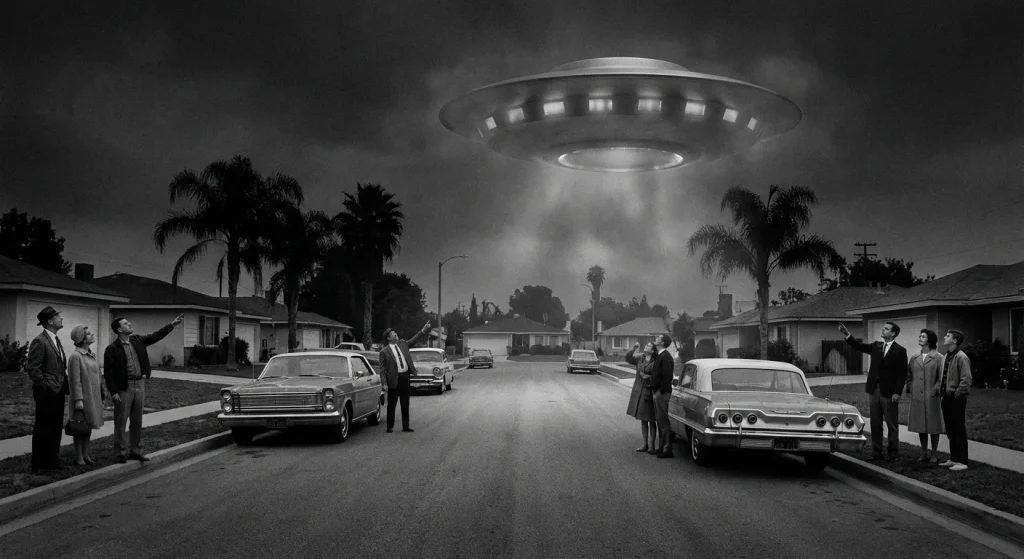
A source-by-source review of the Redlands, California, 1968 mass-sighting claims: what contemporary documentation exists, what public records located so far do not include, and which modern tools and official reports are relevant to re-evaluating the case.
You are trying to keep up with credible UFO news and UAP news, and the signal-to-noise ratio keeps getting worse. Viral threads recycle the same talking points, “disclosure” chatter inflates certainty, and citations dissolve the moment you look for an actual paper trail. The Redlands 1968 story sits right in the middle of that problem: frequently referenced, rarely sourced in a way you can audit.
The claim, in its most repeated form, is simple: a large disc-shaped craft, sometimes described as roughly 50 feet across with windows, was seen by around 200 witnesses. That is the exact tradeoff the case forces on you. The scale makes it compelling as a supposed mass sighting, but the credibility hinges on something less exciting than the headline: what was reported at the time, by whom, and what can still be documented.
This article treats Redlands like a record-building exercise, not a campfire story. It separates the material into three buckets and keeps them from bleeding together: (1) firsthand claims, meaning what witnesses say they saw and how those statements are preserved; (2) contemporaneous media, meaning reporting produced close to the event, before the story had decades to mutate; and (3) later retellings and databases, where repeated summaries can quietly harden into “facts.” In that framework, “50 feet” and “about 200 witnesses” remain reported estimates unless primary or near-contemporary documentation is located later.
This review is based on publicly accessible sources located so far (contemporary newspaper archives, online case-file repositories such as NICAP chronologies, and later secondary summaries), and it documents which key contemporary records I have not located yet: an exact calendar date and time, a street-level or mapped vantage point, and verbatim, attributable witness statements captured near the time of the event. Where authoritative agency or archival documents exist, they are cited below.
Case file and timeline basics
The Redlands 1968 story circulates with a tight bundle of headline details that tend to travel together: the place is Redlands, California (city and immediate area), the year is 1968, and the object is described as a disc-shaped craft with visible windows. The size estimate most often repeated is “about 50 feet,” and the witness count is typically framed as a mass event at roughly 200 people.
For case-file purposes, treat those details as “reported,” not proven. They are the baseline assertions this article is evaluating and trying to pin to primary documentation.
The most basic identifiers that allow independent checks are missing from publicly accessible sources located so far. None of the contemporaneous newspaper items and archives I have located so far include an exact sighting date and time window tied to named witnesses that can be cited; available secondary summaries likewise do not provide an immediate primary citation for a street-level location or a minute-level timestamp. That gap is not cosmetic. Without date, time window, and street-level location, you cannot responsibly run routine validation steps like historical weather reconstruction or later air-traffic corridor checks. Any attempt to “match conditions” without those anchors turns into guessing that looks like analysis.
Below is a worksheet-style scaffold: what the story claims in sequence, and what an investigator would try to lock down once a near-contemporary account (newspaper item, police log, FAA note, dated letter, or archived investigator file) is located. The placeholders are deliberate and should stay blank until a document supports them.
| Timeline point | Reported (circulating claim) | Confirmable if a primary/near-contemporary record is found |
|---|---|---|
| 1) Event anchor | Redlands, 1968; mass sighting narrative | Exact calendar date; day of week; source title/author; publication or agency of origin |
| 2) Time window | Unspecified time of day in sources located so far | Start and end times (or “around HH:MM”); time standard used; how the time was obtained (clock, dispatch time, reporter timestamp) |
| 3) Location | Redlands area; no street-level point located so far | Address, intersection, or nearest landmark; witness vantage points; direction of view; mapped coordinates |
| 4) Object description | Disc-shaped object with windows; “about 50 feet” | Exact quoted descriptors; number/placement of windows; angular size context; distance estimates and how they were derived |
| 5) Witness count | Approximately 200 witnesses | Named witnesses or counted groups; independent corroborators; how the number was tallied (attendance list, neighborhood block count, media estimate) |
| 6) Aftermath and paper trail | Mentions and retellings | Any calls for service, police reports, newspaper follow-ups, aviation advisories, or archived investigator files tied to the event anchor |
Once a date, time window, and point location are established, basic environmental checks become straightforward instead of speculative. The National Centers for Environmental Information (NCEI) provide documentation and tools to view and download weather-station observation history for coordinate ranges covering the Redlands and San Bernardino County area, which enables hour-level reconstructions (visibility, wind, cloud layers) when station coverage exists; see NCEI’s Integrated Surface Database (ISD) and Local Climatological Data (LCD) product pages for how to obtain hourly and station-level records and metadata (NCEI ISD, NCEI LCD). To find station identifiers and nearby stations you can search by place and date using NCEI’s station finder (NCEI station finder) and then download ISD/Global Hourly or LCD files for the station and month of interest (NCEI Climate Data Online).
Flight-context work also becomes meaningful only after the same anchors exist. The FAA Chart Users’ Guide introduces FAA aeronautical charts and publications, which is the reference you use to interpret what charts do and do not imply when checking typical flight corridors near the reported location (FAA ATC publications). That flight-corridor step is not optional context: the U.S. Bureau of Transportation Statistics publishes large-scale passenger and traffic datasets (T-100 and related tables) used to quantify air traffic; for example, BTS and related summaries document total passenger activity for 2023 and the T-100 data bank used for system-level traffic analysis (BTS T-100 / Data Bank 28, BTS transtats), which is why ruling in or ruling out routine aviation factors requires precision, not guesswork.
What the witnesses said they saw
The timeline problem above feeds directly into the witness problem: until a dated, attributable record is located, you are working with a description that has already passed through retelling. That matters because small wording shifts-especially around size and “windows”-can become permanent features of the lore.
The Redlands account persists because the object description is repeatedly retold as engineered rather than amorphous: a disc or saucer shape. In a case like this, the audit question is not “is a disc plausible,” but “where is the earliest citable sentence that uses that term, and is it first-hand or second-hand.” Publicly accessible historical newspaper summaries and later compendia do discuss Redlands-era sightings, but the earliest verbatim witness lines and precise anchors have not been established in the public source base located so far (Press-Enterprise / Redlands Daily Facts summary, Press-Enterprise 2013 retrospective).
The complication is straightforward and document-driven: the public source base located so far does not include verbatim, attributable Redlands witness statements tied to an exact date and time. Without those first-person lines, every descriptive detail stays in the category of reported retelling until primary text is located and cited. Treat “disc,” “windows,” and “50-foot” as claims whose credibility depends on whether they appear in near-contemporary reporting or recorded testimony that can be checked.
Shape and structure. The recurring claim is a disc or saucer shape. The provided public summaries cite that descriptor, but I have not located contemporaneous, attributable witness quotations that would anchor who first used that term (NICAP Redlands listing).
Surface features (including “windows”). “Windows” is one of the details that makes the narrative feel concrete because it implies scale, orientation, and proximity. In the public sources located so far, there is no quoted Redlands witness language describing windows, no count of windows, and no primary record showing how that descriptor entered circulation (local retrospective).
Approximate size. The commonly repeated “about 50 feet” type of estimate is the sort of number that often originates as an on-the-spot judgment and then hardens into a fixed statistic through repetition. The public source base located so far does not include the earliest Redlands source for a size estimate, and it contains no primary text that can be cited as the origin of a “50-foot” figure (NICAP 1968 chronology).
Lighting. Retellings typically attach some form of illumination to the object, because light is one of the easiest features to perceive at distance. The public materials located so far do not contain a Redlands-specific, attributed statement about light color, intensity, patterning, or whether lighting was intrinsic to the object versus an external effect (Press-Enterprise).
Motion (including hovering) and speed changes. Reports of hovering and abrupt speed transitions are common in UAP narratives because they map to perceived control and intent. Here, those categories can only be treated as reported, since contemporaneous, attributable witness language describing hover duration, acceleration, or maneuvering profile has not yet been located in the public materials identified to date.
Sound or no sound. “Silent” or “no engine noise” is another high-salience feature people remember and later repeat. Some later retellings of the Redlands story reference audible phenomena recorded in local retrospective articles; see Press-Enterprise coverage for reporting on witness descriptions of sound (Press-Enterprise).
Duration and direction. Time-on-target and direction of travel are the kinds of details that can be cross-compared across witnesses when documentation exists. The public material located so far does not provide a Redlands witness roster, map, or verbatim accounts that record duration in seconds or minutes, or direction in cardinal terms. As a result, these remain reported elements rather than auditable measurements.
Several independent secondary sources and archive listings use the same scale language for large events, referring to approximately 200 witnesses (phrased as “200,” “over 200,” or “more than 200”) in summaries and compendia (local retrospective, NICAP casefile). An academic account and several archive listings reference “over 200 witnesses” in broader discussions of mass-sighting episodes; those citations show how high witness counts enter the record through institutional or later-historical processes, but they must not be treated as automatically Redlands-specific until the drafting process can confirm the linkage to the Redlands event with a primary, near-contemporary source.
The non-obvious problem is provenance. Even when multiple independent sources repeat “about 200,” the origin still has to be traced to the earliest available account(s) to determine what was counted, by whom, and under what method. The public sources located so far do not identify a single, clearly earliest published statement of the Redlands “about 200 witnesses” figure, so the claim remains a reported number awaiting a traceable source trail.
A large witness pool is not automatically decisive, but it is consequential. One common line in public discussion is that eyewitnesses tend not to contradict each other on core facts, implying a stable “core” that persists across many observers. The practical takeaway is narrower: more witnesses can increase observational coverage across angles and distances, yet it can also standardize language as people compare notes, which can compress variability into a single dominant storyline.
The documentation limits in the public material located so far set the ceiling on what can be asserted about Redlands. No specific named Redlands witnesses with verbatim, attributable quotes have been located in the publicly available excerpts reviewed for this audit. No Redlands police officer, pilot, reporter, or city official appears in the public materials located so far with an attributable, verbatim statement tied to an exact date and time. No excerpted memo, incident report, or signed affidavit has been located in the public source set that can be cited line-by-line.
That absence forces discipline: every descriptive element must be treated as reported until primary text is located, such as a contemporaneous newspaper article with named witnesses, a recorded interview, a police log entry, or a formal transcript if one exists. The same applies to the “about 200” motif: it is widely repeated in later summaries, but it rises or falls on whether the earliest, near-contemporary documentation can be produced and checked.
The next step is documentary: follow the paper trail to the earliest citable records that contain verbatim Redlands witness accounts and the first attributable appearance of the “about 200” figure. Useful starting points include local newspaper archives and archived case files such as NICAP listings (NICAP Redlands) and the Press-Enterprise retrospective (Press-Enterprise).
Explanations that fit and don’t
Because the public materials located so far do not preserve first-person Redlands statements tied to precise anchors, the goal here is not to “solve” the case from description alone. The goal is to show what explanations would have to match once the missing anchors (date, time, location, and attributable testimony) are recovered.
The fastest way to keep this case analyzable is to treat only a small set of “core facts” as constraints: the parts of the report that should not change from one retelling to the next, and that can anchor every hypothesis test.
The Redlands claim set imposes a short list of non-negotiables at the feature level:
- Group observation at scale: the report is framed as a mass sighting (roughly 200 observers), not a single-person misread.
- Structured-object impression: witnesses were not describing a point light only; they reported an object with form.
- “Windows” or window-like features: the account includes discrete panel/window elements rather than a uniform glow.
- An apparent size estimate: “about 50 feet” is part of the story, which forces a geometry check rather than pure narrative interpretation.
Even if many observers converge on these core features, consistency alone does not identify the cause. It only tells you what your explanation must reproduce.
Aircraft (including conventional traffic) fits the “structured” requirement immediately: a fuselage silhouette, landing lights, and cabin lighting can be read as a solid craft with window-like elements. The strain is geometric: a normal aircraft explanation has to match the reported outline (disc-like versus elongated), the implied altitude, and the apparent size. Without azimuth and elevation (where in the sky it was, and how high), you cannot check whether the sightline matches approach and departure corridors, nor whether the motion profile matches a turning aircraft that can briefly look non-airplane-shaped head-on.
Lighter-than-air objects (balloons and blimps) clear the “structured with features” bar more cleanly than most people assume. A large envelope plus gondola can read as a single coherent object, and a gondola’s windows or lighting can plausibly be described as “windows” from the ground. As a plausibility test only: Goodyear currently lists a U.S. fleet and details about its active airships on its site, which shows the historical reality of advertising airships and how a gondola can present window-like features (Goodyear current blimps). That history proves that the “airship with apparent windows” concept is real, not that an airship was over Redlands. The strain is again context: you need the date, local event schedule, wind direction, and an actual track to decide whether a slow lighter-than-air platform was even operationally likely over that area at that time.
Astronomical objects (bright planets, the Moon) are the first thing an investigator tries to kill off because they are deterministic once time and place are known. They fit mass sightings because everyone shares the same sky, and they fit “steady presence” cases. They strain hard against “windows” and “structured disc” unless the description is being driven by perceptual effects, thin clouds, or a partial obstruction (tree line, roofline) that creates segmentation. If the report includes sustained translation across the sky relative to foreground, a fixed astronomical source fails quickly; if the “movement” is subjective and lacks reference points, it stays in play.
Atmospheric effects and optical misperception are the quiet workhorse explanations because they can manufacture “structure” out of a point source: scintillation, thin cloud layers, and contrast effects can create internal bands, apparent edges, and flicker that observers rationalize as panels or windows. The strain is reproducibility: these explanations require a specific sky condition at a specific time, plus a line of sight that encourages depth and motion errors. If you cannot lock time, you cannot lock conditions.
Misperceived distance and size is not a separate object class, but it can rescue or destroy every object-class hypothesis above. “50 feet” is meaningless without distance, because size is inferred from angular size, the angle an object subtends on your retina. If two observers see the same angular size but one assumes “near,” they will report “large,” and if the other assumes “far,” they will report “small.” A tight quantitative illustration shows how sensitive this is: perceptual research demonstrates how angular subtension scales with distance and how easily impressions of size are influenced by assumed range.
Hoax is always a hypothesis, but it is constrained by how the record was formed. A hoax can explain almost any feature list; it struggles when there are independently recorded, time-stamped accounts from separated vantage points that converge without cross-contamination.
Two tools do most of the heavy lifting because they convert vivid description into geometry.
Angular size (the visual angle an object occupies) is the bridge between “it looked 50 feet across” and a testable estimate. If you can recover even a rough angular estimate, for example “it was about the width of my thumb at arm’s length,” you can bound distance and reject whole classes of objects. Without that, “50 feet” is just the brain backfilling a range guess.
Motion parallax (near objects appear to move faster than distant ones as you shift position) is the fastest way to separate “crossing the sky” from “I changed my viewing position and it shifted.” If multiple witnesses were in different locations and recorded the same object against the same fixed references, parallax can estimate range. If everyone was clustered and watching without fixed reference points, apparent motion is easy to misread.
Corroboration only helps if it is structured: multiple vantage points matter when time and location are pinned down and accounts are captured independently, before people converge on a shared story. That is why investigations in other domains explicitly avoid group questioning dynamics that can homogenize accounts, and why “multiple independent sources” is the standard for validating a fact rather than repeating it.
Once Redlands has a date and time, “sky-condition tools” become verification instruments rather than background flavor. Tools that explicitly support historical-date simulation include desktop and mobile planetarium software such as Stellarium (which lets you set arbitrary date and time; see the Stellarium user guide for date/time controls) and SkySafari (which can simulate past dates), plus professional ephemeris systems like JPL Horizons for precise solar-system positions and observer-location ephemerides (Stellarium guide, SkySafari, JPL Horizons manual). Web tools such as timeanddate provide historical Sun/Moon/planet position calculators that are useful for quick checks (timeanddate astronomy tools), and in-the-sky.org offers chart-generation for specified dates and locations (In-The-Sky.org charts). All of these require setting the historical date and the local observer coordinates to reconstruct what was visible at a given time and place.
The discriminators are simple, and the public sources located so far cannot apply them because they are missing the fields that turn description into a solvable problem: the exact date and start time (to the minute if possible), the observers’ precise locations (street-level, not just “Redlands”), the object’s azimuth and elevation at first notice, the duration and whether it was continuous or intermittent, the direction of travel relative to fixed landmarks, contemporaneous weather (cloud layers, visibility, wind), and aviation context (nearby airport activity, known flight corridors, and any reports that would plausibly generate lights or structured silhouettes). Collect those, and the hypothesis space collapses quickly: astronomical and many perception-driven explanations either fail immediately or become strongly favored, and aircraft or lighter-than-air candidates become checkable against actual geometry rather than intuition.
Why 1968 matters in the disclosure era
The methodology above-separating claims into layers and insisting on provenance-maps directly onto how the disclosure-era conversation evaluates evidence. In practice, the question is no longer whether a story is famous, but whether it can survive an audit.
The reason legacy cases from 1968 keep resurfacing in 2024 and 2025 has less to do with any single headline and more to do with a changed evidentiary standard. The disclosure era trained readers to look past anecdotes and toward audited documentation: what was recorded, who held it, what was briefed to oversight bodies, and whether the paper trail can be independently checked. That shift is why a Redlands-style historical report gets pulled back into the conversation, not to relitigate the sighting, but to ask whether it can be re-evaluated under modern reporting expectations.
“UAP” (all-domain framing) pushes the conversation toward precision: where the event occurred, what sensors existed, who had reporting responsibility, and what standardized fields were captured. The practical effect is narrower and stricter than the public often assumes. A modern UAP mindset expects time stamps, provenance, chain-of-custody for any imagery, and a clear distinction between witness testimony and instrumented data. That expectation is friction for legacy cases because most were never collected under a uniform schema, and many were not built to withstand today’s audit-style questions. The takeaway is straightforward: the terminology shift did not “upgrade” old cases, but it did upgrade what people demand before they treat any case as evidence-grade.
The Pentagon and intelligence community have produced a sequence of public documents in recent years that illustrate that shift. The ODNI Preliminary Assessment (June 2021) reviewed 144 UAP reports from 2004 to 2021 and emphasized that most cases remained unexplained while finding no evidence that the reviewed incidents represented extraterrestrial vehicles (ODNI Preliminary Assessment, 2021; NPR coverage). Subsequent unclassified reports and DoD/AARO products have documented additional reports and consolidated findings: AARO’s FY23 consolidated annual report and the DoD/AARO unclassified summaries and releases cover hundreds of reports across services and agencies (AARO FY23 consolidated annual report, ODNI UAP 2024 summary, DoD release on annual report). AARO also released a Historical Record Report (Volume 1) in 2024 that catalogs historical materials and categories of evidence (AARO Historical Record Report, Volume 1 (2024)).
The complication is that recurring summary reports create momentum without automatically producing case-level documentation for specific historical sightings. A public report can summarize categories, processes, or aggregate findings while leaving individual incidents unresolved or redacted. The actionable read is to treat AARO’s outputs and ODNI/DoD annual summaries as the baseline timeline for what the U.S. government is willing to publish in an attributable, version-controlled format, not as an automatic verdict on any one legacy event (AARO, ODNI UAP 2024).
Legislative and administrative changes have also formalized reporting expectations. The FY2024 National Defense Authorization Act and related congressional activity set statutory oversight and reporting requirements that affect how agencies assemble, protect, and transmit UAP-related records (see the FY2024 NDAA bill page and congressional text for legislative context) (H.R. 2670 / NDAA FY2024). Those process and oversight mechanisms change how legacy records are treated, searched for, and declassified, which in turn affects whether a 1968 case like Redlands can be expected to surface with primary documentation in the near term.
What to take from Redlands
Redlands remains compelling because the story is vivid and widely repeated, but the case is only as strong as the documentation that can be produced and audited.
The durable reported claims travel together in most retellings: a mass sighting in Redlands in 1968 involving a disc-shaped object described as having windows, often reported at roughly 50 feet across, and frequently paired with a figure of about 200 witnesses. Those core descriptors persist because they are simple, memorable, and mutually reinforcing: scale, shape, a distinctive feature (windows), and lots of people seeing the same thing.
What the publicly accessible materials located so far do not supply is the information that would let a reader independently check the story: a specific date, a time window, and a street-level location, alongside attributable, verbatim witness material. Even the “about 200” figure still needs origin tracing, because a headline number without a trackable first citation is not evidence; it is a repeatable talking point.
Use a core facts baseline: “facts about which there should be no disagreement” and are treated as agreed baseline information.
Applied to Redlands today, the core facts are limited to what is actually pinned down in the public source base: contemporaneous newspaper follow-ups and archive listings acknowledge a Redlands 1968 episode in later summaries (Press-Enterprise retrospective, Redlands Daily Facts, NICAP), but the date, time, exact location, and quoted named testimony required for a geometry- and evidence-driven re-evaluation do not yet appear in the public materials located so far. This is also why geometry and context checks (sky maps, weather, flight corridors) cannot be applied responsibly until a timestamp and location exist.
If better records exist in archives, they are likely the unglamorous kinds: incident logs, police or dispatch records, and contemporaneous newspaper items—the same category of “boring but decisive” documentation that disciplined archives like historical government investigations often preserve. Search strategies should therefore prioritize local newspaper microfilm and municipal records, NCEI station logs for weather, and any archived investigator files (for example, CUFOS or NICAP holdings and local historical society collections) referenced in later summaries (NICAP 1968 chronology).
The modern benchmark is reflected in agency reporting and guidance. The FAA updated air-traffic guidance in its orders and communications to replace legacy terminology and to direct controllers to route UAP observations into existing safety-reporting channels; official FAA order pages and ATC guidance are the primary sources for those changes (FAA JO 7110.65, FAA ATC UAP section). Likewise, the ODNI and DoD/AARO public reports document how reporting pathways and evidentiary expectations have shifted (ODNI Preliminary Assessment, 2021, AARO FY23 consolidated annual report, AARO Historical Record Report, Vol. 1 (2024)).
For any sighting you want taken seriously, capture: exact time, exact location, direction of travel, duration, photos or video with provenance (original file and metadata), and at least one independent account gathered separately. For credible updates, follow official agency releases and established reporting channels and consult the primary documents linked above for institutional context.
Frequently Asked Questions
-
What is the Redlands UFO sighting of 1968?
It’s a widely repeated claim that a disc-shaped object with “windows” was seen in or near Redlands, California in 1968. The story is commonly framed as a mass sighting involving roughly 200 witnesses.
-
What does UAP mean, and how is it different from UFO?
UAP stands for “unidentified anomalous phenomena,” which the Pentagon uses as the preferred label in official coverage. “UFO” is the legacy shorthand in popular reporting for an unidentified flying object.
-
How big was the Redlands UFO reported to be, and what features were described?
Retellings most often describe the object as a disc or saucer “about 50 feet” across. The same summaries frequently add that it had visible “windows,” but the article notes the packet contains no verbatim witness quotes to document that detail.
-
How many witnesses reportedly saw the Redlands UFO in 1968?
The most repeated estimate is about 200 witnesses, sometimes phrased as “over” or “more than” 200. The article emphasizes that this remains a reported number because the provided materials do not identify the earliest traceable Redlands-specific source for the count.
-
What key details are missing that prevent verifying the Redlands 1968 report?
The provided packet contains no exact sighting date, no time window, and no street-level or nearest-landmark location for a Redlands event. Without those anchors, routine checks like historical weather reconstruction and flight-corridor analysis can’t be done responsibly.
-
What should you look for to evaluate a mass UFO/UAP sighting like Redlands?
The article recommends collecting an exact time, exact location, direction of travel, duration, and photos/video with provenance (original file and metadata), plus at least one independent account gathered separately. It also prioritizes “boring but decisive” records such as newspaper items near the date, police logs, FAA notes, dated letters, or archived investigator files tied to the event.
