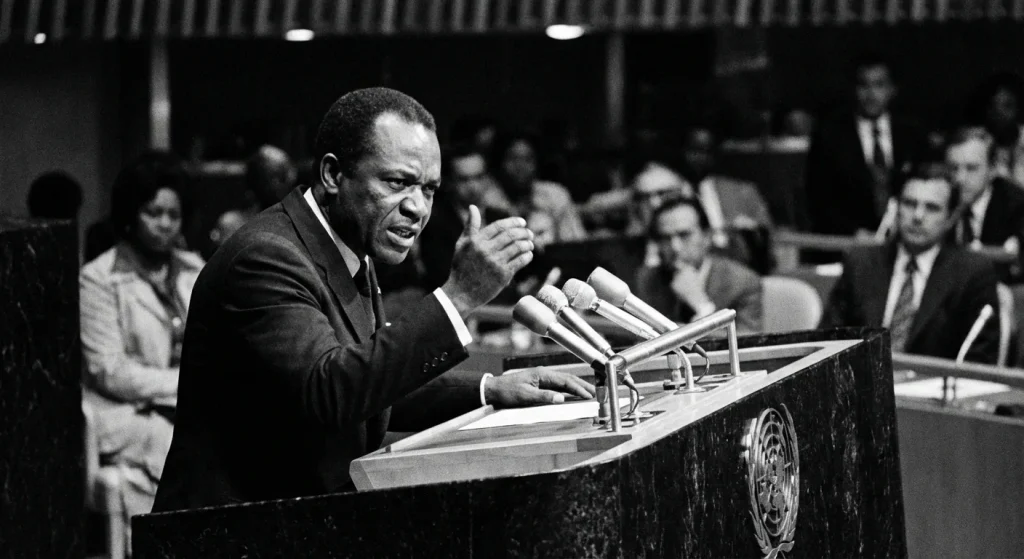
Recent 2025 and 2026 sightings chatter often gets framed as breaking news, but it blurs together because the conversation rarely comes with hard historical anchors. One anchor is routinely skipped: this already happened at the United Nations in 1977, not as a tabloid sideshow, but as a sitting head of government using the UN’s machinery to force a formal, retrievable record of a UFO research demand.
The verifiable core claim is simple: Grenada’s Prime Minister, Sir Eric M. Gairy, used the United Nations General Assembly (UNGA) platform in 1977 to press for formal UFO research, and the documentation trail is still sitting in plain sight. It begins with Gairy’s letter dated 14 July 1977 requesting that a UFO-related item be included in the provisional agenda of the UN General Assembly’s 32nd session, filed as document A/32/142/Add.1. That request matured into an agenda listing: “Research into unidentified flying objects and related phenomena” appeared as agenda item 123 for the 32nd session.
This is easy to miss because stigma scrambles memory. “UFO debate” gets treated like unserious theater, so the institutional fact gets swallowed by the punchline. It also gets misfiled in public discourse: small delegations can put real items in the UN’s paperwork, and those items can still be forgotten because the cultural reflex is to argue about “firsts” instead of pulling the record. Contemporaneous reporting sharpened the contrast. The New York Times described a Prime Minister asking the UN for a UFO debate and reported that Gairy said he was convinced UFOs were “space vehicles” used by “highly intelligent aliens.”
Read today’s disclosure fights through that 1977 lens and the noise drops. The real tension is stigma versus institutional process, curiosity versus state secrecy, and anecdote versus record. Treat every new disclosure claim as a documentation problem: look for the paper trail, the agenda line, the transcriptable statements, the contemporaneous reporting, and the parts that can be retrieved years later by anyone. You will walk away from this article knowing exactly what was put before the UN in 1977, what was said about it at the time, and how to judge modern UAP disclosure arguments by the strength of their records, not the velocity of their summaries.
To see why the 1977 push mattered beyond the headline, you first have to place Gairy himself in the diplomatic and political context of the time.
Gairy, Grenada, and Cold War optics
Sir Eric Matthew Gairy (18 Feb 1922 to 23 Aug 1997) mattered in 1977 because he was not a crank on the sidelines. He was Grenada’s first Prime Minister, the politician who led the country through the independence transition after Grenada gained independence in 1974, and he was still in office in 1977. That combination made his interest in UFOs politically legible: whatever you thought of the topic, the messenger had cabinet-level standing and a state behind him.
You can see that standing in contemporary diplomatic records: U.S. Department of State archival material from 1977 quotes Gairy discussing U.S.-Grenada relations as the country’s leader. In UN terms, this is the difference between a curiosity story and a formal signal. A head of government elevates an issue into the realm of sovereignty, public safety, and international responsibility, even when the subject itself is culturally contested.
That elevation did not remove the stigma. Contemporary reporting already tagged Gairy with a public reputation for taking UFOs seriously. The friction was obvious: raising a fringe-coded subject risked turning a small state’s diplomacy into a punchline. The strategic upside was just as obvious: if you want a hearing on an anomalous topic, you lead with official status, not personal fascination.
The UN’s design gives small states a rare advantage: formal equality. The organization’s stated purposes include maintaining international peace and security and developing friendly relations among states based on equal principles. In practice, that lets a microstate put a microphone in front of an issue that would be ignored in bilateral channels, because the venue treats the state as a state, not a market size.
The catch is that the UN is not a neutral amplifier. In the late Cold War, any novel security-adjacent claim could be read through alliance politics, propaganda anxiety, and prestige competition. For a small member, the way around that problem is framing: attach the issue to shared institutional mandates like safety, stability, and transparency, rather than to national rivalries or sensational claims.
1977 sat in a narrow window where official attention to UFOs was simultaneously tempting and risky. Watergate had hardened public skepticism toward executive-branch truth-telling, and Cold War optics trained audiences to suspect cover stories, psychological operations, and information control. A claim that “governments are not telling the whole story” did not sound exotic; it sounded like the era’s default posture.
At the same time, there was a policy-shaped vacuum in the United States. Project Blue Book ended in 1969 after the University of Colorado study concluded there was no evidence UFOs came from other worlds, and the Air Force regulation framework behind the program was rescinded afterward. That did not end sightings or fascination; it ended an official, widely recognized intake valve. The absence of a standing, credible forum made a UN stage more attractive for anyone arguing that the subject deserved structured inquiry rather than rumor.
The practical takeaway for reading “why now, why then” UFO headlines is straightforward: track institutional incentives and trust cycles, not only the reported observations. When legitimacy is scarce, the forum becomes part of the message, and 1977 offered a forum built to confer it.
Those incentives and risks explain why Grenada did not rely on rhetoric alone. It used the UN’s paperwork and agenda-setting mechanisms, which is where the historical record becomes hard to dismiss.
What Gairy demanded at the UN
Gairy’s move in 1977 was not a campfire story or a backchannel pitch. Grenada used a specific UN General Assembly mechanism: a formal request to place an issue on the Assembly’s provisional agenda. That procedural move matters because it produces retrievable records tied to a UN document symbol, the archive key UN staff use to file and retrieve official papers.
The core identifier in the 1977 paper trail starts with Grenada’s letter dated 14 July 1977, submitted for the UNGA’s 32nd session, issued under the document symbol A/32/142/Add.1 (requesting inclusion on the provisional agenda). Once you have that symbol, you are no longer debating hearsay; you are looking up a specific UN document in the UN Digital Library.
The procedural end-state of that request is also concrete. The UNGA agenda for the 32nd session included “Research into unidentified flying objects and related phenomena” as agenda item 123. In UN terms, an agenda item is the formal label that makes an issue eligible to be scheduled, debated, and acted on by the Assembly. It is not, by itself, an endorsement of any conclusion.
The record is equally specific about the moment of inclusion: the General Assembly decided to include the item at its 5th plenary meeting on 23 September 1977, recorded in A/32/430. That matters because it anchors the claim to a meeting record, not to later retellings.
If you want to validate what the Assembly did on a given day, you do it through the relevant meeting record and, where issued, the verbatim record. These record types are designed to preserve decisions taken in-session and attributable statements, tied to official symbols that can be retrieved in the UN archives.
The title also limits what a careful reader can claim. “Research into unidentified flying objects and related phenomena” is a request for attention to an observed category, not a UN declaration of extraterrestrial fact. An unidentified flying object (UFO) in this setting is simply something observed that has not yet been identified, which is precisely why governments can discuss it without endorsing an alien hypothesis. The agenda text supports “research” and “related phenomena” as the frame, not “proof” or “confirmation.”
The most useful interpretive constraint comes from Grenada itself later in the same year. In a letter dated 10 November 1977 to the Secretary-General, Grenada framed its posture as investigatory rather than doctrinal: “Grenada takes no categoric theoretical stand on the question… unanimity among scientists regarding all aspects of the UFO phenomenon” (Grenada letter to the Secretary-General, 10 Nov. 1977).
That sentence does two jobs at once. First, it blocks a common escalation in modern retellings: it is incompatible with “Grenada told the UN aliens are real.” Second, it explains why the issue could be pressed in a UN forum without requiring scientific consensus. Grenada’s stated problem was the absence of “unanimity among scientists” on “all aspects” of the phenomenon, which is a research justification, not a conclusion claim.
If you are trying to map the 1977 phrasing to later research culture, treat it as terminology, not as evidence of UN action. For example, the Journal of Scientific Exploration published material explicitly titled “A Guide to UFO Research”, and the same volume shows “UAP” terminology in use alongside “UFO research.” That tells you how adjacent research communities talked, but it does not add procedures or decisions to the UN record.
The archival record described above supports four narrow claims: Grenada requested agenda inclusion (A/32/142/Add.1, 14 July 1977); the agenda carried item 123 with the title “Research into unidentified flying objects and related phenomena”; the Assembly decided to include it at the 5th plenary meeting on 23 September 1977 (A/32/430); and Grenada later emphasized an investigatory posture (“no categoric theoretical stand,” 10 Nov. 1977). It does not support the usual internet add-ons.
Hard boundary: none of the provided source documents include a transcript, circulated memo, or letter in which “Gairy” requests a specific UN committee, a specialized body, an expert panel, or an international conference. Because that mechanism-level request is not in the provided record, this article will not claim it.
Use that same discipline when you see “the UN investigated UFOs” circulating as a headline. Agenda inclusion is a procedural fact, not a finding; a meeting record is a decision log, not an endorsement; and a national letter urging research is not a UN institutional conclusion.
- Find the UN document symbol (for example, A/32/142/Add.1) and pull the document from the UN Digital Library.
- Verify the agenda item number and exact title (for 1977, item 123: “Research into unidentified flying objects and related phenomena”).
- Confirm the plenary decision in the meeting record (for 23 Sept. 1977, A/32/430).
- Refuse claims about committees, panels, conferences, or “UN confirmation” unless the specific mechanism appears in a circulated UN document or verbatim record.
Once the item is on the agenda, the historically responsible question becomes narrower: what, if anything, was said and decided on the record after inclusion.
UN reactions and what happened next
Getting an item onto the UN agenda is real, but it is not the same as the UN “investigating UFOs.” The floor of certainty remains document-based: agenda item 123 exists, and the plenary decision to include it is recorded as A/32/430.
Once something is on the agenda, the next question is not general sentiment but what appears in official records. Meeting records and verbatim records are where attributable reactions-if any-either appear under a speaker’s name or do not.
For evidentiary purposes, the workhorse document is the verbatim meeting record: an edited transcript-style record that identifies who spoke and what was said. If someone claims “State X endorsed it” or “the UN dismissed it,” the verbatim meeting record is where that claim either appears as attributed speech or it does not.
This is also where retrieval discipline matters in practice: UN records are tracked through document symbols, and you use those symbols to pull authoritative text instead of relying on paraphrases that drift over time.
The hard reality about follow-through at the UN is structural. Floor time is scarce, mandates compete, and delegations triage based on what they can defend at home and in the chamber. Topics that read as fringe-coded impose reputational risk: even a neutral procedural move can be framed as “endorsing” the underlying claim, so many actors choose silence, deferral, or procedural minimalism.
Procedure adds its own drag. The UN runs on routinized workflows, drafting cycles, and clearance practices; anything that does not plug cleanly into an existing mandate faces inertia by default. “It was discussed” is easy to say; “it produced an attributable, recorded outcome” is harder and requires the right record type.
A constraint you must keep explicit: the provided research set does not contain verifiable outcomes such as committee referral, vote tallies, or final disposition. Do not assert any specific routing, voting, or closure based on this set; verify it first in UN Official Records and the UN document retrieval systems (for example, UNBISnet).
Verification protocol (use this before summarizing any “UN reaction”):
- Find the agenda entry (agenda item 123) and its recorded inclusion decision (A/32/430) so you are anchored to the documented baseline.
- Locate the relevant meeting records for the plenary meeting(s) where the item was taken up, prioritizing verbatim meeting records for attributable statements and recorded decisions.
- Confirm any claimed reaction by matching the speaker, date/meeting, and exact wording in the verbatim text, then summarize only what the record supports.
This emphasis on documents over vibes is not a 1977-only lesson. It is also the most practical way to read the modern disclosure wave, which is built around reporting systems, record custody, and statutory process.
From 1977 to today’s disclosure wave
The UN push in 1977 didn’t produce a standing UN UFO body. What it did leave behind is a clean before-and-after marker: the debate moved from theatrical speeches to paperwork, mandates, and reporting channels, especially inside the U.S. national security system.
“UFO” never stopped existing in public language, but inside government the incentive shifted toward a term that sounded like a reporting category instead of a punchline. “Unidentified aerial phenomena (UAP)” reads like a case label you can put on an intake form, attach a sensor package to, and route through an intelligence workflow, which is exactly what bureaucracies optimize for.
The switch was gradual, not a single renaming event, and the overlap is still visible: many public-facing sources use “UFO/UAP” side by side, while cultural coverage keeps “UFO” as the dominant shorthand. That dual usage signals what the change really was: stigma management plus scope management, where “phenomena” can cover lights, tracks, and sensor anomalies that never resolve into a classic “object.”
The practical result is procedural, not philosophical. “UAP” is a term that survives contact with internal email, classification guides, and data systems; “UFO” carries decades of baggage that makes routine reporting less likely, especially for pilots and operators who don’t want their incident report to sound like a tabloid headline.
The current U.S. disclosure story is built around a single administrative fact: the All-Domain Anomaly Resolution Office (AARO) exists as an office with an intake function, a tasking function, and a reporting function. AARO was established within the Office of the Under Secretary of Defense for Intelligence and Security (OUSD(I&S)) and designated as the Department of Defense’s authoritative office for UAP and UAP-related activities (citation placeholder: AARO’s mandate and reporting memorandum and DoD public release naming OUSD(I&S) and “authoritative” status).
AARO’s real-world impact depends on standardization, not spectacle. When reporting is standardized, the same kind of incident can be captured across platforms (aviation, maritime, space, and other domains) in a way that supports triage: misidentification, benign activity, foreign systems, or unresolved. That is why AARO is paired in public releases with ODNI reporting, rather than treated as a standalone curiosity project (citation placeholder: AARO-ODNI reporting framework documentation).
Records management is also part of the infrastructure, not a side quest. AARO maintains a system of records describing how it collects, uses, and maintains correspondence and reports submitted by current or former U.S. government personnel (citation placeholder: AARO system of records notice). That matters because “disclosure” in practice often becomes a records question: what was reported, who received it, what was retained, and what can be declassified.
The measurable core of the current wave is unclassified reporting totals, not viral clips. In the unclassified AARO-ODNI reporting, 366 UAP reports were included, and 171 were still uncharacterized at the time of reporting (citation placeholder: unclassified AARO-ODNI reporting with 366 and 171 figures). “Uncharacterized” is an administrative status: insufficient data to resolve, not a synonym for “alien.”
The other core component is public oversight moments where allegations enter the congressional record. David Grusch testified under oath at a House Oversight Committee hearing and referenced “Tic Tac” objects with unusual patterns and abilities; that testimony is an oversight milestone because it forces questions about reporting pathways, classification, and record custody, not because it proves the claims (citation placeholder: House Oversight hearing transcript and sworn testimony record).
“Tic Tac” also remains a reference point because specific witnesses have attached specific descriptions to it in formal settings. Former Navy pilot David Fravor has described a “Tic Tac” object in testimony and used the “Five Observables” framing as his way to summarize what he considered notable about the encounter (citation placeholder: Fravor testimony record and exact “Five Observables” wording). Treated correctly, that testimony is evidence of what a witness said under oath, and a prompt to check supporting documentation, not a substitute for it.
The throughline from 1977 to now is that the argument stopped being “Is this topic too weird to discuss?” and became “Do we have a credible process for reporting and records?” That is why the most useful sources look boring: edited verbatim records and meeting transcripts capture who spoke, what was said, and what decisions were taken, and the UN itself distinguishes between record types for statements made in meetings.
- Prioritize official reports and memos first (DoD, ODNI, and AARO releases, plus any establishment or designation documents).
- Read hearing transcripts or official video archives before commentary, because sworn testimony lives or dies on exact wording and Q&A.
- Track documented mandates and recordkeeping notices, since “disclosure” usually turns on what data was required to be collected and what can be released.
Those procedures do not run on institutional habit alone. In the current era, Congress increasingly defines the timelines, repositories, and enforcement levers that turn “disclosure” into a compliance question.
Congress, laws, and transparency pressure
Gairy’s 1977 push lived or died on political attention and diplomatic bandwidth. Today’s UAP disclosure fights are won or lost in far more bureaucratic terrain: who controls records, what gets logged as a “record,” how fast agencies must act, and which oversight venue can compel compliance. That shift matters because it turns “disclosure” from a debate about belief into a process question Congress can measure: inventories completed, repositories populated, deadlines met, and testimony preserved in official transcripts. The friction is that this machinery gets misreported as a promise of instant revelation. It is not. It is a framework for forcing paper trails into the open where oversight can interrogate them.
Modern transparency pressure starts with a hard requirement that did not exist in 1977: federal law required each agency to review, identify, and organize every UAP record in its custody by October 20, 2024 (FY2024 NDAA, Public Law 118-31). Inventory precedes disclosure for a simple reason: you cannot release, review, or declassify what you cannot first locate, define, and control. The complication is that an “inventory” is not a publication. Agencies can complete internal organization without releasing a page publicly. The actionable insight is that the inventory deadline still changes incentives: once records are identified and centralized, they become easier for inspectors general, committees, and archivists to request, audit, and compare across agencies.
Senator Schumer’s UAP Disclosure amendment text proposed an explicit posture shift: a presumption of immediate disclosure for federal government records concerning unidentified anomalous phenomena, paired with mechanisms for records collection, a public repository, and controlled review of what should remain withheld (Schumer amendment text as introduced). That proposal language became the center of public expectations, but the enacted outcome is narrower. In the FY2024 NDAA, Congress enacted Sections 1841 to 1843 of Public Law 118-31, which require the National Archives and Records Administration to establish an “Unidentified Anomalous Phenomena Records” repository or program and set up processes around records handling. The practical takeaway is straightforward: monitor what gets collected and deposited. Repository mechanics are where disclosure either becomes routine or stalls behind process.
Whistleblowing is a separate lever from recordkeeping, and the lanes get conflated. H.R. 10111 (118th Congress) proposed whistleblower protections for federal personnel who disclose the use of taxpayer funds to evaluate or research unidentified items. Proposed protections matter because they signal congressional intent, but they are not the same thing as existing, enforceable pathways inside the Intelligence Community. Separately, the Intelligence Community Inspector General has statutory authorities that provide whistleblower protections for IC employees and contractors reporting fraud, waste, or abuse to the ICIG, with established procedures for receiving and moving allegations through oversight channels. This is how cover-up narratives, which are claims until proven, get pressure-tested: not by viral anecdotes, but by sworn statements, document demands, and IG scrutiny that can corroborate or refute specific allegations. As an additional pipeline, AARO’s reporting form states submissions will inform its congressionally directed Historical Record Report, which creates a formal intake route even when a claim is not ready for public release.
What to watch in 2025 to 2026: Track progress like an analyst, not a fan.
- Check NARA’s UAP records repository updates (what’s added, what’s described, what’s accessible).
- Collect agency compliance statements tied to the October 20, 2024 records-review mandate (FY2024 NDAA, Public Law 118-31).
- Read hearing transcripts and submitted exhibits, because they preserve claims and timelines under oath.
- Compare declassification and release decisions against the “presumption of immediate disclosure” posture described in the Schumer proposal text, noting where enacted law is more limited.
- Follow inspector general findings and referrals, which are the system’s mechanism for validating or falsifying allegations.
- Monitor AARO’s Historical Record Report inputs and outputs as a structured intake-to-reporting pipeline, not as proof of any conclusion.
Against that modern landscape of inventories, repositories, and oversight, Gairy’s 1977 insistence on a retrievable UN record reads less like an oddity and more like an early, institutional version of the same pressure for traceable documentation.
Gairy’s legacy in a UAP era
Gairy’s real legacy is that he forced the UFO question into an institutional record: a UNGA agenda item and the kind of documentary trail that can be checked, cited, and audited later. He framed Grenada’s push as an investigatory exercise, not a slogan, which is why the paper trail matters more than the headlines. The limitation is equally clear in the sources available here: the existence of UN-facing procedure and documentation does not, by itself, establish follow-through or downstream policy outcomes. The safest way to measure impact is to stay inside what is actually documented, including a declassified U.S. documents catalog entry pointing to June 1977 events involving Gairy (document no. 002433, vol. 14) and a scholarly record noting contemporaneous recognition of his June 1977 activities through conference hosting, which is a documented mention rather than proof of influence.
That same legitimacy test is now the dividing line in UAP coverage. The language has shifted from “UFO” to “UAP,” and the authoritative center of gravity has shifted to AARO as the Department of Defense’s designated office for this topic, with ODNI and congressional oversight pushing a compliance mindset around records, reporting, and preservation. This is the same core discipline the introduction promised: separate stigma and summaries from what can actually be retrieved-UN agenda lines and meeting records in 1977, and statutory deliverables and official reports in the current wave. The only disclosure that holds up in 2025 to 2026 is disclosure that ships as official deliverables on statutory schedules, in writing, with traceable sourcing, not viral interpretation.
What to watch next, without feeding misinformation:
- Pull primary records first (UN meeting records and verbatim records), then read claims against what was actually said and recorded.
- Trace citations by document symbol and series conventions, so you can follow a claim back to the originating UN document family instead of a screenshot.
- Verify AARO and ODNI deliverables against official postings and statutory requirements, and ignore “scheduled hearings” unless an official body has publicly announced them.
Frequently Asked Questions
-
Did a world leader really ask the UN to research UFOs in 1977?
Yes. Grenada’s Prime Minister Sir Eric M. Gairy formally requested UN action in a 14 July 1977 letter filed as UN document A/32/142/Add.1, which led to a UNGA agenda entry for UFO research.
-
What was the exact UN agenda item title for the 1977 UFO issue and what number was it?
The UN General Assembly’s 32nd session listed agenda item 123 as “Research into unidentified flying objects and related phenomena.” The article states this title and item number appeared on the official agenda.
-
Which UN document shows the General Assembly included the UFO research item, and when did that happen?
The inclusion decision is recorded in UN document A/32/430. The General Assembly decided to include the item at its 5th plenary meeting on 23 September 1977.
-
Did Grenada claim UFOs were definitely aliens in its UN letters?
No. In a 10 November 1977 letter to the Secretary-General, Grenada stated it took “no categoric theoretical stand” and highlighted the lack of “unanimity among scientists” about the UFO phenomenon.
-
Does having a UFO item on the UN agenda mean the UN investigated UFOs or confirmed anything?
No. The article emphasizes that agenda inclusion is a procedural fact that makes an issue eligible for discussion, not a finding or endorsement, and it warns against claiming “UN confirmation” without specific records.
-
How do you verify claims about the UN’s 1977 UFO action using official records?
Use UN document symbols to retrieve primary sources: pull A/32/142/Add.1 (the 14 July 1977 request), verify item 123’s exact title, and confirm the 23 Sept. 1977 inclusion decision in A/32/430. For any claimed reactions, check verbatim meeting records for attributable statements.
-
What should you look for when judging modern UAP disclosure claims compared to the 1977 UN case?
Prioritize a retrievable paper trail: official document symbols, agenda lines, meeting records, and hearing transcripts over summaries. The article also points to today’s process markers like AARO’s reporting role and the FY2024 NDAA requirement to organize UAP records by October 20, 2024 (Public Law 118-31).
