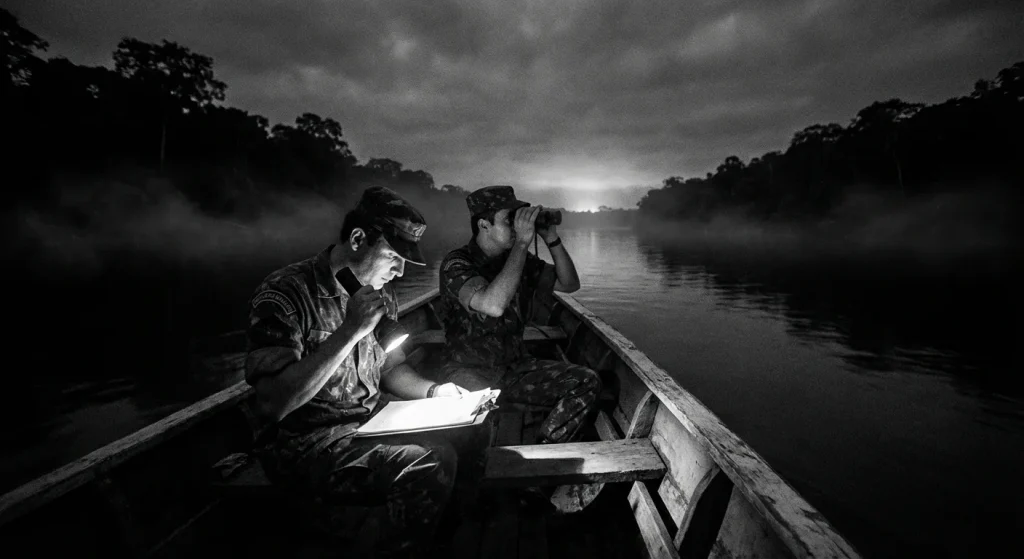
Operation Prato (“Operation Plate”) is the name commonly used for a Brazilian Air Force intelligence effort carried out in 1977 in Pará, northern Brazil, after a wave of unusual aerial-light reports and alleged attacks in riverside communities—most famously on Colares Island. The episode sits at the intersection of documented military recordkeeping, intense local fear, and later testimony that remains contested. This article summarizes what is confirmed by available documents and reporting, what is alleged by witnesses, and why the case continues to be cited in modern discussions about unidentified aerial phenomena (UAP).
Key takeaways
- Confirmed: In 1977, an Air Force team from the Comando Aéreo Regional (COMAR) operated in Pará to collect reports, sketches, and photographs related to unusual aerial lights; materials later surfaced through Brazilian document releases and journalism.
- Reported locally: Residents in areas including Colares described luminous objects (“chupa-chupa”) and in some accounts claimed physical effects such as burns, puncture-like marks, weakness, and anemia-like symptoms; these medical claims are primarily testimonial and reported in local/press accounts rather than established in peer-reviewed clinical literature.
- Key figure: Captain Uyrangê Hollanda (often cited as the operation’s leader in later accounts) gave interviews years later describing the mission and his views; those interviews are influential but are not a substitute for contemporaneous documentation.
- Disputed: Explanations range from misidentification and social contagion to rare atmospheric/astronomical phenomena, hoaxes, and (in UFO interpretations) non-human craft; the evidence base is incomplete and uneven.
Background: the Colares flap in Pará
In mid-to-late 1977, parts of Pará—including the municipality of Colares in the Belém metropolitan region—experienced a surge of reports of strange lights and aerial objects. In local folklore and press coverage, a recurring label was “chupa-chupa,” a term associated with accounts that the lights “sucked” blood or energy from people.
Multiple Brazilian outlets and later documentaries describe community meetings, residents leaving homes at night, and a climate of panic. The central geographic references in most summaries are Colares Island and nearby riverside towns in Pará’s coastal/riverine area. While reports vary in detail, common motifs include: luminous spheres or beams, hovering lights, nighttime incidents, and claimed physical effects on some witnesses.
Attribution: Much of what is popularly known about Colares comes from later compilations, interviews, and journalism; primary-source medical and municipal records are not consistently available in a comprehensive public archive. Treat claims of injuries as reported testimony unless corroborated by contemporaneous medical documentation.
What Operation Prato investigated
Operation Prato is widely described as a Brazilian Air Force investigation tasked with gathering information about the wave of sightings and alleged incidents. Accounts typically describe a small team deployed to Pará to:
- interview witnesses and collect written statements;
- produce sketches and field notes;
- attempt to photograph or film unusual lights;
- coordinate with local authorities amid public concern.
Confirmed vs. alleged: It is broadly supported by document releases and reporting that Air Force personnel collected material and produced internal records. What remains uncertain—and hotly debated—is what conclusions were reached internally, what phenomena were actually observed by the team, and whether any “physical evidence” is conclusive.
Sources: Document sets associated with Brazil’s National Archives (Arquivo Nacional) and reporting by reputable Brazilian journalists have discussed the operation and reproduced excerpts/images of related materials. See, for example, coverage and compilations in outlets such as BBC News Brasil (topic coverage of Brazilian UFO cases and military files) and Brazilian investigative reporting that references archival releases.
Timeline and reported incidents (1977)
Public summaries typically place the most intense phase of the “Colares flap” in 1977 , with reports concentrating in the second half of the year. A commonly cited sequence looks like this:
- Mid-1977: Rising number of reports of strange lights across communities in Pará, with accounts spreading by word of mouth and local media.
- Late 1977: Colares becomes the focal point in many retellings, with residents reporting nightly appearances of lights and, in some accounts, alleged assaults involving beams and physical symptoms.
- 1977 (deployment period): Air Force personnel operate locally to document sightings and gather testimony, producing reports and photographs that later circulate as “Operation Prato” materials.
What is known: Pará is consistently cited as the operational area; Colares is most frequently named as the hotspot. What is not firmly established in public documentation is an authoritative day-by-day log that ties each alleged injury to a confirmed medical record and a specific observed aerial phenomenon.
Uyrangê Hollanda’s position and activities
Captain Uyrangê Hollanda is often identified in later interviews as a central Air Force figure involved with Operation Prato. In widely circulated accounts, he described conducting field interviews, organizing observation efforts, and attempting to record phenomena photographically.
Attribution and limits: Hollanda’s later statements are important because they come from a named participant, but they were made years after the events and should be weighed alongside contemporaneous documents. Some claims attributed to him—such as the nature of what was observed and the implications he drew—remain disputed and are not universally accepted as established fact.
Suggested reading/viewing: Published interviews with Hollanda and summaries by Brazilian journalists are commonly referenced in Portuguese-language UFO scholarship and documentaries. When evaluating these sources, check whether they cite dated documents, named witnesses, and reproducible materials (photos, written reports), or rely primarily on retrospective recollection.
What evidence exists (photos, reports, testimony)
The Operation Prato case is frequently cited because it is associated with multiple types of evidence , though none is universally regarded as definitive:
- Photographs and image reproductions: Various photos have been published in books, magazines, and online compilations said to originate from the operation’s documentation efforts. Image provenance and chain-of-custody are often unclear in public reposting, so the strongest references are those tied to identifiable archival releases or reputable journalistic reproductions.
- Written reports and field notes: Summaries and excerpts attributed to Air Force documentation have circulated, including descriptions of observations, witness interviews, and operational notes.
- Witness testimony: Large volumes of local testimony describe lights, beams, and close encounters. Testimony is valuable for pattern analysis and social history, but it is not equivalent to instrumented data.
How to assess strength: Prioritize (1) dated documents with clear institutional markings; (2) materials traceable to official archives; and (3) contemporaneous press reporting over later retellings. When a claim depends solely on “someone said” decades later, label it as alleged.
External resources: For general context on how governments handle UAP/UFO files and how to interpret declassified material, see the U.S. National Archives overview of government records practices: National Archives. For Brazil-specific archival context, consult Brazil’s Arquivo Nacional (note: availability and search paths can change).
What is disputed / skeptical views
Operation Prato is controversial because the evidentiary record is incomplete and interpretations diverge sharply. Common skeptical or cautionary points include:
- Misidentification: Bright planets, meteors, aircraft, satellites, and atmospheric effects can be perceived as extraordinary—especially at night over water, where reflections and haze can alter perception.
- Social contagion and fear: In communities already alarmed by rumor and press coverage, ambiguous lights may be interpreted within a shared narrative (“chupa-chupa”), amplifying reports and reinforcing expectations.
- Medical ambiguity: Reported symptoms (weakness, burns, punctures) are difficult to tie to a single cause without systematic clinical documentation. Some cases may have involved unrelated illnesses, insect bites, or other explanations later folded into the broader story.
- Photo ambiguity: Many UFO photographs lack sufficient metadata and controls to rule out mundane sources or photographic artifacts. Without negatives/originals and documentation of capture conditions, conclusions are limited.
Important framing: Claims of “government cover-up” or “non-human intelligence” are common in UFO literature, but they remain claims. A careful reading separates what documents show (that an investigation occurred and records were produced) from what is inferred (that the phenomenon was extraordinary in origin).
How historical cases inform modern UAP reporting
Operation Prato is often referenced today not because it predicts “new sightings,” but because it illustrates recurring issues in UAP reporting: how witness testimony spreads, how authorities document events under public pressure, and how evidentiary quality varies from anecdote to archival record.
For readers tracking modern UAP discussions, the practical value is methodological: compare how claims are supported (or not supported) by primary documents, instrumentation, and transparent chains of custody. Historical cases also show how gaps in public records can fuel speculation long after the events.
FAQ
-
What was Operation Prato?
Operation Prato was a Brazilian Air Force information-gathering mission carried out in 1977 in Pará state , prompted by a wave of reports of unusual aerial lights and alleged attacks in riverside communities—especially around Colares. The operation is best understood as an effort to collect witness statements, sketches, and photographic material; public claims about its “final conclusions” go beyond what is consistently available in primary documentation.
-
Where did Operation Prato take place in Brazil?
The operation is most strongly associated with Pará in northern Brazil, with Colares Island frequently cited in reporting as a main hotspot during the 1977 wave. Other nearby communities in the region are also mentioned in witness accounts and secondary summaries, but Colares and the Belém-area coastline/riverside zones are the most common geographic anchors.
-
Who was Uyrangê Hollanda and what was his role in Operation Prato?
Uyrangê Hollanda was a Brazilian Air Force officer (often referred to as Captain Uyrangê Hollanda) widely identified in later interviews as a leading participant in Operation Prato’s field work in Pará in 1977. He is associated with organizing interviews and observation efforts and later provided retrospective accounts of what the team recorded. His interview testimony is influential but should be weighed alongside contemporaneous documents and independent reporting.
-
Is Operation Prato connected to UFO/UAP “disclosure” claims?
Operation Prato is frequently cited in UFO/UAP “disclosure” discussions because it is an example of a documented military response to public reports, and because some materials attributed to the operation (reports and photos) later circulated publicly. What is confirmed is that an investigation and documentation effort occurred; what is alleged is that the files prove non-human origin or a coordinated cover-up. Credible analysis relies on identifiable archival documents and cautious interpretation rather than assumptions.
-
What evidence is publicly discussed for Operation Prato?
Publicly discussed evidence includes (1) reproductions of photographs attributed to the operation, (2) excerpts or summaries of written reports and field notes, and (3) extensive witness testimony from Pará communities in 1977. The strongest citations are those traceable to official archival releases or reputable journalism; many online copies lack provenance, making firm conclusions difficult.
-
What do skeptical analyses argue about the Colares reports?
Skeptical views typically emphasize misidentification (astronomical objects, aircraft, atmospheric effects), the role of fear and rumor in amplifying reports, and the lack of consistently accessible clinical documentation tying reported injuries to a single external cause. These critiques do not “debunk” every report, but they highlight why extraordinary interpretations are not settled by testimony alone.
