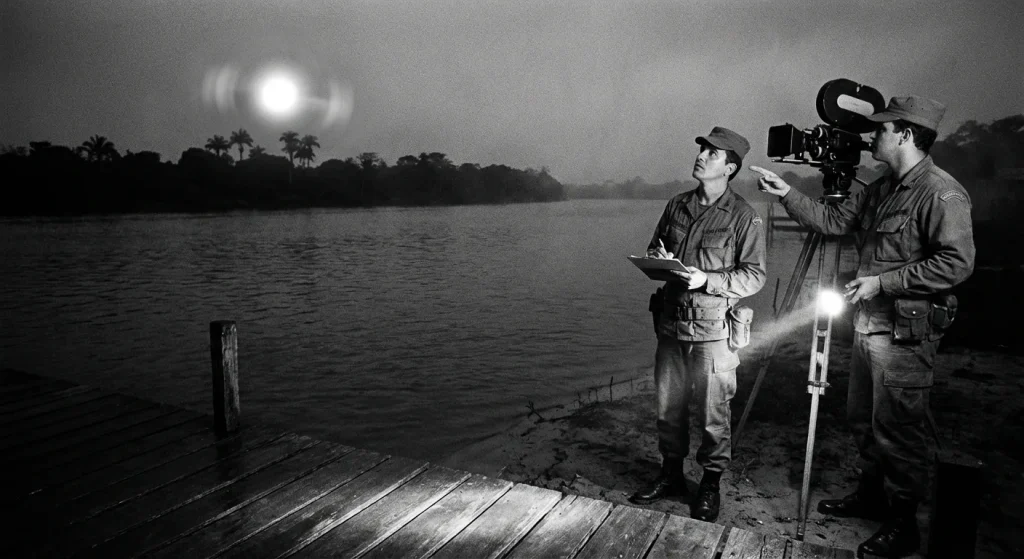
Operation Prato persists because it sits at the intersection of alleged harm and official paperwork. If you have been following the relentless UFO news and UAP news cycle, you have seen it framed as “the Brazilian case with files and injuries,” then watched the details blur into retellings you cannot audit. The frustration is rational: the story keeps getting cited as proof, while the underlying record gets treated like a prop.
The real decision in front of you is interpretive, not emotional: do you treat Colares as evidence of a government UFO cover-up and non-human intelligence, or as a cautionary example of how extraordinary claims spread once “official” is stamped on the narrative. Official documentation creates credibility because it fixes dates, participants, and paperwork trails, but records never interpret themselves, and “documented” is not the same as “confirmed.” This article applies a strict, evidence-first standard: separate what is known from what is disputed, and keep what remains unverified in its own lane. That is the only way to weigh Operation Prato’s documented phases, 20 Oct to 11 Nov 1977 and 25 Nov to 5 Dec 1977 (see the declassified Operacao Prato collection hosted at The Black Vault: https://documents.theblackvault.com/documents/MUFON/Pratt/prato.pdf), without importing conclusions the files do not actually establish.
Modern terminology exists to prevent the words from doing the arguing for you: UAP, short for “unidentified anomalous phenomena,” is used to describe observations without assuming they are vehicles, while UFO, “unidentified flying object,” is the older label that often smuggles in the idea of a craft. Declassification matters for a different reason, it is the formal release of previously restricted government records, and release can amplify confidence even when it adds zero new verification. Brazil is a clean reminder that official logging is real and sometimes large-scale: a Government of Brazil page titled “Official UFO Night in Brazil” reports that on 19 May 1986, 21 unidentified flying objects were sighted by multiple civilian and military witnesses, and it states some were reported as up to 100 meters in diameter (Government of Brazil, “Official UFO Night in Brazil,” 2022; page: https://www.gov.br/en/government-of-brazil/latest-news/2022/official-ufo-night-in-brazil; archived copy: https://web.archive.org/).
You will leave with a disciplined way to separate record existence, record content, and the conclusions people draw from them, so you can tell what the difference between UFO and UAP can prove and what they cannot.
That discipline starts on the ground in Colares, where the story is most often told through testimony and later summaries, not a complete set of local contemporaneous records.
Colares Under the Lights
The Colares reports were experienced as a local crisis, not a hobbyist’s “sighting log.” Later narratives about 1977 place a small community in Pará under repeated nighttime anxiety, with isolation and limited infrastructure acting as interpretive context for why fear spread faster than documentation.
The practical constraint shows up in the paperwork trail we have publicly available: the materials I reviewed (notably the Operacao Prato file hosted at The Black Vault, a summary entry on Wikipedia, and various public discussions and reproductions) do not include contemporaneous Pará newspaper articles or municipal/state records documenting 1977 chronology elements (escalation, curfews/community actions, and the date authorities were contacted). Key sources I consulted include the declassified Operacao Prato collection (https://documents.theblackvault.com/documents/MUFON/Pratt/prato.pdf) and the Wikipedia summary of Operacao Prato (https://en.wikipedia.org/wiki/Opera%C3%A7%C3%A3o_Prato). Because those materials do not contain the local contemporaneous press and municipal records, the public storyline is pushed toward memory, retelling, and the most vivid episodes, while the logistical spine of the timeline stays hard to anchor.
On the reporting side, the publicly available materials reflect a familiar split between (a) witness accounts, local press references, and later retellings versus (b) what would normally be established through official records. In layer (a), later-described accounts attribute the 1977 episode to luminous objects or lights and to alleged attacks and injuries, with the emphasis placed on how residents said the events felt and what they believed the lights were doing.
Those same later retellings also shape how harm is discussed: they present a mix of physical injury claims and psychological strain as part of the crisis narrative. Separately, the publicly available materials include retrospective framing that some individuals were later described as reporting symptoms consistent with PTSD; that is a later description of distress, not a contemporaneous diagnosis and not a medical finding shown in the available documents.
Layer (b) would be anchored by police logs, municipal correspondence, state records, and contemporaneous clinical notes if they were present. They are not present in the public materials I reviewed, so this section does not interpret “official records” beyond stating what those materials actually contain: one secondary summary in the public record remarks that “the authorities are cautious to release any information concerning the case,” a phrasing that appears in later retellings and summaries rather than in contemporaneous local records (see public summaries such as the Wikipedia article: https://en.wikipedia.org/wiki/Opera%C3%A7%C3%A3o_Prato and public discussions linked from that entry).
The composition of the publicly available materials underscores the limitation: among the items is at least one excerpt plainly unrelated to Colares chronology, such as an Army aviation technical handbook line about “hard points” in airworthiness qualification. Alongside that, other included excerpts in public reproductions are secondary or non-archival in nature (for example, corpus-style listings, reflective book snippets, and tourism-logistics passages), which explains why the timeline cannot be reconstructed cleanly from only those items.
- Grounded from these public materials: later reports and retellings exist; community fear and strain were treated as real by those narrators; some secondary texts frame official communication as cautious.
- Provisional until primary local sources are located: any day-by-day chronology, including escalation, curfews/community actions, and the specific date authorities were contacted.
- What would settle it: digitized or physical Pará newspaper archives from 1977 plus municipal/state records that time-stamp complaints, meetings, medical encounters, and official communications.
When local primary sources are missing, the next question becomes narrower and more checkable: what did the Brazilian Air Force consider serious enough to investigate, and what did it actually record while doing so?
Why the Air Force Intervened
A military investigation is a signal of seriousness, not a guarantee of an extraordinary conclusion. Operation Prato matters because it marks a formal Brazilian Air Force response to civilian reports, converting local rumor into an institutional problem with files, tasking, and accountability. Most secondary chronologies describe two phases, dated 20 Oct to 11 Nov 1977 and 25 Nov to 5 Dec 1977; treat those bounds as a working timeline until you can match them to dated orders, logs, or signed reports in the underlying record. The declassified Operacao Prato collection is the primary public source that researchers cite for the operation’s activities (https://documents.theblackvault.com/documents/MUFON/Pratt/prato.pdf).
Operation Prato is best handled as what its name implies: an investigative operation, meaning an organized effort to collect information, standardize reporting, and brief a chain of command rather than a single-officer curiosity. The Brazilian Air Force (FAB) is the national military service responsible for air operations and associated security tasks, and its involvement is a credibility signal in one narrow sense: someone inside the state apparatus judged the situation disruptive enough to warrant formal attention. That credibility signal cuts both ways. Institutional involvement raises the bar for documentation, but it also introduces normal constraints: operational security, reputational risk, and the bureaucratic impulse to keep claims inside what can be written, filed, and defended.
Why would an air force intervene at all? Several interpretations fit standard government behavior, and none should be treated as a proven motive without the mandate text.
- Public safety interpretation: persistent reports, even if confused or exaggerated, can drive injuries, misidentification, and vigilantism; an official presence can stabilize the situation.
- Intelligence-interest interpretation: militaries investigate anomalous aerial reports because misperception, adversary activity, and instrumentation limits all look similar at first pass.
- Public-order interpretation: secondary accounts describing cautious official communication are consistent with an agency trying to prevent panic or rumor escalation, not proof of a cover-up.
Accounts of the mission commonly attribute workmanlike field methods: interviewing witnesses, conducting patrols or site visits, taking photographs, producing sketches, and compiling reports into a coherent package for superiors. Those are exactly the kinds of actions you expect from an investigative detachment tasked to reduce uncertainty fast.
The public materials do not, however, verify many operational specifics often claimed elsewhere. They do not supply confirmed camera models, staffing numbers, or verbatim mission-objective text in a clearly dated, contemporaneous order, so any confident narrative built on those details is outrunning the accessible public record.
The practical takeaway is simple: evaluate every claim about Operation Prato the way you would evaluate any real investigation. Look for dates attached to signed documents, explicit mandate language, an identifiable chain of command, and an inventory of what was actually collected and preserved. That is what a real file shows, and it is what you should be able to check in primary Operation Prato materials (for example, the declassified collection hosted at The Black Vault: https://documents.theblackvault.com/documents/MUFON/Pratt/prato.pdf).
This separation between process and conclusion is not unique to 1977. It also describes how modern disclosure-era UAP programs present what they can say publicly without turning unknowns into verdicts.
Operation Prato in Today’s Disclosure Era
Disclosure is not a verdict; it’s a data problem. Operation Prato is the cleanest disclosure-era case study for that reality because it shows how “government documentation” can be simultaneously meaningful and inconclusive: official attention, formal collection, and real witnesses can coexist with gaps in measurement, uneven recordkeeping, and selective release that leave the core questions unsettled.
Recent U.S. government reporting on UAP includes titled, dated reports that are directly relevant to how contemporary agencies frame unresolved cases. Two publicly released documents are especially pertinent: the “UNCLASSIFIED FY23 Consolidated Annual Report on UAP” (October 25, 2023; PDF: https://www.aaro.mil/Portals/136/PDFs/UNCLASSIFIED-FY23_Consolidated_Annual_Report_on_UAP-Oct_25_2023_1236.pdf) and the “AARO Historical Record Report, Volume 1” (posted March 8, 2024; PDF: https://media.defense.gov/2024/Mar/08/2003409233/-1/-1/0/DOPSR-2024-0263-AARO-HISTORICAL-RECORD-REPORT-VOLUME-1-2024.PDF). These reports explicitly note that some incidents remain unresolved because the available reporting was insufficient to support a confident attribution. For example, the FY23 consolidated report states that “in many instances the data available are insufficient to draw firm conclusions” (UNCLASSIFIED FY23 Consolidated Annual Report on UAP, October 25, 2023).
Clarification of what AARO did and did not conclude: these reports document the office’s processes, case handling improvements, and the existence of residual cases that remain without definitive explanations. They do not assert that unexplained cases are proof of non-human intelligence; rather, they emphasize limitations in data quality and availability and recommend improved collection, interagency cooperation, and analytical tools to reduce the number of unresolved cases. See the FY23 consolidated report and the AARO Historical Record Report for the full context (links above).
The same recent AARO reporting also describes upgrades in how cases are handled, specifically improved data collection, the use of AI, privacy protections, and increased civilian collaboration. Read those as process claims, not outcome claims. Better pipelines reduce ambiguity, but they do not eliminate it; they increase the chance that future cases can be resolved without retrofitting narratives onto thin evidence.
The first overreach is semantic: “unexplained” is not synonymous with non-human intelligence. In a case file, unexplained usually means the available data failed to support a confident attribution, not that a particular extraordinary attribution was proven.
The second overreach is evidentiary: documentation is not confirmation. A government memo can confirm that an event was reported, tracked, and considered important. It does not automatically confirm what the event was.
The third overreach is a keyword trap. “Government UFO cover-up” and “non-human intelligence” are discourse-level claims that require primary documentation. The public materials I reviewed do not include official hearing transcripts verifying where the exact phrase “non-human intelligence” appears in sworn records, so treat NHI as a hypothesis discussed publicly unless and until it is tied to a primary transcript with clear provenance.
- Demand primary records (reports, transcripts, source documents) instead of screenshots, paraphrases, or secondhand summaries.
- Corroborate across independent sources, ideally with different collection paths (radar, imagery, contemporaneous logs, multiple witnesses).
- Verify chain of custody for the key artifact you are being asked to believe, including who collected it, who stored it, and what edits or redactions occurred.
- Bracket uncertainty explicitly: separate “reported,” “documented,” “unexplained,” and “attributed,” and refuse to collapse those categories.
Use Operation Prato as your calibration tool: declassification and partial releases can validate that officials took something seriously without settling what it was. Apply that standard to future UFO/UAP headlines and yearly roundups, and you’ll stay aligned with evidence instead of momentum.
Calibration only works if it leads to concrete verification steps. In Colares, that means returning to the paper trail itself and identifying exactly what exists, what is missing, and what can be authenticated independently.
What Colares Still Demands
Operation Prato endures because it’s an official paper trail wrapped around unresolved claims. That combination is exactly why Colares still demands disciplined documentation standards: you are weighing a real investigation timeline against contested human testimony, all while working from an evidence base that is widely circulated but unevenly authenticated. If you collapse “there was an inquiry” into “the claims are therefore proven,” you lose the only advantage this case offers: a traceable path to verification.
The baseline chronology is straightforward in public summaries: Operation Prato is documented as running in two phases, 20 Oct-11 Nov 1977 and 25 Nov-5 Dec 1977 (primary declassified materials commonly cited: Operacao Prato collection hosted at The Black Vault, https://documents.theblackvault.com/documents/MUFON/Pratt/prato.pdf). The other firm anchor is institutional: there was an official investigative response, which is more than most legacy cases can say even before you debate what any particular item means.
The public materials I reviewed do not confirm what alleged unreleased materials actually exist (full photo negatives, complete annexes, medical files), and they do not document any official Brazilian acknowledgment that specific items are missing or being withheld. Treat that as an evidence gap, not as proof of a cover-up: absence of confirmation is not confirmation of concealment.
The practical problem is not curiosity, it’s chain of custody. Without inventories, originals, or corroborating records outside the UFO ecosystem, authentication stays stuck at the “widely repeated” level instead of moving to the “independently verifiable” level.
- Inventory the official paper trail by locating primary registers, logs, and accession records plausibly held in municipal archives, Pará state archives, or Brazilian federal and military archival channels.
- Authenticate originals where possible: compare physical originals to reproductions; document provenance; separate observation statements from later interpretation, the same discipline used above.
- Corroborate claims with contemporaneous medical and police records tied to names, dates, and locations, rather than narratives retold after media exposure.
- Validate imagery using first-generation materials if they exist: negatives, lab marks, or other source artifacts, and any recoverable metadata on later copies.
Apply the same limits established earlier (attribution matters; memory changes under repetition), and keep the disclosure-era filter firmly in place: unexplained does not equal non-human intelligence, and disclosure does not equal confirmation.
- Where is the complete, official inventory of Operation Prato outputs?
- Do first-generation photo materials exist, and who can document their provenance?
- Which specific medical and police records can be matched to specific incidents?
- Which annexes are cited as existing, and where are their accession traces?
- What can Brazilian archival channels confirm, in writing, about holdings and gaps?
Follow responsible updates in UFO news and UAP news with the same standard implied from the start: respect the existence of official paperwork, but do not let the stamp do the reasoning. Verify the record before you upgrade the conclusion.
Frequently Asked Questions
-
What was Operation Prato in Brazil?
Operation Prato was a formal Brazilian Air Force (FAB) investigative operation launched in response to civilian reports around Colares in 1977. It is notable because it produced an official paperwork trail (reports, interviews, photos/sketches) even though the underlying claims remain disputed.
-
When did Operation Prato take place in 1977?
The commonly cited chronology describes two phases: 20 Oct to 11 Nov 1977 and 25 Nov to 5 Dec 1977. The article treats these dates as a working timeline until they can be matched to dated orders, logs, or signed reports.
-
What is the difference between UFO and UAP in this article?
UAP means “unidentified anomalous phenomena” and is used to describe observations without assuming they are vehicles. UFO means “unidentified flying object,” an older term that often implies a craft even when the data does not prove that.
-
What evidence is missing from the Colares case according to the article?
The provided research packet contains no contemporaneous Pará newspaper articles and no municipal/state records that time-stamp key 1977 timeline elements like escalation, curfews, or when authorities were contacted. It also does not provide contemporaneous clinical notes or police logs for the alleged injuries.
-
What did the Brazilian Air Force reportedly do during Operation Prato?
Secondary accounts commonly describe field methods like interviewing witnesses, conducting patrols or site visits, taking photographs, producing sketches, and compiling reports for superiors. The article notes the packet does not confirm operational specifics often claimed elsewhere, such as camera models, staffing numbers, or verbatim mission objectives.
-
What specific UFO numbers does the article cite from Brazil’s official logging?
It cites a Brazilian government page stating that on 19 May 1986, 21 unidentified flying objects were sighted by multiple civilian and military witnesses. The same page states some were reported as up to 100 meters in diameter.
-
What should you look for to verify Operation Prato claims instead of relying on “official” labels?
The article recommends checking for dated, signed primary documents, explicit mandate language, an identifiable chain of command, and an inventory of what was collected and preserved. It also advises corroboration across independent sources (e.g., radar, imagery, contemporaneous logs, multiple witnesses) and verifying chain of custody for key artifacts.
