You are trying to figure out whether a famous “pilot UFO” story deserves your confidence while UFO news and UAP news churn out fresh claims every week. Older cases can look cleaner than the modern noise: named witnesses, professional credentials, and a narrative that gets repeated so often it starts to sound settled.
The Nash-Fortenberry report sits right in that trap. Major case summaries consistently date it to July 14, 1952, and place it in the evening (local time), with the core witnesses identified as two Pan American pilots: William B. Nash and William H. Fortenberry. Examples include the NICAP case write-up (NICAP case index) and modern summaries such as the Wikipedia article; these sources agree on the July 14, 1952 date, the evening timing, and the named Pan Am crew, while they differ on details such as the number of lights reported and the aircraft type. People treat the case as either strong evidence of something structured in the sky, a cockpit misperception, or a story that hardened into myth through repetition. Your job is choosing which bucket it actually belongs in.
The reason this report persists is straightforward: trained airline cockpit witnesses described a structured, multi-light event that reads like modern headlines, which is why it gets cited in UFO disclosure and government UFO cover-up conversations. The friction is just as straightforward: decades of retellings reward confident wording, and confidence is exactly how quote-drift turns “someone’s paraphrase” into “what the pilots said.” In today’s terms, it is a UFO (unidentified flying object) case with unusually professional observers, and unusually messy downstream storytelling.
This article uses strict source discipline. I will separate (a) what the pilots reportedly observed, (b) what later authors inferred, and (c) what official documentation actually exists. Before any direct quote, the source will be identified so you can judge proximity to the original record. Paraphrases will be written as paraphrases, using different vocabulary and sentence structure than the source. Exact wording without quotation marks is treated as plagiarism even when a citation appears, because it disguises a quote as original writing.
You will leave able to say, with precision, what is solid, what is disputed, and what specific documentation would actually move the needle for or against the case.
Who Saw What and Where
The Nash-Fortenberry case keeps resurfacing for a simple reason: it starts with two professional cockpit witnesses describing a specific, multi-light event on a known date and general corridor, even while popular retellings clash on the flight and aircraft particulars. Locking down that baseline, and labeling what is genuinely uncertain, is the only honest way to approach everything that gets argued later about motion and behavior.
On the evening of July 14, 1952, William B. Nash and William H. Fortenberry reported a sighting from a Pan American World Airways cockpit. Nash served as a Pan American World Airways captain. Fortenberry served as a Pan American World Airways first officer (copilot). Those roles matter because cockpit observation is not a single-person, casual glance: it is routine to scan outside, compare what one pilot sees with what the other sees, and relate any unusual lights to the most immediate operational question, whether it is other traffic.
That cross-checking culture is the core distinction. Two trained observers, sitting at different positions with a shared forward view, can quickly confirm whether both are seeing the same set of lights in the same part of the sky, and whether the spacing between lights appears stable. It is still nighttime viewing, which limits certainty about distance and size, but it is not the same category as a lone ground witness trying to interpret an unfamiliar scene.
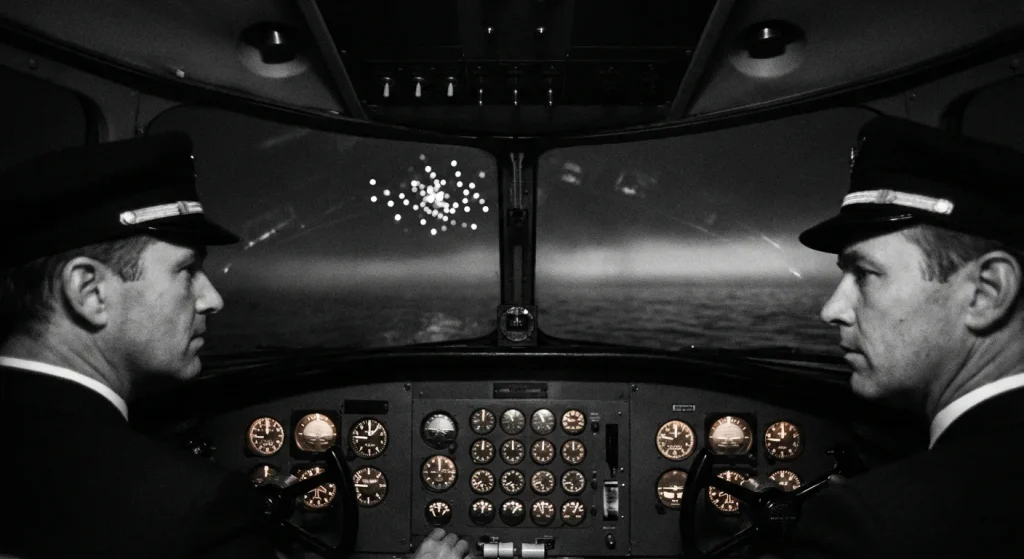
The broad setting is consistent across serious summaries: the report is tied to the Chesapeake Bay area, and it is explicitly an evening sighting. The recurring core description is not a single light but multiple lights seen together, frequently retold as a group of reddish or crimson points, described in terms that sound like a “formation.” In plain English, “formation” here means a coherent grouping: multiple lights with recognizable spacing and alignment that appears organized rather than random, like a cluster that holds its shape for at least part of the observation.
Weather and visibility details are often mentioned in retellings, but they are also where over-precision creeps in. For baseline purposes, the only safe claim at this stage is that the crew reported what they believed they could see from the cockpit over or near the Bay during the evening hours. Any tighter claims about exact visibility metrics belong with the underlying documentation, which is addressed later.
The biggest trap in this case is that many secondary accounts flatten conflicting versions into one confident narrative. Retellings conflict on the aircraft and flight context in ways that are easy to miss if you read only one source. Some versions place Nash and Fortenberry in a Boeing 377 Stratocruiser. Others identify the aircraft as a DC-4. Flight numbers and even routes also vary across retellings, with some accounts attaching a specific flight designator and others changing the city pairings.
The correct way to handle that is to treat it as a documentation issue, not a storytelling detail. Sources closer to contemporary reporting or to NICAP-style case files carry more weight than much later compilations. For example, the NICAP write-up and case index emphasize the Chesapeake Bay location and the July 14, 1952 evening timing while other later summaries reproduce alternate aircraft types and inconsistent flight details. For this section, the aircraft type and flight number are explicitly marked as contested unless they can be tied back to primary or near-primary reporting. What remains solid is narrower: a Pan Am cockpit, two named crew members, an evening date, and a multi-light observation described as a grouped or “formation” display over the Chesapeake Bay area.
Later analysis can tighten geography responsibly by using modern mapping and GIS to approximate where “over the Chesapeake Bay” places the aircraft relative to shoreline geometry and named reference points. Chesapeake Bay monitoring station latitude and longitude tables exist, high-resolution historical shoreline GIS data exists, and tools such as Google Earth or other public GIS viewers allow drawing shapes or uploading coordinates to inspect imagery. Used correctly, those resources help reconstruct plausible headings and relative positions. They do not replace original cockpit instruments, logs, or primary records, and they should never be presented as if they were 1952 navigation data.
- Fixed: The sighting report is tied to the evening of July 14, 1952, and to Pan Am crew members William B. Nash (captain) and William H. Fortenberry (first officer/copilot) observing from the cockpit.
- Fixed: The event is described broadly as multiple lights seen together in a coherent grouping often characterized as a “formation” over the Chesapeake Bay area.
- Contested: Aircraft type and flight specifics vary by source, including Stratocruiser versus DC-4, and inconsistent flight numbers and routes.
- Analytic aid only: GIS and modern mapping can reconstruct plausible geography and headings later, but those products remain reconstructions.
Once the basic witness-and-setting claims are separated from the contested flight particulars, the analysis turns on the same question every retelling leans on: what, exactly, does “formation” imply in a night cockpit view?
The Formation and Flight Characteristics
The most diagnostic element in this case is not a claimed speed or altitude. It is the reported coherence: multiple lights holding a stable geometry long enough to look like a single, coordinated formation rather than independent, random points. That kind of “formation” behavior, in aviation terms, is about relative motion: objects that keep consistent spacing, show coordinated changes in bearing, and preserve a recognizable pattern as the observer aircraft moves.
A flight crew can directly observe a limited set of things about lights at night, and those observations are still useful if you keep them in the right box. Direct observations include apparent bearing changes (a light sliding left or right against the windscreen), relative spacing (two lights staying the same distance apart in the pilot’s view), coordinated geometry changes (the whole pattern “rotating” or “opening” together), angular-rate cues (how fast the pattern moves across the field of view), and duration (how long the geometry holds before it breaks up or disappears). Those are qualitative but operationally meaningful: they describe what the crew actually saw.
What the crew cannot reliably measure from unknown lights at night, without external references, is the hard performance layer people instinctively infer from those visuals: true range, true size, true altitude, true airspeed, and true acceleration. The trap is simple: when lights appear to move fast, observers and later readers tend to convert “fast across the windscreen” into “high speed” and then into “extreme acceleration,” even though the cockpit never had calibrated range or closure-rate instrumentation on the lights themselves.
Operationally, high closure rates also compress decision time. Converging high-speed traffic can deny a crew the seconds needed for positive identification and evasive action, so “couldn’t identify it” is not surprising even in otherwise competent, experienced cockpits.
Discussions of this case often borrow formation descriptors that come from military and aviation shorthand. Terms like “line abreast” and “echelon” are standard ways to describe relative geometry; some analysts apply those labels when describing how the lights appeared. A contemporaneous Department of Defense/technical review covering a wide set of 1952 to 1955 sightings, titled “Flying saucers: UFO report — No. 2” (AD0688332, 1967), is available online and can be consulted for historical context about how investigators of the era summarized multiple-case patterns rather than a single-case motion profile (see the Sources / Further Reading list below for the DTIC link). In the absence of a precise contemporaneous phrasing tied to the original cockpit notes, treat those formation words as geometry descriptors rather than as calibrated measurements.
Two night-perception limits explain why formation-like visuals can feel more precise than they are. Autokinesis, a night-vision illusion where a fixed light appears to move when stared at in darkness, can inject apparent drift or jitter into a stationary point source. Size-distance ambiguity, a perception limitation where an unknown light’s apparent size and distance cannot be reliably inferred without reference cues, blocks the usual shortcut of “it looks big, therefore it’s close” or “it’s small, therefore it’s far.” Pilots can misjudge range and size at night due to size-distance ambiguity, and that directly contaminates any attempt to turn apparent motion into real speed.
Some secondary analyses go further and attach extreme acceleration estimates, ranging from almost 100 g to 1000s of g, to the reported maneuvers. Those figures are not measured cockpit data in the original sense; they are later analytical inferences that depend heavily on assumed distance, assumed altitude, and assumed timing. The same sources that cite those extreme accelerations also note the absence of signatures that normally accompany such performance: no sonic booms, no observed air disturbance, and no evidence of excessive heat. That mismatch is exactly why the extreme-number layer is contentious, even among readers who take the formation report seriously.
Old reports like this stay useful if you apply one rule: treat formation and motion words as qualitative geometry unless the account supplies independent range and time references. “Held formation,” “spread,” “closed,” “turned together,” and even “shot away” can be strong evidence of perceived coordination, but they are not a license to back-calculate precise speed or g without verified distances. Put differently: keep observation (lights held a pattern; bearings changed) separate from inference (they accelerated at X g), and the behavior remains analyzable without turning it into fake instrumentation.
That distinction-useful geometry, unreliable performance inference-sets the terms for evaluating conventional explanations. The question is not “what could exist,” but “what could plausibly produce this reported appearance and persistence from a cockpit at night.”
Prosaic Explanations and Their Limits
Conventional explanations are strongest when they explain both the appearance and the structure. Here, most “easy” candidates fail not because they are impossible, but because they struggle to match two constraints at the same time: multiple lights that read as a coherent formation and a duration long enough to sustain repeated observation under night conditions.
This article uses one rubric throughout: a candidate either matches the report’s salient constraints, partially matches (fits one constraint while straining another), or doesn’t match. The constraints that matter most in this case are (1) multi-object appearance, (2) apparent coordinated motion or formation coherence, and (3) duration. Brief perceptual effects (autokinesis, size distance ambiguity) can amplify misreads, but they do not create long-duration, multi-light structure from nothing.
Meteors partially match the “bright light at night” piece, and they can fragment, which sometimes produces multiple points of light. For a meteor to fit the pilot account as a formation, you would need a train of fragments that stays visually grouped and appears to maneuver in a coordinated way from a cockpit vantage.
The friction is duration and coherence. Typical meteor visibility is brief, and even when fragmentation produces multiple luminous pieces, the geometry generally reads as dispersal along a path, not stable formation flight. Just as important, meteor support in the available sources is weak and indirect: some retellings cite non-authoritative social media posts rather than contemporaneous astronomical observing logs for the date and region. Without primary observational logs for July 14, 1952 covering the Chesapeake Bay region, “a meteor shower that night” is an unsupported claim and does not belong in the evidentiary column.
Multiple aircraft are the cleanest partial match because they naturally explain multi-object appearance and duration. They can also look “structured” when lights align with airway geometry, spacing, and perspective, especially at night. The catch is formation coherence: to read as a tight, deliberate formation, the relative geometry must stay consistent from the pilots’ viewpoint, and any apparent turns or accelerations must be explainable by intersecting tracks, closure rates, or banking lights rather than true coordinated maneuvering.
Air-traffic plausibility here is fundamentally a geometry and perception question, and the current source set does not contain confirmed, event-specific 1952 radar or traffic documentation that would let you lock down who was where. That documentation gap matters because “plausible in principle” is not the same as “supported for this sighting.” One commonly repeated example that cannot be supported with current sources is a claim, circulated in a Facebook post, that air traffic control “confirmed” the object or formation (see Sources / Further Reading for the Facebook post link cited in some accounts).
Military flares or training near NAS Patuxent River also sit in the partial match category. Flares can present as multiple bright lights and can persist long enough to be observed repeatedly. The friction is formation coherence: drift, altitude loss, and changing spacing often read as dispersion rather than controlled station-keeping unless the observer is far enough away that motion cues collapse into a single pattern. The operational context supports careful language, not a date-specific conclusion: NAS Patuxent River maintains procedures for ordnance and range safety and issues notices of activity, so it is reasonable to search for NOTAMs and range activity logs, but the sources currently available do not establish a flare event scheduled for July 14, 1952.
Balloons don’t match the core constraints. They can explain a single light or reflective target and can persist, but sustained, coordinated multi-object motion is the wrong behavioral profile, especially at night when the visual cues for envelope shape and altitude are weakest.
Bright astronomical objects partially match duration and nighttime visibility, and they can be misperceived as moving when the reference frame is unstable. They struggle with the multi-object, formation-like structure unless you posit multiple stars or planets being grouped by cockpit framing, cloud gaps, or windshield artifacts.
Atmospheric effects and reflections partially match brightness and odd apparent motion, and they can create repeated “returns” when the viewing angle changes. The friction is achieving stable, multi-light formation coherence over time without a consistent, identifiable optical mechanism tied to the aircraft’s own lighting or cockpit geometry. Background meteorology can help frame what refraction or ducting might do to imagery, but meteorology by itself does not substitute for event-specific evidence linking a refractive mechanism to the observed lights.
With the current source set, the most defensible position is evidence-weighted: multi-aircraft and flares remain the leading conventional buckets on fit because they can produce multiple lights and persist; meteors are frequently suggested but are unsupported here without primary astronomical logs; balloons fit poorly; and astronomical or atmospheric explanations can cover some perceptions but strain to reproduce formation coherence.
The short list of uncertainty drivers is straightforward: absence of event-specific air traffic or radar records in the current sources, absence of primary astronomical logs for meteor activity, absence of date-specific NOTAM or range documentation tied to nearby military operations, and insufficiently constrained geometry (exact headings, times, and relative positions) to test whether a mundane multi-source scene would collapse into a “formation” from the cockpit viewpoint.
Those uncertainty drivers all point to the same bottleneck: without a reliable paper trail, even a good-fit conventional hypothesis stays speculative, and even a dramatic narrative stays unauditable.
Official Handling and the Paper Trail
Documentation, not excitement, determines what a case can prove. The Nash-Fortenberry report sits in the exact era when UFO claims were actively processed by both civilian groups and the U.S. government, yet the auditable trail is thinner than most retellings imply. The gap between “enduring story” and “verifiable case file” is the hinge, and this case shows how quickly that hinge can fail when you cannot point to specific records, in a specific archive, that say specific things.
NICAP (National Investigations Committee on Aerial Phenomena) was a civilian organization from the 1950s that collected and analyzed UFO reports and related correspondence. In this case, what is concretely associated with NICAP is not an official ruling, but an extended three-way correspondence involving Charles Maney and Nash about the sighting and possible explanations. That matters because it shows the real mechanism NICAP used: persistence. Civilian investigators did not “close” cases the way an agency does; they pushed witnesses and institutions for clarifications, timelines, and technical plausibility, then preserved the paper trail they could obtain.
Project Blue Book was a U.S. Air Force program (1947 to 1969) that investigated and cataloged UFO reports, headquartered at Wright-Patterson Air Force Base. Blue Book’s mandate included assessing whether reports had national security implications, which is a different standard than proving an exotic vehicle. In the current source set, there is no specific Blue Book document for Nash-Fortenberry that can be quoted for a case number, investigative summary, or disposition. Without that record in hand, any claim that “Blue Book concluded X” is not an audit-grade statement.
Radar and air traffic control data are the fastest way to turn a story into a testable event, so that is what an evidence-first reader looks for. In the provided sources, none of the documents explicitly report ATC or radar data for a 1952 case, so radar or ATC involvement is not confirmed in the sources at hand. A DTIC contextual point helps frame expectations: regional command centers could direct interceptor aircraft when radar contacts were deemed threats. That context explains how radar could matter operationally, but it does not prove radar existed for this case.
- Identify the exact document (title, date, originating office), not a general reference to “Blue Book files.”
- Locate the holding archive or collection and its catalog entry, so the item can be independently retrieved.
- Quote the relevant lines verbatim, separating what is stated from what is inferred.
- Verify whether the record includes primary data (logs, message traffic, radar plots, ATC transcripts) versus summaries.
- Explain gaps as routine realities first: retention limits, fragmented reporting channels, and incomplete forwarding, not automatic proof of suppression.
That audit mindset is not just a historical exercise. It is the same lens modern UAP debates claim to apply, which is why 1952 cases keep getting pulled back into circulation.
Why 1952 Echoes in 2025
The reason Nash-Fortenberry keeps reappearing in 2025 to 2026 search cycles is simple: modern disclosure politics recycles older cases that showcase the same evidentiary failure modes oversight is trying to fix. The story endures because it pairs trained observers with an unresolved data record, then adds institutional stigma that discourages clean follow-up. That combination produces controversy that can be argued indefinitely, even when nobody can honestly claim it proves anything about non-human intelligence.
“UAP (unidentified anomalous phenomena)” is the modern umbrella term for unidentified observations in air, sea, or space that lack sufficient data for identification, and that framing signals a shift from arguing about “objects” to auditing sensor coverage, custody of records, and analytical gaps. The term is doing governance work: it widens the aperture beyond a single sighting narrative and forces the question that older cases often cannot answer, which is what instruments recorded, who held the data, and whether the record is complete.
David Grusch testified under oath on July 26, 2023 at a House hearing frequently referenced in UAP coverage, and that single fact changed the media incentive structure: sworn testimony is easier to headline than a decades-old ambiguity. The broader ecosystem of familiar names, including Lue Elizondo, Christopher Mellon, and George Knapp, functions as a set of context signals for readers tracking the topic. None of that validates a 1952 event; it explains why public attention accelerates faster than auditable data.
The UAP Disclosure Act concept is best understood as records engineering, not a promise of extraordinary conclusions. Proposals include requiring NARA to generate an official UAP Records Collection, and bill text language explicitly includes “(b) DISCLOSURE OF RECORDS” and directs disclosure of “All unidentified anomalous phenomena records.” In parallel, a reported legislative change eliminates duplicative reporting requirements and streamlines how UAP-related data is provided to AARO, which is another signal that standardization pressure is rising.
Congress.gov timing matters because it anchors public expectations: the 118th Congress is 2023 to 2024, and the 119th Congress is 2025 to 2026. When a new Congress convenes, disclosure proposals, hearings, and record requests tend to re-enter the conversation, and search behavior follows. That is why “UFO sightings 2025” and “UFO sightings 2026” queries often pull legacy cases back into view as shorthand examples of what the system failed to capture.
Use a hard rule: separate oversight claims from ontology claims. Oversight arguments are about whether records exist, whether they are complete, and whether disclosure standards are consistent; claims about non-human intelligence require verifiable data that can survive adversarial review. Nash-Fortenberry persists because it spotlights the pattern that still drives conflict: credible observers, missing instrument data, and stigma that warps institutional handling. Treat it as a stress test for process, not a substitute for proof.
Seen that way, the case does not need a sensational resolution to remain useful. Its value is in what it exposes about observation, inference, and the durability of stories that outlive their documentation.
What the Case Still Teaches
This case stays alive for a simple reason: credible testimony outpaced the instrumentation and record-keeping needed to turn “we saw it” into “we can measure it.” The pilots’ report is not the weak link. The weak link is the missing chain of contemporaneous, retention-grade data that would lock down distance, speed, and geometry.
The case-basics hold steady where they should: the date and the identity of the pilot witnesses remain stable, while flight-context details drift across retellings, which is exactly where uncertainty accumulates. The formation-behavior section made the key technical point: “formation” language is diagnostically useful, but night flying invites autokinesis and the size-distance ambiguity that makes performance inference unreliable. The conventional-explanations review did its job by narrowing, not solving: several prosaic candidates partially fit, but the stubborn conflicts cluster around coherence and duration, so claiming a single resolved cause would be dishonest. The official-record section also landed cleanly: documentation gaps exist, radar and ATC corroboration are not confirmed in the provided sources, and absence of records is not proof of suppression. The modern-disclosure context explains the staying power: this story persists because it is a compact example of recurring evidence failures that modern oversight is trying to fix.
Standardized expectations differ from 1952 because the FAA has regulated and overseen civil aviation since 1958. On top of that, Aviation Safety Reporting System (ASRS) is confidential, voluntary, and non-punitive, and it receives, processes, and analyzes incident reports submitted by pilots and air traffic controllers, creating a repeatable pathway for capturing time-sensitive details while they are still checkable.
- Preserve radar track data (raw returns and track files): it fixes trajectory and groundspeed, preventing distance and speed from being inferred from apparent motion.
- Retain ATC audio with timestamps: it resolves sequencing, removes paraphrase drift, and lets analysts align spoken bearings and maneuvers to tracks.
- Capture cockpit audio plus transponder or ADS-B equivalents: it ties the crew’s callouts to the aircraft’s exact position, altitude, and heading, tightening geometry enough to separate “formation-like” appearance from actual formation flight.
Treat vivid motion language as a lead, not a conclusion. Before upgrading any sighting from “intriguing” to “explanatory,” demand sensor provenance (what instrument, what settings, what timestamps), retention (is the underlying record accessible), and cross-corroboration (independent streams that agree on geometry). Skepticism is not dismissal; it is the discipline that keeps testimony and data in the same frame.
Sources / Further Reading
- National Archives research page on Project Blue Book and Air Force UFO records
- NICAP homepage and archive materials (National Investigations Committee on Aerial Phenomena)
- “Flying saucers: UFO report — No. 2”, AD0688332 (DTIC, 1967)
- House Oversight and Accountability Committee hearing page: “Unidentified Anomalous Phenomena” (July 26, 2023)
- Congress.gov: Senate Amendment 797 text, “Unidentified Anomalous Phenomena Disclosure Act of 2023”
- Wikipedia: Nash-Fortenberry UFO sighting (case summary and references)
- Revisiting One of the Classics: The Nash-Fortenberry UFO Sighting, July 14, 1952 (academia.edu)
- Example social-media retelling cited in some summaries (Pan Am Museum Facebook post)
Frequently Asked Questions
-
What is the Nash-Fortenberry 1952 UFO sighting?
It is a reported evening sighting dated July 14, 1952 in which Pan Am pilots William B. Nash (captain) and William H. Fortenberry (first officer) observed multiple lights over the Chesapeake Bay area. The core description is a coherent grouping of lights often retold as a “formation.”
-
Where and when did Nash and Fortenberry report seeing the UFO formation?
Serious summaries consistently tie the report to the evening of July 14, 1952 and to the Chesapeake Bay area. The article treats the date, time-of-day (evening), and the two named Pan Am cockpit witnesses as the fixed baseline.
-
What did the pilots reportedly see in the Nash-Fortenberry case?
The recurring report is of multiple lights seen together in a coherent, organized-looking pattern, frequently described as reddish or crimson points. “Formation” is used as a geometry description-lights holding recognizable spacing and alignment for at least part of the observation.
-
Was the Nash-Fortenberry aircraft a Boeing 377 Stratocruiser or a DC-4?
The article flags the aircraft type as contested because retellings conflict, with some naming a Boeing 377 Stratocruiser and others a DC-4. Flight numbers and routes also vary by source, so those specifics are not treated as settled without primary documentation.
-
What can pilots reliably judge from unknown lights at night, and what can’t they?
They can directly describe qualitative cues like apparent bearing changes, relative spacing, coordinated geometry changes, angular-rate across the windscreen, and duration. They cannot reliably measure true range, size, altitude, true airspeed, or acceleration without independent references, and the article highlights autokinesis and size-distance ambiguity as key night-perception limits.
-
Did Project Blue Book or air traffic control confirm the Nash-Fortenberry UFO sighting?
In the provided source set, there is no specific Project Blue Book document that can be quoted for a case number, summary, or disposition, and radar/ATC involvement is not confirmed. The article also notes that a commonly repeated claim that ATC “confirmed” the object appears in a Facebook post and is not supported by the current sources.
-
What records would actually help verify or debunk the Nash-Fortenberry case today?
The article says the most decisive additions would be retention-grade instrument and communications data: radar track data, ATC audio with timestamps, and cockpit audio tied to position/altitude/heading (modern equivalents include transponder or ADS-B-type data). It also recommends an audit approach: identify the exact document, locate the holding archive, quote the relevant lines verbatim, and separate primary data from later summaries.
