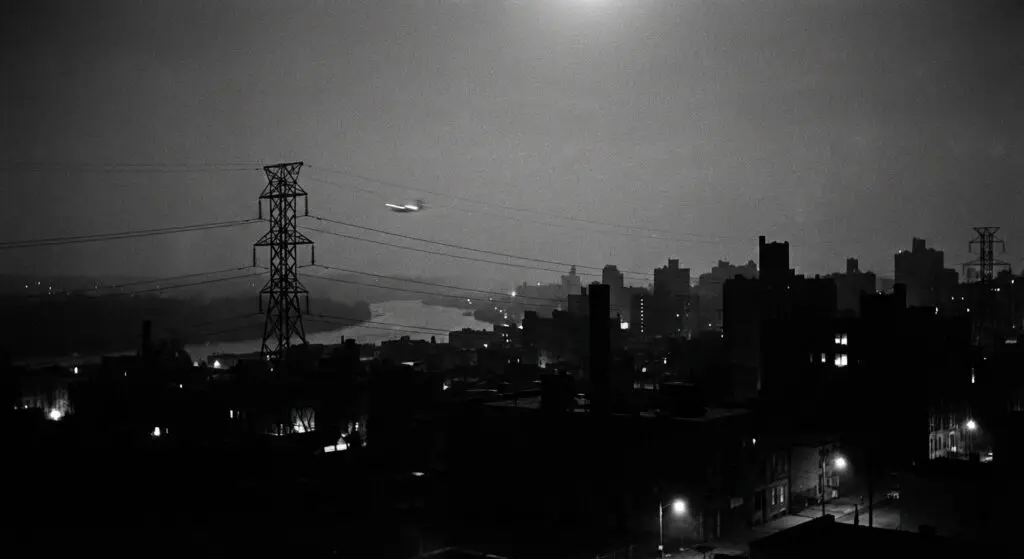
You keep seeing the same claim: “The 1965 blackout happened because UFOs interfered with the grid.” It’s a tidy story, and it’s exactly why you’re frustrated, because blackout plus strange lights gets treated like automatic proof of a cover-up.
The tension is real: a crisis this large invites extraordinary explanations, but correlation is not causation. If you do not separate what is documented from what is alleged, the timeline turns into a Rorschach test where later retellings outrun what anyone actually recorded that night.
The baseline facts are not mysterious. The Northeast blackout of 1965, a major regional power outage on Tuesday, November 9, 1965 affecting parts of the Northeastern U.S. and Ontario, is commonly timed to an onset of about 5:27 PM local time in contemporaneous summaries. The footprint is widely described as spanning Ontario through New York, including New York City and Buffalo, to New England, with Boston and Toronto commonly included. Scope estimates commonly cited for the 1965 outage put the impact at roughly 30 million people across an area of about 80,000 square miles, and the primary authoritative contemporaneous investigation is the United States Federal Power Commission report “Northeast power failure, November 9 and 10, 1965” (report to the President, December 6, 1965) and related federal summaries and reviews (see Sources below).
That scale is also what makes the “UFO near power infrastructure” angle slippery: when entire regions go dark, people report lights, flashes, and strange objects for reasons that range from ordinary aviation and atmospheric effects to misread distances and adrenaline-fueled perception. Meanwhile, later UFO narratives often compress time, relocate details, and borrow language from other incidents, producing a confident story that is not the same thing as a contemporaneous record.
To keep this grounded, we will work three questions in order: what historical and official records actually document about the outage itself; what we genuinely have, source-wise, on lights or UFO claims in the same window; and how to evaluate infrastructure-linked UFO claims in a modern UAP disclosure environment using clear evidence tiers, from official reporting to contemporary journalism to later UFO retellings. You will walk away able to make an evidence-first judgment about what the 1965 blackout proves, and what it does not, before you decide what you think happened.
Blackout Timeline and Official Findings
The official record explains the 1965 blackout as a grid event with recognizable failure dynamics: a disturbance in an interconnected system, a rapid cascade of line trips, deliberate and automatic separation into electrical islands, then a controlled restoration. Nothing in the documented summaries and post-incident analyses treats the outage as an unexplained intrusion.
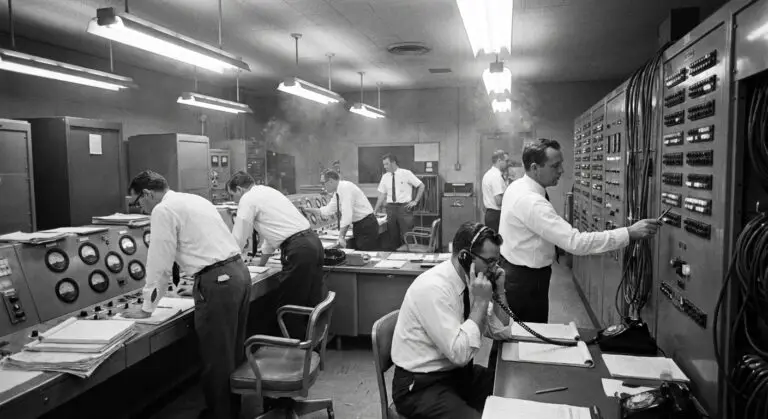
Before the outage, the Northeast was operating as part of a tightly interconnected high-voltage network. That interconnection is the point: it enables large-area power sharing and stability under normal conditions, but it also creates the precondition for a cascading failure, where one disturbance forces power onto fewer paths, overloading or destabilizing neighbors until the problem snowballs across the network.
From the primary federal investigation and later technical reviews, the initiating action for the November 9 event is best described as the operation of a protective relay and the trip of a 230 kV transmission line near the Sir Adam Beck (Ontario Hydro) station, rather than a simple, isolated “breaker failure.” The event sequence began in the mid-evening rush period (reporting commonly places the first line trip around 5:15 to 5:16 PM, with the broader onset often cited at about 5:27 PM), and the system-wide collapse unfolded within minutes as cascading trips redistributed flows and removed critical paths (see Sources). The documented restoration proceeded overnight, with large swaths of the region returned the next day and some local areas reported without power for up to about 13 hours in contemporaneous accounts and summaries.
Once the disturbance began propagating, the timeline becomes more about topology than about any single component. The key documented inflection point is when the affected region stopped being electrically tied to the rest of the Eastern Interconnection.
Official summaries describe the cascade becoming contained after the Northeast U.S. and Ontario were completely separated from the rest of the Eastern Interconnection. In practical terms, that separation is the moment the failure stops spreading outward, because the “fuel” for further propagation, large inter-area power transfers, is cut off by the islanding boundary (see Sources).
Restoration is documented at a high level as a broad overnight recovery rather than a neat, minute-by-minute re-lighting of every load pocket. That is consistent with how large restorations actually work: system operators re-energize backbone transmission, synchronize generation, and then progressively pick up load while keeping voltage and frequency inside limits.
From the outside, a cascading outage reads like a scatterplot: one line is fine, another trips, then an area far away goes dark. Post-incident reconstruction replaces that apparent randomness with a physical narrative driven by power-flow redistribution, voltage stress, and the automatic actions meant to prevent equipment damage.
One of the most counterintuitive findings in post-incident analyses is that some transmission lines failed while carrying power flows at or below their emergency ratings. That undercuts the simplistic mental model that “only overloaded lines trip,” and it points readers toward the broader reality that stability margins, voltage conditions, and protection system behavior can be decisive even when a single loading number looks acceptable (FERC review, FPC report).
Investigations also describe the sequence of line trips as non-random, following a discernible pattern consistent with power-flow rerouting and weak interface separation rather than independent random failures (FERC review, FPC report).
Protection devices are among the fastest actors on the grid. A protective relay senses local conditions and trips breakers automatically to prevent equipment damage; in an already stressed system those automatic trips can accelerate a spreading outage by removing still-healthy paths and forcing even more power onto what remains. The official emphasis on trip patterns and containment through separation is a reminder that the grid’s fastest actors are devices and physics, not dispatchers and phone calls (FPC report).
The official record summarized in post-incident findings is about grid mechanisms: interconnection behavior, transmission line trips, automatic protection actions, and the way separation into islands stops a cascade. It does not present “UFO involvement” as a cause, a contributing factor, or even a relevant technical hypothesis. That absence matters because it draws a clear boundary between two datasets: documented engineering reconstruction versus the later cultural narrative that grows around dramatic blackouts.
Accounts linking unusual lights to blackouts exist in broader storytelling about power failures. Treat those claims as external narratives layered onto the event, not as conclusions supported by the post-incident grid analyses.
The actionable way to read the 1965 timeline is to treat the official milestones and findings as the control dataset: a fast cascade, contained by electrical separation, followed by staged restoration. Any UFO overlay has to clear that baseline first, because the documented failure dynamics already explain why the outage spread quickly, why the trip sequence looked eerie to observers, and why the system stabilized only after it broke into islands.
That baseline also clarifies what the engineering record cannot do: it does not validate or invalidate individual sighting stories unless those stories can be tied to dated, independent documentation. That sourcing gap is where the UFO claim either becomes testable or collapses into repetition.
Sources for the technical claims above include the Federal Power Commission’s post-incident report to the President and later federal reviews and summaries. See the Federal Power Commission report “Northeast power failure, November 9 and 10, 1965 : a report to the President” (FPC report, govinfo and HathiTrust record) and federal technical summaries and reviews (FERC chapter on historical disturbances).
UFO Reports Near Power Lines
The blackout’s official record is an engineering and operations story. The UFO angle is a documentation problem. Large infrastructure failures reliably attract reports of aerial lights and “something hovering near the lines,” but the deciding factors are sourcing and proximity to the blackout window, not how cinematic the details feel.
Bucket 1: same-night (Nov 9, 1965) claims are the ones that matter most if you are testing a “blackout-linked UAP” idea, because the blackout affected the Northeastern U.S. and Ontario. These reports typically share a tight motif: bright lights described as hovering or moving slowly along transmission corridors, pausing near substations, or “tracking” power lines. The complication is that many same-night claims are repeated without a contemporaneous record that anchors the time, location, and reporting chain. The actionable rule: treat a same-night “near substation” detail as unestablished until you can point to at least one independent record created during, or immediately after, the outage (for example, a police log entry, a newspaper archive item, or a dated case file).
Bucket 2: near-in-time claims cover reports from the days or weeks around Nov 9, where the blackout becomes a convenient timestamp even if the sighting did not occur during the outage itself. The typical content here is looser: lights “in the region,” a mention of “power equipment” without a named facility, or a narrative that slides between “that week” and “that night.” The complication is cognitive glue: once a major event becomes a shared reference point, people naturally use it to date unrelated experiences. The practical takeaway: near-in-time reports can be relevant for understanding what people were primed to interpret as anomalous, but they do not support a blackout linkage unless the report itself contains a hard date and an independently traceable report path.
Bucket 3: later retellings that merge into the blackout narrative are where the “set piece” hardens: a glowing object over a substation, lights pacing high-tension lines, a hovering craft “drawing power.” These accounts often read as if they come from a single coherent incident, but they are frequently compilations where separate claims, from different places and times, have been fused into one blackout-adjacent story. Secondary UFO sources also sometimes attach effects beyond lights or craft, such as alleged vehicle or power disruptions, but any direct linkage to the 1965 blackout remains unestablished without primary sourcing.
In other words, the more confidently a story asserts a direct interaction with infrastructure, the more it depends on whether you can trace it back to a record created when the outage was still news, not legend.
Strong sources are boring on purpose. They are created close to the time of the alleged event, by organizations that record routine activity without caring about UFO folklore. For blackout-window claims near power infrastructure, the strongest forms look like: a contemporaneous police blotter or dispatch log noting a call about “lights near the substation,” a local newspaper archive item with a publication date and named witnesses, or utility incident notes that document reported hazards or public calls tied to specific facilities. The catch is availability: these records are often not digitized, and when they are digitized, they are not indexed for “UFO” keywords.
Weak sources are optimized for repetition. Later books, catalogs, forums, and unsourced timelines can preserve a claim, but they also smooth out missing specifics: “near the lines” becomes “over the substation,” and “around the blackout” becomes “during the blackout.” The reliability problem is structural, not moral. A cleanly written summary can be less evidentiary than a messy, timestamped log entry.
A well-sourced contemporary example is the CBC broadcast and archive coverage of the November 9, 1965 northeastern power outage, which documents the scale of the outage and contemporaneous reporting around lights and disruptions in Canada and the United States (CBC archives). Use contemporaneous media and official logs the same way: as anchors, not as story accelerants.
Start by forcing every claim into one of the three buckets, then demand at least one contemporaneous, independent record before you treat it as blackout-linked. The quickest verification path is to work outward from dated archives rather than inward from retellings.
- Pin the claim to a date and place in writing. “During the blackout” is not a date. You need Nov 9, 1965 (same-night) or a specific nearby day (near-in-time), plus a city or county and a named facility type (substation, transmission line corridor, generating station switchyard).
- Check primary local records first if you have a location: newspaper archives, police blotters, fire dispatch summaries, and municipal logs. These are the records most likely to exist even when nobody cared about “UFOs.”
- Use Project Blue Book (Air Force UFO program) as a cross-check, not a shortcut. Blue Book produced reports on more than 12,000 sightings overall, and a publicly posted searchable Project Blue Book document archive of about 6,000 Blue Book documents can help you rapidly search for terms like “power lines,” “substation,” “transformer,” “transmission,” and specific town names. If a blackout-window claim is real and reported through channels that touched the Air Force, it often leaves a paper trail you can at least attempt to locate.
The disciplined takeaway is simple: classify the story, then require documentation that existed before the story became popular. That is how you separate “lights near power equipment” as a repeated motif from “lights near power equipment” as a blackout-linked fact.
What Could Mimic a UFO
Under blackout conditions, the grid can generate spectacular light phenomena that read as “objects” because they appear suspended near lines and substations, recur in bursts, and stand out against an unusually dark background. In that frame, a light seen near power equipment is often a symptom of grid stress or restoration activity, not the cause of a system collapse.
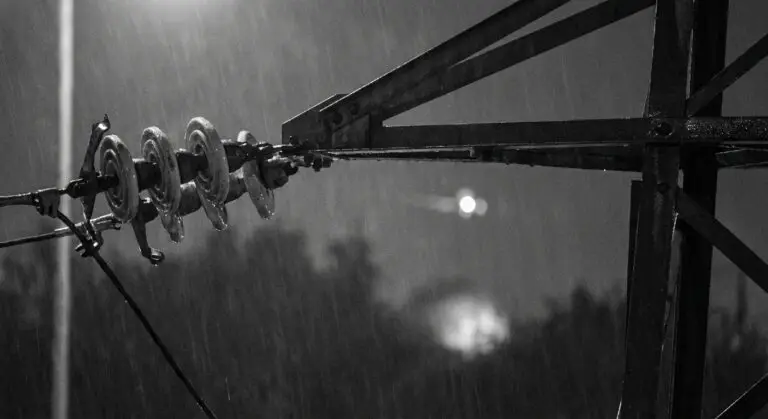
A high-voltage fault can create light that looks self-contained and “in the air” because the electrical action is happening at elevated conductors, insulators, and bushings, not at ground level. A flashover across insulation, a contaminated insulator tracking to ground, or a failed transformer bushing can all present as a sudden flare localized to a pole top, tower crossarm, or substation structure, sometimes followed by a second burst as protection clears and equipment attempts to reclose.
Corona discharge appears as a faint glow and audible buzz around energized high-voltage conductors, and in deep darkness that low-level halo can be misread as a hovering light that “sticks” to a line corridor. The practical cue is location: it clings to where the electric field is strongest, such as hardware edges, insulator strings, and conductor bundles, rather than moving freely across the sky.
Arc flash is an electrical explosion or discharge triggered by a short circuit in high-power equipment, and to a witness it registers as a sudden, extremely bright flash with a brief duration that can seem to “pop” from a substation or a transformer bank. The grid-facing takeaway is simple: a bright, instantaneous flare near a piece of apparatus is consistent with a fault clearing event, not with an object maneuvering.
Restoration is not a single moment; it is a sequence of switching operations, and switching operations during restoration cause distortions in power flow that can coincide with visible light phenomena during re-energization. That timing matters because repeated energize-deenergize cycles, reclosing attempts, and sectionalizing can produce multiple flashes minutes apart, which observers naturally interpret as a “response” to attention or rumor rather than as stepwise grid work.
Operationally, utilities can execute restoration actions rapidly, including remote switching commands, which compresses cause and effect into tight windows that feel uncanny from the outside. When a bright event occurs near a known power corridor and streetlights remain out, the human brain anchors on the most salient coincidence: “the light happened when the power changed,” even when the light is the visible byproduct of that switching, not an independent driver of it.
Switching also includes deliberate emergency operations to de-energize equipment during incidents, and those actions can shift where stress shows up next. That is why “moving lights” reported along a line can map cleanly to switching boundaries: the work moves the energized edge of the system, and the visible effects move with it.
Citywide darkness changes perception physics, not just mood. Eyes dark-adapt, contrast sensitivity rises, and small light sources become dominant reference points; meanwhile emergency lighting automatically illuminates during loss of normal power, creating isolated pools of bright light that can reflect off low clouds, windows, and glossy surfaces.
Emergency power systems that feed critical loads add more “unexpected” illumination: lit industrial sites, pumping stations, and facilities on backup power can look like anomalous beacons when everything around them is dead. Add anxiety, sirens, and crowds scanning the same corridor, and you get rapid social reinforcement: people look where others point, then interpret ordinary electrical light as extraordinary because there are few stable reference points left.
A disciplined weather note belongs here because visibility drives misreads. Anticyclones are associated with clear weather and the absence of rain and violent winds, and clearer air makes any localized electrical glow, flash, or reflection easier to see from farther away. That general principle strengthens the perception effect without claiming any specific local meteorology for November 9, 1965.
A coincidence in timing is not, by itself, a causal link. To argue a causal UAP-grid interaction, you would need independent instrumentation that tracks the electrical event and the visual event as separate variables: time-stamped substation logs and relay targets, switching records, fault recorder data, synchronized photos or video with fixed landmarks, and confirmation that the light’s position and motion do not match known energized assets or restoration steps. Without that, the most defensible reading is engineering first: treat lights near substations and lines as testable grid phenomena before escalating to extraordinary explanations.
From Cold War Secrecy to UAP Disclosure
Old UFO cases do not stay fixed in time. Their public meaning changes as government reporting systems change and as official promises about transparency harden into expectations. The same thin record that once read as routine triage in a security-focused era now gets reinterpreted as “suppressed” in a disclosure-focused era, especially when the underlying event, like the 1965 blackout, already carries high drama and incomplete documentation.
That shift in expectations matters because it changes what people think a “real” case file should look like. When the modern public is accustomed to formal intake channels and public-facing summaries, a 1965-era paper trail can feel suspiciously quiet even when it reflects the recordkeeping norms of the time.
In 1965, UFO reporting ran through a Cold War pipeline built to reduce uncertainty, not to maximize public understanding. Project Blue Book, the U.S. Air Force program created to investigate UFO sightings through a national-security lens, explicitly aimed to determine whether UFOs posed a threat to U.S. security and ultimately investigated thousands of reports. That posture shaped everything downstream: centralized military intake, a bias toward rapid categorization, and a public-facing posture that treated most reports as noise unless they intersected with defense concerns.
Security logic produced sparse public records by design. When authorities prioritize threat screening, they document what they need for assessment and move on. Decades later, that same minimalism becomes interpretive fuel: skeptics see “absence of evidence,” while believers see “evidence of suppression.” The 1965 blackout sits directly in this tension because it is a major public disruption with a parallel strand of UFO reporting that can never be fully reconstructed from surviving paperwork alone.
Today’s posture is bureaucratically more explicit and reputationally more exposed. AARO, the Department of Defense office that centralizes intake and analysis of UAP reports, maintains a system of records for submissions by current and former U.S. government personnel. A recent Pentagon historical record report cited an intake figure of 801 UAP reports as of April 30 in its reporting period context; that number is an intake statistic and a modern accounting artifact rather than a measure of case quality (Pentagon/AARO report). Legislative debates and amendments about declassification and disclosure have been part of the recent public conversation; for example, text related to amendments and manager packages is publicly available through congressional records (Congressional amendment text), which provides context for how modern disclosure expectations interact with legacy cases.
Modern UFO news and UAP news reward re-litigation. Viral incentives favor ambiguous originals, “missing file” narratives, and keyword frames like “alien disclosure” and “government UFO cover-up,” even when the historical record cannot support those conclusions. Once a story is circulating, confirmation loops do the rest: each retelling treats prior uncertainty as intentional withholding, and the blackout’s emotional charge supplies the hook.
The takeaway is straightforward. Modern UAP offices and modern reporting totals explain why the 1965 blackout keeps resurfacing, not what it “really was.” Treat today’s intake systems as context for the news cycle, not as retroactive proof of non-human intelligence or a hidden 1965 cover story.
How to Judge the Blackout UFO Claim
Extraordinary infrastructure claims live or die on documentation quality, not on how compelling the narrative sounds. “UFOs were spotted near power lines as the 1965 grid failed” is a testable proposition only if you can tie a specific sighting, at a specific time and place, to specific grid operations records and independent observers. The complication is that many relevant records are fragmented across utilities, municipalities, and federal repositories, and some record types were never retained long-term. That gap is where confident myths flourish.
- Rank the source: Prefer primary operational records (utility logs, dispatch logs) over memoirs, retellings, and “someone heard” accounts.
- Lock the time proximity: Give the most weight to notes, calls, and logs created during the event window, not years later.
- Demand independent corroboration: Two unrelated sources that agree on time and location beat ten copies of the same story.
- Check technical plausibility: Ask whether the described observation matches what grid hardware, aircraft, and already-established alternative mechanisms can produce, without inventing new physics.
- Verify alternatives were tested: Treat the claim as “not yet supported” until plausible non-UFO explanations have been explicitly ruled out with records, not vibes.
Start with documents that can either connect the alleged sighting to an actual grid operation or sever the link cleanly:
- Utility switching logs and substation incident reports: timestamps for breaker operations, relay trips, alarms, line patrol dispatches, and crew notes tied to a named facility.
- Police and fire dispatch logs: calls about “lights,” “objects,” “explosions,” or hazards near transmission corridors, including the exact address or cross-streets.
- Radar records (and retention realities): identify who would have held data (civil aviation, military, local ATC) and confirm what still exists before building theories on “there must be radar.”
- Photos and film with provenance: original negatives or first-generation prints, photographer identity, camera details, and an unbroken custody path.
- Contemporaneous newsroom archives: local papers, wire copy, and assignment logs; microfilm beats later “anniversary” articles because it anchors what was actually reported at the time.
- Write a tight records request: specific date range, facility name, and record type; broad “everything about UFOs” requests fail.
- FOIA the right repositories: the Lyndon B. Johnson Presidential Library maintains federal records subject to FOIA, making it a concrete pathway for White House era federal material.
- Use governed access for military records: requests for Wisconsin National Guard records must be processed under FOIA and Privacy Act procedures, so build requests around unit, date, and mission descriptors, not conclusions.
- Work in a forensic venue: CUFOS publishes a Journal of UFO Studies, a useful model for documenting sources, separating observation from inference, and refusing to escalate speculation when the paper trail is thin.
What remains unknown is whether any contemporaneous operational record places an unusual aerial object at the same time and location as a documented grid event, with independent corroboration. Many potentially decisive artifacts are local, hard to discover, or retention-limited, which blocks clean falsification and keeps the story alive. Until the claim is anchored to timestamped logs and cross-verified reporting, it stays in the category of narrative, not evidence.
Conclusion
The 1965 blackout-UFO linkage remains unproven because the best-supported record explains the grid failure without any outside actor. On Tuesday, November 9, 1965, a cascading outage knocked out power across a Northeast footprint, affecting on the order of tens of millions of people. The official baseline is straightforward: the disturbance stayed contained after key separations, protection operated in repeatable patterns, and some critical lines were already operating at or below emergency ratings, which is exactly how a stressed network falls apart.
That baseline is also why the article’s three questions matter in practice: the engineering timeline provides the control dataset, the sightings claim rises or falls on whether it can be sourced in the blackout window, and the modern disclosure environment mostly explains why the story keeps getting retold. What keeps the UFO narrative durable is not strong documentation but thin, merged sourcing, which is why the only defensible way to handle the sightings is to bucket claims by proximity to the grid event and by whether the source is contemporaneous, official, or retrospective. Grid faults and restoration can generate UFO-like lights, and reports timed to the re-energization window are easy to misread as a separate event. If you want to settle it, prioritize utility switching logs, protection relay records, control-room transcripts, and time-stamped incident reports, then use FOIA and archival newspaper searches to map each sighting claim to a primary document before repeating it.
Frequently Asked Questions
What was the Northeast blackout of 1965 and when did it start?
The Northeast blackout of 1965 was a major regional power outage affecting parts of the Northeastern U.S. and Ontario. Contemporaneous summaries commonly time the onset to about 5:27 PM local time on Tuesday, November 9, 1965.
How big was the 1965 blackout in terms of area and people affected?
It is widely described as spanning Ontario through New York (including New York City and Buffalo) to New England, with Boston and Toronto commonly included. Scope estimates in the article put the impact at roughly 50 million people and about 61,800 MW of load loss.
What do official records say caused the 1965 blackout?
The article summarizes the official record as a grid disturbance in an interconnected system that cascaded through rapid line trips and protective relay actions. It describes the initiating event as a breaker failure and notes the system collapsed on the order of roughly ten minutes.
What is a cascading failure and why did the blackout spread so quickly?
A cascading failure is when one disturbance forces power onto fewer paths, which overloads or destabilizes neighboring parts of the network and snowballs across the grid. The article explains that interconnected high-voltage networks enable power sharing but also create the precondition for fast cascades driven by physics and high-speed protection systems.
Did the official investigation mention UFOs as a cause of the 1965 blackout?
No-according to the article, the documented summaries and post-incident analyses focus on grid mechanisms like interconnection behavior, line trips, protective relays, and separation into electrical islands. The official record does not present UFO involvement as a cause, contributor, or technical hypothesis.
How can you tell whether a “UFO near power lines” report is actually linked to the 1965 blackout?
The article says to classify the claim as same-night (Nov 9, 1965), near-in-time (days/weeks around it), or later retelling, then require at least one contemporaneous independent record such as a police/dispatch log, dated newspaper item, or utility incident note. It also recommends cross-checking with Project Blue Book’s archive (about 6,000 searchable documents) using terms like “power lines,” “substation,” and town names.
What electrical phenomena during a blackout can look like a UFO near substations or transmission lines?
The article lists high-voltage fault flashes, flashovers, transformer bushing failures, corona discharge (a faint glow around energized conductors), and arc flash as sources of “hovering” or sudden bright lights near grid hardware. It also notes restoration switching and reclosing can produce multiple flashes minutes apart, which can be misread as an object moving or “responding.”