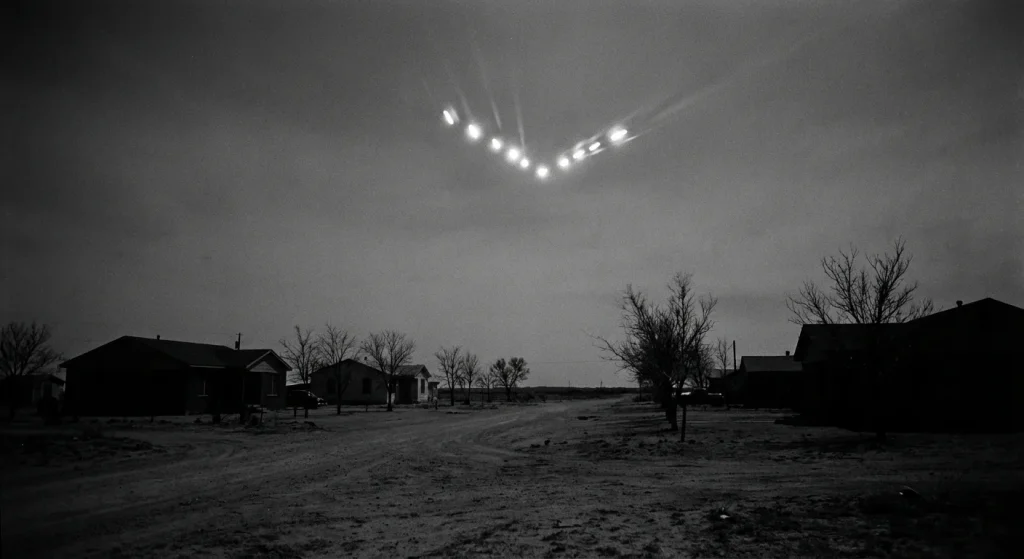
The Lubbock Lights won’t go away because this case has the rare mix that keeps a UAP story alive: repeat sightings on multiple nights, unusually credible witnesses, and photographs that keep resurfacing every time UFO news or UAP news spikes.
If you keep seeing Lubbock cited in UAP disclosure arguments, you’ve probably hit the same wall: the case gets retold as a single, polished legend, and it becomes hard to separate what’s documented from what’s repeated because it sounds good in a debate.
The documented core is straightforward and stubborn. The sightings occurred over Lubbock, Texas in August and September 1951, with recurrence across multiple nights. A widely cited professor-witness event occurred on August 25, 1951, involving Texas Tech professors observing the lights. Contemporary local newspapers reported that hundreds of people, including university scientists and professors, were witnesses during the August 1951 wave (local reporting). That combination is exactly why the story still carries weight when people argue about what “counts” as evidence.
UAP (unidentified anomalous phenomena) is the right lens for that weight because it labels the evidence status, not the origin claim: something observed and not confidently identified from the available record. The friction is that Lubbock’s strongest features also create pressure to overreach. Credible testimony plus photos tempts definitive conclusions, but the evidentiary record has hard limits: incomplete documentation, uneven reporting, and gaps you can’t responsibly fill with confidence just because the witnesses were respected or the images are memorable.
This is the decision you’re actually making: what to treat as solid fact, what to treat as interpretation, what to ignore as lore, and how to talk about the case without sounding credulous or reflexively dismissive.
What follows is an evidence-first walkthrough designed to separate what is solid from what is speculative, and to mark which questions still have answerable, document-based boundaries.
West Texas 1951 and credible witnesses
In the Lubbock Lights case, credibility did not come from the “mystery.” It came from repetition and reputation: unusual lights were reported over Lubbock, Texas across August and September 1951, and the story kept resurfacing because multiple nights of reports were paired with observers the public was trained to treat as careful and technically literate. That combination turned a local oddity into a reputational event that newspapers and radio could not ignore.
The narrative most people inherit foregrounds Texas Tech professors as the primary witnesses, and that emphasis is doing social work. In 1951 media culture, “professor” and “scientist” functioned as credibility shortcuts: not proof, but a signal that the observer was less likely to be dazzled by ordinary aircraft or a casual light display. A professor’s report also implied a path to verification, because colleagues could compare notes, argue about what they saw, and put names to statements.
The complication is that “credible witness” is a category that gets stretched in retellings. Firsthand accounts are what a named observer said they saw at the time. Contemporaneous reporting is what local media recorded while the flap was active, often secondhand and condensed. Later retellings blend the two, sometimes collapsing different nights into one “event” or promoting the most legible witnesses (faculty) while sidelining less quotable groups (students, neighbors, motorists). Treat the professor-heavy cast list as a clue about how the story traveled, not as a stamp of certainty.
Other groups matter for a different reason: volume. Reports attributed to multiple independent observers across separate nights add the kind of recurrence that makes a rumor expensive to dismiss. Even so, recurrence still is not validation. It is a reason to take the paper trail seriously and ask what, exactly, was claimed on which night.
West Texas in 1951 was not an aviation blank spot. Reese Air Force Base near Lubbock was part of the postwar training system. According to Air Force historical summaries and local base histories, Reese handled a succession of training aircraft in the postwar era and later hosted jet trainers such as the T-33 before the T-37 appeared at Reese in the early 1960s (Air Education and Training Command history) (base timeline). That context cuts both ways. On one hand, a community living next to a training base sees aircraft constantly, which raises the bar for a “nothing like we usually see” report. On the other hand, a training-heavy environment supplies conventional candidates and normalizes night activity. The critical boundary is technological: jets are a popular shorthand in later speculation, but Reese’s jet training era came after 1951, and general references on Reese and Air Force training do not document specific night-formation routes over Lubbock for mid-1951.
- Late August 1951: Reports begin circulating of an unusual formation of lights seen over Lubbock, Texas. The key point for orientation is recurrence: this was not a single, isolated claim, but a pattern of sightings that people compared across days.
- August 25, 1951: One of the principal sighting nights in the standard chronology, frequently referenced in contemporaneous accounts and later summaries as part of the build-up that established the “this keeps happening” character of the flap. Keep your sourcing straight here: many later narratives compress what different people reported into one clean storyline.
- August 30, 1951: Another anchor night in the chronology and the date commonly associated with the Texas Tech professor-focused narrative leading up to the photographs. For timeline purposes, what matters is sequencing: repeated reports first, then documentation attempts.
- September 1951: Additional reports continue over Lubbock. This extension into September is why the case is described as an August to September 1951 wave rather than a one-night incident.
Read witness credibility and timelines like a historian, not a juror. Names, titles, and repeated nights tell you where to focus attention in the record and which claims were socially legible enough to spread. They do not, by themselves, tell you what the lights were. The disciplined move is simple: separate firsthand statements from contemporaneous summaries, separate both from later retellings, and only then decide how much weight recurrence and reputation deserve.
Once the timeline and witness landscape are in view, the next step is narrower: what people actually reported in the sky, and where their accounts converge versus where perception predictably blurs.
What witnesses said they saw
The strongest value in the Lubbock Lights testimony is not the unresolved “what was it,” it’s the repeatable pattern: independent observers, separated by role and vantage point, converged on a small set of perceptual features while disagreeing in the exact places night-sky perception reliably breaks down.
Across professors and scientists, students, pilots, and local residents, the reports repeatedly describe multiple discrete lights behaving as a single organized display, not a lone point source. Witnesses describe a “formation impression,” meaning the lights maintained a recognizable grouping and relative order long enough for people to talk about spacing and shape rather than just “a flash.”
The traversal behavior is also consistent at the level that matters: observers describe a steady passage across the sky (a track with directionality), rather than abrupt start stop jumps at random points. That matters because any explanation has to reproduce continuity in apparent motion and relative positioning as seen from different locations.
Sound reports cluster into a familiar split seen in many night observations: some people report no sound at all, while others report hearing something they associate with aircraft. The key commonality is that sound, when reported, is not described as a synchronized, unmistakable “right under it” cue for altitude. That leaves distance and height underdetermined from audio alone.
Lighting descriptions also show a shared baseline: witnesses talk about point-like lights (not an illuminated solid body) and discuss brightness and color in qualitative terms, the way people naturally do at night when there is no reference photometry.
Altitude estimates diverge because the eye has no built-in ranging for the night sky. People back into altitude by assuming a physical size, then “solving” distance from how big it looked. That inference chain is where accounts spread out.
Speed estimates diverge for the same reason. Observers tend to convert “how fast it crossed my view” into miles per hour by implicitly choosing a distance. Two people can describe identical apparent motion and honestly disagree on “fast” versus “slow” if their distance assumptions differ.
Size impressions diverge because night observation compresses depth cues. A line of lights can be interpreted as “small and close” or “large and far” with very little to break the tie.
Timing precision diverges because most people do not start a stopwatch when something unexpected appears. Estimates rounded to the nearest minute are normal, especially when attention is split between watching, pointing, and finding others to confirm the sighting.
Here is the quantitative crux without dismissing anyone’s sincerity: “angular size” is what your eye actually measures, and for small angles (in radians) it follows the small-angle approximation, θ ≈ s / r (physical size over distance). If you guess s wrong, you force r to change, sometimes by an order of magnitude.
Speed behaves the same way. What you observe is “angular speed,” ω = dθ/dt, and for purely transverse motion ω = v / r, equivalently v = r · ω. Identical apparent motion implies radically different physical speeds depending on r.
Worked example with explicit assumptions: suppose a light pattern sweeps across the sky at an apparent rate of 0.5° per second (ω ≈ 0.00873 rad/s). If it is at r = 100 m (nearby), then v = r·ω ≈ 0.87 m/s, about walking speed. If it is at r = 10,000 m (far), then v ≈ 87 m/s, about 314 km/h. Nothing about the visual impression changes between those two calculations, only the distance assumption does.
- Time-stamp the start and end with a phone clock, then note any mid-event changes (formation changes, brightening, splitting).
- Capture angles by recording video that includes reference points (rooflines, poles, known stars), so angular spacing and angular speed can be measured later.
- Record audio continuously, even if you “hear nothing,” because later review can separate wind, traffic, and distant aircraft signatures.
- Write down geometry immediately: direction of travel, elevation above the horizon, and whether the motion was smooth or stepped.
- Avoid inferring altitude, size, or miles-per-hour on the spot; preserve the observables (angles and time) and let distance be the variable tested.
Those witness-level consistencies are the constraints any explanation has to meet. The photographs matter because they are often treated as the most durable form of that constraint-even though the photo record brings its own vulnerabilities.
The photographs and their chain of custody
The photographs are the Lubbock Lights case’s most portable “proof” because they travel farther than any single witness and they feel objective on sight. They are also the easiest place for evidence quality to degrade, because every analog step between the shutter click and the image you see today can strip away context, alter tonal relationships, and erase the metadata that lets you check a claim.
The result is predictable: the images circulate widely, the story accumulates confident captions, and the underlying documentation often stays thin. Contemporary and later accounts reference multiple reports and photographs connected to the 1951 events, but “referenced” is not the same as “fully documented.” That gap is where folklore grows.
The best-known Lubbock Lights photographs are attributed to Carl Hart, Jr., and those photos are commonly dated to the night of August 30, 1951. Those two lines are repeated so often they can sound like hard lab labels stamped onto the negatives. In practice, they are frequently encountered as captions, summaries, and retellings, not as a complete paper trail that a skeptical reader can independently audit.
The distinction matters because attribution and dating are not trivia, they are the anchor points for every downstream inference. If you cannot tie “Carl Hart, Jr.” and “Aug 30, 1951” to contemporaneous documentation such as a dated negative sleeve, a lab receipt, a newspaper photo log, or an original caption written close to the event, you are relying on a claim that may be correct but is not yet demonstrated by documentation you can inspect.
Early interest from media, scientists, and the Air Force is part of the case’s public record at a high level, and that attention is one reason the photos kept circulating. What often goes missing in later tellings is the boring part: which specific physical items were handled, by whom, and in what condition at each stage.
Camera format and film speed are the technical facts most directly tied to what detail a surviving image can legitimately support. A 4×5 sheet negative captures far more scene detail than a 120 roll negative, and a 120 negative captures more than a 35mm strip. That hierarchy matters because enlargements of small-format negatives amplify grain and processing artifacts, and claims about fine structure should be supported by a negative with the resolving power to show that structure. Likewise, a high-ISO film stock or slow shutter will produce motion blur and grain that limit what can be read from a single frame. If the original format and exposure are unknown, do not treat visible “edges” or faint internal structure as scene detail rather than film or reproduction artifacts.
Camera identification and lab documentation are equally consequential. A press camera or large-format view camera produces different depth of field and motion characteristics than a handheld 35mm. Processing receipts, negative sleeves, or first-generation prints let an analyst match image resolution to plausible scene geometry. Without them, confident claims about object geometry and brightness are speculative because the evidentiary chain is incomplete.
Chain of custody is the plain-language record of who controlled the original material at each handoff, and that transfer documentation directly determines evidentiary weight. For historic photos, the ideal chain runs from original capture to the original negative, to first-generation prints made directly from that negative, to any later copies. Break the chain, and you lose the ability to say whether a later image is an accurate representation or an altered descendant.
Generation loss is what happens when copies are made from copies: each step can add contrast shifts, lose shadow detail, blow highlights, and smear edges. That is why a newspaper reproduction, a printed halftone, a photocopy, or a scan of a print cannot be treated as equivalent to an original negative or a first-generation print, even if the subject matter looks “the same.” In mid-century publication workflows, photographs were routinely converted into halftone dots for printing, and those dots can create false textures and apparent structure that never existed in the continuous-tone original.
You can responsibly infer only a narrow set of things from surviving reproductions: that an image existed, that it was compelling enough to circulate, and that its visible shapes survived at least one reproduction chain. You cannot responsibly infer precise object geometry, absolute brightness, or fine edge structure from unknown-generation prints or halftones, because you cannot separate scene information from processing and reproduction artifacts.
- Request the original negatives (or transparencies), not just prints or scans.
- Prioritize first-generation prints made directly from the original negative.
- Obtain dated lab notes, processing receipts, or negative sleeve markings tied to the roll or sheets.
- Collect contemporaneous logs: photographer notes, newsroom intake records, or investigative file inventories.
- Document every custody transfer with dates, handlers, and storage conditions.
Photographs and negatives are commonly treated as records by institutions, which is exactly why the paperwork should exist somewhere for well-handled cases. The photographs’ value is not just what they depict, it is whether the originals and their documentation can still be traced without gaps.
Those provenance limits are why the case does not reduce cleanly to “the photos prove it” or “the photos are worthless.” The explanations that follow persist precisely because each has to satisfy both the recurring witness pattern and the uneven photographic record.
Leading explanations and why they persist
The argument has never been “mystery vs debunk.” It is a contest between explanations that each fit part of the record and collide with another part, which is exactly why the Lubbock Lights remain described as unresolved more than 70 years later.
One reason this case persists is institutional: Cold War-era reporting pipelines collected data without turning that collection into proof. Project Blue Book records at the National Archives logged and investigated reports, but an investigation file is not a resolution, and the National Archives holds and references Air Force UFO materials from that era as historical records rather than final answers (National Archives Project Blue Book holdings). For historical context on Project Blue Book investigations and contemporaneous Air Force handling, see Edward Ruppelt’s account and the archival summaries of Blue Book records (Ruppelt, Project Blue Book).
Historical proposed explanation: Project Blue Book investigators and some subsequent commentators proposed that birds reflecting city lights could account for the Lubbock Lights, a conclusion often tied to local researcher commentary and Air Force notes. The Texas Tech-affiliated discussion of birds and reflections is associated with named faculty who observed the lights, and later skeptical accounts emphasized streetlight reflections on avian bodies as a plausible mechanism (Texas Tech primary materials) (summary of contemporary skeptical views).
Analytical model of how the bird/streetlight hypothesis would have to work: to account for the record, the bird/reflection model must meet measurable constraints. It needs a plausible nocturnal migrant species present at the time, flock geometry that can read as discrete points rather than a diffuse mass, flight altitudes and angles that produce specular reflections visible from many vantage points, and a municipal lighting environment capable of delivering the necessary illumination and spectral character. These are testable variables: species migration records, municipal streetlight rollout and fixture specifications, and witness geometry can be combined to evaluate whether the reflection model is quantitatively plausible for the nights in question.
| Hypothesis | Explains well (ties to witness consistencies) | Struggles with (ties to photo constraints and/or testimony) |
|---|---|---|
| Birds reflecting city lights | Multi-light appearance and recurrence across nights | Formation coherence, brightness consistency, and distance assumptions implied by apparent motion |
| Streetlight-reflection framing | Color/brightness as a lighting artifact tied to the city environment | Requires specific local lighting placement and timing documentation |
| Aircraft formations | Structured spacing and V-like geometry | Sound expectations, navigation-light patterns, and speed/altitude consistency with what witnesses described |
| Atmospheric/optical effects | Color shifts and apparent brightness changes | Producing repeated, formation-like structure night after night |
| Hoax or photographic artifact | Some image-level oddities can be generated without a physical object | Scaling to many observers and multiple nights; limitations without original negatives |
| Residual “unknown” | Admits what the evidence cannot discriminate | Not an explanation, only an evidence-status bucket |
“Migrating birds” stays on the table because it matches two stubborn facts from “what-was-seen”: the lights were reported across multiple nights, and night flight is common in migration. Many migratory bird species are primarily nocturnal migrants, and migration itself is a seasonal, typically twice-yearly movement between breeding and wintering grounds, so late-summer timing does not need special pleading.
The friction is the same place the bird hypothesis always lives or dies: reflectivity and distance. To look like discrete, bright points rather than a dark flock, the birds must be at an altitude and angle where they catch and return enough city light toward observers, and the observers must be positioned so that many individuals “flash” in a way that reads as a coherent formation. That has to line up with the consistent formation impression reported by witnesses, and it has to remain compatible with what the photos can actually support (a small number of frames, limited exposure context, uncertain reproduction lineage). If the apparent angular motion was fast, the distance assumptions get unforgiving in a hurry: nearby objects cross the field quickly; far objects need very high true speed.
The actionable takeaway is that “birds” is not a single claim. It is a bundle of measurable requirements: plausible species for the season, plausible flock geometry, and plausible flight altitude. Even for well-studied shorebirds, agencies explicitly flag migration routes and altitude or flight information as data needs, which is a reminder that altitude is often the weakest, most assumed variable in retrospective reconstructions.
The streetlight-reflection framing tries to tighten the bird idea into a specific mechanism: bright city lighting creates the luminous points, and the “formation” is a perceptual read of a moving, reflecting group. As a model, it is testable. It must match the local lighting environment and timing: what fixtures were installed, where they were located, when they went live, and whether their spectral output and brightness plausibly match the reported blue-green character.
The problem is documentary, not rhetorical. Without sourced installation specifics for Lubbock in 1951, the theory asks the reader to assume the very thing that would decide it. A serious version of this hypothesis rises or falls on municipal records, utility documents, and streetlight procurement and rollout dates, not on a clever diagram.
Aircraft explain a clean V-like layout better than almost anything else. A formation can hold spacing, can recur across nights, and can present as a set of steady lights. If “what-was-seen” emphasized disciplined alignment, aircraft deserve a hearing.
The friction is that the aircraft hypothesis has to match more than shape. It must match expected sound at the reported times and apparent distances, it must match how navigation and landing lights would present from below, and it must match the apparent motion witnesses described. The photographs, as discussed in “the photographs,” are not a complete telemetry record: they do not, on their own, lock down altitude, speed, or aircraft type, and reproduction uncertainty makes fine-grained brightness comparisons a weak foundation. Without corroborating flight activity records, “aircraft” remains plausible but underdetermined.
Atmospheric optics can change what a light looks like without changing what the light is. Rayleigh scattering is a standard example of the atmosphere shifting apparent color by preferentially scattering shorter wavelengths, a reminder that “what you see” is always filtered through air and geometry.
What atmospheric effects struggle to do, by themselves, is repeatedly generate a crisp, formation-like set of discrete points that multiple witnesses interpret similarly across separate nights. Optics can smear, halo, tint, or amplify; they do not usually fabricate stable, evenly spaced structure on command. As an auxiliary explanation layered onto another source (birds, aircraft, or city lighting), optics stays relevant; as a standalone generator of a V formation, it is doing too much work.
A hoax theory has to clear a higher bar than “the image could be manipulated.” It has to account for the volume of observers and the multi-night recurrence described in “what-was-seen.” An image-level artifact can explain a single frame; it does not automatically explain independent sightings.
At the same time, the photographic record has real constraints: without original negatives and full documentation, some artifact categories cannot be conclusively ruled in or out. That is exactly why responsible analysis does not treat the photographs as either definitive proof or definitive fraud. They are partial evidence inside a larger claim.
“Unknown” is not a competing story. It is the remainder after every named hypothesis runs into a mismatch with either consistent testimony elements or the limits of the photographic record. Keeping an “unknown” bucket is honest bookkeeping: it separates “best current fit” from “proved.”
The responsible way to argue UAP explanations is to demand decision-grade missing data, not more certainty from thin inputs. For Lubbock, that means: primary photographic materials with traceable provenance, contemporaneous logs that constrain aviation activity, and sourced municipal documentation that pins down streetlight type, placement, and activation timing. Until those exist, each leading hypothesis will keep fitting part of the record and failing another part, which is the real engine of persistence.
That same tension between compelling narratives and auditable records is not unique to 1951. It is also the defining fault line in how older incidents get pulled into today’s disclosure debates.
Lubbock Lights in the disclosure era
The disclosure era changed the question people ask. The debate is less about “did anyone see something?” and more about “what records exist, who controls them, and what can be audited?” That shift matters for legacy cases because it resets expectations: credibility arguments increasingly compete with paperwork arguments.
The Department of Defense established the All-Domain Anomaly Resolution Office (AARO) to standardize intake, reporting, and analysis across the defense enterprise and to provide a central process for handling new reports (AARO mission and role). Institutional placement signals the real job: standardize intake, reporting, and analysis across the defense enterprise, then report upward through an intelligence and security chain, not a public archive. The friction is structural: what AARO is-and what it says it cannot do-can centralize leads and reconcile reporting pathways, but it does not automatically control every historical file, and it cannot unilaterally declassify information created and classified by other entities. The practical payoff for older incidents is narrower than most headlines imply: you get clearer process, not instant documents.
Legislative proposals show where public pressure is aimed. Senate Amendment 2610 (118th Congress) proposed creating an “unidentified anomalous phenomena Records Collection” at the National Archives and should be read as proposed language rather than enacted law (S.Amdt.2610 text and status). Treat that as a transparency demand signal, not a finished outcome. Proposed language is often revised, narrowed, or removed before anything becomes binding law.
High-profile testimony travels at internet speed because it is immediately quotable and emotionally legible. Documentation moves at classification speed. David Grusch testified under oath and explicitly framed his scope: he was “speaking to the facts as I have been told them.” That sentence draws a bright line between secondhand claims, sworn testimony about what someone reports, and verified documentation that can be audited.
Actionable rule for consuming UAP disclosure news: treat modern claims as prompts for specific document requests and provenance checks, not as retroactive proof for older cases.
What the Lubbock Lights teach us
The case endures because it stacks three hard-to-dismiss pillars from the body sections: recurrence across multiple nights (timeline matters), a notable witness set that included professors and other scientists, and a photographic record. Those same sections also define the ceiling of what can be known: key variables, especially definitive range and altitude, are not recoverable from the existing record, so any reconstruction will have irreducible uncertainty. The photographs contribute structure and timing that pure testimony cannot, but their limitations live in the record’s gaps, not in anyone’s confidence; the explanations section stays contested because each hypothesis fits part of what was reported and photographed while failing to fully account for the whole.
That is also why the case so easily hardens into a “single, polished legend” in debate: the headline elements travel well, while the missing documentation does not. If you keep the original frame from the introduction-fact versus interpretation versus lore-the Lubbock Lights become less a verdict and more a model for disciplined evaluation.
Use the Lubbock pattern as a filter for new UAP reports today by grading evidence, not vibes:
- Document with originals, timestamps, and unedited files.
- Corroborate with multiple independent witnesses, recorded separately.
- Contextualize with environmental conditions that night.
- Demand transparency: records requests, logs, and a clear chain of custody; analog-photo evaluation hinges on provenance and generation loss.
Stay curious and rigorous: “unresolved” is a statement about evidence limits, not an identity claim about origin.
Frequently Asked Questions
-
What were the Lubbock Lights in 1951?
The Lubbock Lights were repeated sightings of multiple discrete lights seen over Lubbock, Texas across August and September 1951. Reports described the lights moving together in an organized, formation-like pattern, and the case includes widely circulated photographs.
-
When did the main Lubbock Lights sightings happen, and what dates are most cited?
The sightings occurred over multiple nights in August and September 1951. August 25, 1951 is frequently cited for the Texas Tech professor witness event, and August 30, 1951 is commonly associated with the best-known photographs.
-
What did witnesses say they saw during the Lubbock Lights sightings?
Witnesses repeatedly described multiple point-like lights that maintained a recognizable grouping and moved steadily across the sky rather than appearing as a single flash. Reports also split on sound, with some hearing none and others hearing something they associated with aircraft.
-
Why do witness estimates of altitude and speed vary so much in the Lubbock Lights case?
The article explains that observers mainly perceive angular size and angular speed, not true distance, so assumed range changes the inferred physical speed and altitude. It gives an example where the same apparent motion (0.5°/s, about 0.00873 rad/s) implies about 0.87 m/s at 100 m but about 87 m/s (≈314 km/h) at 10,000 m.
-
Who took the famous Lubbock Lights photos, and what date are they usually given?
The best-known photographs are commonly attributed to Carl Hart, Jr. and often dated to the night of August 30, 1951. The article notes these details are frequently repeated as captions and summaries and should be tied to contemporaneous documentation when possible.
-
What chain-of-custody details matter most for evaluating the Lubbock Lights photographs?
The article emphasizes identifying original negatives (or transparencies), securing first-generation prints made directly from those negatives, and collecting dated lab notes, receipts, or negative sleeve markings. It also stresses documenting every custody transfer because copy-of-copy reproduction can cause generation loss and halftone artifacts.
-
How do you decide between the main explanations for the Lubbock Lights (birds, aircraft, hoax, or unknown)?
The article’s standard is to prefer the hypothesis that best matches the recurring multi-night pattern and consistent witness elements (formation impression and steady motion) while staying compatible with photo limits (missing metadata and reproduction uncertainty). It also advises minimizing undocumented assumptions, such as unverified flight activity or unverified streetlight installation specifics.
