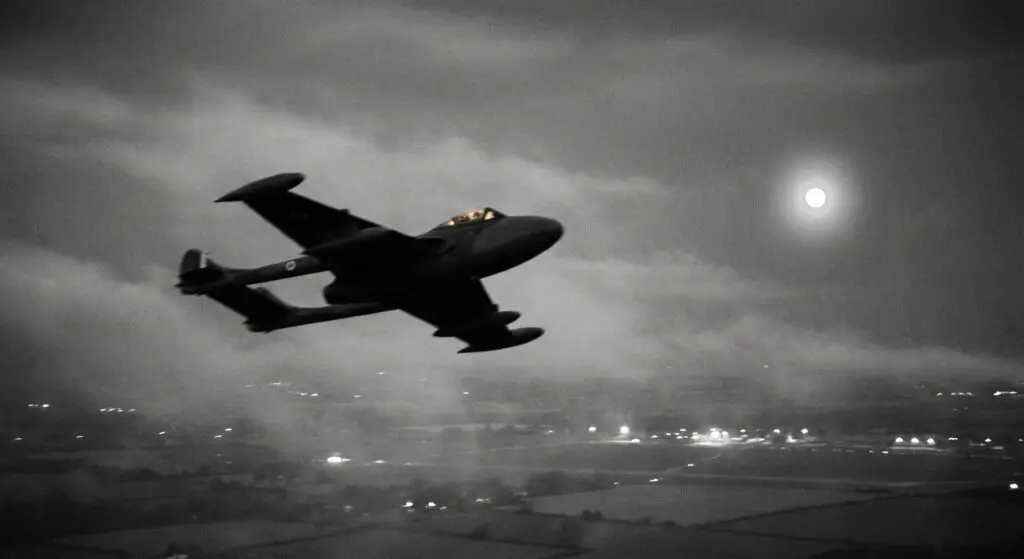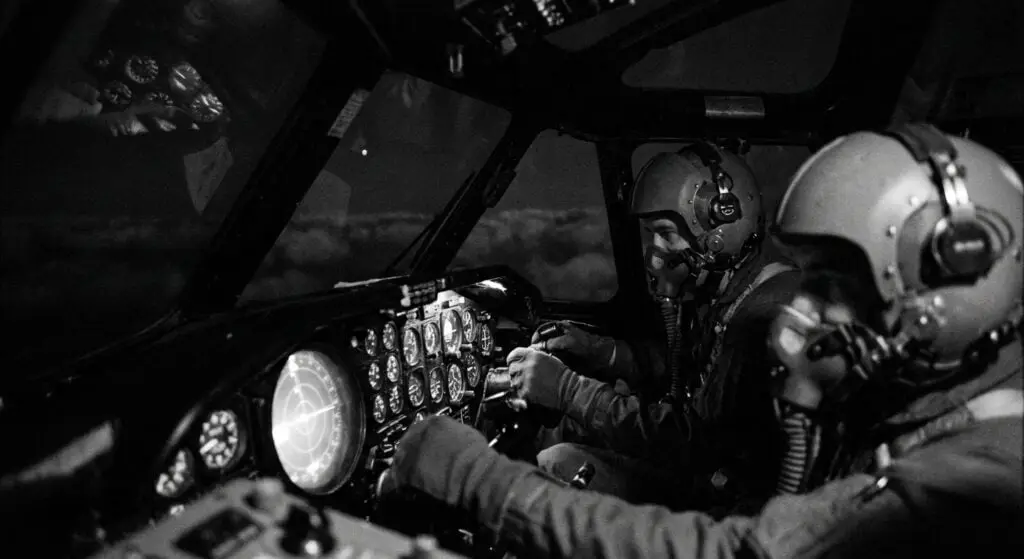
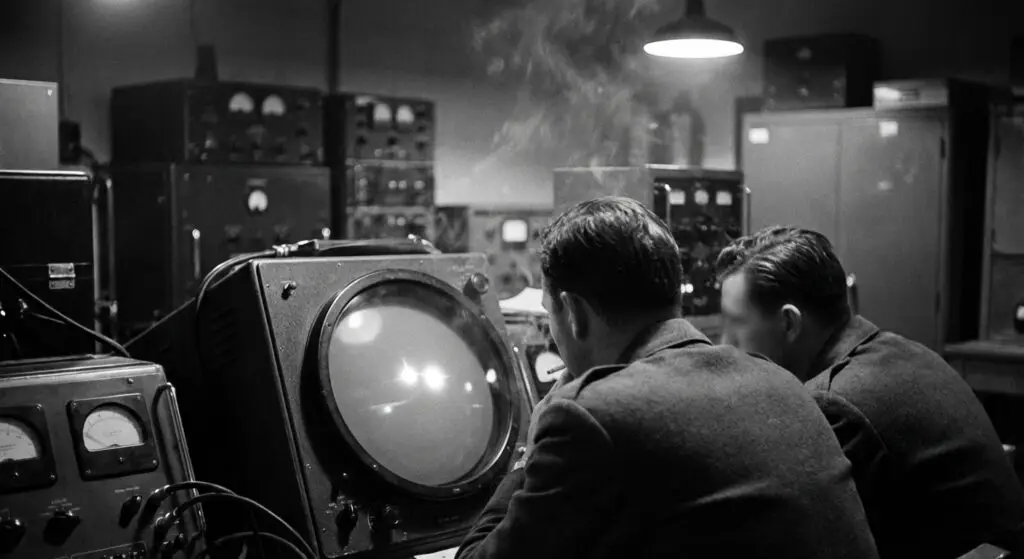
The Kinross Incident still circulates because the story is clean: a radar return “merged” with an unknown target and then a jet never came home. The record is not clean. What is documented is the trigger event: on the evening of November 23, 1953, a Northrop F-89 (F-89C) was scrambled from Kinross AFB to intercept an unidentified radar target.
The friction starts the moment the tale is pinned to paperwork. The unknown track is often retold as a single dramatic moment, but the underlying timeline is made of partial reports, paraphrases, and later summaries. Even one hard detail gets blurred in retellings: the unidentified target had been tracked about 160 miles before the loss was reported. That gap between a vivid narrative and uneven documentation matters because once an aircraft is treated as “missing,” the absence becomes the story.
That “missing” label has a precise meaning in aviation administration, and it helps explain why unresolved losses remain sticky in public memory. Transport Canada defines an aircraft as “missing” when the official search has been terminated and the wreckage has not been located. That definition is a framing concept here, not a claim about what any Kinross authority formally concluded. The practical tradeoff is unavoidable: a compelling radar-intercept account on one side, and a limited set of verifiable artifacts on the other, including what survives in logs, transcripts, and physical recovery.
This article separates the points that are firmly documented from layers asserted later: what can be said with confidence about the scramble and the last tracked returns, what claims depend on secondhand retellings, and what specific evidence would actually settle competing explanations, including original radar logs, authenticated communications records, and located wreckage tied to the event. It also explains why the same evidence gap that fuels UFO retellings remains relevant in modern disclosure-era debates about recordkeeping and oversight.
Who, Where, and What We Know
Most arguments about the 1953 Kinross case collapse for one basic reason: retellings stop separating hard identifiers from interpretive radar narrative. Once that boundary blurs, details like “exact coordinates,” “named crew,” or “precise last point” get treated as established facts when they are not. A clean case file fixes that by locking down only what can be stated without analysis.
The baseline event date is 23 November 1953. The geographic framing that appears in the provided materials ties the incident to Kinross Air Force Base in Sault Ste. Marie, Michigan, placing the episode in the upper Great Lakes region. The unknown aircraft was reported over Lake Superior, which is the only water body that belongs in the file at this stage.
The interceptor was a Northrop F-89C with the exact serial stated as 51-5853A. In the provided materials, F-89C 51-5853A was scrambled to intercept and identify an unknown aircraft over Lake Superior. Those identifiers (date, type, variant, serial, and broad region) are the anchor points that survive contact with conflicting narratives.
The sortie is not a “routine training intercept” in the baseline record. The provided materials describe it as an air-defense intercept against an unknown aircraft, meaning a live scramble launched in response to an active track that required identification. Stated plainly: the sortie was an air-defense intercept (live scramble), not a routine training intercept.
That context matters because it constrains what claims can be evaluated later. A live scramble implies real-time tasking and real-time command guidance, so any later account that treats the flight as a planned training profile is already departing from the clean file.
The control agency named in the provided materials is “Naples” GCI. The baseline claim to preserve is narrow and specific: the scramble of F-89C 51-5853A was vectored by “Naples” GCI. At the high level, that means Naples served as the controlling source that provided headings and intercept guidance, not that it supplies any automatic confirmation of what the unknown aircraft was.
The aircraft carried the standard two-man interceptor crew: a pilot and a radar operator. The provided materials, as given here, do not confirm identities, spellings, ranks, or unit assignment for those crew members, so this article will not assert them in the case-file baseline. Names belong in the record only when a cited document in the provided excerpts actually prints them.
None of the provided excerpts explicitly report coordinates or a last-known position on Lake Superior. Even where other document types could contain geographic granularity, the excerpts supplied here do not put a coordinate set, sector box, or fixed “LKP” into evidence.
This is the single most common contamination point in later summaries: they quote a precise location as if it were part of the original record, even though the excerpts at hand do not contain it.
- Detect (reported): An unknown aircraft/contact is reported in the upper Great Lakes area, described as over Lake Superior.
- Scramble (confirmed): F-89C 51-5853A launches from the Kinross AFB area to intercept and identify the unknown aircraft.
- Vector (confirmed): “Naples” GCI provides intercept guidance to the F-89C 51-5853A.
- Attempt intercept (reported): The interceptor proceeds to attempt identification of the unknown aircraft over Lake Superior.
- Report loss (reported): The intercept sortie is reported as ending in loss, without coordinates or a documented last-known position in the provided excerpts.
Use this baseline as a checklist: if a dramatic claim about Kinross cannot be cleanly attached to 23 Nov 1953, F-89C 51-5853A, Lake Superior, Kinross AFB (Sault Ste. Marie), and “Naples” GCI vectoring, it is not part of the verified case file.
Reconstructing the Intercept Timeline
The baseline above narrows what can be responsibly reconstructed: it establishes the scramble, the controlling GCI site, and the operating area, while leaving later-added coordinates and dialogue out of the file. Within that boundary, the hinge point in the Kinross story is the reported “merge” on radar, because it is also the moment when radar ambiguity peaks and operational decisions get made with the least margin.
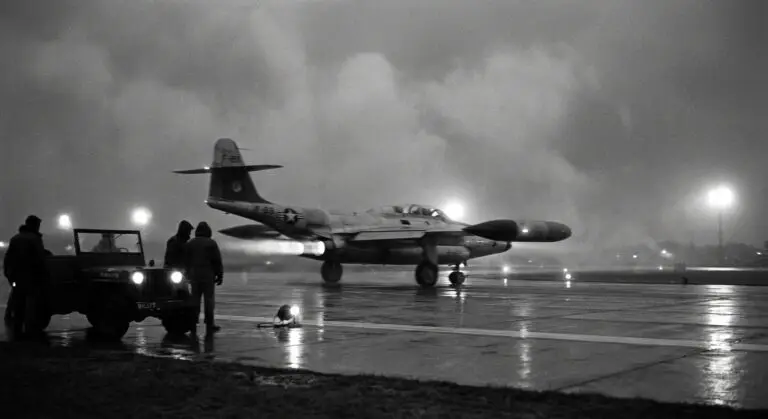
The sequence begins the way Cold War air defense routinely began: radar operators at Sault Ste. Marie, Michigan detected an unidentified object, and the object was monitored by Air Defense Command (ADC) Ground Intercept radar on the evening in question. In contemporaneous air defense terms, that “unknown” label is often an information problem, not a statement of intent, because a primary radar return is simply reflected energy that yields range and azimuth but limited identity.
The decision to launch is reported as an active intercept, not a routine flight: an F-89C (serial 51-5853A) was scrambled by the “Naples” GCI site to intercept an unknown aircraft over Lake Superior. That framing matters operationally because it puts the mission inside the Ground-controlled intercept (GCI) system, a Cold War air-defense method where ground radar controllers vector a fighter to an unknown target by radio, meaning the intercept is mediated by radar limits and radio coordination as much as by the jet’s performance.
The aircraft is described as an all-weather interceptor, and in this context “all-weather” is a mission requirement: the interceptor and the ground network were built to prosecute tracks when visibility was irrelevant and the only reliable picture was what the scopes showed.
The F-89’s job in this system was straightforward: launch, climb, and take instructions. The aircraft type is described in reference material as an all-weather, twin-engined interceptor, a configuration aligned with the GCI mission profile of getting a radar-equipped crew to a target area under controller direction.
Later summaries and compiled records describe the intercept tasking in practical terms: the jet departed on an air-defense intercept toward an unknown contact reported at significant distance from Kinross, and USAF records also describe an unidentified radar target that had been tracked at about 160 miles. Those distance figures explain why GCI mattered: at that scale, the controller is not “helping,” the controller is the system integrating the ground picture, choosing an intercept geometry, and keeping the fighter pointed at the most current plot.
In a working GCI intercept, the controller takes successive radar updates and turns them into short, unambiguous radio commands: headings to fly, altitude blocks to use, and closure cues based on how the unknown’s track is moving between sweeps. The crew in the interceptor acknowledges, executes, and reports back anything that changes the control picture: onboard radar acquisition, visual contact, turbulence, icing, radio issues, or anything that affects their ability to hold the assigned heading and altitude. The friction is that the controller and the crew are never looking at the same “truth.” They are correlating two imperfect sensor pictures over voice radio and trying to make them agree enough to complete an identification.
Radar control sounds deterministic until you put yourself behind a 1953 scope. Primary radar return data is narrow: it gives a plot, not a labeled aircraft, and it can be degraded by clutter, propagation effects over water, and resolution limits that decide whether two objects are displayed as two separate tracks or a single blended echo. Even when the ground station has IFF overlays, the identity layer is only as good as the responding equipment and the operator’s ability to correlate it to the correct primary return.
That is why controllers cared about continuity more than drama. A track that is steady sweep to sweep is actionable. A track that jumps, fades, or intermittently doubles forces the controller to slow the intercept, widen the geometry, or demand more confirmation before committing the fighter into what could be a bad solution based on a bad plot.
The term “radar merge” is best treated as an operator description, not a physics conclusion. In operator terms it means an apparent convergence where two contacts become one plot on the scope. That can happen for reasons that look dramatic in hindsight but are routine at the limits of sensor geometry: two targets passing close together in azimuth from the radar’s point of view, one target moving into the other’s return within the radar’s range and azimuth resolution, or a momentary loss of separation because the radar update rate and the targets’ relative motion compress two distinct returns into one displayed position.
In the Kinross reporting, the “merge” is the moment that later narratives treat as decisive, because it is also near the last radar reporting associated with the sortie that had been directed by the Naples GCI site. Operationally, though, a merge report is a signal that the system has entered its hardest correlation problem: the controller must decide whether the display is showing one object, two objects unresolved, or one object that has been dropped while another remains.
The non-obvious part is that none of those interpretations require physical contact. A scope does not show airframes; it shows returns. When two returns become one, the only honest statement is what the operator saw: two plots became one plot. Everything beyond that depends on radar type, display processing, and whether there was an independent identity channel to keep the tracks distinct.
The cleanest way to keep a fighter and an unknown separate on scopes is an identity reply. An IFF/transponder is an identification system that transmits a coded response to an interrogation so friendly aircraft can be distinguished from other returns, and losing it can turn a known jet into just another ambiguous plot. Loss of an aircraft’s IFF/transponder can prevent ground or airborne radar operators from maintaining radar contact during an intercept, which is a plausible ambiguity mechanism in any intercept timeline, not a conclusion about this specific sortie.
Once that identity layer degrades, several mundane effects can break continuity fast: the fighter’s primary return can weaken during turns or altitude changes, the controller can momentarily lose the correct correlation between the jet and the unknown if the two are close on the scope, and propagation over large bodies of water can alter what the radar receives in ways that look like a sudden merge or a sudden disappearance. The key operational point is that track loss is not a moral failure, it is an expected failure mode in a system that is stitching together intermittent measurements into a continuous picture.
Takeaway: whenever you read “merged on radar” in any historical radar case, treat it as a prompt to ask four concrete questions before you infer collision, capture, or anything exotic:
- What radar type produced the plots (primary only, or primary plus height and secondary layers)?
- What identity system was in use (IFF/transponder status and correlation to the primary return)?
- What recording exists (logs, scope photos, contemporaneous reports versus later summaries)?
- What alternative track-loss mechanisms could create a merge-like display (resolution limits, geometry, clutter, propagation, or identity dropout)?
Official Explanations and Their Gaps
The operational picture above explains why the case is vulnerable to overconfident conclusions: radar merges and track loss are interpretable events, but the interpretation lives or dies on the original records. The Kinross disappearance stays contested for a simple reason: the phrase “the official conclusion” gets repeated more often than the underlying, case-specific record is produced.
In the provided research snippets, there is no accessible, incident-specific U.S. Air Force accident investigation conclusion that can be read end-to-end, with findings, exhibits, and signatures. That forces a hard separation between (1) what was publicly stated close to the event and (2) later attributions that cite an “official” determination without attaching the originating document.
That gap is not hypothetical in this research set. Some excerpts are plainly unrelated biographical or contextual material, which demonstrates the dataset does not currently contain the kind of authenticated, case-bounded paperwork that would normally anchor a definitive conclusion.
Project Blue Book matters here, but mostly as a boundary condition, not a guarantee. Project Blue Book was the U.S. Air Force program (1952-1969) that investigated and analyzed UFO reports and issued findings. It was terminated, and the Air Force regulation that established and controlled the program was rescinded. Even if a case is famous, Blue Book’s existence does not mean a surviving, accessible file will answer every operational question, and after its closure there was no single, centralized USAF UFO tracking program operating under that rescinded framework.
| Explanation bucket | What would close the loop (confirmatory artifacts) | What the provided research set is silent on |
|---|---|---|
| Weather and spatial disorientation | Contemporaneous weather observations along the route (surface and aloft), forecast products used by the unit, any pilot weather brief documentation, and radio or operations logs indicating deteriorating conditions. The strongest closure would be wreckage signatures consistent with controlled flight into terrain or water impact, plus an accident report that ties conditions to decision points. | No case-specific weather package, no authenticated radio transcripts, and no wreckage recovery documentation tying impact to met conditions. The research includes a generic notice about pilot responsibilities in meteorological conditions, not this event’s data. |
| Mechanical failure | Maintenance records for the aircraft, discrepancy logs, parts-change history, and engine/airframe time since overhaul. Confirmation usually comes from recovered components showing a specific failure mode, correlated to cockpit indications described in radio calls or debrief notes. | No aircraft forms, no maintenance history, no recovered components, and no accident board narrative identifying a mechanical causal chain. |
| Misidentification, radar error, or track confusion | Radar site logs, contemporaneous plot boards or scope photos if they exist, controller logs, and time-synchronized radio communications that demonstrate how tracks were correlated and why a merge was assessed. Confirmation requires the original records, not a retrospective summary. | Only general, veteran-reported context that Cold War air defense activity included scrambles and intercepts, without authenticated Kinross-specific logs, plots, or recordings. |
| Other-aircraft confusion | Verified flight schedules and track data for all aircraft in the relevant airspace, including training, ferry, and civilian traffic, plus cross-agency coordination records. A clean closure shows which aircraft were present, their routes and altitudes, and how identification was confirmed or lost. | No complete traffic picture for the time window, no cross-referenced flight plans, and no contemporaneous coordination logs establishing or eliminating another aircraft as the relevant track. |
The key stress test is consistency across records. A weather-disorientation conclusion should show weather products and operational decision points; a mechanical-failure conclusion should show maintenance lineage and failure signatures; a track-confusion conclusion should show the original plotting and communications. The current research set contains general operational context, not that level of case-specific corroboration.
Militaries and civil agencies write down how they handle losses: there are formal aircrew operational procedures and search-and-rescue doctrine issued under joint authority. That cuts both ways. It means a real investigation normally leaves a document trail, but it also means that if the trail is missing, fragmented, classified, lost, or simply not in your hands, any “official explanation” you see in secondary writing is still an assertion until the primary records are produced.
- Demand an authenticated accident investigation finding (or an official statement explicitly saying no finding was possible) that is traceable to an archive reference, not a paraphrase.
- Verify the underlying exhibits: weather data, maintenance records, radar and radio logs, and any SAR recovery documentation.
- Reject any “official conclusion” that cannot show its chain of custody from the originating agency document to the quoted claim.
How the UFO Narrative Took Hold
The evidentiary gap in the “official explanation” space is exactly where narrative pressure does its work. Kinross endures less because anyone keeps finding new documents and more because its story structure is self-propagating: an intercept is launched, something unknown is tracked, then the jet disappears. That arc is easy to retell, easy to dramatize, and hard to disprove after the fact.
Layer one is contemporaneous reporting, the thin, time-pressed record produced closest to the event. In the Kinross case, the anchored fact is operational, not sensational: an F-89C was scrambled by “Naples” GCI to identify an unknown aircraft over Lake Superior. That is the spine the rest of the narrative hangs on.
Layer two is official briefings, the attempt to stabilize an incident into a coherent explanation for command channels and the public. These products typically speak in controlled language, and they often compress uncertainty, because “we do not know” is operationally awkward.
Layer three is later UFO retellings, where the same core disappears-while-intercepting motif gets rewritten to satisfy narrative demand: cleaner causality, sharper dialogue, and a stronger adversary. The tell is not the conclusion, it is the documentation. When retellings add specificity without dated primary material, they are not updating the record, they are upgrading the story.
Across all three layers, the stable center is minimal and stubborn: a live air-defense intercept was attempted against an unknown contact, then the interceptor failed to return. Even the stripped-down database style summaries preserve that core, describing an intercept mission directed at an unknown contact and ending with the loss of the aircraft and crew.
The other stable element is the narrative hook created by radar itself. Primary radar provides range and azimuth, and radar processing has evolved dramatically over time. That technical reality leaves room for later writers to turn “tracked contact” into “perfectly understood event,” even when the contemporaneous layer never supports that certainty.
Version drift starts where anxiety meets ambiguity. An intercept that ends in a disappearance produces a psychological debt: readers want mechanism. Later accounts often pay that debt by asserting a collision, a recovery, a precise distance from shore, or a list of named radar sites and operator remarks that sound like transcripts.
The evidence problem is straightforward: none of the provided excerpts explicitly confirm collision, recovery, distance-from-shore claims, or specific radar-station attributions. Without a dated document that actually contains those details, they belong in layer three as later assertions, not in the contemporaneous or official layers.
Why the upgrades persuade is equally straightforward. Specific numbers, named facilities, and purported operator phrasing borrow the authority of bureaucracy. The oft-repeated claim that the targets merged on radar scopes (radar merge, two returns appear as one) feels like a log entry, even when no log is produced.
- Anchor every claim to the earliest dated source you can locate, and write that date next to the claim in your notes.
- Demand primary artifacts for drama: logs, transcripts, message traffic, accident-report text. If none are shown, treat “operator lines” as later attribution, not quotation.
- Separate “what happened” from “where exactly,” because precise bearings, distances, and station names are the easiest details to invent and the hardest for readers to falsify later.
- Flag any new specificity that appears only in later tellings: collision, recovery, exact offshore mileage, or a growing roster of radar sites.
Kinross is a useful precedent in UFO news and UAP news coverage for one reason: it shows how a real intercept and a real disappearance can be surrounded by increasingly confident specifics. If a modern claim cites Kinross to justify certainty, the first question should be documentary, not ideological: what is the earliest dated record that contains the detail being asserted?
Kinross in the Disclosure Era
Kinross matters in the disclosure era for a simple reason: it shows what happens when an incident outlives its accessible records. The modern policy debate is not only about “what happened,” but about whether today’s systems can reliably preserve, route, and scrutinize the next Kinross before the paper trail thins out.
Three things changed. First, detection is no longer dominated by a handful of human-interpreted channels; modern military and intelligence architectures generate far more machine-recorded, time-stamped data across domains. Second, reporting pathways are more formalized, which reduces the odds that a sighting or sensor event stays trapped inside an operational silo. Third, oversight expectations are higher, with Congress and inspectors general treating UAP handling as a governance problem, not just an oddity.
Three things did not change. Classification still blocks public release of sensitive sources and methods, even when the underlying event is decades old. Archives are still incomplete in practice because retention, transfer, and compartmentalization rules can leave gaps that no press conference can fill. Public trust still fractures along a familiar fault line: agencies can truthfully say “we reviewed what we have” while the public asks whether “what we have” is the whole file.
Today, the All-domain Anomaly Resolution Office (AARO) formalizes intake and oversight in a way Cold War-era ad hoc handling did not: AARO accepts reports of U.S. Government programs or activities related to UAP from current or former U.S. Government employees, service members, or contractors, and it publishes annual reports that track case intake and disposition. That structure improves accountability, but it does not guarantee rapid declassification of legacy material tied to historical incidents.
What AARO does (and what its reports include) illustrates the workload reality. In one reporting period, it received 757 UAP reports, and 485 of those involved incidents that occurred during that same period. High throughput forces prioritization: triage, data hygiene, and standardization determine what gets resolved quickly versus what sits pending, especially when cases arrive with uneven documentation.
The Schumer-Rounds UAP Disclosure Act is best understood as a proposed framework to accelerate identification and declassification or release of UAP-related records through a structured process. Its political history is the point: the measure was revised, and whistleblower David Grusch described the revised measure as a “mixed bag of success.”
Revisions signal where disclosure goals collide with institutional constraints: national security equities, enforcement mechanics, and the practical question of who decides what must be released, when, and in what form. “Disclosure” is not a single switch; it is contested scope plus contested compliance.
Modern hearings and modern legislative language do not automatically produce new Kinross-specific evidence. They change process and expectations: clearer intake channels, clearer audit trails, and clearer demands for document-level accountability. They do not retroactively create missing logs, resurrect unretained tapes, or dissolve classification barriers that still apply.
Use Cold War cases in modern disclosure headlines as a test of rigor. Treat “newly revealed” as meaningful only when it comes with document identifiers, custodianship details, and a clear chain from archive to public release. If the headline cites Kinross but cannot point to specific records newly located or newly declassified, you are reading about changing oversight, not changing evidence.
What the Kinross Incident Still Teaches
Kinross still teaches that a dramatic operational moment plus missing documentation produces lasting controversy: on Nov. 23, 1953, an F-89 was scrambled, the aircraft disappeared, and the reported “radar merge” remains the hinge point in most retellings. What the record set here cannot do is turn that story into a conclusion. The provided research snippets do not include verifiable documentation of wreckage location, recovered components indicating failure mode, or authenticated radar plot logs for this case; they also do not confirm the crew identities in primary, incident-level paperwork. The case only tightens when specific artifacts surface: identified wreckage with forensic indicators, authenticated radar logs or plots, radio transcripts, and a declassified accident or investigation file that can be independently checked.
Serious work also depends on transparency discipline, because the absence of primary records is often as consequential as the records themselves. Canadian institutions are legally required to conduct a “reasonable search” for records within the scope of an access-to-information request, and the BC government maintains an online list of completed FOI requests that can be searched to see what’s already been asked for and released. Even within the provided materials, excerpts unrelated to the incident include no last-known-position coordinates, underscoring how easily effort gets wasted on non-probative documents. For document-based updates, track the emergence of primary records as they surface, without betting the outcome on narrative momentum.
Frequently Asked Questions
What was the Kinross Incident in 1953?
On November 23, 1953, a Northrop F-89C interceptor was scrambled from Kinross Air Force Base to identify an unknown radar target over Lake Superior. The jet did not return, and later retellings emphasize a reported “radar merge” with the unknown contact.
What exact aircraft was involved in the Kinross Incident?
The interceptor is identified as a Northrop F-89C with serial number 51-5853A. The article treats these identifiers (type, variant, serial) as part of the verified baseline record.
Where did the Kinross F-89 intercept take place?
The incident is tied to Kinross AFB in Sault Ste. Marie, Michigan, with the unknown contact reported over Lake Superior in the upper Great Lakes region. The provided excerpts do not include coordinates or a documented last-known position.
Was the Kinross F-89 flight a training mission or a live scramble?
The article describes it as an air-defense intercept against an unknown aircraft, meaning a live scramble in response to an active radar track. It explicitly distinguishes this from a routine training intercept.
What does “radar merge” mean in the Kinross story?
A “radar merge” is described as an operator observation where two radar contacts appear to become one plot on the scope. The article states this does not by itself prove physical contact, because radar shows returns and can blend tracks due to resolution limits, geometry, clutter, or propagation effects.
What records would actually settle competing explanations for the Kinross disappearance?
The article says the decisive artifacts would be original radar logs or plots, authenticated communications records, and located wreckage tied to the event. It also notes the provided research set lacks an incident-specific accident investigation conclusion, wreckage documentation, and authenticated radar/radio logs.
What should you look for before trusting an “official conclusion” about the Kinross Incident?
The article says to demand an authenticated accident investigation finding (or an explicit statement that no finding was possible) that is traceable to an archive reference, not a paraphrase. It also recommends verifying supporting exhibits like weather data, maintenance records, radar and radio logs, and any SAR recovery documentation.