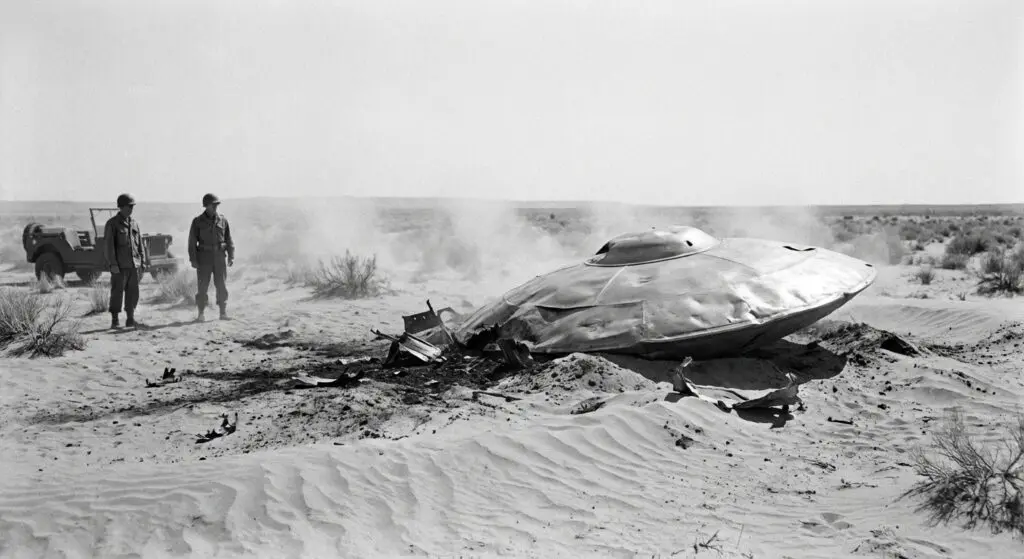
You keep seeing “Aztec 1948” pop back up every time UFO news and UAP news heats up, usually packaged as if it’s a settled crash-retrieval fact pattern. The problem is speed: the story reads complete, the headline is clean, and the sourcing is rarely shown, so you need a fast way to separate legacy myth from evidence before the rerun becomes “common knowledge” again.
The Aztec story keeps selling itself because it offers the full crash-retrieval arc in one bite sized bundle: an alleged saucer downed in March 1948 near Aztec, New Mexico, often described as a mesa and sometimes tied to Hart Canyon, followed by a recovery narrative. It feels credible because it’s specific. Dates, terrain, and a named place anchor the claim in the real world, which is exactly what persuasive storytelling does.
The complication is that the verifiable publication record is clearer than the unverified event claims. Frank Scully popularized the Aztec crash and recovery story in 1949 through his Variety columns, then expanded it in his 1950 book, Behind the Flying Saucers. Many modern online retellings still trace back to Scully’s 1949/1950 publications even when the post is labeled “Aztec 1948,” and that label often gets treated like documentation instead of a shorthand title. Used that way, “Aztec UFO incident” stops being a sourced claim and turns into a bucket for whatever version the latest cycle needs.
When publication history gets mistaken for event history, the distortion compounds. Repetition starts to masquerade as corroboration, and a story that is trackable mainly through its later retellings begins to look “confirmed” simply because it’s familiar. In the current disclosure chatter, that confusion punishes open-minded readers who still insist on evidentiary standards, and it rewards narratives engineered to travel fast.
This article treats Aztec as a case study in how hoaxes exploit curiosity, media incentives, and disclosure-era attention without needing hard verification to keep circulating. The takeaway is practical: use publication provenance as your first filter when a legacy crash story trends again, and you’ll quickly separate repeatable sourcing from repeatable rumor.
Aztec 1948 and the rumor pipeline
The crucial fact is that the “1948 crash” date and the story’s public origin are not the same thing. Later retellings commonly place the alleged Aztec crash in March 1948. That date functions as an asserted event marker, not a publication marker.
What is dated with clarity is the narrative’s first widely cited route into public circulation: Frank Scully’s 1949 columns, followed by his 1950 book Behind the Flying Saucers. Those print timestamps are the earliest spine you can point to without relying on someone’s retroactive memory of what supposedly happened “out near Aztec.”
The friction starts when online summaries compress those two categories into one: “Aztec 1948” gets treated like a documentary label, as if the year itself certifies the account. It does not. “March 1948” is the claim about when the incident supposedly occurred; “1949 to 1950” is when the story becomes broadly attributable in a way readers can actually date and track.
Scully did not present his Aztec narrative as something he personally witnessed or independently verified on scene. His story was fed through intermediaries, chiefly Silas Newton and Leo Gebauer, who functioned as the bridge between an alleged recovery operation and a writer with access to a national audience.
Intermediaries matter because they sit at the exact point where verification usually lives or dies. They can claim proximity without granting it. They can describe “sources,” “scientists,” or “inside contacts” without producing records a reader can inspect. They can also set the terms of access, deciding what can be checked and what must be taken on trust. In a crash-retrieval story, that distance from the supposed event is not a minor detail; it is the central structural weakness.
At a high level, this is the rumor pipeline that turns a private claim into a public narrative:
- Originators assert an extraordinary event and attach it to a place and date (here, commonly March 1948 in later sources).
- Intermediaries (here, Newton and Gebauer) carry the story outward, presenting themselves as connected to the “people who know,” while keeping the alleged primary participants out of reach.
- A publisher or columnist (here, Scully in 1949 and 1950) converts that account into print, which gives the story a stable form that can be repeated verbatim.
- Popular uptake follows as other writers, enthusiasts, and later summaries cite the printed version, often treating it as confirmation rather than as a dated retelling of what intermediaries said.
That pipeline does not require elaborate mechanics to work. It only requires a compelling claim, a controlled channel of “insider” access, and a publication venue that converts private assertion into quotable text.
Once a claim is in print, it stops being a local story and becomes a reusable reference. Scully’s 1949 columns and his 1950 book created a template other people could repeat, paraphrase, and build on. The details could shift in later retellings, but the narrative’s public existence could always be anchored to those dates.
The first major, widely cited public challenge also has a hard date and a hard title: in 1952, True magazine published J.P. Cahn’s exposé, “The Flying Saucers and the Mysterious Little Men.” As a timeline anchor, that piece matters less for any single argument than for what it represents: the Aztec narrative had traveled far enough, and hardened enough in the public mind, that it drew a prominent, named rebuttal in a mainstream magazine.
So the verifiable arc runs like this: an alleged event date commonly stated as March 1948 in later sources; a public narrative entering the widely cited record via Scully in 1949 and 1950; and a named, dated critique appearing in 1952. That sequence is what can be cleanly attributed without pretending the alleged crash date and the public documentation date are interchangeable.
| Aztec vs. Roswell (what’s comparable / what isn’t) | What the dated record lets you say |
|---|---|
| Claimed crash date | Aztec is commonly said (in later sources) to be March 1948; Roswell narratives claim a crash in summer 1947. |
| What you can date without relying on the alleged event | Aztec has a widely cited publication pathway through Scully’s 1949 columns and 1950 book; the key point is the clarity of the print timeline, not the truth of the claim. |
| Why the comparison breaks down fast | This section uses Roswell only as a dating contrast. It does not treat Roswell as a parallel proof, disproof, or explanatory model for Aztec. |
When an online summary asserts “Aztec 1948” as if the label itself proves the event, treat that as a warning sign, not a conclusion. Separate the alleged date from the dated record, then rebuild the story from the first traceable publications outward: 1949 columns, 1950 book, and the 1952 True magazine challenge. That publication record is the first verifiable spine of the narrative-and it also tells you where scrutiny has to start, because it identifies the people and claims that can be checked.
How the Aztec story unraveled
Aztec unravels because its evidentiary structure can’t survive basic verification. A crash-retrieval claim is not “big” because it’s extraordinary; it’s big because it demands ordinary proof in extraordinary quantity: paperwork that exists before the story becomes famous, witnesses you can identify and cross-check, physical material you can examine, and a timeline that matches verifiable records.

Run those checks in the most literal way possible. Start with documentation: dated reports, receipts, lab submissions, property records, telegrams, flight logs, anything that forces the narrative onto paper that can be authenticated. Then look for independent witnesses: not “an insider said,” but people outside the promoter’s orbit whose accounts can be confirmed as contemporaneous. Add physical evidence that can be tied to a specific place and date, not a floating artifact with an origin story. Finally, align the story with fixed points in the public record: addresses, employment histories, court filings, business registrations, travel, and other items that do not bend to retellings.
The friction is that crash stories often feel “document-heavy” because they’re detail-heavy. Details are not documentation. Verification is about what a detail lets you check. If a story gives you names, dates, locations, and institutions, it should become easier to corroborate over time. If it gets harder, that is diagnostic.
Released government records can be powerful, but they answer narrower questions than most readers assume. The Freedom of Information Act (FOIA) is the mechanism that lets the public obtain certain federal records, and those releases can illuminate the background of claimants and the government’s investigative posture without proving the claimant’s headline allegation.
The cleanest example in the Aztec ecosystem is the FBI material on Silas M. Newton. The FBI Vault, the FBI’s electronic FOIA library, contains released files on Silas M. Newton documenting FBI investigations into his fraudulent activities between 1951 and 1970. Those FBI Vault pages explicitly note the materials were reviewed and released pursuant to FOIA. That gives you something concrete: a documented investigative interest, allegations recorded in the file, and a chronology of investigative attention across that window.
It also draws a hard boundary around what the file does not establish. The existence of an FBI file does not validate the Aztec crash claim. An investigative file is evidence that the Bureau received information, evaluated leads, and tracked allegations. It is not a scientific finding, not an adjudication of truth, and not an endorsement of any embedded narrative a subject might have been selling. If a crash-retrieval story is real, it should stand up on its own evidentiary legs. A fraud-focused file can inform your risk assessment of a storyteller; it cannot substitute for crash documentation, identifiable witnesses, and testable material.
Use that distinction as your template. “Released under FOIA” tells you how you got the document, not what the document proves. The release language is about process and compliance. The content is about whatever the Bureau collected, at whatever level of confidence, for whatever investigative purpose.
Long before modern online amplification, Aztec faced an adversarial read from journalists willing to do the unglamorous work: ask for names, ask for dates, and compare claims to records that do not care about mythology. J.P. Cahn’s 1952 True magazine article, “The Flying Saucers and the Mysterious Little Men,” stands as an early debunking milestone because it represents that method applied in public, with the burden placed where it belongs: on the people making the claim.
Be strict about sourcing here. You can verify that Cahn published that titled piece in True in 1952. What you should not do, without the text in hand, is repeat secondhand summaries as if they were direct quotations or precise findings. Treat any retelling of the article as a claim about what Cahn wrote. If a summary says he interviewed specific individuals, checked specific documents, or caught specific contradictions, the responsible move is to confirm those points against the original issue before you elevate them into evidence.
As process, the takeaway is simple and reusable: serious journalism stresses a story by forcing it into contact with independent records and named accountability. When a narrative depends on anonymity, unverifiable institutions, or perpetual deferral (“the paperwork is classified,” “the material was taken,” “the witness disappeared”), it becomes resistant to that stress test for reasons that have nothing to do with national security.
- Demand documentation, not texture. A story packed with technical-sounding descriptions still fails if it produces no authenticable paperwork tied to time, place, and custody.
- Separate insiders from independents. Anonymous “military” sources are not corroboration; they are narrative devices until a third party can confirm identity, role, and proximity to the event.
- Verify institutions before claims. If the story leans on laboratories, units, or officials, check whether they existed in the relevant form at the relevant time and whether any verifiable record links them to the claimant.
- Track story drift across retellings. When core facts change while the conclusion stays fixed, you are watching adaptation, not accumulation of evidence. Recycled details that migrate between accounts are a common sign of narrative copying.
- Check conflicts with fixed records. Addresses, dates, business filings, travel constraints, and documented investigations do not settle the extraordinary claim, but they do expose when a storyteller’s timeline cannot be true as told.
The practical takeaway is not “dismiss everything,” it’s “rank claims by how checkable they are.” Use FOIA as a way to pull on paper trails, and use the FBI Vault as a way to read what the Bureau actually released about a person or allegation, in context. Then ask the only question that matters for any viral UFO or UAP claim: does new access to records produce independent corroboration of the event, or does it only deepen the backstory of the people selling it?
Why Aztec keeps coming back
Even after early challenges and later record-based context about the people promoting it, Aztec returns because the story fits modern incentives better than evidence does. Once a crash narrative is old enough to feel “archival” but vague enough to resist final verification, it becomes reusable content: easy to summarize, easy to dramatize, and hard to kill off with any single rebuttal.
The Aztec template persists because it ships with narrative parts that travel well online: insiders who “were there,” secrecy that blocks ordinary checks, recovered technology that promises world-changing stakes, and a suppressed truth that explains why you cannot see the receipts. The catch is structural: the same elements that make the claim emotionally complete also make it procedurally incomplete. If the core witnesses are unnamed, the physical chain of custody is opaque, and verification is framed as impossible by design, the story stays permanently “open,” which makes it endlessly republishable. The actionable implication is simple: the more a crash story leans on secrecy as its proof, the less it can be settled by normal documentation standards, so it will keep cycling back as content.
Aztec’s afterlife runs on citation loops. Retellings often cite Frank Scully as the source chain, then treat the existence of multiple retellings as corroboration, even when those retellings are just Scully filtered through summaries, then through video scripts, then through new summaries that cite the videos. That repetition feels like independent confirmation because the claim appears in many places, but the underlying sourcing does not diversify. The friction is that “many citations” can still be “one citation,” replicated. The resolution is a method: when you see Scully cited, ask what sits behind him in the chain. If the trail never touches contemporaneous documentation, primary records, or independently sourced witnesses, you are looking at a loop, not accumulating evidence.
Mechanism matters more than metrics here because the provided research set contains no sales data, reprint history, reception statistics, or contemporary reviews for Scully’s book. Any claim about how widely it circulated or how it was received would be a narrative add-on, not something supported by this source set.
Resurgence also tracks attention cycles. Modern UAP disclosure moments, including hearings, recurring report cycles, and renewed transparency debates, create spikes in demand for stories that look like “answers in advance.” Legacy crash accounts are ready-made for that demand because they already contain the big reveal: a retrieval, a cover-up, a technological prize. The complication is that these cycles reward the most narratively complete story, not the best-documented one. The practical takeaway is to treat each disclosure spike as a redistribution event for old claims, then evaluate the sourcing anew instead of assuming age equals validation.
The next time UFO disclosure or UAP disclosure trends, spot the loop before you absorb it: list the citations in order, trace them back to the first publication, and discount chains where every “new” source is just a restatement of the same original claim. Multiple retellings only matter when the sourcing becomes independent, contemporaneous, and checkable.
Aztec in the disclosure era
Modern disclosure-era oversight raises the evidentiary bar for crash-retrieval claims. The mid-century environment that let sensational narratives circulate through newspapers, radio, and personality-driven publishers has been replaced by an expectation of institutional traceability: who received a report, what records were created, how information was handled, and what oversight bodies can compel.
AARO, the U.S. government office tasked with handling and integrating reporting on unidentified anomalous phenomena, formalizes a reporting pathway that is designed to produce accountable artifacts: intake records, analytic products, referrals, and interagency coordination. That does not authenticate any specific legacy story. It changes what a serious claim is supposed to look like when it enters government hands: documented, attributable, and auditable.
UAP disclosure, the public-policy push for greater transparency, adds a second kind of pressure: it shifts attention from anecdotes to record systems and review processes. A crash-retrieval allegation that can survive modern scrutiny needs more than a compelling narrative. It needs documentation that can be inspected, custody that can be traced from origin to present possession, independent corroboration from identifiable people willing to stand behind their statements, and a plausible path for classified elements to be reviewed and, where lawful, declassified.
That is the practical effect of today’s oversight conversation: it forces a claim to live or die on paperwork integrity, provenance, and corroboration, not on how long the story has been repeated.
Disclosure headlines are easy to misread as retroactive validation. The UAP Disclosure Act (Schumer/Rounds), introduced as a Senate amendment in the 118th Congress, included as introduced a presumption that federal UAP records should be subject to immediate disclosure, though later changes altered the proposal. H.R.10111 (118th Congress) is described as providing whistleblower protections related to disclosure of taxpayer-funded UAP evaluation and research. The House Oversight hearing titled “Restoring Public Trust Through UAP Transparency and Whistleblower Protection” took place on September 9, 2025. None of those touchpoints constitutes evidence that a particular 1940s crash story happened.
The clean way to use the disclosure era is as a standards upgrade: treat modern oversight expectations as a template for what credible documentation and verifiable handling should look like, and require old stories to meet that bar before granting them new weight.
A skeptic’s checklist for crash claims
Aztec is a model of how a story can be famous without being evidenced. Weak sourcing can survive because the incentives are strong and repeatable: a clean event date, a vivid recovery narrative, and just enough specificity to feel anchored. Disclosure-era attention spikes amplify the risk, because repetition can start to feel like corroboration, citation loops can harden into “common knowledge,” and modern oversight language can tempt people to backfill old claims into new processes. The fix is not cynicism. It is standards.
- Identify the earliest attributable publication and pin it to a calendar: separate the date a claim entered print or broadcast from the date the alleged event occurred.
- Demand primary source material, meaning an original, contemporaneous document, record, testimony, or object created at the time by a participant or direct witness. If the “evidence” starts decades later, you are reading mythology, not documentation.
- Separate an “insider story” from independently confirmable records: names, units, locations, and dates that can be checked without trusting the storyteller.
- Require chain of custody, the documented sequence of possession and handling from discovery to present. If no one can show where an alleged artifact has been, who held it, and how it was secured, it cannot carry extraordinary claims.
- Use released records to evaluate claimants and paper trails, not to “prove” the extraordinary: check identities, prior representations, and document patterns using tools like the FBI Vault, the FBI’s electronic FOIA library with thousands of scanned public documents.
- Sequence your records requests correctly: if you think something sits at the National Archives, submit FOIA to the FBI first, because NARA staff cannot locate FBI records responsive to an inquiry until the requester has first filed directly with the FBI.
- Hunt citation loops: track every “as reported by” until it reaches something contemporaneous, or admit it never does.
- Clarify what modern disclosure and oversight would require today: docketed reports, named custodians, auditable handling, and records that survive contact with inspectors and archivists.
Stay open to new data, including genuinely new records releases, but refuse low-standard viral narratives that cannot produce primary sources or a chain of custody. The same filter that helps you handle “Aztec 1948”-publication provenance first, then documentation and custody-also helps you evaluate whatever legacy crash story gets recycled in the next disclosure spike. If you want more checklists like this as new UFO sightings 2025 and UFO sightings 2026 headlines break, subscribe or follow for updates.
Frequently Asked Questions
What is the Aztec UFO incident supposed to be?
It’s a crash-retrieval claim that an alleged saucer went down near Aztec, New Mexico (often described as a mesa and sometimes tied to Hart Canyon) and was recovered. The story is commonly labeled “Aztec 1948,” with later retellings placing the alleged crash in March 1948.
Who first popularized the Aztec 1948 crashed saucer story in print?
Frank Scully popularized the Aztec crash-and-recovery narrative in 1949 through his Variety columns. He expanded it in his 1950 book, “Behind the Flying Saucers.”
What’s the difference between the claimed Aztec crash date and the dated publication record?
“March 1948” is an asserted event date used in later sources, not a publication timestamp. The verifiable public record begins with Scully’s 1949 columns and his 1950 book, which are the earliest widely cited, dateable sources.
Who were Silas Newton and Leo Gebauer in the Aztec UFO story?
They were intermediaries who fed the Aztec narrative to Frank Scully rather than being independently verified on-scene witnesses. The article highlights intermediaries as the weak link because they can claim “inside” access without producing checkable records.
What is the 1952 True magazine article that challenged the Aztec story?
In 1952, True magazine published J.P. Cahn’s exposé titled “The Flying Saucers and the Mysterious Little Men.” The article is cited as a dated, mainstream rebuttal milestone in the Aztec timeline.
What do the FBI Vault files on Silas M. Newton actually document, and what years do they cover?
The FBI Vault contains FOIA-released files documenting FBI investigations into Silas M. Newton’s fraudulent activities from 1951 to 1970. The article stresses that an FBI file shows investigative attention and allegations in the record, not proof that an Aztec crash occurred.
How can I quickly vet “Aztec 1948” or other crash-retrieval claims when UFO/UAP disclosure news spikes?
Start by separating the alleged event date from the first traceable publication, then trace citations back to the earliest attributable sources (for Aztec: 1949 columns, 1950 book, and the 1952 True magazine challenge). Require primary documents and a clear chain of custody, and discount citation loops where many retellings reduce to the same original claim.