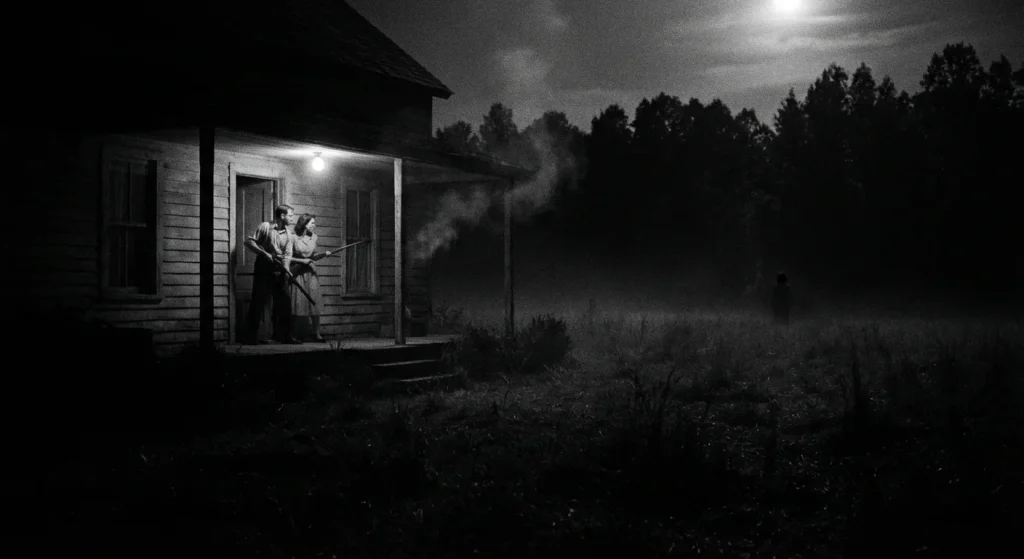
A porch light is useless against the dark. By the time the decision is made to leave a rural Kentucky farmhouse and drive into town, fear has had hours to settle in, the yard has been watched for movement, and the priority has narrowed to one thing: keeping everyone inside alive and calm long enough to get help.
The report is dated to the night of August 21, 1955, often cited around 11:00 PM, and it is now known as the Kelly-Hopkinsville encounter: a set of claims made by a household, followed by a documented law enforcement response. Police did respond to the family’s account, which means the incident did not remain a private anecdote traded between neighbors; it entered official records at least at the local or state level, with officers treating it as a real call that demanded a real check.
That official response is the story’s leverage and its limitation. A police visit anchors time, place, and urgency, but it does not automatically produce definitive physical documentation, and this case is famous precisely because the paperwork and the later legend do not match in volume. The incident is widely associated with “siege” framing, yet the research set provided here does not include early press excerpts confirming “siege” as a first-72-hours media label. The word stuck anyway, and once it stuck, it shaped how every retelling sounded.
That gap matters in the current era of today’s UAP disclosure conversation and UAP news, where UAP (unidentified anomalous phenomena) is used as a more cautious label for unresolved reports, and UFO (unidentified flying object) remains the period term people reach for when the unknown feels airborne and threatening. Legacy cases like this one train the public to treat narrative momentum as evidence, especially when authority figures show up on scene.
This article separates three layers: what witnesses reported, what authorities actually recorded, and what later repetition added. Read it that way, and you have a practical filter for evaluating the next wave of future UAP or UFO claims without surrendering to either reflexive belief or reflexive dismissal.
The Farmhouse, The People, The Timeline
Most misunderstandings about the Kelly Hopkinsville case start before the first shot was ever fired: people mix up who was actually on the property, where the farmhouse sat relative to nearby homes, and what the witnesses say happened in the minutes leading up to the first bright object. Lock those three points down, and the rest of the night becomes easier to evaluate on its own terms.
At the Sutton family farmhouse, the two adult names that anchor the witness group are Elmer “Lucky” Sutton, the resident tied to the farm, and Billy Ray Taylor, a visitor from Pennsylvania who was staying there that night. Accounts commonly report eleven people in the house at the time, a mixed group of adults and children rather than a single isolated witness.
That headcount matters because it changes the dynamics of perception and reporting. Eleven people means overlapping sightlines, multiple conversations, and a crowded interior where reactions can synchronize fast. It also means you should treat later descriptions as a household event, not a lone-observer story, and keep roles straight: Sutton as the local household anchor, Taylor as the out of town visitor, and the rest as family members including children.
The setting is rural western Kentucky: the Sutton family farm sat near the Kelly community, close to Hopkinsville. “Near” and “close” are not trivia, because the case lives in the gap between a farmhouse yard and the next reliable reference point, whether that is a neighbor’s porch light or a town streetlamp.
In a rural layout, darkness is not just ambiance; it is an information constraint. Exterior lighting is sparse, horizons are softer, and distance is harder to judge without fixed markers. A bright source in the sky can dominate the scene, while fences, tree lines, and outbuildings turn into silhouettes. Those conditions do not decide what was seen, but they do decide how easily a group can describe shape, range, and movement with confidence.
The time anchor is consistent across retellings: the night of August 21, 1955, around 11:00 PM, with the household already settled into an ordinary late evening rhythm before anything unusual was reported.
The first sky level detail is also consistent in its emphasis: witnesses described an object or light so intense that its shape was difficult to make out. They also reported a change in the illumination itself, with the lights dimming and then brightening. In practical terms, that combination pushes observers toward describing brightness, direction, and effect before they can describe structure, edges, or features.
As the tension rose, some later accounts claim a person ran to a nearby house and pounded on the front door; those details appear in non-contemporaneous retellings and should be treated with caution. That detail matters because it frames the pre incident window as a rapid transition from observation in the yard to urgent movement across a dark rural property, with limited reference points guiding decisions.
Hold three anchors in your head as you read any later claim: eleven people in the farmhouse, a rural Kelly location close to Hopkinsville with darkness and sparse lighting shaping sightlines, and an initial report centered on an overwhelmingly bright object whose intensity made shape hard to resolve and whose lights reportedly dimmed then brightened. Treat those anchors as an evidence habit: verify cast, verify layout, then weigh descriptions against the initial viewing conditions.
Four Hours Of Fear And Gunfire
The part of the Kelly-Hopkinsville story that still grips people is not a single “monster sighting.” It is the claimed persistence: a sustained, repeating pattern of perceived intrusion that witnesses generally placed on that late-night window in August 1955, continuing for hours until the household stopped trying to hold the line and drove for police. Treated as a time-sequenced set of claims, it reads less like a glimpse and more like a night-long pressure test of nerves, light, darkness, and the limits of a rural home’s perimeter.
The reported sequence begins the way the timeline above frames it: attention fixes on an intense light outside, strong enough that witnesses struggled to resolve a clear shape, with illumination described as dimming and brightening. That opening beat matters because it sets the emotional tone as uncertainty under glare, not immediate certainty about a recognizable object.
The friction in this opening beat is practical. A bright source at night washes out edges and erases distance cues, so it can create certainty about intensity while still defeating identification. Witnesses did not claim they could clearly describe a craft at this point; they claimed they could not, because the light overpowered the view. The actionable takeaway from the first signal is straightforward: the account’s first uncertainty is not who saw it, but what the light would allow them to see.
In the reported narrative, attention then shifts from the sky to immediate proximity quickly and jarringly. The household described the first close encounter as happening at the boundary that matters most in a rural night: the door or a window, the thin line between “outside” and “inside.” They reported seeing a small figure at or near an entry point, close enough to trigger immediate fear rather than curiosity, and close enough that the home itself became the battlefield.
Here is where later retellings commonly harden details that the earliest framing often leaves looser. Many popular summaries describe exaggerated eyes, strange ears, claw-like hands, an odd sheen or glow, and movement that looks less like running and more like gliding. In a disciplined reconstruction, those specifics should be treated as “reported in later summaries,” not as settled, contemporaneous measurements, unless a particular description is tied to a dated statement. What stays consistent across versions is the claimed effect: the sight at the door or window was interpreted as an intrusion in progress.
The household’s immediate reaction was defensive, in the plain sense of “secure the inside and repel whatever is outside.” Accounts describe people moving to check doors and windows, retreating from exposed glass, and responding with firearms as the perceived threat presented itself near openings. The key point is not the exact weapon mix or an exact shot count, which varies across retellings and is often repeated without a clear contemporaneous log. The key point is that the witnesses understood the encounter as an attack on their perimeter, and they responded as if holding a position.
The four-hour “siege” framing comes from the rhythm witnesses described: appearance, alarm, defensive response, disappearance, then another appearance at a different point of the house. The claim is not that one figure stood in a lit yard for hours. The claim is that the sense of intrusion returned repeatedly, preventing the house from ever settling back into normal night quiet.
The complicating reality is psychological, not cinematic. A farmhouse at night gives you narrow sightlines, uneven exterior lighting, and constant blind zones created by corners, trees, and the pitch-black beyond the yard. In that environment, every check of a window becomes a gamble: you might see nothing and feel relief for ten seconds, then hear a noise and feel the whole cycle start over. The witnesses’ reported behavior tracks that grind, repeated trips to windows and doors, repeated scanning of the yard, repeated flinches away from glass, repeated decisions about whether to stay put or move as a group.
The defensive actions, as the household described them, were reactive and local. They were not conducting a search of the property; they were responding to perceived proximity, especially at openings. Later popular retellings often add crisp, memorable beats: precise numbers of rounds, dramatic claims about bullets having no effect, or highly specific creature behaviors. Those add punch, but they can also blur what the “evidence unit” actually is. The durable unit is the reported repetition: something appeared close, fear spiked, people acted defensively, the immediate stimulus vanished, then the stimulus returned.
Witnesses reported reaching a point where “staying and checking” no longer felt like control, it felt like waiting to be surprised. The claimed persistence, hours rather than minutes, turned the problem from “identify a thing outside” into “we cannot secure the perimeter.” When a household stops believing its doors and windows are enough, the logic of staying collapses.
The decision to flee, in the reported timeline, was not a casual choice to “go tell someone.” It was an exit driven by fear and exhaustion: an attempt to trade an isolated property for the perceived safety of authority, light, and other people. That pivot is also why the case became culturally loud. It produced not just a spooky anecdote, but a scenario people could picture, a family abandoning a home because the pattern would not stop. In U.S. popular culture, the episode is often cited in discussions of the “little green men” trope rather than as a documented causal source History.com.
In broad strokes, responding officers encountered a shaken group reporting an hours-long sequence of intrusions. What officers reportedly did not do, on arrival, is corroborate the central claim in the way a skeptic or believer might want: they did not arrive to find creatures still present and plainly observable. What they reportedly did do was respond to the complaint, hear the account, and assess the scene as they found it, a household insisting the threat had been real and immediate enough to force them off the property. The gap between those two points, an intense report versus a non-confirming arrival, is part of why the story stayed contested without needing to be argued inside the witnesses’ own reconstruction.
The clean way to read this case is to treat it as a time-sequenced set of claims, not a single claim. The pattern is the evidence unit: an initial sky-level light that did not resolve cleanly into shape; attention shifting to doors and windows; repeated perceived approaches; repeated defensive reactions; then a decision to run to police when the household no longer believed the home could be held.
Police Response, Press, And Early UFO Era
The Kelly Hopkinsville case became famous because it moved fast from private terror into official and media channels. That pipeline mattered, but it also froze the event in a thin layer of paperwork and headlines, capturing far less than later mythology implies.
Kentucky State Police (KSP) responded to the incident that became known as the Kelly Hopkinsville encounter, and KSP has since described it as one of the agency’s strangest complaints. See Kentucky State Police social posts recounting the episode and the KSP multi-part series Facebook and a related KSP recap video Facebook.
The friction is the gap between “responded and recorded” and “verified.” A police response documents who said what, when, and in what condition. It does not automatically certify the underlying cause of the report, especially when the core claim involves something no officer can independently reproduce on scene.
Readers expect the kind of hard artifacts that close arguments: shell casings in an evidence bag, photographs of damage, measured footprints, sketches with dimensions, lab results, and an inventory number tying it all together. In the publicly circulated material around this case, those specifics are the weak link. Retellings routinely imply physical traces, but they rarely provide a stable, checkable list of what was actually collected, what was simply observed, and what was never preserved.
The practical takeaway is simple: without a documented evidence inventory, “there were traces” turns into a vibe, not a fact. That is how cases accrete certainty in public memory while staying evidentiary-light on paper.
Even when an object exists, the chain of custody, the documented, continuous control of an item from collection to storage to analysis, determines whether it can support later conclusions. When custody logs, storage locations, or transfer notes are missing or unpublished, later investigators cannot rule out substitution, contamination, loss, or mislabeling. In this case, the evidentiary gaps are not an argument for or against the story; they are a limit on what anyone can responsibly claim the physical record proves.
That limit fits the era. Project Blue Book, the U.S. Air Force program (1952-1969) created to collect and evaluate UFO reports, functioned as an intake and triage system, not an endorsement machine. Blue Book recorded 12,618 reports; 701 remained “unidentified.” It was discontinued after concluding there was no evidence UFOs were extraterrestrial and no evidence they posed a national security threat. For program totals and conclusions see National Archives coverage of Project Blue Book National Archives and the U.S. Air Force historical fact sheet Af.
KSP notes the encounter is widely credited with popularizing “little green men,” and that shorthand helps explain why the case stuck.
Headlines prefer nouns you can picture. “Goblins,” “little green men,” and “siege” compress a messy night into a clean story shape, and that shape becomes the memory. Once a label dominates, it quietly edits the evidence standard downward by making the narrative feel already settled.
That is why separating documentation from interpretation is not academic in this case; it is the only way to keep later storytelling from doing the evidentiary work for you.
- Start with primary reports: who said what, and when.
- Prioritize contemporaneous documentation: dispatch logs, incident reports, dated notes.
- Demand preserved evidence with chain of custody: collection, storage, and access records.
- Downgrade later retellings to context: useful for culture, weak for proof.
Owls, Hoaxes, And Human Factors
Once you accept how thin the hard record is, the debate shifts from paperwork to plausibility. Most of the disagreement around Kelly-Hopkinsville comes from a category error: treating a recorded complaint as if it were a verified external threat.
The record already contains a built-in perception problem: witnesses described a light or object whose intensity made its shape hard to discern, and they also reported lights that dimmed and brightened. That combination matters because intense glare destroys edge detail, and a dim-to-bright cycle encourages the brain to “fill in” missing contours between glimpses. In rural darkness, where reference points are sparse and distances are hard to judge, a bright source can turn ordinary size cues into guesses. The skeptical point is straightforward: if shape is hard to discern by the witnesses’ own description, then an identification built from partial silhouettes and changing brightness is fragile, even before anyone argues about what the thing “was.”
A deliberate hoax has to clear a higher bar than people assume. It must account for multiple witnesses describing the same general episode, a sustained duration rather than a single moment, and police involvement that produced contemporaneous documentation rather than a story told weeks later. A hoax also needs a delivery mechanism: something visible enough to keep attention for hours but controllable enough to avoid being unmasked at close range. The only clear “benefit” a hoaxer reliably gets is attention, and attention did arrive, amplified by press coverage. The strain is practical: as the circle of witnesses and responders widens, the odds rise that someone contradicts the staging in a way that can be pinned to time and place.
Claims of intoxication sit in a different evidentiary category: they are allegations about witness reliability, not explanations for what was seen. To treat impairment as decisive, you need corroboration that is contemporaneous and specific: observations from responding officers, consistent notes about demeanor and coordination, or medical testing. The existing public record is stronger on the fact that authorities recorded the complaint than on any documented finding that the witnesses were impaired. Without that kind of corroboration, “they were drunk” functions as a dismissal, not an explanation.
Four hours is long enough for stress physiology to reshape perception. Adrenaline narrows attention, darkness magnifies ambiguity, and memory compresses repeated events into a few vivid snapshots. Group reinforcement also matters: when several people are scanning the same windows and reacting to the same noises, expectation effects spread fast. Weapon fire and loud reports add another layer by spiking arousal, degrading fine visual discrimination, and making every new stimulus feel like confirmation of the last one.
Language can harden into “facts” after the moment ends. The label “little green men” became widespread as a cultural shorthand, even though it is more a headline-friendly frame than a careful summary of what was documented. Once that phrase takes over, later retellings tend to backfill details to match the label.
- Separate the viewing conditions from the interpretation: glare, distance, obstructions, and any dimming or brightening cycles.
- Count truly independent witnesses: who described events without coaching, and how consistent were those first descriptions.
- Demand contemporaneous documentation: dispatch logs, officer notes, time-stamped photos, or anything created before the story had time to evolve.
From 1955 To UAP Disclosure Politics
Those human-factor arguments never stayed confined to one Kentucky night; they became templates for how later audiences argue about unresolved reports. Kelly-Hopkinsville endures because it sits at the intersection of a terrifying domestic narrative and an incomplete official file, perfect fuel for decades of retelling. The gaps do not kill the story; they keep it portable. Every time the public’s attention swings back toward “what the government knows,” this case reappears as a familiar benchmark: a close encounter at a home that was serious enough to draw law enforcement, yet never closed with a single, universally accepted evidentiary endpoint.
NICAP became one of the main engines of mid-century case preservation by turning scattered reports into standardized summaries people could cite, reprint, and argue over. Its compendium The UFO Evidence (1964), edited by Richard H. Hall, condensed hundreds of reports investigated up to 1963 into a reference format that later writers could treat as a shelf-stable record. That move mattered: once a case is “compendium-ready,” it stops being just local history and becomes part of a reusable catalog that can outlive the original paperwork.
Persistent attention to government UFO investigations is not confined to niche forums; it is a mainstream publishing topic. National Geographic published a timeline-style overview tracking decades of UFO-related government investigations, which functions as a cultural signal: the subject is treated as an ongoing public-interest beat, not a closed oddity. That kind of coverage keeps legacy cases circulating as context, even when the underlying files are thin.
Pentagon UFO office (AARO) is the current Department of Defense coordination office for handling Unidentified Anomalous Phenomena reporting, and its existence is an institutional response to ongoing reports, not a retroactive verdict on 1950s testimony. On the policy side, the Congressional Record contains a division titled “Unidentified Anomalous Phenomena Disclosure Act of 2024,” and congress.gov hosts amendment text titled “Unidentified Anomalous Phenomena Disclosure Act of 2023.” Those titles are evidence of records-focused attention at the federal level. They are not evidence that any specific 1955 claim is authenticated.
Modern disclosure cycles reward recognizable reference points, so unresolved historical cases get pulled into each new disclosure wave as shorthand. Names that drive renewed scrutiny, including Grusch, Elizondo, Mellon, and Knapp, plus the House Oversight hearing, statements by Burchett, Luna’s task force framing, and debates over whistleblower protections, all raise the temperature around “non-human intelligence” narratives. The mistake is treating that heat as illumination: contemporary UAP disclosure arguments are primarily about access, process, and documentation, not instant validation of a 1955 event.
Use modern disclosure responsibly: read it as a records-access and oversight story first. If a new disclosure push produces documents, provenance, or corroboration that touches a legacy case, then the evidentiary picture changes. Until then, the politics explain why Kelly-Hopkinsville stays in circulation, not what happened on the ground.
What We Know And What We Don’t
What can be said with confidence about that night is narrower than pop culture suggests: a frightened group reported something urgent enough to bring law enforcement to the scene, and the complaint entered official channels.
The friction is in what the record does not lock down. The provided research set does not supply a definitive, contemporaneous single authoritative incident report that consolidates complete times, photographs, or retained specimens, which means later summaries cannot be audited against one complete primary packet. That absence matters because chain-of-custody logic is what turns a claimed artifact into evidence you can test, re-test, and independently verify, and here the trail is not available to follow end-to-end. As the Blue Book posture illustrates, institutions can record reports while still declining extraordinary conclusions, and documentation is not the same thing as endorsement. The strongest skeptical pressure, stated cleanly, is that human perception under darkness, stress, and sustained alarm compresses time, distorts distance, and amplifies pattern-matching.
The case persists because the uncertainty is structural: what was observed is not the same thing as what was recorded and kept, which is the same fault line modern UAP disclosure debates keep pushing on. Use an evidence hierarchy for evaluating UAP or UFO claims: contemporaneous logs with timestamps first, then sensor data, then physical evidence with a documented chain of custody, then independent corroboration, and treat late retellings as context, not anchors. Push for better reporting standards and transparency and declassification, because uncertainty only shrinks when the underlying record improves.
Frequently Asked Questions
-
What is the Kelly-Hopkinsville encounter (1955) in Kentucky?
It refers to claims from the night of August 21, 1955 (often cited around 11:00 PM) that a household near Kelly, close to Hopkinsville, experienced an hours-long series of perceived intrusions. The case is notable because law enforcement responded, putting the complaint into official channels.
-
How many people were in the Sutton farmhouse during the Kelly-Hopkinsville incident?
Accounts commonly report 11 people in the house that night, including adults and children. Two key adult names are Elmer “Lucky” Sutton and Billy Ray Taylor, a visitor from Pennsylvania.
-
What did witnesses say they saw first in the Kelly-Hopkinsville case?
Witnesses described an intensely bright object or light outside whose shape was hard to make out because of the glare. They also reported the illumination dimming and then brightening.
-
How long did the reported Kelly-Hopkinsville “siege” last, and what made it a “siege” story?
The story is framed as lasting about four hours, based on a repeating pattern witnesses described: appearance near doors/windows, alarm and defensive reaction, disappearance, then another appearance elsewhere. The claim is persistence through repeated episodes, not one continuous sighting.
-
Did police find physical proof or see the creatures when they arrived at Kelly-Hopkinsville?
The article states officers reportedly did not arrive to find creatures still present and plainly observable. It also emphasizes that publicly circulated material lacks a stable, checkable inventory of collected evidence and chain-of-custody documentation.
-
What did Project Blue Book conclude overall, and how many UFO reports stayed “unidentified”?
Project Blue Book (1952-1969) recorded 12,618 reports, with 701 remaining “unidentified.” It was discontinued after concluding there was no evidence UFOs were extraterrestrial and no evidence they posed a national security threat.
-
What should I look for to evaluate UAP/UFO claims like Kelly-Hopkinsville in 2025 or 2026?
Use an evidence hierarchy: prioritize contemporaneous documentation like dispatch logs and incident reports, then sensor data, then physical evidence with documented chain of custody, and then independent corroboration. Treat later retellings as context rather than proof, and separate viewing conditions (glare, darkness, distance) from interpretation.
