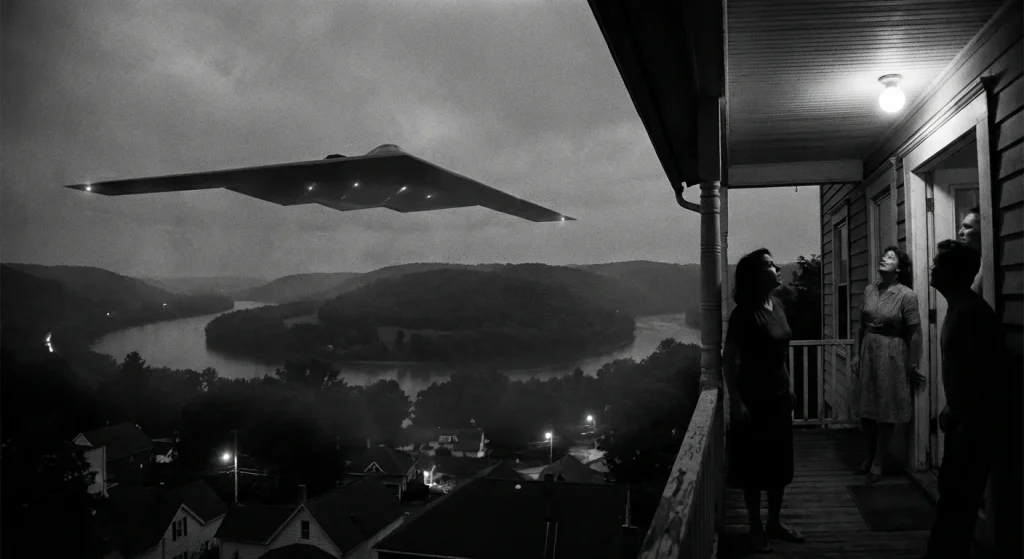
The Hudson Valley UFO wave is one of those UFO cases that gets repeated as a slogan: “5,000 witnesses,” a single mysterious craft, an entire region looking up in unison. The problem is obvious if you follow UAP news: repetition isn’t documentation. As public attention shifts from campfire-style UFO storytelling to UAP, the modern umbrella term for unusual aerial observations that aren’t immediately attributable, readers now demand basics that older retellings often blur: dates, locations, primary reporting trails, and who is accountable for separating firsthand reports from amplified lore.
You can treat the Hudson Valley story as a pile of misidentifications and move on. Or you can treat it as a serious case study in how large numbers of ordinary people, across multiple towns and nights, described something strikingly similar and insisted it was not business as usual.
The distinctive thing here is scope. The “Hudson Valley UFO wave” refers to a clustered run of mid-1980s reports in New York’s Hudson Valley describing a very large V or boomerang-like object, often presented as near-silent, with prominent lights, seen low enough to feel immediate and physical. The wave is commonly cited as peaking in 1983 to 1984 and is often labeled the “1984 Hudson Valley UFO sightings.” Some compiled timelines broaden the window to roughly 1982 to 1986, and attention drops sharply after 1985 even though reports continue.
The geography is equally specific: summaries repeatedly anchor the core reports in Putnam, Dutchess, and Westchester counties, especially along the Taconic Parkway and the Route 9 corridor. That bounded where and when is exactly what makes the case usable again. Mass testimony can be powerful corroboration when the accounts line up across time and place; the same mass testimony becomes distortion when estimates, anecdotes, and secondhand retellings harden into “known facts.”
You’ll leave able to state what the Hudson Valley case reliably supports, what it doesn’t, and what evidence would change the verdict. To get there, the first step is separating the repeating witness motifs from the layers of retelling that accumulated afterward.
What Witnesses Actually Reported
The Hudson Valley record rises or falls on what separate people kept describing the same way, not on whichever anecdote gets retold most dramatically. The most durable evidentiary center is pattern, because pattern survives imperfect memory: multiple observers, different towns, similar geometry, similar light behavior, similar sound reports. The faster you drift into later embellishments, the less you are analyzing the wave and the more you are analyzing the storytelling around it.
Most summaries place the main concentration in 1983 to 1984 while also implying a wider window that runs beyond a single year, often nesting the Hudson Valley reports inside a broader 1982 to 1986 span. In the same summaries, attention and media visibility thin out after 1985 even though reports continue, which matters because it affects what survives in the public record.
The recurring report reads less like a single scripted story and more like the same visual problem encountered by different people: a very large, structured object presented at night, with lights that create a strong sense of geometry. Witnesses often reached for “V-shaped/boomerang craft” language, meaning a wedge or boomerang-like outline inferred from the placement of lights and the perceived span. That shape language matters because it is the easiest element to pattern-match across independent reports; it is also the easiest element to contaminate once a community settles on a shared label.
A commonly repeated description anchors the lighting pattern: a very large boomerang or V-shaped object with a bright white light at the “nose” and red blinking lights around its perimeter. That combination, a front reference light plus a perimeter rhythm, is exactly the sort of detail that tends to persist when multiple people are describing what they think they saw, even when their distance and angle are uncertain.
Beyond the outline, the typical account pairs brightness with ambiguity. People describe lights bright enough to define edges against the sky, but the body itself often reads as a dark mass or not clearly visible at all. Sound reports split into two buckets that create real interpretive friction: either near-silence that feels wrong for something so large, or a low, steady hum that does not map cleanly onto familiar aircraft cues. That tension is part of why the case endured; it forces you to hold competing observations in the same frame.
When witnesses talk about motion, the emphasis is usually on smoothness rather than aerobatics: a steady traverse, sometimes slow enough to watch for an extended stretch, sometimes described as surprisingly fast once it commits to a line. Altitude impressions are consistently hard-edged in the telling but soft in the actual evidence, because night judging compresses distance cues. People report “low” because the lights look large and organized, but without a verified reference you cannot convert that impression into a usable band. Duration is similar: the dominant feel is “long enough to process,” minutes rather than seconds, but the record here does not supply a vetted timing corpus.
- Structured geometry inferred from light placement (often described as a V or boomerang)
- Distinct light behavior (a front reference light plus multiple blinking perimeter lights is a recurring motif)
- Sound reported as either near-silent or a low hum, not a consistent engine signature
“Around 5,000 witnesses” works as a scale signal. It communicates that this was not a single isolated observer, and it points to repeated opportunities for corroboration across different households, roads, and nights. In that sense, it supports the idea of a mass sighting, a cluster of reports generated around the same general phenomenon rather than a lone, uncheckable claim.
The methodological catch is that mass witnessing also accelerates shared-perception effects. Once a community converges on a label like “boomerang” and a narrative like “silent craft,” later observers can unintentionally map their perception onto the dominant template, and later retellings can blend separate nights into one super-event. Scale can corroborate, but scale can also launder uncertainty if nobody shows the counting method and the de-duplication rules.
Publicly available summaries rarely provide verifiable, date-specific multi-witness event chronologies that you can audit, meaning no confirmed night-by-night listings with times, precise locations, and observer counts tied to primary reports are readily accessible online. They also usually omit corpus-method details behind big-number claims, including how the “about 5,000 witnesses” estimate is derived, how many formal reports exist, how duplicates were handled, or what proportion of accounts are firsthand versus secondhand. Without those basics, any precise-sounding total, including “about 5,000,” is rhetorically powerful but methodologically fragile.
The responsible way to talk about the Hudson Valley wave is straightforward: emphasize what repeats across accounts, especially the V or boomerang geometry and the distinctive light patterning, and treat big witness totals and tightly dated “mass sighting nights” as unverified unless a transparent, report-level chronology and counting method is produced.
Those repeating motifs are the raw material of the case, but they only became widely known because the reports moved through investigators, local media, and informal networks that shaped how people described what they saw.
Investigators, Media, and Official Reactions
What turned the Hudson Valley UFO wave into “a case” was not only what people said they saw, but how those accounts moved through the 1980s information ecosystem. Summary-level histories say that during the 1980s, thousands reported a large triangular object over the Hudson Valley region of New York and Connecticut. A wave like that is partly a social event: the story that gets repeated, filed, aired, and argued over is the story that survives.
Most of the durable record for a regional flap comes from civilian investigators building their own paper trail. The standard toolkit is simple and repeatable: witness interviews (often by phone first), handwritten or typed case files, follow-up calls to reconcile timelines, and local networking through newsletters, meetings, and call-in lines where new reports can be captured quickly. Those methods don’t “prove” an event, but they do preserve raw details that otherwise disappear within days.
Linda Zimmermann is a concrete example of this compilation culture. She is the author of Hudson Valley UFOs: Startling Eyewitness Accounts from 1909 to the Present, a compilation of eyewitness accounts and interviews collecting over a century of reports related to New York’s Hudson Valley (see the title listing and publication details at Amazon and Apple Books: Amazon, Apple Books). Treat that role for what it is: a curator of narratives and documents, not an official adjudicator. The value is traceability: who said what, when it was recorded, and what contemporaneous items (clippings, letters, notes) were saved alongside it.
Local media can scale a wave faster than any investigator, because coverage turns a private anomaly into a public prompt. One broadcast or newspaper item produces a predictable effect: more people reinterpret prior odd experiences as “reportable,” and new witnesses now know exactly where to call. The resulting surge isn’t just volume; it’s convergence, because retellings start to reuse the same labels and comparisons. Over time, that feedback loop standardizes language, which makes separate reports easier to bundle but also flattens differences that might matter.
That dynamic also explains why “peaks” and “declines” can be misleading. Discovery UK’s summary of the Hudson Valley story notes that after 1985 media attention declined though sightings continued, a pattern consistent with a story losing airtime even while reports persist in smaller channels (Discovery UK, June 26, 2024 reel and article).
Readers often assume there must be a clean set of official artifacts: police logs with narrative detail, FAA statements, dispatch recordings, radar confirmations, or a named agency investigation. The available public sources used for this article, including the Discovery UK summary, Linda Zimmermann’s compilation, contemporary gallery summaries, and community posts, do not yield comprehensive contemporaneous local media citations (outlet, date, headline) or a single, centralized archive of police or FAA statements tied to specific Hudson Valley events. That does not validate or invalidate the sightings; it defines what can be responsibly claimed from the accessible record here. Sources consulted include: Discovery UK (link), an Unsolved Mysteries gallery summary (link), and community posts with historical recollections (Facebook).
Public records and investigative files are often subject to withholding rules. In the United States, the Freedom of Information Act includes exemptions that allow agencies to withhold material that could reasonably be expected to interfere with law enforcement or ongoing investigations, or that would invade personal privacy. That is one reason an outside-facing file can appear thin even when an investigative record exists.
Cold War-era public expectations amplified the tension: people were primed for secrecy narratives and, at the same time, primed to dismiss UFO talk as cultural noise. The practical takeaway is straightforward: weigh retrospective summaries by how transparently they source contemporaneous documentation. Prioritize items with dates, locations, original quotations, and reproducible artifacts over polished narratives that can’t show their work.
That sourcing gap is also where conventional explanations earn their leverage: when official or instrumented corroboration is thin, the first job is to see how much of the pattern can be produced by ordinary aviation under night-visibility constraints.
The Plane Formation Hypothesis
The strongest conventional competitor is the plane-formation hypothesis because it explains the two things most night observers actually perceive: a handful of lights and the geometry those lights suggest. Multiple aircraft flying in loose coordination can plausibly read as one large V or boomerang when the only “structure” your brain has to work with is light points against a dark sky. That fit is real. It also does not automatically reconcile every reported detail, especially perceived size, low altitude, and “one craft” solidity. The right way to handle it is stress-testing, not dunking.
Night flight is constrained by regulatory requirements for lighting. Position lights are required for night operations under 14 CFR 91.205, and 14 CFR 91.209 addresses the requirement to light position and anticollision lights. Specifically, 14 CFR 91.209(b) states that if an aircraft is equipped with an anticollision light system, those anticollision lights must be turned on during operations unless the pilot-in-command determines, for safety reasons, that they should remain off. See the regulation text at the Electronic Code of Federal Regulations and Cornell Law’s Legal Information Institute: 14 CFR 91.209 (eCFR), 14 CFR 91.209 (Cornell LII), and for required equipment for VFR night see 14 CFR 91.205.
That regulatory text matters for interpretation: anti-collision lights are not an unconditional requirement for every aircraft at every time regardless of installation. Instead, the rule applies to aircraft that are equipped with such systems, and a pilot-in-command may determine they should be off when required for safety. Advisory guidance on anticollision lights and maintenance is provided in FAA advisory materials, which describe acceptable means of compliance and maintenance program development (FAA AC 43-217).
Operationally, many aircraft run the beacon with the engine, and use strobes in takeoff, flight, and landing phases. For observers on the ground, that can look like a periodic pulse that appears, disappears, and “jumps” across what feels like a single outline. On larger aircraft, certified coverage is designed to be visible above and below the aircraft’s horizontal plane, which means a strobe can remain prominent even when the aircraft is not directly broadside to you.
At night, humans do pattern-completion automatically. A small number of bright points arranged in a shallow V is enough for the visual system to “draw in” the missing edges and treat it as one object. That is why a loose formation can read as a single boomerang: the eye connects the dots, then the brain commits to one large silhouette.
The catch is distance. In darkness you lose most depth cues, so altitude and size collapse into a single ambiguous impression: “big and close” can look the same as “small and farther.” If several aircraft hold roughly consistent spacing, their lights move as a unit across the sky, which reinforces the single-object interpretation. Add intermittent strobes and the viewer can experience the flashes as features on a single craft, not independent aircraft announcing themselves.
The Hudson Valley’s setting matters because it historically had many small airports and airparks scattered across the region. In a place with that kind of general aviation footprint, you should expect more small-aircraft activity, more training flights, and more unusual-looking night traffic than you would in a corridor dominated by only a few major commercial fields.
Airports also serve as community venues. Air shows and fly-ins are routine parts of airport culture, and aviation publications maintain calendars of these events. Mid-Valley Airpark, for example, is noted in community postings for hosting a fly-in and a spot-landing contest in connection with airport improvements; see local community references (community post) and regional galleries (Unsolved Mysteries gallery). None of that “proves” a specific sighting was a formation, but it anchors the conventional baseline: local aviation activity is normal, and special-event flying is normal too.
| Reported element to match | Formation of aircraft lights explains it cleanly | Formation of aircraft lights strains to explain |
|---|---|---|
| V or boomerang “shape” defined mostly by lights | Multiple aircraft points can form a stable V and read as one outline. | Requires spacing that stays visually coherent from multiple viewpoints. |
| Flashing or pulsing lights along the “craft” | Anti-collision beacons and strobes naturally create periodic flashes. | Observers often interpret flashes as surface features on one body, not separate airframes. |
| Perceived enormous size | Night depth ambiguity routinely inflates perceived scale. | Very large apparent span can exceed what a reasonable formation would imply if altitude was truly low. |
| Very low altitude impressions | Bright lights can feel “low” without reliable reference points. | Consistently low-altitude estimates across many locations would demand supporting radar or track data. |
| “Silent” passage | At distance, wind and ambient noise can mask engine sound. | Close, slow aircraft are usually audible; widespread silence claims are a pressure test on the hypothesis. |
| Single solid body with an underside | Pattern-completion can create a filled-in silhouette from sparse lights. | Detailed structure claims require better-than-typical night visibility to be reliable. |
Secondary conventional candidates sit behind formations. Helicopters can carry conspicuous lighting and move in ways people find uncanny at night, but their acoustic signature is usually harder to miss at close range. Advertising aircraft exist and can run repetitive tracks that invite “it’s circling us” interpretations, but that explanation lives or dies on local flight records. Astronomical and sky misperceptions can account for isolated lights and motion illusions, but they do not naturally produce a crisp V made of multiple, coordinated points.
- Correlate synchronized witness timestamps with FAA radar and ADS-B tracks for the same minutes and bearings.
- Capture multi-angle video with calibrated reference (known focal length, stable exposure, fixed landmarks) so analysts can triangulate altitude and spacing.
- Record audio with a known microphone location and timecode; audible signatures constrain distance claims fast.
- Preserve raw files and metadata immediately; compression and re-uploads destroy the measurements that distinguish “one craft” from “several aircraft.”
If the lights resolve into multiple independently tracked aircraft moving in consistent formation, the conventional case becomes decisive. If the tracks show nothing where the lights were, and calibrated footage still supports a single extended object at low altitude, the plane-formation hypothesis weakens sharply.
Even where aviation can plausibly account for the raw inputs-lights, geometry, depth ambiguity-the Hudson Valley wave still persists as a single, memorable object story. That staying power is the next part of what needs explaining.
Why the V-Craft Story Endures
Hudson Valley endures in popular memory less because of one “killer detail,” and more because several impression-level elements lock together into a single mental model. Even after conventional explanations are put on the table, the same cluster keeps reasserting itself: a perceived giant object with stable geometry, coordinated lighting, slow movement, and reported silence. That stack of motifs feels internally consistent, which makes it psychologically sticky even when the underlying record is uneven.
Publicly available summaries do not always supply robust, sourced examples that catalog the most-cited hard-to-reconcile elements with original quotations and exact circumstances. For that reason, the elements below are presented as commonly reported motifs, not settled facts, and not a curated inventory of primary-source witness statements. Sources consulted for motif summaries include compilations such as Linda Zimmermann’s Hudson Valley UFOs and retrospective summaries like the Discovery UK article and regional gallery items (Zimmermann, Apple Books listing, Discovery UK, Unsolved Mysteries gallery).
- Size impression. The story’s gravity comes from scale: not “a light in the sky,” but something witnesses remember as enormous. The friction is that perceived size is the easiest part of an account to inflate over time, especially when distance and altitude are uncertain. The actionable read is to treat “massive” as a memory-anchor, not a measurable dimension.
- Stable geometry. A commonly repeated descriptor includes a V/boomerang geometry (with a “nose” light) plus perimeter lights, forming an outline people feel they can redraw years later. The catch is that a shape that clean and repeatable becomes a template, and templates travel farther than documentation. The practical takeaway: the geometry is the motif that makes the whole story portable.
- Coordinated lighting. Witnesses tend to describe the lights as behaving like one system rather than independent points. The complication is that “coordinated” is an inference about control and structure, not a measurement. Read it as a perception of unity that reinforces the object-model.
- Slow movement. “Slow and steady” functions as a credibility cue because it clashes with expectations of fast, fleeting aerial sightings. The friction is that speed judgments are notoriously unstable without reliable reference. Treat “slow” as part of the gestalt, not a quantified performance claim.
- Reported silence. Silence, especially when paired with “low and large,” is the hardest motif to reconcile cleanly in casual retellings. The problem is documentation: without a robust catalog of who heard what, from where, under which conditions, silence hardens into a headline. Handle it as reported experience, not a verified acoustic fact.
Once a narrative has a clean visual signature and a tight bundle of supporting impressions, later stories borrow the template because it is easy to picture, easy to retell, and easy to compare. Memory and storytelling compress complexity: ambiguous spacing becomes a single outline, mixed motion becomes “gliding,” and partial lighting becomes a defined perimeter. That is how later “black triangle/boomerang” narratives can feel familiar without needing to be the same phenomenon. The repetition proves the strength of the template, not continuity of the source.
Public summaries consulted for this article do not provide a credible dataset-based comparison to later “black triangle/boomerang” cases, so parallels must be treated as suggestive, not evidentiary, and not as a demonstrated pattern across reporting systems.
The disciplined way to hold Hudson Valley is simple: keep the motifs on the table because they explain the case’s staying power, but keep your language tight about what is verified. The story is worth taking seriously as a durable cluster of reported impressions; it is not a license to promote the cluster into a proven craft profile, regardless of interpretive preference.
That distinction-between a compelling motif cluster and an auditable case file-is exactly where modern expectations have changed the ground rules, and why older waves get re-litigated under contemporary standards for documentation and deconfliction.
Hudson Valley in the Disclosure Era
In recent years, “a lot of people saw something” no longer lands as the endpoint. A Hudson Valley scale wave occurring now would be judged on process: what got logged, who received it, how it was triaged, what got ruled out through deconfliction, and what records can be audited later. Readers now expect a traceable paper trail, not just rumor density.
Modern UAP debate reshapes the public’s default assumptions about recordkeeping. If mass reports hit 911 centers, local agencies, aviation channels, and any centralized reporting lines in the same week, audiences expect those streams to converge into a coherent case file: timestamps, geographies, corroborating sensor references, and a documented decision trail for why explanations were accepted or rejected. The core pressure is institutional accountability. People assume there is an oversight audience that expects agencies to show their work.
That expectation collides with the reality that transparency is conditional. Governments and agencies routinely restrict release when disclosure would interfere with investigative work or operational needs. In the United States, FOIA exemptions and related policies allow withholding material that could reasonably be expected to affect law enforcement or ongoing investigations, which is why public-facing files can be incomplete even when internal records exist.
It also changes incentives to document well. When oversight and transparency are part of the conversation, sloppy intake becomes a liability. A defensible UAP file is not built from anecdotes alone; it is built from standardized fields, consistent taxonomy, and clear custody of supporting material.
- Intake: Reports get captured in standardized formats where possible, because free-text stories do not scale when hundreds of cases arrive across jurisdictions.
- Triage: Analysts prioritize cases with safety, airspace, or national security implications, and separate high-information reports from low-information ones.
- Deconflict: Relevant stakeholders coordinate to rule out known sources and conflicts, including conventional aviation activity, training routes, and other legitimate operations, without assuming that every detail is publicly releasable.
- Document constraints: Any decision to withhold specifics gets logged with a rationale tied to classification, privacy, or active investigative concerns, because that rationale is itself part of the accountability record.
- Publish what survives: Public-facing summaries focus on what can be released without compromising sources, methods, or investigations, which often means narrower detail than the public wants but a clearer audit trail than past eras delivered.
Disclosure-era credibility contests increasingly run through formal channels. Congress and oversight bodies have held hearings and requested records, and proposals to protect whistleblowers related to anomalous reporting have been part of the public conversation. Sworn allegations and contested claims appear in public debate, but allegations are not the same as independently verified documentation. The central shift is procedural: the more institutionalized intake, triage, and deconfliction become, the less a mass-report episode rests solely on narrative force.
The takeaway is simple: a future Hudson Valley scale wave becomes meaningfully more resolvable when the public can point to process-level evidence, not just volume. Case numbers, triage outcomes, deconfliction notes, and releasability rationales are the difference between an enduring argument and a question that can be audited to closure.
Seen that way, Hudson Valley is less an argument over one night in the sky and more a test of what mass testimony can and cannot carry without an auditable trail behind it.
A Case Study in Mass Mystery
The Hudson Valley UFO wave proves you can get thousands of people to converge on a consistent story and still fail to settle what actually happened without hard, audit-ready data. The record is strongest where it is bounded and repeatable: a constrained time window with a clear 1983 to 1984 peak, followed by a longer tail into the mid-1980s, and a recognizable narrative shape that witnesses kept returning to.
The same record is weakest where precision matters most. The often-cited “about 5,000 witnesses” figure functions as a rhetorical anchor, but the public sources reviewed here do not provide a transparent corpus method showing who is counted, what reports are duplicates, and what documentation exists per witness. Eyewitness reports also routinely arrive with muddled timing, direction, altitude, and scale, and they are frequently insufficient on their own to produce conclusive UAP analysis. And while the best conventional competitor remains aviation, including formation flying and standardized anti-collision lighting, that explanatory pressure does not substitute for measurements that can be independently checked.
Aviation lighting is not an ad hoc detail; it is a regulated, standardized part of night operations, including required position lights and approved anti-collision systems (beacons and/or strobes) that can present as red or white. For regulatory text on these requirements see 14 CFR 91.205 and 14 CFR 91.209 (91.205, 91.209), and FAA advisory guidance on anticollision-light maintenance is available in AC 43-217 (AC 43-217).
- Capture exact time, location, direction of travel, approximate azimuth and elevation, duration, and weather, then write it down immediately.
- Preserve original photo and video files with metadata intact; do not repost a compressed copy as your “evidence.”
- Cross-check the sky before you conclude: look for scheduled traffic patterns and nearby airport activity.
- Report through official channels when appropriate and follow agency guidance for safety reporting and incident submission.
- Follow up with records-based requests; official records and responses on UAP inquiries have been produced through public records processes, and that paper trail beats endless retelling.
Treat the next UAP sighting like a field investigation: document it cleanly, report it responsibly, and insist on transparent, auditable processing rather than viral mythology.
Frequently Asked Questions
-
What is the Hudson Valley UFO wave?
The Hudson Valley UFO wave refers to clustered mid-1980s reports in New York’s Hudson Valley describing a very large V- or boomerang-shaped object seen at night. It’s commonly cited as peaking in 1983-1984, with some timelines broadening the span to roughly 1982-1986.
-
Where did the 1984 Hudson Valley UFO sightings mainly happen?
Summaries repeatedly anchor the core reports in Putnam, Dutchess, and Westchester counties. Sightings are especially associated with the Taconic Parkway and the Route 9 corridor.
-
What did witnesses say the Hudson Valley V-shaped craft looked like?
A commonly repeated description is a very large boomerang/V shape defined by lights, with a bright white light at the “nose” and red blinking lights around the perimeter. Witnesses often reported the body as a dark mass or not clearly visible while the lights defined the geometry.
-
Was the Hudson Valley UFO reported as silent or loud?
Sound reports split into two main patterns: near-silence or a low, steady hum. The article emphasizes this inconsistency as a key friction point in interpreting the case.
-
How many Hudson Valley UFO witnesses were there really?
The wave is often summarized as “around 5,000 witnesses,” but the article states there is no transparent counting method provided for that figure. It specifically notes a lack of report-level details on de-duplication, firsthand vs. secondhand accounts, and how the total was derived.
-
Could the Hudson Valley UFO have been a formation of aircraft lights?
The article presents aircraft formation as the strongest conventional explanation because a few lights in a shallow V can be perceived as one large object at night. It ties this to regulated aircraft lighting, including required position lights and anti-collision systems (beacons and/or strobes) that can flash red or white.
-
What evidence would help confirm or rule out the plane-formation explanation for Hudson Valley sightings?
The article recommends correlating synchronized witness timestamps with FAA radar and ADS-B tracks, plus capturing calibrated multi-angle video for triangulation. It also calls for timecoded audio recordings and preserving original files/metadata to distinguish a single object from multiple aircraft.
