This happened at the UN in 1978, on the record. If you are trying to judge nonstop UFO disclosure and UAP disclosure headlines in 2025 and 2026, the hardest part is not the volume of claims, it is the lack of primary citations: everyone says “official,” almost nobody points to the meeting where something was actually said.
You are making a real decision every time a new clip, whistleblower quote, or “government UFO cover-up” thread hits your feed: treat it as documented history, or treat it as recycled rumor with new packaging. That decision gets harder when “non-human intelligence” narratives borrow institutional language while skipping institutional paperwork.
The cleanest anchor is older than most of the modern disclosure discourse. During the UN General Assembly (UNGA) 33rd session, presentations on UFOs were delivered in New York within the Special Political Committee, 35th meeting, on Monday, 27 November 1978. J. Allen Hynek and Jacques Vallée formally spoke to that Special Political Committee as invited presenters and experts. Those are checkable, dated, UN-context facts, not internet lore.
The tension is obvious: public curiosity wants a single, decisive confirmation; institutional proof lives in minutes, committee rooms, and narrow wording. Modern discourse often treats “serious UFO talk at the UN” as a new phenomenon and treats the UN as irrelevant to the topic, yet the UN was a venue where arguments and purported evidence were put into the formal record.
Precision matters here. This was not the full General Assembly “confirming aliens.” It was a UNGA-connected committee forum where material was presented and preserved as part of standard UN business. Using that episode as your baseline changes how you evaluate today’s UFO news and UAP news: you can test claims against documentation-first habits, and you can track three specific figure-nodes without drifting into mythology: J. Allen Hynek, Jacques Vallée, and the Gordon Cooper credibility thread connected to Grenada and Sir Eric Gairy.
Why the UN became a UFO venue
Grenada did not try to turn the UN General Assembly into a courtroom for extraordinary claims. It used a normal UNGA tool: a formal request to include an agenda item at the thirty-third session, framed around building a United Nations capability (an agency or department) to coordinate research and information-sharing on unidentified phenomena. That framing mattered in 1978, because anything that sounded like air-defense intelligence immediately ran into Cold War sensitivities, while an international coordination mandate fit the UN’s institutional comfort zone: information exchange, scientific cooperation, and standardized reporting.
That same institutional logic is why the story points to committee work rather than a dramatic General Assembly plenary scene. Member States route much of the General Assembly’s workload through its Main Committees, where proposals are aired, questioned, and procedurally shaped long before anything becomes an outcome the wider public recognizes.
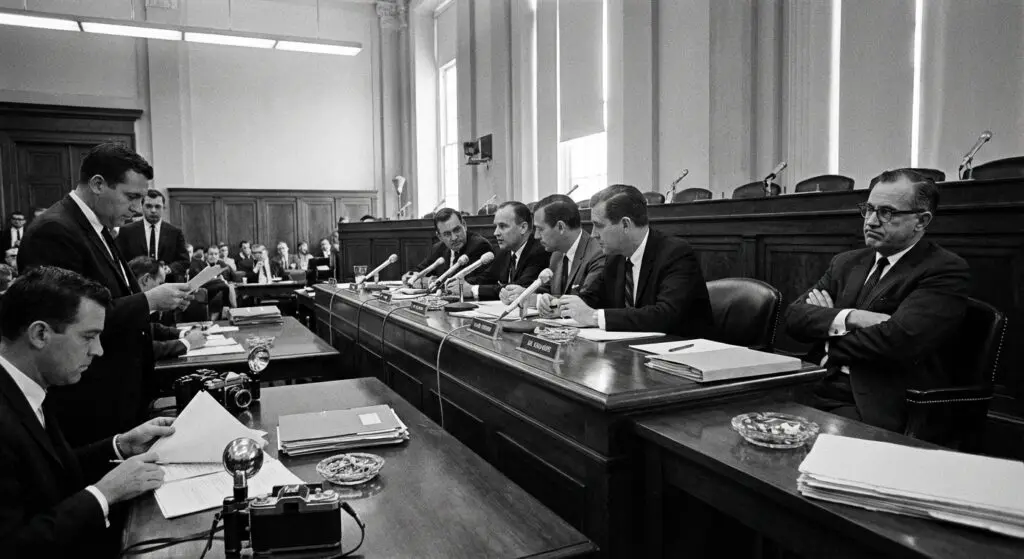
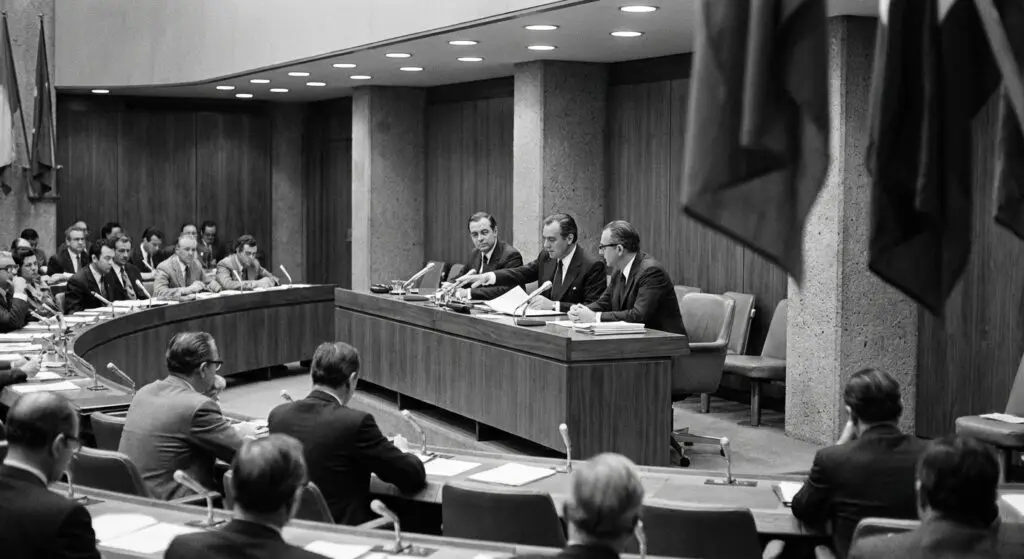
On the documentary record, the key venue is the UN General Assembly’s Special Political Committee: UFO-related presentations were heard during its 35th meeting on 27 November 1978 in New York. The UN Digital Library includes a “verbatim record (partial)” entry for that meeting, which is the institutional anchor for separating what was actually said in the room from later retellings. The meeting record is available as document symbol N79/552/98 (UN verbatim record (partial)); the PDF is available from the UN documents server at https://documents.un.org/doc/undoc/gen/n79/552/98/pdf/n7955298.pdf?OpenElement. The verbatim record names invited participants in the session, including references to Dr. J. Allen Hynek and Mr. Jacques Vallée as speakers in the meeting text.
Secondary reporting states that Gordon Cooper is said to have sent a letter to Grenada’s UN mission in 1978; however that letter’s direct inclusion in UN files is a matter of secondary reporting and has not been independently confirmed in the primary records cited here. Some secondary sources associate Cooper with a UN document referenced as N79/553/03; direct access to a scanned copy was not verified here, so the Cooper attribution should be treated as unverified secondary reporting rather than an independently confirmed primary artifact.
The friction point for readers is procedural, not mysterious. A committee can hear presentations, circulate statements, and still produce no headline resolution. In UNGA practice, many outcomes are adopted through consensus adoption, meaning the chair declares an agreed decision with no vote tally. When the Assembly does vote, the record can show a recorded vote that names how Member States voted. If you expect every controversial topic to generate a roll-call result, you will misread how the institution documents work.
The “verbatim record (partial)” label is the second reason expectations break. Partial coverage is still a primary-source trace, but it means you must treat the meeting identifier, date, and committee name as the controlling coordinates, then check what the record actually captured, line by line.
- Search the UN Digital Library for the Special Political Committee, 35th meeting, dated 27 November 1978 (New York), and open the verbatim record (partial) entry.
- Cross-check Grenada’s formal agenda request, titled “Establishment of an agency or a department of the United Nations for the study of unidentified flying objects and related phenomena” (document symbol A/SPC/33/L.20; UN Digital Library record: https://digitallibrary.un.org/record/655114?ln=en), and compare the agenda-item wording with the meeting text you are viewing.
- Confirm whether any outcome was documented as consensus adoption or as a recorded vote by reading the meeting record and any linked committee decisions, rather than relying on secondary summaries.
Those procedural details explain why the 1978 episode is best treated as a traceable record trail rather than a single climactic “UN moment.” With that institutional context established, the next question is what the invited experts actually argued inside that framework.
Hynek’s case for scientific investigation
Hynek’s value in the 1978 UN moment was methodological: he made UFO talk discussable by reframing it as an evidence-and-method problem that scientists can interrogate, not a belief contest. An astronomer who served as an astronomy consultant for the U.S. Air Force on UFOs, he formally addressed the UN Special Political Committee in the session context tied to 27 Nov 1978, positioning the issue as one of disciplined observation, comparability, and honest uncertainty rather than spectacle.

Hynek’s core conceptual tool was a sixfold UFO sighting classification system ranked by proximity, developed to organize reports in his book The UFO Experience. Proximity is the lever because it controls information density: distant lights over a horizon collapse into ambiguity, while nearer events can be interrogated for shape, motion, duration, environmental context, and the presence of corroborating data. The friction Hynek was solving is obvious to anyone who has tried to compare sightings: without shared categories, you cannot aggregate, you cannot triage, and you cannot tell whether two “UFO” reports are even the same kind of claim.
A proximity-ranked scheme also forces an uncomfortable but productive conclusion: most reports will sit in low-information bins. That is not an insult to witnesses; it is a filtering principle. It lets investigators spend their limited time where the evidentiary upside is highest, instead of letting the loudest story dominate attention.
Hynek consistently emphasized that witness quality matters because trained observers describe technical details more reliably under pressure, and he explicitly pointed to credible observers such as pilots, engineers, scientists, military personnel, and police. The practical point is not hero-worship of credentials; it is error control. A serious report states what the observer could actually perceive, from where, for how long, under what viewing conditions, with what reference points and instruments, and with what documentation.
His best-known “high-signal” bucket is the Close Encounter (Hynek classification), because proximity-based categories separate low-information lights-in-the-sky from events that can carry multiple independent data points. Close encounters are commonly described as within roughly 500 feet, about 150 meters, with the First Kind defined at 500 feet or less. At that range, reports can include geometry, apparent structure, interaction with the environment, or other constraints that reduce the space of ordinary explanations.
Trace evidence needs the same discipline: secondary sources describe Hynek as taking physical traces seriously and analyzing them, but the provided findings do not confirm he referenced specific trace or high-strangeness cases in his UN remarks. Treat that gap as a feature, not a bug. Method comes first; case lore comes second.
Applied to today’s UFO news, Hynek’s mindset is simple: ignore viral certainty and ask for structured specifics. Look for measurement context, observer vantage, timing and duration, corroboration across independent sources, and documentation that can be preserved and reanalyzed. If a claim cannot survive those demands, it is not “mysterious.” It is just underspecified.
Hynek’s standards-focused posture narrows the question from “what do you believe?” to “what can be checked?” Vallée approaches the same problem from the other direction: not just the quality of any one report, but how the entire information stream shapes what investigators think they’re seeing.
Vallée’s patterns beyond simple answers
The hardest part is not one sighting. It is the integrity of the entire dataset. Jacques Vallée’s distinctive contribution is insisting that the phenomenon’s most important features may sit at the pattern level and the information level, not just at the level of “a craft did X.” Once you lock onto a single storyline too early, you stop seeing the signals that do not fit, and you start mistaking narrative momentum for evidence.
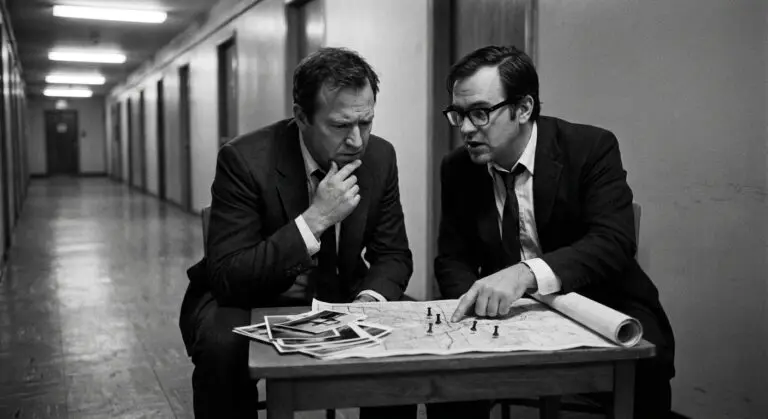
Vallée brought that posture into official space when he formally spoke to the UN Special Political Committee in the 1978 context, arguing for disciplined inquiry built around what the evidence can actually sustain.
Vallée’s methodological warning is blunt: well-constructed hoaxes and media manipulations have misled UFO researchers and diverted attention from substantive issues. In his framing, contamination is not an edge case; it is a core variable. If you treat every headline, photo, or “leak” as a neutral input, you guarantee that staged material will be indistinguishable from genuine anomalies once it is amplified through television, print, and now social feeds.
That complication changes what “serious investigation” means. You do not just evaluate the reported object; you evaluate the information environment that shaped the report. The practical resolution is to treat provenance as evidence: who had the material first, who edited it, who packaged it, and who benefits from the timing. A dataset that cannot survive that scrutiny is not a dataset you can build conclusions on.
Vallée’s second constraint is interpretive: recurrence across cultures and historical periods, coupled with shifting narratives, does not reduce cleanly to a single nuts-and-bolts spacecraft storyline without losing key data. The same “event type” can present with different symbols, different intelligibility to witnesses, and different cultural overlays, while still preserving structural similarities at the pattern level.
This is where pattern analysis buys leverage. It forces you to separate invariant features from the story people use to make the event legible. The friction is obvious: the more you privilege patterns, the less satisfying any single-cause explanation becomes. The actionable resolution is not to abandon hypotheses, but to refuse hypothesis lock-in until the cross-context structure is mapped with the same seriousness you would apply to any noisy observational field.
Vallée’s caution also reframes “disclosure” talk. He favors transparency, but he has warned that an official declaration could be chaotic and raise complex religious and security questions. That is a systems problem, not a public relations problem: institutions react, adversaries exploit uncertainty, and belief systems collide with authority claims.
Modern non-human intelligence discourse benefits from this discipline. Vallée’s approach strengthens the case for inquiry that is rigorous, falsifiable, and resistant to narrative capture, while refusing simplistic conclusions that outrun the data.
The takeaway for reading modern UFO news is operational: ask “what would change my mind?” and then audit the source chain. If the chain is opaque, if incentives are obvious, or if the story arrives pre-interpreted as certainty, treat it as influence activity until independent corroboration forces an update.
Hynek and Vallée both emphasize method, but credibility still enters through people-especially when a famous name is attached to a document. The Cooper thread is where many retellings leap from “circulated in UN channels” to “verified by the UN,” and the gap between those two ideas is exactly where documentation discipline matters.
Gordon Cooper and witness credibility
In the 1978 UN storyline, Gordon Cooper matters less as a celebrity and more as a credibility signal. That signal only turns into evidence when the paperwork is traceable. Some sources attribute a Cooper-associated written statement referenced in UN documentation as N79/553/03, but this association is based on secondary reporting and the original letter has not been independently verified here. Treat the Cooper linkage as an example of how names circulate through submitted statements rather than as a standalone verification of events.
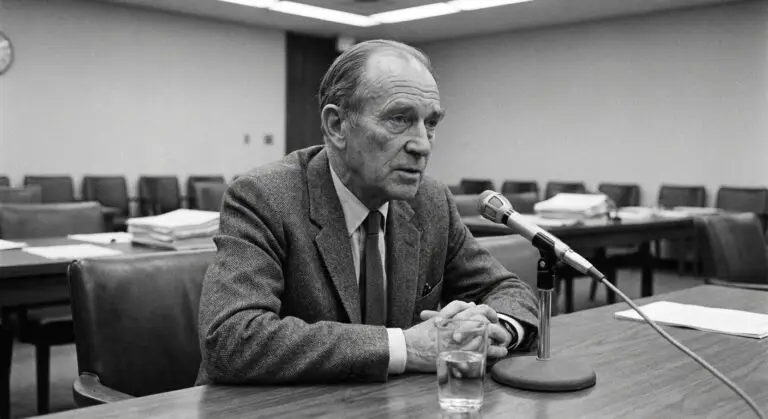
That identifier, when cited by others, performs real work: it points readers to a purported object with a retrievable label. It does not, by itself, certify the underlying claims as verified events, nor does it, by itself, establish what Cooper personally witnessed versus what he relayed from others. It establishes a claimed paper trail, not a proof standard when the underlying artifact cannot be independently examined.
Once you leave the UN document itself, certainty tends to get manufactured. Secondary sources frequently repeat a tidy timeline detail: that Cooper sent a letter to Grenada’s UN mission, often given the date May 5, 1978. That date and the description remain commonly repeated attributions in secondary reporting, but they should be treated as unverified until the original letter, its recipient, and its path into UN records are independently located and cited.
Cooper’s astronaut résumé increases attention, but it does not repair evidentiary gaps. UFO literature also links him to a reported 1957 Edwards AFB incident described as involving trained observers and claims about film. The evidentiary problem is not the status of the observers; it’s the missing corroboration that would let an outsider audit the story end-to-end.
Film claims are a clean example of why standards matter. Without a chain of custody (documented handling history), even compelling film or material claims remain vulnerable to contamination and authenticity disputes. If you cannot show who shot it, who held it, when it was duplicated, and where it resides now, “film exists” stays a claim, not a stable piece of evidence.
Use Cooper as a practical filter for current UFO news: weight claims by documentation, not by rank. Give the most weight to items with document identifiers you can retrieve, verify, and cite. Treat precise dates and “official letter” narratives as secondary until you can locate the original artifact and its provenance. High status can open doors; it does not close evidentiary questions.
What 1978 achieved and missed
The 1978 UN episode legitimized the question more than it built an institution. Its durable impact was procedural: it pulled UFOs into a formal multilateral setting where statements, submissions, and cataloged records can be cited later, even when governments refuse to operationalize the topic.
The first win was legitimacy. A subject that had been treated as entertainment and rumor was argued in an international forum designed for state coordination, not spectacle. That distinction matters because legitimacy is a gating factor for what diplomats, ministries, and scientific bodies will put their names on.
The second win was documentation. The UN system creates paper trails by default: meeting records, distributed statements, and library catalog entries. The UN Digital Library includes a record describing a proposal to establish a United Nations agency or department to undertake, coordinate, and disseminate research into unidentified phenomena. That is not an investigative program in itself, but it is an institutional artifact that anchors later debate in something more concrete than press coverage.
Relatedly, UN-circulated materials from the period show how the topic entered official channels as submitted text, not just hallway talk. Even when submissions are contested, the fact of submission is a record-keeping milestone.
The third win was agenda framing. The argument shifted from “prove a sensational claim” to “coordinate how states handle anomalous reports,” which is the only framing that fits the UN’s design constraints.
No standing UN UFO program emerged, and no enduring investigative body was created. The record available here does not verify any adopted General Assembly resolution or decision with an exact UN document symbol that mandated ongoing work on UFOs. Without a specific, adopted text, there is no institutional mandate to staff, fund, or measure.
That also kills the popular misread: there was no “UN confirmed aliens” outcome. A forum can create attention and still fail to create authority.
One reason confusion persists is terminology. Resolutions are formal expressions of the opinion or will of UN organs; decisions are another type of formal action taken by UN bodies. Without a verified resolution or decision on this topic, the episode remains a moment of debate, not an act of governance.
Momentum faded for structural reasons the UN cannot wish away: sovereignty limits what states will share, classification blocks the most sensitive reporting, the lack of standardized data prevents aggregation, and stigma discourages ministries from sponsoring a continuing agenda.
Continuity also broke politically. On March 13, 1979, Grenada’s prime minister Eric Gairy was ousted in a coup organized by the New Jewel Movement, led by Maurice Bishop. Whatever follow-through depended on a single champion lost its sponsor overnight, and the initiative stopped compounding.
Takeaway: treat institutional “moments” as legitimacy and record-creation events. Real disclosure momentum shows up as durable mechanisms: adopted texts with symbols, assigned responsibilities, budgets, and repeatable data pipelines.
From UN appeals to modern disclosure laws
In 1978, the argument for UFO transparency leaned on persuasion and international coordination. In recent years, disclosure has been pushed through enforceable oversight tools: statutory record-management duties, defined repositories, and formal classification controls that decide what can be released and on what timeline.
Modern official reporting uses Unidentified Anomalous Phenomena (UAP) as the umbrella for unidentified observations across domains, which is why contemporary mandates talk about records management rather than “flying saucers.” The clearest structural break from 1978 is statutory: the National Defense Authorization Act for Fiscal Year 2024, Pub. L. 118-31, enacted December 22, 2023, carries UAP-related provisions in sections 1841 through 1843 that directed agencies to review records and supported the establishment of an Unidentified Anomalous Phenomena Records Collection at the National Archives. See the enacted law text at https://www.congress.gov/118/plaws/publ31/PLAW-118publ31.pdf. The National Archives and Records Administration implemented guidance in response to those statutory directions; see NARA’s public guidance page at https://www.archives.gov/records-mgmt/uap-guidance and the implementing memo AC-04-2025 at https://www.archives.gov/records-mgmt/memos/ac-04-2025.
Those enacted provisions set deadlines for agency record reviews and for identifying material responsive to the new collection requirements. NARA’s guidance and memo provide the operational instructions agencies were to follow for identifying, organizing, and preserving UAP records in accordance with the enacted NDAA provisions. The statutory direction is reflected in the enacted Public Law language and NARA’s implementing materials.
Some more expansive public-disclosure language was proposed during congressional consideration. For example, Senate Amendment 2610 (the Unidentified Anomalous Phenomena Disclosure Act, as offered in floor amendment text) contained provisions that would have accelerated and broadened certain public-release requirements; the published amendment text is available at https://www.congress.gov/amendment/118th-congress/senate-amendment/2610/text. Many of those amendment provisions were modified or removed before final enactment; the enacted language is what appears in Pub. L. 118-31, sections 1841 through 1843, and should be read as the operative statutory direction.
Classification mechanics remain a practical limiter. Congressional text and debate considered mechanisms such as a consolidated classification matrix for sensitive program elements, and congressional materials describe classification and declassification authorities as part of the implementation challenge. Some language on classification mechanics was discussed in legislative and committee materials during consideration of related bills and amendments, but the final enacted NDAA text and NARA implementation guidance establish the binding authorities agencies must follow. Where language was proposed but not enacted, treat it as proposed only; the enacted outcome is what agencies must implement under Pub. L. 118-31 and the corresponding NARA guidance.
Fragmented custody adds friction even with good-faith compliance. Records sit across agencies, contractors, legacy systems, and mixed formats. That fragmentation is why the policy fight increasingly revolves around process proof: documented review steps, auditability, and repeatable release criteria.
Hynek, Vallée, and Cooper pressed the same fault lines that still dominate: data quality, narrative contamination, credibility disputes, and classification barriers. The difference is that today’s arguments rise or fall on documentation discipline. Public attention, including recent spikes in UFO and UAP reporting in 2025 and 2026, accelerates demand, but it does not substitute for records that can be traced, authenticated, and lawfully released.
The most reliable way to judge modern disclosure claims is to ask what mechanism produced them: a formal record release tied to an agency review, an archival collection action, a hearing record, an inspector-driven oversight product, or an unaccountable rumor chain. Process is the credibility filter.
The lasting lesson of the UN effort
The lasting lesson of the 1978 UN episode is blunt: “disclosure” is a documentation and governance problem before it is a belief problem. Without stable records, standardized language, and traceable custody of claims, institutions default to ambiguity, and audiences fill the gap with certainty they did not earn.
Hynek’s contribution was standards: treat UFO reports as testable cases, and separate repeatable observations from stories that cannot survive basic methodological discipline. Vallée’s contribution was pattern-level thinking paired with narrative hygiene: the signal gets distorted fastest when people optimize for a satisfying explanation instead of contamination-resistant documentation. The Cooper thread adds the real-world friction: credibility matters, but it only becomes durable when it is anchored to documents and evidence handling, not to a famous name or a compelling anecdote.
The introduction’s baseline holds: if you want a checkable anchor, you go to the dated venue and the identifiers, not to the loudest retelling. The UN Digital Library has an entry for the Special Political Committee 35th meeting (27 Nov 1978) in a verbatim-record style, and the public entry can be partial; the visible search-result excerpt also does not display an official UN document symbol. In contrast, a Cooper-associated reference like N79/553/03 is cited in secondary literature as an example of how document identifiers anchor a claim to something checkable, but the Cooper linkage should be treated as unverified unless the original artifact is produced. For a modern baseline of “official but constrained,” ODNI’s Preliminary Assessment: Unidentified Aerial Phenomena (2021-06-25) was published to brief policymakers on the challenges of characterizing potential UAP threats. The next time a UFO or UAP headline goes viral, prioritize primary documentation, corroboration, and consistent terms, and treat viral certainty as the red flag it is.
Frequently Asked Questions
What happened at the UN about UFOs in 1978?
During the UN General Assembly 33rd session, UFO presentations were delivered in New York in the Special Political Committee, 35th meeting, on Monday, 27 November 1978. J. Allen Hynek and Jacques Vallée formally spoke as invited expert presenters, and the UN Digital Library lists a “verbatim record (partial)” for that meeting.
Did the UN General Assembly confirm aliens or pass a UFO resolution in 1978?
No-this was a UNGA-connected committee forum, not the full General Assembly “confirming aliens.” The article states there is no verified, adopted General Assembly resolution or decision (with an exact UN document symbol) that mandated an ongoing UN UFO program.
Why did Grenada bring UFOs to the UN in 1978?
Grenada used a standard UNGA process: a formal request to include an agenda item at the thirty-third session. The request was framed around creating a UN capability (an agency or department) to coordinate research and information-sharing on unidentified phenomena.
How can I find the primary UN record for the 1978 UFO meeting?
Search the UN Digital Library for the Special Political Committee, 35th meeting, dated 27 November 1978 (New York), and open the “verbatim record (partial)” entry. Then cross-check Grenada’s thirty-third-session agenda request and confirm any documented outcome by reading the meeting record and linked committee decisions.
What is Hynek’s Close Encounter distance spec mentioned in the article?
The article describes Hynek’s “Close Encounter” category as commonly being within roughly 500 feet (about 150 meters). It also notes “Close Encounters of the First Kind” as defined at 500 feet or less.
What UN document number is associated with Gordon Cooper’s UFO statement?
The article identifies a Cooper-associated written statement circulating in UN documentation channels as document N79/553/03. It describes it as a scanned archival PDF with OCR imperfections and emphasizes that the identifier anchors the existence of a circulated text, not verification of the underlying claims.
How should I evaluate modern UFO/UAP disclosure headlines using the 1978 UN episode as a baseline?
Use documentation-first habits: prioritize retrievable primary records (meeting identifiers, dates, and document symbols like N79/553/03) over viral summaries. For current claims, ask what mechanism produced them-official record releases, hearings, oversight products, or a records-collection action-because process is the credibility filter.