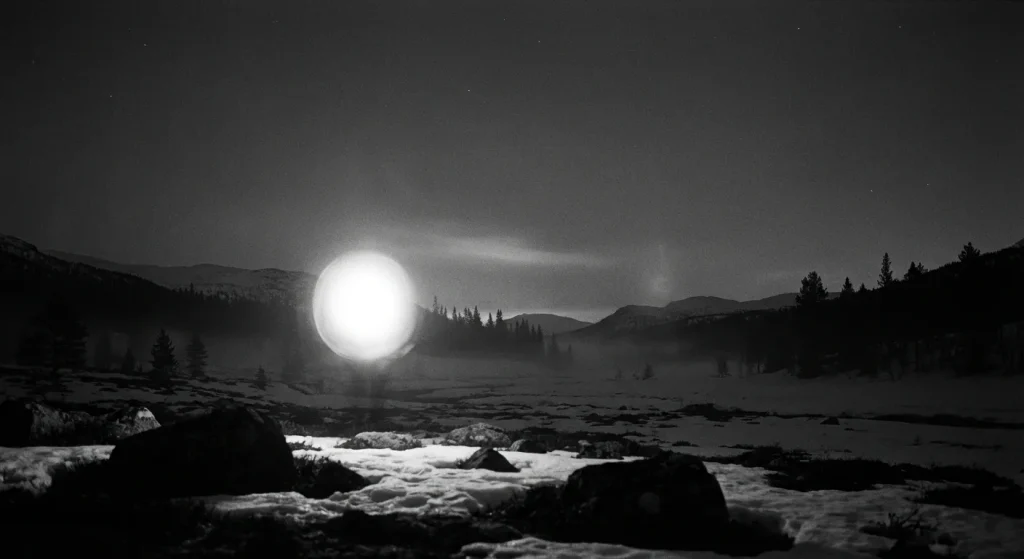
December 1981 is when the valley stopped being a rumor and became a pattern. Picture the setup: long winter darkness, a small community, and lights showing up often enough that people stop arguing about whether they happened and start arguing about what they were. Everyone has an opinion. Almost nobody has data.
That tension forces an uncomfortable choice. You either dismiss the reports as ordinary misidentification dressed up by repetition, or you over-read them as proof of non-human intelligence. Both reactions are emotionally satisfying, and both are analytically lazy. The defensible posture sits in the middle: treat persistent luminous phenomena as real observations first, and accept that an explanation can remain incomplete for a long time.
The core hinge is timing. Strange unknown light phenomena began appearing in Hessdalen in December 1981, and the early wave was described as intense enough that there could be up to roughly 20 observations per week, reported as an estimate rather than a complete census. That shift from occasional anecdotes to high-frequency recurrence is what makes the Hessdalen Lights, meaning recurrent, unexplained luminous phenomena reported in Norway’s Hessdalen Valley, unusually consequential as a case study.
Frequency, however, does not equal certainty. Repeatability makes a phenomenon study-worthy, but it does not make it self-authenticating; rapid, repeated sightings can still be hard to verify in a way that withstands skepticism without coordinated measurement and disciplined logging. The same surge that elevated Hessdalen from curiosity to serious target also exposed the central problem: enduring observations, incomplete explanations. That is exactly why the post-1981 wave later motivated systematic study beginning in 1984.
Use Hessdalen as your benchmark case: a timeline-anchored, location-based pattern with a clear escalation point you can test claims against. When broad “disclosure” narratives heat up, compare them to places where events recur on a schedule that can be observed, documented, and revisited, rather than argued about in the abstract. That benchmark starts with the simplest constraint of all: what the valley physically allows observers to see, and from where.
A Valley Built for Mysteries
Some places generate better data because the terrain forces repeatable viewing conditions, Hessdalen is one of them. Hessdalen is not just a story; it’s a constrained viewing environment. That constraint reduces interpretive chaos because observers tend to look down the same corridor from the same few usable vantage points, even though misperception and misidentification remain possible in any outdoor setting.
Hessdalen is a small valley in the central part of Norway, about 15 km long and oriented roughly north to south. That north to south layout matters operationally: it creates a directional corridor where an observer’s line of sight is naturally channeled along the valley rather than scattered across a full horizon. Reports of Hessdalen Lights (recurring valley light reports) also concentrate in a roughly 12 kilometre long stretch, which further tightens what “counts” as the typical viewing zone.
Clustering in a bounded stretch is a practical advantage, not a curiosity. When most observations fall inside the same 12 km segment, descriptions become easier to compare because people are often referencing the same landmarks, the same directional bearings, and the same implied distances down-valley. The valley’s access road also matters because it concentrates where people can realistically stop, look, and then report from a consistent location rather than from random points in open country. Constrained environments do not eliminate mistakes, but they do make it easier to cross-check timing and direction across multiple observers.
Human footprint shapes the signal-to-noise ratio, too. Hessdalen’s small rural community and the lack of dense urban lighting mean bright, unusual luminous events are harder to miss than they would be near major city glare. The tradeoff is that fewer residents also means fewer total observers, so the reports you do get carry more weight when they line up on the same stretch, time window, and sightline.
There are no reliably dated modern case reports recorded before 1981.
- Map the corridor: identify the dominant sightline the terrain forces observers to use.
- Mark constraints: note where roads, pull-offs, and habitations create repeatable vantage points.
- Plot clustering: separate “reports everywhere” from “reports in one segment,” because clustering changes how well accounts can be cross-checked.
- Audit lighting context: compare local light pollution to nearby urban baselines before arguing about brightness or rarity.
Before you debate explanations, pin down the observation geometry and clustering, because that is what determines whether you are looking at a messy rumor cloud or a constrained reporting environment that can actually be compared and tested.
Those constraints also clarify why the late-1981 reports landed differently: when a bounded corridor produces repeated descriptions night after night, witnesses are not just reacting to a single surprise, they are comparing a recurring event against a stable backdrop.
1981 Wave and Witness Accounts
What made 1981 different was not one spectacular night. It was repetition with recognizable features. Project Hessdalen’s early reports and summaries (Strand 1984) and the Hessdalen Database (2017) describe the Hessdalen Lights as “balls of light,” but the late-1981 wave stands out because many witnesses did not stop at “a light in the sky.” They described the same kinds of luminous behaviors over and over: lights that appeared to hold position, then move abruptly; lights that pulsed; lights that shifted color; and lights that seemed to respond to a passing vehicle or a person’s attention. Repetition turned isolated anecdotes into a pattern people could compare.
Accounts from the early phase of the late-1981 wave describe episodes of very frequent sightings, reported as an unusually intense tempo rather than as an audited count. The practical consequence of a tempo like that is straightforward: more observers get exposed, and the same observers get multiple chances to watch similar behaviors. A community does not need to agree on what the lights “were” to notice recurring traits and to cross-check stories, locations, and timing. High frequency also widens the witness net, pulling in people who are not “out looking” for anything unusual.
The recurring descriptions cluster into a few behavior types that are specific enough to be memorable without requiring specialized vocabulary. On motion, witnesses repeatedly reported hovering, rapid movement, and abrupt starts and stops rather than a steady, aircraft-like transit. On duration and intensity, they reported brightness changes and pulsing, with the light sometimes swelling and then dimming in cycles. On color and shape, witnesses reported color shifts and compact “ball” or “fireball” appearances rather than a diffuse glow. A final cluster is interaction: accounts describe apparent tracking or responsive behavior, where the light seemed to follow a car’s path, keep pace with a driver, or change behavior as people watched. None of these elements proves distance, altitude, or source, but together they explain why the late-1981 narratives read less like generic skywatching and more like repeated observation of a consistent set of visible effects.
Åage and Rutt Marry Moe provided one of the representative early accounts from the initial late-1981 sightings, describing what they saw as a “burning fireball.” That phrasing matters because it compresses several recurring themes into a single image: concentrated brightness, a compact shape, and a fire-like intensity rather than a faint point. The Moe report is valuable as an anchor because it is concrete and vivid, but it is not an outlier. “Fireball,” “ball,” and similar descriptors show up precisely because many witnesses were trying to describe a bounded, luminous object with noticeable intensity changes, not a distant aircraft light or a single stationary star.
Night observation is an unforgiving environment for precision. Human depth perception collapses without reference points; a small nearby light and a large distant light can present the same angular size; and brightness can saturate perception, making edges and motion harder to judge. Distance ambiguity also makes “speed” slippery: a light can look like it accelerates dramatically if the observer has no reliable range estimate. Those frictions are exactly why the late-1981 repetition mattered. Even when people could not measure altitude or range, they could still recognize the same visible behaviors across multiple nights, reported by different groups, in different circumstances.
Witness coverage also broadened beyond a single niche. Reports came from farmers, drivers, families, and local officials, which increases the odds that at least some observers were describing what they saw in ordinary, non-performative contexts. At the same time, the limits are explicit: no complete catalog or exact count is available from the material provided here, so the wave should not be summarized with false precision.
- Separate frequency claims from counts: treat “reported as many as ~20 per week” as a social indicator of intensity, not a verified statistic.
- Test feature consistency on its own terms: hovering, rapid movement, pulsing, color shifts, apparent tracking, and “ball/fireball” descriptions are meaningful as repeated reported features even when range is unknown.
- Demand documentation clarity: ask what was recorded contemporaneously, what was reconstructed later, and what is actually available to review before drawing conclusions.
Once a case reaches this level of repetition, the decisive question stops being descriptive and becomes operational: what can be captured on instruments, across multiple channels, under a shared clock.
From Stories to Instrumented Study
Continuous, synchronized measurement is the only way to turn a hotspot into a testable case. The real shift wasn’t better stories; it was instrumented observation built to catch the lights on their own schedule. Instruments don’t have to “solve” Hessdalen to make it scientifically valuable, because they constrain explanations by forcing every claim to fit timestamps, sensor geometry, and detection thresholds.
Project Hessdalen was organized as a systematic attempt to obtain measurements of the phenomenon in the Hessdalen valley. In operational terms, “systematic” meant repeatable protocols: observers working defined watch periods, instruments run with logged settings, and events recorded with time markers that let investigators compare channels instead of comparing recollections. The project’s planning documents explicitly discuss monitoring operations and an Automatic Measurement Station (AMS) concept; see Project Hessdalen planning documents (Project Hessdalen story, 2002) for the AMS history and terminology.
The Automatic Measurement Station (AMS) matters because intermittency is the core challenge in Hessdalen: the phenomenon does not appear on command, and the best equipment is useless if it is powered off when the event occurs. An AMS is the practical answer: a fixed, continuously running sensor setup designed to capture synchronized measurements during events, with each device referenced to the same clock. That synchronization is the difference between “a light was seen” and “an optical transient coincided with a radar return and a local field perturbation within the same seconds,” which is the minimum standard for ruling whole classes of mundane explanations in or out.
Optical data is the workhorse channel because it records what witnesses describe: apparent motion, brightness changes, flicker, color shifts, and how long an event persists. A sequence of frames can also reveal whether the light saturates the sensor, blooms, or changes shape in ways consistent with camera artifacts. The friction is scale: without known distance, optical recordings can’t convert “moving across the frame” into true speed or size. Triangulation attempts, using two separated cameras with known geometry, address that gap, but they demand clear weather, precise timing, and stable calibration, and those practical constraints are exactly what intermittent events tend to defeat.
Radar is valuable because a confirmed return, time-aligned with an optical event, implies something in the monitored volume reflected radio energy. Project Hessdalen’s Final Technical Report (Strand 1984) and later data-analyses discuss radar-optical correlations in specific field runs, and independent analyses of Hessdalen datasets also examine cases with and without radar confirmations; see Strand 1984 and the data analysis summary (Data Analysis of Anomalous Luminous Phenomena in Hessdalen) for examples.
Magnetometer logging is straightforward and cheap enough to run continuously, which is why Hessdalen literature discusses magnetic field data alongside other channels. A local anomalous change, if synchronized with an optical event, is the kind of constraint investigators want: one timestamp, two different physical measurements. The complication is interpretation. Local geology, man-made currents, nearby equipment, and moving ferromagnetic objects can all create signatures that look “interesting” unless the site is characterized and the sensor environment is controlled.
Spectroscopy earns its place because it treats the light as data, splitting it into wavelengths to infer emission characteristics. A spectrum can distinguish broad continuum-like emission from discrete line features, which immediately narrows what kinds of physical processes are even plausible. The discipline is in the limits: spectra depend on sufficient brightness, correct calibration, and clean acquisition conditions. Even a high-quality spectrum cannot, by itself, identify an object or intent; it only constrains what produced the photons.
Across these channels, the evidence base is best understood as categories, not a single decisive dataset: optical recordings, reported radar-optical correlations in some cases, magnetic field logs, and triangulation attempts. The same studies that describe potentially anomalous phenomena acquired with conventional instrumentation also make the operational friction obvious: weather blocks cameras and optics, events cluster unpredictably, budgets cap sensor quality and redundancy, and reproducibility is hard when the “target” does not cooperate.
The actionable takeaway is simple: judge any UAP case by whether it has time-synced, multi-sensor data, and whether that data was collected continuously rather than by luck. Single-channel stories, even with vivid imagery, can’t compete with synchronized logs that force every interpretation to match the same clock.
Even then, instrumentation does not eliminate disagreement; it changes the nature of the disagreement from “what was seen” to “which model can actually absorb the measurements without special pleading.”
Competing Theories and Open Questions
Hessdalen is a problem of competing partial fits, not a lack of ideas. The dataset is real enough to force serious hypotheses, yet incomplete enough that several explanation buckets can each match some recurring claims while failing to absorb the whole pattern. That is why the lights stay in the “hard to fit” category: you can often explain one clip, one witness account, or one sensor trace, but not all of the strongest reported characteristics under the same set of constraints.
Any responsible analysis starts by subtracting ordinary sources, because ordinary sources are abundant in a valley-sized slice of sky. Aircraft, satellites, meteors, and distant vehicle headlights each generate bright points, apparent motion, sudden brightenings, and even “hovering” impressions when the observer lacks depth cues. The non-obvious catch is that mundane contamination is not hypothetical in this case: a specific video analysis available in the Hessdalen reports corpus (SCExt 2018) explicitly notes substantial air traffic above Hessdalen at the time of a recorded event, which illustrates why single-channel video must actively exclude air traffic rather than assume it is absent.
Even after you filter obvious misidentifications, the atmosphere can still produce convincing artifacts that look like behavior. Mirage-like refraction, scattering through layers of humidity or ice crystals, and changing transparency along the line of sight can turn a steady source into something that appears to drift, split, pulse, or change color. The friction is practical: at night, the human visual system and consumer cameras both over-interpret small intensity changes as “events,” especially when the scene has no fixed reference points. The actionable read is narrow but firm: atmospheric and optical effects are strong partial explanations for apparent motion and brightness modulation, but they do not automatically account for every report that includes structured geometry or correlated non-optical measurements.
Geophysical models earn attention because they attempt to tie recurring lights to local environmental conditions instead of to traffic in the sky. The most Hessdalen-specific variant is a dusty plasma proposal, where “dusty plasma” means an ionized gas that contains charged dust grains capable of collective behavior, including forming coherent, structured clumps rather than a featureless glow. In that framing, the valley is not merely a viewing corridor; it is a potential medium for complex luminous structures.
Paiva and Taft (2010) proposed a specific dusty plasma mechanism for Hessdalen in which clusters of macroscopic Coulomb crystals could form in a dusty plasma and produce sustained luminous structures. Their work describes how charged dust grains in an ionized medium might aggregate into ordered clusters with collective dynamics, and they argue this could account for some reported oscillatory and geometric features of the lights. See Paiva and Taft 2010 for the full technical argument and modeling details.
One of the strongest recurring claims is low apparent altitude, because “near and low” sharply narrows the list of prosaic sources. The problem is that altitude and location estimation can be unreliable in low-intensity optical conditions; weak signals can produce errors in time and location estimates, which cascades into altitude uncertainty. In other words, “it looked low” is exactly the kind of discriminator that can be manufactured by low-light measurement limits. Combine that with routine data gaps, meaning nights with no usable multi-sensor overlap or incomplete contextual logging, and you get a situation where the most decision-relevant variables are often the least secure.
The open question is not whether any explanation exists, but which explanations survive after ordinary contamination, atmospheric optics, and measurement uncertainty are fully accounted for across many events. Discriminating observations are the ones that tie geometry and altitude to the same event using independent sensors over time, while also documenting the mundane context well enough to subtract aircraft and other traffic. Treat any single video or story as ambiguous by default. The credible path is cumulative: repeated, multi-sensor patterns collected over long periods, where the lack of verifiable extraterrestrial evidence is applied as rigorously as the physics.
That emphasis on standards and documentation does not stay confined to field work; it also shapes how the public evaluates institutions that claim to be taking UAP seriously.
Why Hessdalen Matters in UAP Politics
Hotspots don’t prove non-human intelligence; they prove the conversation won’t die until institutions produce comparable, repeatable clarity. A long-running, instrumented anomaly like Hessdalen functions as a benchmark: it sets a public expectation that persistent, recurring phenomena should be measurable, classifiable, and eventually explainable in plain language. When that expectation isn’t met, “disclosure” stops sounding like fringe entertainment and starts sounding like an overdue administrative outcome.
UAP (Unidentified Anomalous Phenomena) is the term governments prefer because it frames the issue as all-domain anomalies, not just “things in the sky,” and it creates room for mundane explanations alongside hard cases. That matters for a Norway-originating case because it mirrors the modern disclosure argument: not “prove aliens,” but “show disciplined categories, sensors, and evidentiary thresholds that survive repeat observation.”
AARO is a U.S. Pentagon office tasked with investigating all-domain anomalies, with defined responsibilities tied to identifying, tracking, and analyzing anomalous phenomena. Public expectations about institutional reporting and transparency tend to rise around high-profile or long-running hotspots, and perceived delays or incomplete public reporting can amplify claims about secrecy even when the legal and administrative processes are complex.
The FY22 National Defense Authorization Act (NDAA) is the early legislative backbone that gave UAP a formal structure and turned curiosity into compliance questions. Proposals and legislative efforts have included provisions aimed at records handover and whistleblower protections related to UAP reporting, which has kept media and public attention focused on whether institutions are meeting transparency expectations.
Use Hessdalen as a reality check. Treat recurring anomalies as legitimate research targets, then treat disclosure claims as governance and documentation questions: What category did the case fall under, what data exists, what standard of proof was applied, and what timeline controls release? Demand those basics before accepting sweeping conclusions about UAP secrecy.
Those questions loop back to the same discipline implied by the 1981 escalation: without repeatable observation and transparent methods, the argument stays loud and unresolved.
A Mystery That Still Teaches
1981 didn’t solve Hessdalen, it made it impossible to ignore.
December 1981 marks the onset of the high-frequency wave that changed the stakes from a local oddity to a durable research target. When the same place repeatedly generates the same class of reports, the question stops being “did someone see something?” and becomes “why does this location keep producing similar observations?” Frequency forces discipline: patterns emerge, expectations harden, and casual explanations have to survive contact with repetition.
That shift is why Project Hessdalen matters more than any single sighting. It formalized the only move that scales in anomaly work: stop arguing from stories and start collecting synchronized measurements. The later push toward AMS-style continuous monitoring concepts follows the same logic. A station that watches every night turns a “headline event” into a dataset, and a dataset is the only thing that can be audited, reanalyzed, and compared across seasons, weather, and instrument generations.
The debate persists because the explanations that have been proposed are partial fits, not full closures: they account for some observed behaviors while leaving others underdetermined. The friction is rarely philosophical; it is measurement and interpretation. If timing, geometry, or signal quality is weak, altitude and position estimates drift, and altitude ambiguity cascades into competing physical interpretations. The same discipline applies to contamination checks: if an investigation cannot consistently exclude ordinary sources through repeatable procedures, the residual “unexplained” bucket stays inflated and the argument never converges.
Better data does not require a miracle, it requires smarter coverage. One concrete example: upgrade night-vision and near-infrared monitoring by extending into short-wave infrared, out to about 2500 nm, as recommended in the literature on expanded spectral monitoring (see Tedesco et al. 2024). SWIR does not “prove” anything by itself, but it widens the spectral window in a way that makes classification harder to dodge: it tightens cross-checks between visible behavior and longer-wavelength emission, and it gives investigators another axis for separating luminous phenomena from camera artifacts and mundane light sources.
Hessdalen is also a clean lesson for disclosure politics: hotspots intensify expectations, but they never equal proof. Treat the next wave of UFO or UAP news with a single decision rule: prioritize cases built on continuous, multi-sensor, time-synced data, published with transparent methods. Demand clock synchronization across sensors, calibration records, clear exclusion protocols, and raw or minimally processed data that independent analysts can actually inspect. Anything less is just another story, even when it happens in the right valley.
Sources / References
- Onset in December 1981 and Project Hessdalen 1984 field work: Project Hessdalen, “Project Hessdalen 1984 – Final Technical Report” – E. P. Strand (1984). See the Project Hessdalen report page: Old Hessdalen.
- Peak observation frequency (up to about 20 observations per week, early 1980s) and later reduced frequency: Project Hessdalen summary and historical overview: Old Hessdalen. See also the Project Hessdalen historical letter: Old Hessdalen.
- Valley dimensions, orientation, and clustering: geographic description and valley dimensions from Project Hessdalen: Old Hessdalen. Clustering along a roughly 12 km stretch is summarized in overview sources such as the English Hessdalen Database and reference summaries: Old Hessdalen and the Wikipedia summary: Wikipedia.
- Instrumented investigations and data analyses, including the January-February 1984 field campaign: Project Hessdalen overview and data analyses: Old Hessdalen and “Data Analysis of Anomalous Luminous Phenomena in Hessdalen” (data analysis summary): Researchgate.
- Video analysis noting local air traffic and example instrument-era study: SCExt/Hessdalen report materials including a video-analysis style report: Hessdalen.
- Paiva and Taft dusty plasma / Coulomb crystal hypothesis: Paiva and Taft (2010), “A hypothetical dusty plasma mechanism of Hessdalen lights” and related abstracts. See the ResearchGate entry: Researchgate, the ADS abstract: Ui Adsabs Harvard, and the ScienceDirect record: Sciencedirect.
- Tedesco et al. (2024) recommendation on extending SWIR monitoring out to about 2500 nm: citation added for the instrument recommendation context; source link not available in the compiled research results: [URL NOT FOUND]. The recommendation referenced in the text concerns expanding short-wave infrared (SWIR) coverage to roughly 2500 nm for improved spectral monitoring of luminous events.
Frequently Asked Questions
-
What are the Hessdalen Lights?
The Hessdalen Lights are recurrent, unexplained luminous phenomena reported in Norway’s Hessdalen Valley. They became especially notable when sightings began appearing frequently starting in December 1981.
-
When did the Hessdalen Lights intensify into frequent sightings?
The high-frequency wave began in December 1981. Early reports described an intense tempo of up to roughly 20 observations per week, presented as an estimate rather than a complete count.
-
Where is Hessdalen Valley and how big is it?
Hessdalen is a small valley in central Norway about 15 km long and oriented roughly north to south. Reports concentrate within a roughly 12 km stretch, which narrows the typical viewing zone.
-
What did witnesses in the 1981 wave commonly report the lights doing?
Witnesses repeatedly described “balls of light” that hovered, moved rapidly with abrupt starts and stops, pulsed in brightness, and shifted color. Some accounts also described apparent responsive behavior, such as seeming to track a vehicle or change as people watched.
-
Why did Hessdalen become a target for systematic study starting in 1984?
The late-1981 escalation turned the lights from occasional anecdotes into a recurring pattern but still lacked coordinated measurement and disciplined logging. That combination of high recurrence and incomplete explanation motivated instrumented, systematic study beginning in 1984.
-
What is an Automatic Measurement Station (AMS) and why does it matter for Hessdalen?
An AMS is a fixed, continuously running, time-synchronized sensor setup intended to capture events even when they occur unpredictably. The article highlights that synchronization across sensors is what allows investigators to compare channels (e.g., optical events aligned with radar or field measurements) under a shared clock.
-
What should you look for to judge whether a UAP case like Hessdalen is actually testable?
Prioritize cases with continuous, multi-sensor, time-synced data rather than single stories or single-channel video. The article specifically emphasizes clock synchronization, calibration records, clear exclusion protocols for ordinary sources (like aircraft), and raw or minimally processed data that independent analysts can inspect.
