The Belgian UFO wave of 1989–1990 refers to a large cluster of reports of unusual lights and aerial objects observed across Belgium, including many nighttime sightings and some reports involving police officers. The episode drew unusual attention because it was investigated publicly by the Belgian Air Force and because the country’s military and scientific voices engaged in an unusually open discussion for the time.
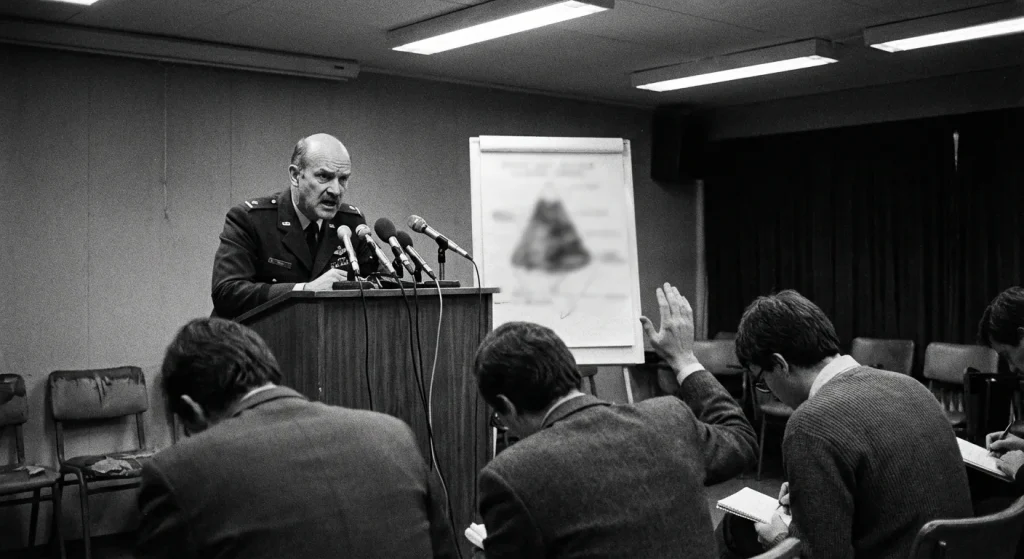
“Official briefings” fit into the timeline after the wave had already generated substantial public reporting, especially following high-profile observations in late 1989 and early 1990. As questions mounted about what (if anything) Belgium’s air defenses had detected, Air Force representatives participated in public communications—most notably a widely cited press conference in 1990—explaining what was known, what had been checked, and what remained unconfirmed.
Background on the Belgian Wave
Reports began in earnest in late 1989 and continued into 1990, with witnesses describing formations of lights and, in some cases, a large, structured object. The wave became one of the most discussed European UFO episodes because it combined (1) a high volume of civilian reports, (2) claims of observations by trained observers (including police), and (3) public statements by military officials indicating they had taken the reports seriously enough to review radar data and scramble aircraft on at least one occasion.
De Brouwer’s Role and Statements
Wilfried De Brouwer was a Belgian Air Force officer who served as a spokesperson/press officer for the Belgian Air Force during the period when the wave was being publicly discussed. In that capacity, he became one of the officials most often quoted in media coverage about what the Air Force had (and had not) been able to confirm.
De Brouwer’s public position, as reflected in contemporary reporting and later summaries, was generally cautious: the Air Force acknowledged that it had received reports and investigated specific incidents, but it did not claim proof of extraterrestrial craft. He emphasized that officials were dealing with a set of observations that were not readily explained at the time, while also distinguishing between eyewitness descriptions and what instruments could verify.
What the Official Briefings Said
The most frequently referenced “official briefing” is the Belgian Air Force press conference held in 1990 in Brussels, commonly cited as having occurred in mid-1990 (often reported as July 1990). At this event, Air Force representatives discussed the wave and addressed questions about whether the military had tracked objects on radar.
Accounts of that briefing typically note the following points:
-
The Air Force acknowledged receiving multiple reports and said that it reviewed available information rather than dismissing the issue outright.
-
Intercept activity was discussed in relation to a key episode in 1990 (often associated with the night of March 30–31, 1990), during which Belgium’s air defenses responded and aircraft were reportedly scrambled. Officials indicated that radar-related information was examined, but they did not publicly present it as definitive proof of an extraordinary craft.
-
No official identification of an “alien” origin was made. Public statements were framed around what could be said from the available data: some reports remained unexplained, but “unexplained” was not equated with “extraterrestrial.”
In short, the documented official messaging from the period is best characterized as: reports were taken seriously; certain incidents prompted military review and response; some elements were not conclusively explained; and no official conclusion of non-human technology was announced.
Public and Media Reaction
The combination of a high number of witnesses and a comparatively open posture from the Air Force contributed to intense media attention. For many observers, the fact that military officials discussed the subject publicly—rather than refusing comment—was itself notable. At the same time, skeptics and investigators raised questions about how to separate misperceptions, astronomical objects, aircraft, and other mundane sources of lights from any truly anomalous events.
What Remains Unresolved
Several aspects of the Belgian wave remain debated, including how to interpret eyewitness descriptions and what weight to give radar-related claims discussed in public sources. Some widely circulated photographs and reconstructions associated with the wave have been disputed or re-evaluated over time, which complicates efforts to treat the entire episode as a single, uniform phenomenon.
Claims about “alien disclosure,” “non-human intelligence,” or a “government cover-up” are often attached to the Belgian wave in modern UFO/UAP discussions, but those are interpretive claims rather than conclusions found in the Belgian Air Force’s public statements from 1990. The more firmly documented record is that officials briefed the public on what had been reported and what had been checked, without endorsing an extraterrestrial explanation.
References
- The Black Vault — Belgian Wave (archival documents and summaries)
- Skeptical Science — The Belgian UFO Wave (critical overview and evidence discussion)
- NICAP (National Investigations Committee on Aerial Phenomena) — Historical UFO case resources
-
GEIPAN (CNES, France) — Official investigative body and methodology for unexplained aerial phenomena
-
Who is General Wilfried De Brouwer in the context of the 1990 Belgian UFO wave?
Wilfried De Brouwer was a Belgian Air Force officer who acted as a public-facing representative (press/spokesperson role) during the period when the 1989–1990 wave was being discussed. He is frequently associated with the Air Force’s public communications about what had been reported, what was investigated, and what the military could (and could not) confirm from available information.
-
What does the term “1990 Belgian UFO wave” refer to?
It refers to a cluster of UFO/UAP reports in Belgium spanning late 1989 through 1990, involving many civilian sightings of unusual lights and, in some cases, reports from police officers. The wave became notable internationally because the Belgian Air Force publicly acknowledged receiving reports and described aspects of its review and response.
-
What does the article cover about official briefings on the Belgian UAP sightings?
It refers primarily to the Belgian Air Force’s public briefings and media communications in 1990—most notably a widely cited press conference commonly reported as occurring around mid-1990—where Air Force representatives addressed the volume of reports and discussed investigative steps. Public accounts also link these communications to the best-known 1990 incident (often cited as March 30–31, 1990), when air-defense activity and radar-related claims were discussed, without an official declaration that the objects were extraterrestrial.
-
How is this article connected to UFO disclosure and UAP disclosure topics?
The Belgian wave is often cited in modern UAP discussions as an example of a government/military taking reports seriously and speaking publicly. However, “disclosure” narratives that frame the case as proof of non-human technology go beyond what Belgian Air Force officials publicly stated in 1990, which was more limited: acknowledgment of reports, discussion of investigative steps, and the point that some elements were not conclusively explained.
-
Does the article treat the Belgian 1990 case as part of current UFO news and UAP news?
No. The Belgian wave is a historical case (1989–1990). It is still referenced in current UFO/UAP debates as a precedent for official engagement with public reports, but it is not inherently “current news,” and it is not framed here around later-year “sightings” keywords.
-
What should you look for when comparing UAP disclosure claims versus a government UFO cover-up, based on this article’s focus?
Compare primary, dated public statements (such as the Belgian Air Force’s 1990 press communications) with later retellings. Specifically, check: (1) what officials actually said about radar/air-defense activity around early 1990 incidents, (2) whether any official source claimed an extraterrestrial origin (they did not, in the documented public record), and (3) whether later “cover-up” claims cite verifiable documents or rely mainly on inference from “unexplained” elements.
