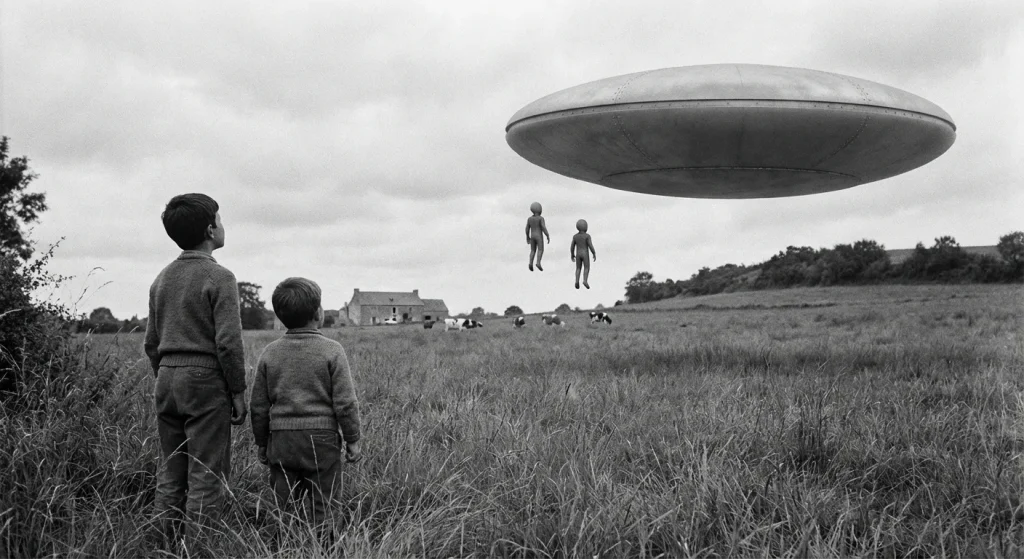
Every week brings fresh UFO disclosure and UAP disclosure headlines, but the story quality swings wildly, and the same older cases keep getting recycled with just enough new framing to feel urgent again. You are left sorting vivid anecdotes from a paper trail that often stays stubbornly out of reach.
The real decision is straightforward: does a resurfacing case point to meaningful evidence for non-human intelligence, or is it simply a durable story that thrives because it is easy to retell and hard to audit?
The tradeoff is the one that traps most readers: a close encounter narrative, especially in daylight and at short range, hits harder than distant lights, but the more compelling the claim sounds, the more it demands sources you can actually check.
That is why the Cussac Close Encounter keeps returning to the center of modern UFO news cycles. The incident is reported to have occurred on August 29, 1967, in Cussac, France, in the Cantal region, and a primary-style summary describes two child witnesses: a 13-year-old boy and a 9-year-old girl. What makes it stick is one striking movement detail repeated in later retellings: small beings are reported to have floated or levitated back into a craft, a visual that feels concrete even decades later.
The friction is that the supplied record does not show a clear earliest local newspaper item, gendarmerie note, or investigator bulletin for this case, which is exactly the sort of documentation that would let you trace what was claimed, when it was claimed, and by whom.
You will leave able to separate what is reported about Cussac from what is documented in the evidentiary trail, and understand why the case persists even when verification remains difficult.
What the children said they saw
The commonly reported narrative places the Cussac incident near Cussac in France’s Cantal region in late August 1967, with the two children described above as the direct witnesses in later summaries. The core claim inside those retellings is consistent in structure: a daylight, close-range observation that ends with the beings rising or floating back into a craft before it departs.
Modern discussion often files cases like this under UAP (unidentified anomalous phenomena) as an umbrella label, while older retellings use UFO (unidentified flying object); the label changes the filing cabinet, not the identification problem. The complication is practical: the more specific the details people repeat, the more this draft has to flag what the supplied sources do not actually preserve in earliest verbatim form.
The reported story begins with the children outdoors in the countryside when their attention is drawn to an unusual object described as a craft on or very near the ground, with figures nearby. Accounts typically frame the scene as quiet and ordinary until the craft and the figures become the focal point, which is why later summaries treat it as a close encounter rather than a distant aerial report.
What is unspecified in the supplied record for this draft is the earliest verbatim description of the craft’s appearance, any count of the figures, and the exact way the children first noticed it (sound, movement, reflection, or simple visibility). Without that early wording, you cannot responsibly conclude whether the initial detection was prompted by a specific stimulus or by general visibility in daylight.
In the commonly repeated timeline, the children move toward the scene and observe it from close range, close enough to distinguish a craft-like object and humanoid-like figures associated with it. The narrative turns on proximity: the observation is not framed as a momentary dot in the sky, but as a sustained look at something occupying the same field as the witnesses.
The missing precision matters. The supplied sources do not provide verbatim earliest statements that lock down distance or duration, and later tellings often compress those variables into a single phrase like “close by” or “near them.” That prevents any firm conclusion about how long the observation lasted, whether it was seconds or minutes, and how much time the children had to check their own perceptions against changing angles, lighting, or movement.
Retellings commonly describe a turning point where the figures register the children’s presence, after which their behavior shifts from whatever they were doing near the craft to an apparent withdrawal. The reported sequence is simple and repeatable: awareness, reaction, and movement oriented toward the craft rather than toward the witnesses.
Several specific details that people often want here are not supported by verbatim early statements in the supplied sources: appearance (including any consistent height estimate, clothing, headgear, or gestures), the number of figures, and any communication or signaling. With those elements absent at the primary-statement level in this draft’s sourced record, you cannot conclude whether the behavior was coordinated, whether it involved direct interaction with the children, or whether the “reaction” was inferred from movement alone.
The signature moment in the Cussac narrative is the reported return of the figures into the craft via an unusual upward motion described in later summaries as rising or floating. This is the detail that gives the incident its distinctive internal shape: not merely figures walking into an opening, but an ascent that reads as controlled and not purely like climbing.
What remains unspecified, based on the limitations of the supplied sources, is how that upward motion was described in the earliest words the children used, whether it was simultaneous for all figures, and what physical reference points the witnesses used to describe it (edge of the craft, ground slope, or surrounding vegetation). Without those anchors, you cannot conclude a mechanism, a height, or even whether “floating” is the witnesses’ term or an interpretive gloss introduced in later retellings.
After the figures are reported to have re-entered the craft, the narrative ends with the craft leaving the area. Later retellings treat departure as the endpoint that closes the encounter: the object is present, associated figures are observed, the figures withdraw via an upward motion, and the craft is no longer there.
What the supplied sources do not provide here are the concrete departure descriptors people usually ask for: acceleration description, trajectory, sound level, and the children’s earliest verbatim phrasing. That blocks conclusions about performance characteristics or even about whether the departure was experienced primarily as motion, noise, a visual transition, or a sudden absence. It also keeps the “immediate aftermath” in the realm of reported summary rather than a reconstructable minute-by-minute sequence of who was told first and in what words.
What we can say from the reported narrative alone: the Cussac story, as commonly summarized, is built from a tight set of elements: two children (13 and 9) reporting a daylight, close-range encounter near Cussac on August 29, 1967; a craft-like object at rest; figures associated with it; an apparent reaction to being observed; an unusual upward “rising” or “floating” return into the craft; and a departure. Treat that as “the reported story,” and reserve judgment about specifics until the documentary trail includes the earliest verbatim statements, because this draft’s supplied sources do not preserve them for appearance, number of entities, communication, exact distance, or duration.
That compact sequence is also why retellings travel so well: it is easy to summarize without needing technical language. The harder question is whether the version being repeated can be traced back to stable, early statements rather than later, cleaner write-ups.
Witness profiles and statement consistency
In legacy close-encounter cases, the handling of witness statements often matters as much as the reported observation. A close-range claim can stay evidentially useful for decades, but only if later write-ups can be traced back to early, stable accounts rather than to increasingly polished summaries.
The commonly cited witness profile is straightforward: a 13-year-old boy and a 9-year-old girl in Cussac, France. Those ages matter because children’s recall is sensitive to how adults react in the first hours and days, and because children rarely control the documentation of their own accounts.
At least one widely circulated secondary summary also describes the witnesses simply as “two child witnesses,” which is consistent with the age framing and shows how quickly a case can collapse into a minimal descriptor once it enters UFO cataloging culture.
Rural context shapes the reporting pathway. In a small community, the first audiences are usually family members and nearby adults, not professional interviewers. That increases the odds that the earliest “record” is conversational, repeated, and socially negotiated long before anyone treats it as a formal statement.
The defensible way to think about statement transmission in a village case is by categories, not by asserting a specific chain this draft cannot document: children tell family, family tells neighbors, a local authority figure hears about it, and only later do outside investigators or UFO groups compile a narrative that becomes the version most readers encounter. Each handoff rewards clarity and completeness, so later retellings often sound more confident and more detailed even if the original account was simpler.
This is where memory contamination enters the picture: not fabrication, but the gradual blending of one’s own recall with repeated questions, adult interpretations, and community talk that adds structure to ambiguous moments.
Child eyewitness suggestibility varies widely across individuals; there is no single “child reliability” setting. The consistent risk factor across the research literature is interviewing effect: leading questions, repeated interviews, and feedback from authority figures can reshape how details are expressed and which details become “fixed” in the witness’s mind.
Across decades of eyewitness research, the details most likely to remain stable are the core scene elements the witness anchored on in real time: the basic setting, the presence of an unusual object or figure, and the primary action that made the event memorable. The details most likely to drift are the ones that require precision under stress or at distance: exact counts, exact sequences, exact durations, and fine-grain descriptors like clothing features, helmet shapes, or step-by-step motions.
The key constraint for Cussac, based on the supplied research set, is that it contains no usable primary retellings or interview transcripts to run a real cross-source consistency audit. That makes the record thin and disputed for this draft, not because the children should be discounted, but because later summaries cannot be reliably mapped back to first-generation statements.
Use a simple discipline when reading repeated summaries of this case: separate the “core claim” from “later ornamentation.” If a later account offers high precision but cannot be tied to an early, documentable statement, treat that added precision as lower-confidence until primary documentation shows it was present from the start.
When the statement trail is this hard to reconstruct, researchers often reach for a different tool: comparison by motif. That can be useful, but it can also smuggle confidence into details that are not actually anchored to early documentation.
Parallels in close-encounter folklore
Recurring motifs are not proof. They are intelligence: a way to classify reports, see what clusters together, and generate testable questions about what drives the similarities. Legacy cases stay discussable for decades precisely because they snap into recognizable patterns that let different researchers argue from the same shared “shape” of details.
Cussac is often grouped with close-encounter motifs that show up repeatedly in catalog-style UFO landing literature: small humanoid figures at close range, clothing that reads as suit-like or helmet-like, little to no conversation (interaction is present but thin), and departure behavior that looks procedural rather than dramatic. Jacques Vallée’s Passport to Magonia is the anchored reference point for this motif-catalog approach because it compiles many visitation-style accounts and explicitly treats modern UFO and “visitor” reports as continuous with older historical and folkloric reports, using that continuity as the interpretive frame. Within that cataloging mindset, even a brief “floating” return functions less as a punchline and more as a tag that links the case to a broader locomotion motif.
Lens 1: Recurrence points to an external phenomenon. Patterning across many reports is exactly what you expect from a real stimulus producing constrained human descriptions: similar-sized figures invite similar “small humanoid” labels; unfamiliar gear gets rendered as helmets and suits; and limited exchange stays limited because the encounter is short and goal-directed. Under this lens, Vallée’s Passport to Magonia and the Magonia database is a crude but useful instrument: it identifies which elements persist across decades and geographies, then lets investigators interrogate the stable pieces rather than the colorful ones.
Lens 2: Recurrence points to narrative contagion and cultural templates. Motifs also spread because they are memorable, portable, and easy to retell. Once “helmeted little beings” becomes the expected grammar of a close encounter, later narratives can converge without any shared external cause, especially when retellings circulate through popular media. The current research set does not supply reliable, case-specific parallels with exact motif matches, so named comparisons should be treated as anecdotal at best, and excluded from serious inference.
What keeps Cussac in circulation is not a single motif in isolation; it is the combination of broad daylight, child witnesses, and close range. Those constraints reduce the wiggle room that usually lets cases drift into pure legend while still leaving enough ambiguity for both readings to remain live.
Use motif comparisons as prompts, not confirmations. Track which details recur across independent sources and early records, then downgrade details that appear only after popular retellings. Patterns do real work when they sharpen questions about sourcing, timing, and transmission, not when they substitute for them.
The same motifs that make a case easy to classify also make it easy to weaponize in today’s debates. Once a story is reduced to a few sticky tags-daylight, children, levitation-it can circulate faster than the documentation that would let you test it.
Why legacy cases matter in disclosure
In 2025 and 2026 UAP discourse, legacy close-encounter reports like Cussac function as raw material. They circulate less as stand-alone evidence packages and more as symbols people use to argue for or against “disclosure,” institutional competence, or a government cover-up. The friction is that symbolism travels faster than documentation, so the case’s evidentiary status stays the same even as the story’s cultural weight inflates.
What revived interest is the structure of the current information environment: public-facing offices, recurring congressional attention, and a steady cadence of headlines about “what the government knows.” That ecosystem rewards classic cases because they are easy to retell, emotionally sticky, and already formatted for clips and threads. The catch is that more official conversation creates a false sense that “more talk equals more proof,” even when the underlying record for any single 1960s report remains uneven.
Public reports and mandates institutionalized UAP intake and reporting after the U.S. Department of Defense established it in July 2022. Its mandate includes quarterly reports, semiannual briefings, and an annual report to Congress, plus a public website that hosts UAP imagery, records, case resolutions, congressional reports, and FOIA releases. That framework raises audience expectations: if the topic has formal pipelines and public artifacts, people assume individual incidents are being “validated” through proximity to the process. Mainstream reporting also exists that a Pentagon report said it found no evidence of extraterrestrial spacecraft, a stated conclusion that still gets misread online as definitive proof in either direction.
The most common failure modes are mechanical: cherry-picked one-paragraph summaries, screenshots of tertiary write-ups, and inflated certainty based on repetition. Cussac gets folded into “UFO sightings 2025/2026” listicles and thread compilations that recycle the same basic identifiers (often the Aug. 29, 1967 date and “two child witnesses”) as if repetition were corroboration.
Use a two-step check. First, confirm the institutional action being claimed (an office created, a report issued, a bill introduced, for example a bill introduced titled to require public release of UAP-related records). Then, separately verify the case itself through primary documentation and provenance. Process is real; it is not automatic validation.
Applied to Cussac, that discipline forces the conversation back to the same issue raised at the start: a vivid anecdote will keep resurfacing, but only a checkable paper trail can move it from durable story to durable evidence.
What Cussac can and cannot prove
Cussac stays compelling because the reported core facts are unusually concrete, but its proof-value is capped by what can be documented from first principles.
The account centers on a specific date and place in 1967 and two child witnesses, framed as a daylight, close-range encounter rather than a distant light. The recurring motif is physical: figures described as floating or levitating, tied to a craft-like object, and the detail that the entities returned to it before departure gives the narrative a structured sequence instead of a single flash impression. Those elements are exactly why the case still circulates decades later.
The supplied research set does not provide a confirmable earliest contemporaneous document for Cussac, so the public record is hard to audit from first principles in this draft. That auditability gap, plus the memory and interviewing risks already acknowledged, means the story cannot be elevated into a verified event without stronger sourcing. The evidentiary bar for physical traces remains clear: dated, original documentation and recoverable, well-provenanced materials that can be independently re-tested.
France’s CNES-linked public archive context (GEIPAN and its predecessors GEPAN/SEPRA) is a plausible pathway for future primary-source checking, not confirmation that a file exists or contains specific claims. AARO’s post-2022 public reporting framework amplifies attention to legacy cases, but it does not validate any single older report.
Rule for 2025 and 2026 UFO sighting claims: treat close encounters as leads to be audited with primary records and traceable evidence, not conclusions to announce.
That is the practical takeaway for Cussac: the levitation detail and the daylight proximity make it memorable, but without the earliest checkable statements and documentation, it remains stronger as a reported narrative than as a documented case.
Frequently Asked Questions
-
What is the Cussac close encounter (1967) case?
It is a reported UFO/UAP close-encounter story said to have occurred on August 29, 1967 near Cussac in France’s Cantal region. Later summaries describe two child witnesses (a 13-year-old boy and a 9-year-old girl) observing a craft on or near the ground with small beings nearby.
-
Who were the witnesses in the Cussac 1967 incident?
Commonly repeated accounts identify two children: a 13-year-old boy and a 9-year-old girl. The article notes that children rarely control how their accounts are documented, which affects how reliably later write-ups can be traced to early statements.
-
What did the children reportedly see the beings do in the Cussac case?
Retellings consistently highlight that the beings “rose,” “floated,” or “levitated” upward back into the craft before it departed. The article emphasizes that the earliest verbatim wording for this motion is not preserved in the supplied record.
-
What key details are missing from the documented record for the Cussac encounter?
The supplied sources do not provide an earliest checkable local newspaper item, gendarmerie note, or investigator bulletin. They also lack earliest verbatim statements that would lock down the craft’s appearance, the number of figures, exact distance, duration, communication, and departure characteristics like trajectory and sound.
-
Why does the Cussac close encounter keep resurfacing in modern UFO/UAP disclosure news?
The case is easy to retell because it has a compact, vivid sequence: daylight, child witnesses, close range, beings, a “floating” return, and a departure. The article says legacy cases often get recycled in today’s disclosure environment because symbolism and repetition travel faster than primary documentation.
-
How do recurring close-encounter motifs affect how researchers interpret the Cussac case?
The article says motifs like “small humanoids,” suit/helmet-like clothing, limited interaction, and procedural departures can be used for classification but are not proof. It presents two lenses: recurrence could reflect a real external phenomenon or could reflect narrative contagion and cultural templates.
-
What should you look for to judge whether the Cussac story is evidence or just a durable narrative?
The article recommends separating the reported core claim from later ornamentation and prioritizing primary documentation with clear provenance. It also advises a two-step check: verify any claimed institutional action (reports/offices) separately from verifying the 1967 case through earliest contemporaneous records and verbatim statements.
