Case Overview
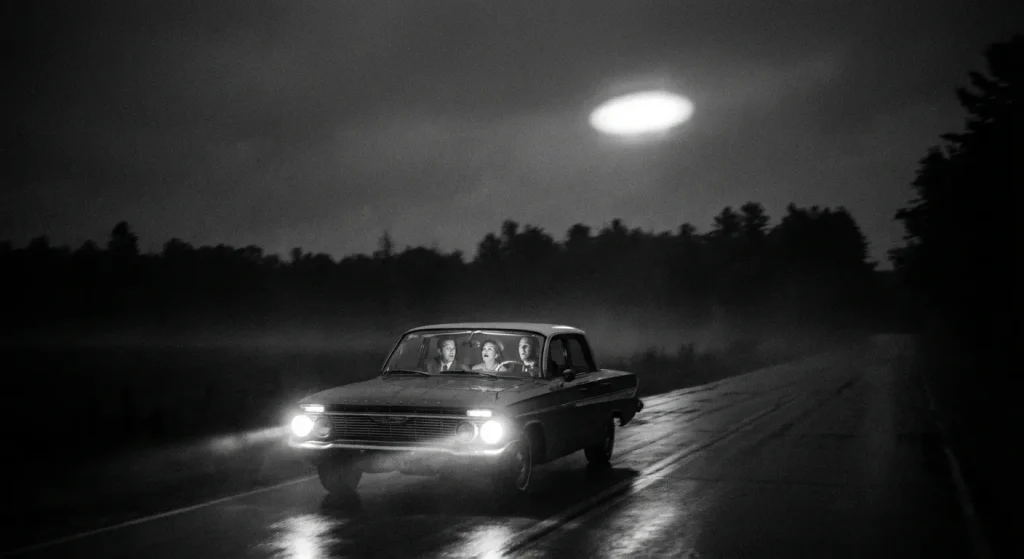
Betty and Barney Hill, a married couple from New Hampshire, reported that while driving home from a vacation in Canada they saw a bright object in the night sky and later concluded they had experienced “missing time.” In the months that followed—especially after hypnosis sessions in 1964—they described a more detailed narrative that included a close encounter and an alleged abduction. The Hills’ account became widely known through journalism and later books, and it is often cited as a foundational case in modern abduction folklore.
Timeline of Events
- Night of September 19–20, 1961: The Hills drove south through northern New Hampshire toward their home (commonly described as traveling on/near U.S. Route 3 through the White Mountains/Lincoln–Franconia Notch area). They reported seeing a bright object that appeared to move and pace their car. The most immediate, on-the-road element of the story is the sighting and their reaction to it.
- Shortly afterward (same night): They later reported realizing they had arrived home later than expected and noticed unusual details (e.g., scuffed shoes, binocular strap damage, and other small anomalies) that they interpreted as consistent with a period of “missing time.”
- Late 1961–1962: The Hills discussed the experience with others and sought guidance, including contact with the National Investigations Committee on Aerial Phenomena (NICAP), which collected accounts of UFO reports during that era.
- 1964: Barney Hill underwent hypnosis with psychiatrist Dr. Benjamin Simon, primarily to address anxiety and sleep issues. Under hypnosis, both Betty and Barney provided more elaborate accounts that included being stopped on a road and taken aboard a craft. These hypnosis-derived narratives are the primary source of the “abduction” details most people associate with the case.
- Mid-1960s onward: The case entered mass public awareness through reporting and later book-length treatments, helping shape popular ideas about alien abduction narratives.
What Betty and Barney Reported
The initial sighting: The Hills said they observed a bright object that seemed unusual in behavior and apparent proximity as they drove through northern New Hampshire at night. They described watching it for a period of time, including at points when they stopped and used binoculars (per later retellings), and they felt increasingly uneasy about its movements and perceived closeness.
Later abduction details (reported after the fact): In subsequent accounts—especially those associated with the 1964 hypnosis sessions—they described a road encounter in which they felt compelled to stop, heard buzzing or beeping sounds, and then experienced a gap in memory. In that later narrative, they described being taken aboard a craft and subjected to examinations by non-human beings. These details were not part of an immediate, contemporaneous “abduction report” on the night itself; they emerged later as the Hills tried to make sense of the missing-time episode and recurring dreams/anxiety.
Investigation & Hypnosis
The Hills’ story circulated through UFO investigative channels, including NICAP, which preserved summaries and correspondence related to many major UFO cases. The most influential development in the case’s public narrative was the hypnosis conducted by Dr. Benjamin Simon in 1964. Hypnosis is sometimes used clinically to explore anxiety and traumatic memories, but it is also widely understood to carry risks of suggestion and confabulation, which can complicate the reliability of detailed recollections obtained in trance states. As a result, many discussions of the Hills’ account distinguish between what they reported contemporaneously (a strange aerial object, fear, and later “missing time”) and what was described later under hypnosis (detailed abduction imagery and events).
Skeptical Explanations
Several skeptical interpretations have been offered over the decades, often focusing on ordinary astronomical or aviation stimuli for the initial sighting (for example, a bright planet or star low in the sky, aircraft, or misperception under stress and fatigue) combined with the psychological dynamics of memory, dreams, and expectation. Other analyses emphasize how hypnosis can produce vivid narratives that feel real to the person recalling them while remaining vulnerable to reconstruction, suggestion, and contamination from later discussion and media exposure. These explanations do not “settle” the case; rather, they illustrate why the Hills’ detailed abduction account is debated even among people who accept that the couple experienced something frightening and unexplained to them at the time.
Cultural Impact & Legacy
The Hill case is notable not only because it received significant attention, but because it helped establish story elements that would recur in later abduction reports: missing time, medical examinations, and non-human entities encountered aboard a craft. It has influenced books, documentaries, and broader popular culture, becoming a reference point in both UFO history and the study of how extraordinary experience narratives form and spread.
Claims About “Cover-ups,” “Non-Human Intelligence,” and “Disclosure” (Neutral Context)
The Hill case is sometimes invoked in modern “disclosure” discussions and in claims about government secrecy or “non-human intelligence.” In this specific case, however, the best-documented record is primarily the Hills’ own testimony, later investigative correspondence, and the hypnosis-derived narratives. Assertions that the Hills’ experience proves a government cover-up or confirms non-human intelligence are best understood as speculative interpretations rather than conclusions established by publicly available primary-source documentation.
References & Further Reading
- Smithsonian Magazine — “The Real Story Behind the Famous UFO Abduction” (overview and historical context; journalistic secondary source)
- NICAP (National Investigations Committee on Aerial Phenomena) Archive (repository for historical UFO investigative materials and case summaries)
- Stuart Appelle, Kevin Christopher, & J. Allen Hynek, The UFO Experience: A Scientific Inquiry (includes discussion of classic cases and investigative approaches; Hynek is a major historical figure in UFO studies)
-
Kathleen Marden & Stanton T. Friedman, Captured! The Betty and Barney Hill UFO Experience (book-length pro-interpretation treatment drawing on interviews and documents; important for understanding the believer-side case)
-
What is the Betty and Barney Hill report from 1961?
It’s the account of a New Hampshire couple who said they saw an unusual object in the night sky while driving through northern New Hampshire in September 1961 and later believed they experienced “missing time.” In later retellings—especially after hypnosis in 1964—they described an alleged abduction and onboard examination, making the case a landmark in UFO and abduction lore.
-
When did the Betty and Barney Hill UFO sighting and alleged abduction take place?
The initial sighting occurred late on the night of September 19 into the early hours of September 20, 1961, as the Hills drove south through northern New Hampshire (commonly described along/near U.S. Route 3 in the White Mountains region). The “abduction” details are not a contemporaneous report from that night; they were described later—most notably during 1964 hypnosis sessions—building on the couple’s earlier report of fear, odd sensations, and a period of missing time.
-
Why is the Betty and Barney Hill case considered one of the most famous UFO sightings?
It combined a widely reported road-trip UFO sighting with a later, highly detailed alleged abduction narrative and became broadly public through mid-1960s media and subsequent books. The case helped establish themes—missing time and medical examinations—that later became common in abduction stories, giving it lasting cultural influence.
-
Is the Betty and Barney Hill incident a UFO sighting, a UAP sighting, or both?
Historically it’s described as a UFO sighting (the terminology of the time), and it’s often discussed today under the broader modern label “UAP” when people talk about historical cases. The underlying event being referenced is the same: a reported aerial object and the Hills’ later interpretation of what happened.
-
How does the 1961 Betty and Barney Hill report relate to UFO disclosure and alien disclosure topics?
People often cite the Hills’ story in “disclosure” conversations as a famous early abduction narrative, but connections to a government “cover-up” or confirmed “non-human intelligence” are claims rather than established facts in the public record for this case. The best-documented materials center on the Hills’ testimony, investigators’ summaries, and the later hypnosis sessions, which remain controversial as evidence.
-
What sources should I consult to learn more about the case?
Start with reputable summaries and primary-source repositories, then compare interpretations. Useful entry points include Smithsonian Magazine’s historical overview, the NICAP archive for case-related materials, and book-length treatments such as Captured! (Marden & Friedman) alongside more skeptical or methodological discussions in works associated with J. Allen Hynek and related investigators.
