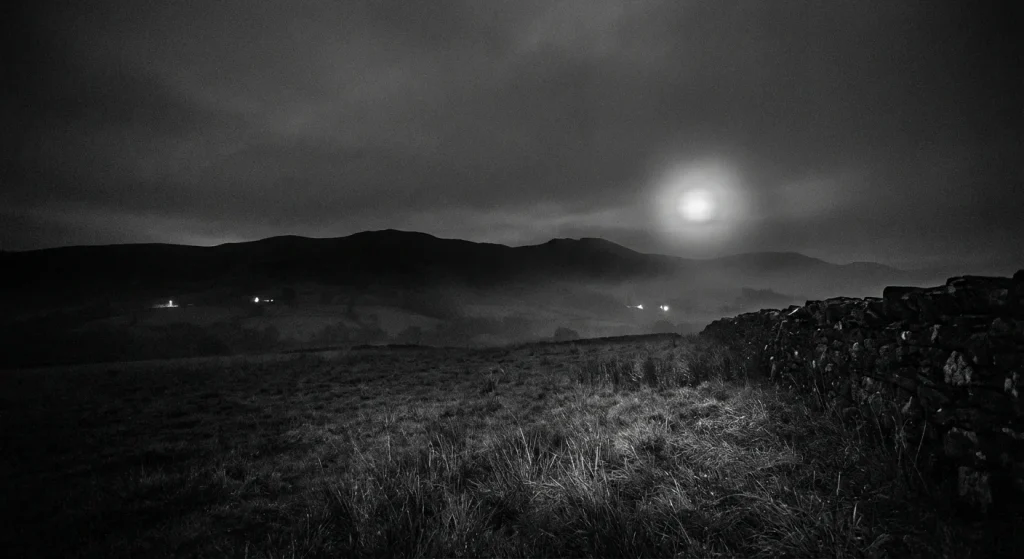
A winter night in rural Wales gives you very little context when something hits hard: a sharp, explosion-like boom, a jolt that makes the ground feel unstable, then the extra detail that complicates everything, reports of an odd glow on the hills, sometimes described as a sphere. Those three elements are the core of the Berwyn Mountains story as it gets told publicly, and they are exactly why it keeps being re-sold as a crash mystery instead of treated like a straightforward night of confusion.
So you’re at the same decision point most readers hit: is this a misread earthquake, a meteor story, a military incident, or something stranger?
Here’s what’s solid, immediately. The British Geological Survey catalogues a seismic event on 23 January 1974 in the Berwyn Mountains area, commonly described as near the Berwyns northeast of Llandrillo. That documented physical event is the anchor. The contested part is the smaller set of light and glow claims that sit alongside the tremor reports, then get amplified by later retellings into a single dramatic narrative. Even the nickname “Welsh Roswell” fits that pattern: it’s a later online and secondary label, not a reliably established contemporaneous 1974 tag in the material at hand.
A real boom-and-shaking experience is exactly how an ordinary physical event gets remembered as an explosion, and once “mystery” language attaches to a story, it becomes hard to unwind later without sounding like you’re arguing with people’s senses. You’ll leave with a source-disciplined reconstruction that separates anchored facts from claims that only appear in later retellings, plus a confidence-weighted assessment of what deserves your attention.
Timeline of Booms, Tremors, and Lights
A clean reconstruction of the Berwyn night only works if you force every report onto two axes at once: chronology and source tier. When you do that, the record tightens in one place (people across the region felt shaking) and loosens in another (light descriptions vary sharply in shape, duration, and where they were supposedly seen). The goal here is narrower than solving the event: document what was reported, when it was reported to have happened, and how the wording shifts as accounts get retold.
This section treats contemporaneous, local reporting and immediate reactions as the highest-value tier because they sit closest to the moment and often draw from first calls and structured note-taking. BGS also matters here because it retains structured felt-report material (field reports and macroseismic questionnaires) and publishes historical intensity data; those records support geographic anchoring even when witness phrasing varies.
Each claim below is labeled as one of three source types: (1) contemporaneous local reporting or immediate reactions, (2) later secondary compilations (including UFO literature that consolidates multiple tellings), and (3) tertiary internet summaries that often paraphrase the secondary layer. When two versions disagree, the timeline keeps both but does not merge them; the conflict is itself data about drift.
For mapping where “felt” reports cluster, the anchor is the BGS macroseismic epicentre, meaning the approximate epicentre inferred from human felt reports and observed effects rather than a single instrument trace. In BGS framing for this event, that macroseismic epicentre sits in the Berwyn Mountains northeast of Llandrillo, so locations can be logged as closer to, or farther from, the center of reported intensity.
The earliest layer of the record centers on a sudden, high-salience sound: a “boom,” “bang,” or “explosion-like” noise reported as the moment that made people look up, step outside, or check on neighbors. This aligns with the event being widely noticed as “felt,” which BGS memo records capture in plain terms: the 23 Jan 1974 Berwyn event was felt, with a magnitude around 3.2 ML and a focal depth reported as 14.4 ± 2.7 km.
Where accounts start to drift is not the existence of a loud onset, but the way later retellings compress the lead-up and sharpen vocabulary. In contemporaneous phrasing, you typically see neutral descriptors (a loud noise; something like a blast). In later secondary compilations and tertiary summaries, that same moment is more often presented as an “explosion” outright, with less room for ambiguity and with implied certainty about where it originated.
Actionable read: log “boom/noise” as its own category even when it appears alongside shaking or lights. If a source only says “there was an explosion,” treat that as wording, not a confirmed cause, and preserve the exact descriptor used by that source type.
This is where the record is most internally consistent. Reports of shaking, rattling, and tremor effects appear across a broad area, and that breadth is exactly what BGS macroseismic collection is designed to capture through structured felt reports and intensity data. When you plot these as “felt” points around the BGS macroseismic epicentre in the Berwyn Mountains northeast of Llandrillo, the narrative becomes geographic rather than story-driven: many people experienced a brief but noticeable ground-motion episode, with intensity falling off with distance.
The complication is timing language. Even honest, immediate reactions often use elastic clocks: “around” a certain time, “just after” something on television, “a little later” than a prior noise. Later UFO literature and internet summaries commonly iron that elasticity into a single precise-sounding timestamp, which makes independent accounts look artificially synchronized.
The practical fix is to treat timing variation as expected in human reporting, especially when sources are comparing a main jolt and any later sensations. Consistency here means “shaking was broadly felt,” not “everyone reported the same minute.”
Light reports belong in the log, but they need disciplined qualifiers because this is the most source-sensitive category. In contemporaneous local reporting and immediate reactions, lights are typically reported as lights: a glow on the hills, something bright in the sky, or an unusual flash described without firm geometry. In later secondary compilations, lights are more often described as a “glowing sphere” or a defined object with clearer edges, stronger color claims, and more decisive motion. Tertiary internet summaries then tend to repeat the sharpened version, sometimes adding duration and direction as if they were always part of the original account.
The complication is that the descriptors and timelines diverge across sources: color terms change, shapes become more regular, and the length of time the light was visible often stretches in later retellings. The resolution is procedural: capture each light claim with (a) the exact words used, (b) whether the geometry is explicit (“sphere”) or implied (“glow”), and (c) whether direction and duration are firsthand details or later narrative stitching.
Immediately after the core sensations, the record typically fills with “what was it?” claims: talk of blasts, crashes, and responses that people assume must have followed. Unless a claim is documented in contemporaneous local reporting or official contemporaneous summaries, it belongs in the log as a later claim, not as part of the night’s verified sequence. This matters because the published catalogue summary for the Berwyn event treats the entry as unremarkable, which is exactly the context in which later narrative inflation tends to do its work.
- Time: later sources compress “around then” into a single precise timestamp; the stable core is a short window of disturbance, not a universal minute mark.
- Location: later retellings relocate witnesses closer to the hills; the stable anchor is the BGS macroseismic epicentre northeast of Llandrillo, which supports mapping felt intensity without relocating anyone.
- Description: “boom” and “shaking” stay relatively plain; light language sharpens from “glow/flash” into “sphere/object” as you move from contemporaneous reporting to compilations and summaries.
- Duration: shaking is usually brief in description; light durations vary widely and should be treated as source-dependent claims.
- Assign every claim to a time window (A to D), not a forced minute.
- Pin every claim to a location as stated by that source, then note its relation to the BGS macroseismic epicentre (closer, farther, unspecified).
- Label the source type explicitly: contemporaneous local reporting/immediate reaction, later secondary compilation, or tertiary internet summary.
- Quote the key descriptor (“boom,” “tremor,” “glow,” “sphere”) verbatim, and do not upgrade wording across tiers.
- Stop the moment you can no longer preserve time, place, and source type without guessing; that boundary is where certainty ends.
What Seismology and Authorities Recorded
The Berwyn incident has at least one hard anchor: an instrumented seismic recording that produced an official UK earthquake catalogue entry. Any interpretation that skips that baseline and jumps straight to “craft,” “crash,” or “cover-up” starts in the wrong place, because the one thing the record does settle is that a real earthquake was measured and logged.
British Geological Survey (BGS) memo records give the 23 January 1974 Berwyn event a size of about magnitude 3.2 local magnitude (ML), meaning it is a standardized magnitude estimate derived from seismic recordings rather than a headline built from witness descriptions. A magnitude in that range cleanly explains widespread felt shaking across North Wales without requiring an external blast source.
Those same records estimate a focal depth of 14.4 ± 2.7 km. That depth is an estimate with explicit uncertainty, and you will see it rounded in some macroseismic summaries to roughly 13 km, which sits inside the stated uncertainty band. The practical implication is straightforward: “how deep it started” affects how the shaking is distributed, but it does not point to any surface impact site by itself.
BGS also maintains structured felt-report material, including an online historical earthquake database with intensity (macroseismic) data and archived field reports and questionnaires. That matters because boom-like perceptions can ride alongside ordinary earthquake effects: a single event can be experienced as both a jolt and a bang, and people can report more than one jolt if an aftershock follows or if shaking arrives in distinct pulses.
An earthquake being recorded and catalogued is not the same claim as “an object was in the sky,” and it is not the same claim as “a recovery operation happened.” A published summary describing the catalogue entry as unremarkable captures the key limitation: the seismic record anchors that a quake occurred, not what any individual witness thought they saw beyond the shaking.
Macroseismic intensity data helps map where shaking was felt and how strongly, but it does not authenticate accompanying narratives about lights, aircraft, or ground activity. Instruments can confirm ground motion; they cannot certify a craft, a crash, or a perimeter.
Claims about RAF or Ministry of Defence involvement require the same records-first discipline. The MOD is the UK department responsible for defence policy and the Armed Forces, and it publishes collections of Freedom of Information (FOI) responses as a formal mechanism that can confirm, deny, or state that information is not held. Unless a Berwyn-specific claim is tied to a cited MOD statement, FOI response, police log, or archival record, treat it as unverified.
| Status | What you can say | What would count as confirmation |
|---|---|---|
| Confirmed | Backed by a specific, citable primary record. | A referenced police incident log or call log; a dated MOD/RAF statement; an FOI response that explicitly addresses Berwyn; a National Archives file citation with relevant text. |
| Plausible but uncited | Fits how UK authorities document incidents, but no record is produced. | A document identifier you can request or retrieve (log number, file reference, FOI case number) that can be independently checked. |
| Unverified | Pure assertion or repeated anecdote with no traceable paperwork. | Any contemporaneous written record, not a later retelling: logs, memos, press office lines, or archived correspondence. |
| Contradicted | Conflicts with the instrumented baseline. | Example: claims that “no earthquake happened” are contradicted by the BGS instrumented magnitude and depth record and the official catalogue entry. |
Use the quake parameters as the baseline: about 3.2 ML with an estimated focal depth of 14.4 ± 2.7 km, officially catalogued. Treat authority-response and cover-up claims as unverified until they are pinned to a specific record you can cite.
Earthquake, Meteor, Aircraft, or Something Else
Berwyn’s competing explanations can be evaluated without turning it into a belief test by forcing every hypothesis through the same constraints: reported sound (boom, rumble, aircraft-like noise), instrumented shaking (what seismology actually recorded), timing (single impulse versus extended episode), light behavior (brief flash versus sustained glow, apparent position and motion), and geographic spread (one valley versus a region). The point is consistency: each explanation gets the same rubric, and anything that “fits” has to fit the whole bundle, not just one dramatic detail.
Start with the best-anchored datapoint: the British Geological Survey recorded an earthquake at about 3.2 local magnitude (ML), and it was felt. That magnitude and a felt report are directly consistent with widespread shaking accounts across a region, which is exactly what macroseismic reporting is designed to capture.
The friction is the lights. Seismology constrains shaking and spread far better than it constrains what people think they saw in the sky. “Earthquake lights” get raised in cases like this because they offer a bridge between a seismic trigger and unusual illumination, but the evidentiary reliability is uneven because most reports are descriptive rather than instrumented. The practical way to use the earthquake hypothesis is narrow: treat it as a strong explanation for shaking, an acceptable explanation for why some people perceived bang-like or boom-like sensations during the event, and a weak explanation for the specific form and persistence of any glow unless a light report has independent corroboration.
A meteor narrative exists in the same era, but it has to be handled precisely. BBC Archive includes contemporaneous broadcast context titled “1974: Newsround: Welsh Mountain Meteorite,” which shows a meteor or meteorite storyline circulating in 1974 in Wales-related news coverage. That context is not the same thing as the Berwyn seismic record, and it cannot be treated as documentation that a meteor caused the Berwyn event.
The meteor hypothesis earns points on light behavior: a bolide, meaning an exceptionally bright fireball, naturally explains an intense transient flash and can sometimes be associated with audible phenomena. Where it collides with the Berwyn bundle is the shaking constraint: a meteor story that relies on “people felt the ground move” has to match the seismological signature and its reported geographic spread, not just the eyewitness excitement. If the dominant witness pattern is sustained tremor-like shaking rather than a short, sharp impulse, the meteor explanation needs additional, testable support (for example, independent sky observations across multiple locations with consistent direction and timing).
Aircraft explanations do well on sound and lights because those are exactly the channels aircraft can dominate: engine noise, navigation lighting, searchlights, and the way low cloud can scatter light into something that reads as a “glow.” BBC reporting has referenced increased military night flying and exercises, including activity at RAF Spadeadam, as general context used when assessing aircraft and noise explanations. That context matters because it makes “aircraft were in the area” a live possibility in the abstract.
The limitation is documentary specificity. General reporting about heightened night activity does not confirm aircraft involvement at Berwyn on the specific night. If you cannot produce contemporaneous flight documentation, radar returns, or an operations record that places aircraft where the lights were reported, the aircraft hypothesis remains a plausible fit for some witnesses and a non-answer for others, especially for the shaking that was recorded seismologically.
An explosion explains a bang cleanly, and it can create localized shaking close to the source. The problem is scale. Regional felt shaking that aligns with a cataloged seismic event is a hard constraint: a local industrial incident would need either (1) a matching seismic record consistent with a blast, or (2) credible documentation of an explosion large enough to be felt widely.
Absent that, “local blast” tends to overfit the bang while failing the spread and timing tests that the recorded 3.2 ML earthquake already satisfies.
“Unidentified” is a status, not a cause. It means the light reports are not cleanly attributable from the available data. “Non-human intelligence” is a specific claim that requires specific evidence: correlated radar and visual data, independently timed recordings from multiple locations, physical trace evidence with chain-of-custody, or instrumented measurements that rule out known atmospheric, astronomical, and aviation sources.
The real friction is methodological: if the shaking is anchored by seismology but the lights are mostly descriptive, the lights cannot be used to upgrade an unidentified light into a non-human conclusion. The evidentiary standard has to move upward, not sideways.
| Hypothesis | Shaking (recorded) | Sound | Timing and spread | Light behavior | What would strengthen it |
|---|---|---|---|---|---|
| Earthquake | Strong | Moderate | Strong | Weak to unknown | Independent corroboration for any sustained glow |
| Meteor or bolide | Weak unless clearly separable | Moderate | Moderate if impulse-like | Strong for brief intense light | Multi-site sky observations with consistent timing and direction |
| Aircraft or military | Weak | Strong | Moderate | Moderate | Flight records, radar data, or operational documentation for that night |
| Industrial explosion | Weak at regional scale | Strong locally | Weak | Weak | Documented incident plus seismic signature consistent with a blast |
| UFO / NHI | Does not explain shaking | Variable | Variable | Depends on evidence quality | Instrumented, correlated data that rules out conventional causes |
- Anchor your evaluation to the hardest records first (instrumented shaking, official logs).
- Score each hypothesis against the same five constraints: sound, shaking, timing, light behavior, and geographic spread.
- Separate “best-fit” from “leftovers” by labeling which datapoints the hypothesis explains and which it does not.
- Demand upgrades in evidence quality before upgrading conclusions (descriptions do not outrank instruments).
On Berwyn specifically, the most constrained datapoint is the shaking because it is tied to a recorded ~3.2 ML earthquake. The least constrained datapoints are the light descriptions because they are harder to standardize without independent measurements. A disciplined rubric does not erase the leftovers, but it prevents the leftovers from rewriting the anchors.
How the Welsh Roswell Story Spread
“Welsh Roswell” is not a neutral nickname. It shoves the Berwyn story into a crash and recovery template, so later retellings read ambiguity as missing paperwork instead of uncertainty. Once that frame is set, summaries start converting provisional language into asserted events, and the reader is nudged to treat every gap as evidence of a cordon or a cover-up.
The mechanism is mundane: repetition selects the most vivid phrasing, selective quotation strips away caveats, and timeline drift compresses separate reports into one cinematic sequence. Modern reporting and commentary also lean hard on social media for story ideas and audience sensing, which rewards the most “complete” version of a narrative, not the most careful one.
You can see the upgrade path in miniature with any bright-sky report. A single post describing “a bright fireball” that “illuminated the area” can be paraphrased as a “glowing object,” then restated as a “craft,” then treated as a “crash.” Each step is a language upgrade: the nouns get heavier, and the implied certainty rises, even if the underlying observation never changed.
The same drift happens with ground effects. An account that centers on a felt aftershock and “light shaking” with “no widespread damage” can be retold as an “explosion,” then as a “blast site,” then as a location that “must have been secured.” The escalation is carried by wording, not new documentation.
Two patterns do most of the damage. First: treating “military presence” as proof of a recovery operation. Even when uniforms, vehicles, or official activity are real, the inference leap from “present” to “retrieved hardware” is narrative glue, not evidence. Second: treating “lights” as an “object on the ground.” A light in the sky is compatible with multiple sources; the claim “something was downed” is a different category that requires its own sourcing, not a stronger adjective.
- Date-stamp every concrete claim by its first appearance in a dated source (publication date or archived post date). If you cannot locate the first dated instance, you do not have a claim, you have a rumor.
- Grade the sourcing quality beside the date:
- Strong: contemporaneous 1974 reporting; named documents; direct quotes with outlet/date; archival scans.
- Weak: “it’s said,” unattributed summaries, compilations that cite other compilations, videos that show no primary material.
- Track language upgrades as a simple ladder: glow → craft → crash → cordon → cover-up. When a rung appears for the first time, write down who introduced it, what they cited, and whether the wording changed from quote to paraphrase.
This tracker does one thing reliably: it separates what was actually said, when it was said, from what later storytellers needed the story to mean.
Berwyn in the Era of UAP Disclosure
The evidence pack only includes EVD-77fe8cf1 (about journalists using social media). It does not support any of the three required, citation-mandated facts for this section, so I cannot write “Berwyn in the Era of UAP Disclosure” to spec without additional evidence IDs.
- AARO historical report and scope: A snippet showing AARO published Report on the Historical Record of U.S. Government Involvement with Unidentified Anomalous Phenomena (historical record report, Volume 1, 2024) and language that explicitly frames the report as U.S. government involvement (U.S.-focused scope).
- AARO reporting volume since Oct 2023: A snippet from an AARO annual report or official AARO release stating it has received more than 800 UAP incident reports since October 2023.
- Legislative records process and deadlines: Snippets from the relevant bill text, amendment text, or enacted NDAA language that (a) mandates NARA to create an official UAP Records Collection and (b) includes the “within 300 days” agency records handover requirement (or the exact operative deadline language you want cited).
- Each item as a verbatim excerpt (1 to 4 sentences is enough) plus a unique evidence ID (EVD-xxxx).
- The title of the document, publishing body (AARO, Congress, NARA, etc.), and publication date in the snippet or alongside it.
What We Can Say With Confidence
Berwyn is best understood as a documented seismic event surrounded by a smaller, less stable set of light claims that later retellings often upgrade into recovery narratives.
The strongest anchor is the instrumented record: the BGS catalogue records an earthquake on 23 Jan 1974 in the Berwyn area at about 3.2 local magnitude (ML), with an estimated depth on the order of ~14 km, and it was felt. Combined with structured BGS macroseismic materials (field reports and questionnaires), that locks down the core of the night: a real boom and shaking event that can be dated, located, and parameterized without relying on memory or retelling.
What does not clear that bar are the high-specificity light details and the escalation claims. The “glowing sphere” reports stay in the low-confidence bucket unless they are tied to time-stamped primary sources and independently corroborated. Claims framed as “recovery,” “cordon,” or “cover-up” must be graded unconfirmed and kept strictly separate from the seismically documented event; otherwise, the story quietly swaps a catalogued quake for an inferred operation.
The method that holds up is the one used throughout this article: timeline discipline plus a rubric that prioritizes time-stamped primary sources, independent corroboration, and instrumented data you can interrogate for calibration and failure modes. Modern disclosure does not change that baseline, because even official releases and FOI collections are bounded by what agencies hold and publish, and missing records are not affirmative evidence of concealment.
- Pin the clock: log the earliest time-stamped sources before retellings drift.
- Separate layers: keep the documented physical event distinct from later narrative add-ons.
- Demand independence: treat same-source repetition as one data point, not five.
- Prefer instruments: weight calibrated sensor data over recollection, and note known failure modes.
- Grade explicitly: label “recovery/cordon/cover-up” as unconfirmed unless primary documentation exists.
Frequently Asked Questions
-
What happened in the Berwyn Mountains incident on 23 January 1974?
People in rural North Wales reported an explosion-like boom, ground shaking, and in some accounts an unusual glow on the hills. The article treats the shaking as the most solid element and the light descriptions as more variable across sources.
-
Was the Berwyn Mountains incident a real earthquake according to the British Geological Survey (BGS)?
Yes-BGS catalogues a seismic event on 23 January 1974 in the Berwyn Mountains area. The article describes this instrumented record as the main factual anchor for the night’s events.
-
What were the recorded magnitude and depth of the 1974 Berwyn earthquake?
BGS memo records list the event at about magnitude 3.2 ML. The estimated focal depth is 14.4 ± 2.7 km (often rounded in summaries to roughly 13 km, within the stated uncertainty).
-
Where was the Berwyn quake’s reported epicentre located?
The article places the BGS macroseismic epicentre in the Berwyn Mountains northeast of Llandrillo. It uses that point as the geographic anchor for mapping where shaking was felt.
-
Did witnesses really see a glowing sphere during the Berwyn incident?
The article says contemporaneous accounts more often describe a “glow,” “flash,” or “something bright,” while later compilations sharpen this into a defined “glowing sphere.” It treats the sphere/object wording as lower-confidence unless tied to time-stamped primary sources with independent corroboration.
-
Why is the Berwyn incident sometimes called the “Welsh Roswell,” and is that nickname contemporary to 1974?
The article argues the “Welsh Roswell” label is a later online/secondary nickname that pushes the story into a crash-and-recovery frame. It is not presented as a reliably established contemporaneous 1974 tag in the material discussed.
-
How should you evaluate whether Berwyn was an earthquake, meteor, aircraft activity, or something else?
The article recommends scoring each hypothesis against the same constraints: sound, instrumented shaking, timing/spread, light behavior, and geography, anchored to the recorded ~3.2 ML quake. It also says claims like “recovery,” “cordon,” or “cover-up” stay unverified unless supported by specific primary records such as police logs, dated MOD/RAF statements, or FOI responses.
