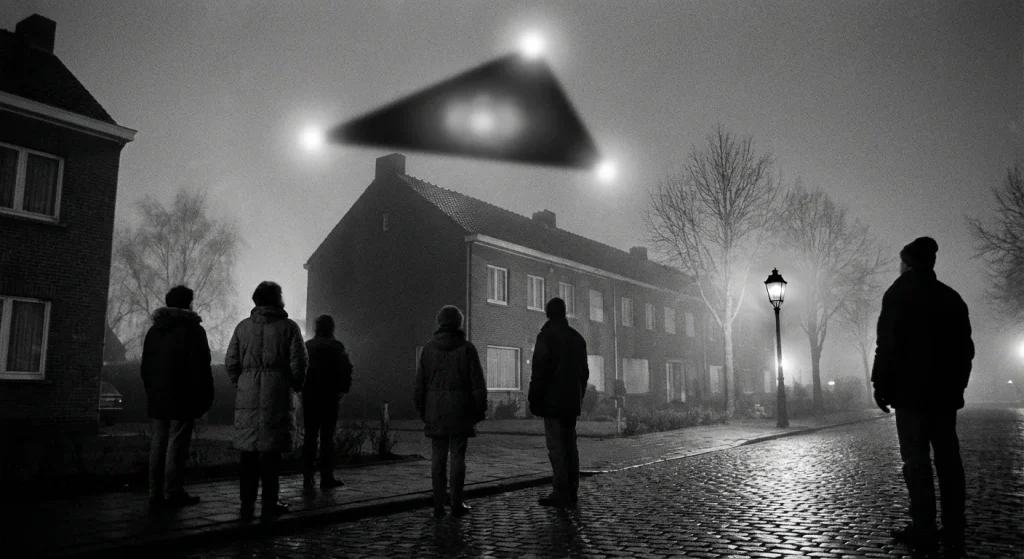
If your 2025 to 2026 feed keeps resurfacing “Belgian military opened the UFO files” headlines, you are seeing a real pattern and a familiar problem: the official touchpoints are clear enough to sound definitive, while the underlying case details stay blurry in the retelling. The Belgian Wave (the widely reported 1989 to 1990 Belgian UFO flap) gets recycled because it is one of the few mass sightings episodes in modern Europe where public, on-the-record military engagement became part of the story, not a footnote.
The tension is simple and it is the entire reason this case still matters. Belgium’s public-facing response created a durable paper trail: dates, a documented military posture, and specific nights that anchor the discussion. But “the military engaged” is not the same claim as “the military identified the object,” and it is definitely not “the military proved an alien craft.” Those are different statements that get collapsed into the same headline, which is how the same Belgian Wave facts get used to argue opposite narratives: a cover-up that slipped, or unusual transparency that stopped short of certainty.
Minimal timing is enough to keep the record straight. The Belgian Wave is commonly described as running from late 1989 into 1990. Sources such as the English Wikipedia article “Belgian UFO wave” (secondary summary) and the Belgian Air Force briefing document “THE UFO BRIEFING DOCUMENT. CASE HISTORIES. 1989-1990” (preliminary contemporaneous report by Major P. Lambrechts, Belgian Air Force General Staff) both identify the peak reference point as the night of March 30 to 31, 1990 (see Wikipedia and the briefing document at The UFO Briefing 1989-1990). More specifically, on March 30, 1990, at least one unknown object was reported tracked on radar and prompted the scramble of jets (see contemporaneous military reporting summarized in the briefing document and summarized in secondary sources such as Wikipedia and The Week).
“Opened files” can prove that reports were received, logged, briefed, and acted on. They can prove what officials said publicly at the time, and what they were willing to put in writing. They cannot, by themselves, transform official attention into official confirmation. By the end of this piece, you will be able to separate what is firmly documented about the Belgian Wave from what is extrapolation, and you will understand exactly why this case keeps getting pulled into UFO disclosure and UAP disclosure arguments in 2025 and 2026.
Belgian Wave timeline and key players
The Belgian Wave is best understood as an escalation story: a run of tightly clustered public reports that grew into an institutional problem because the volume was too visible to ignore. The period is commonly summarized as running from November 1989 until April 1990 (see Wikipedia). The defining feature of the opening phase was density, not a single “best” sighting.
That density arrived fast. On the evening of 29 November 1989, approximately 140 sightings were reported in a small area of Eastern Belgium; that figure is cited in statements attributed to Wilfried De Brouwer and summarized in secondary accounts (see Wilfried De Brouwer statement, “General De Brouwer statement” archived at Scribd and the event summary on Wikipedia).
Descriptions varied, but many reports were grouped together because witnesses kept converging on the same broad presentation: a large, structured object, often summarized in UFO reporting as an “enormous triangle.” That shared headline feature is why the incidents were treated as a wave, even though the underlying record was always going to be uneven from the start.
As reports continued into early 1990, the pattern shifted from a one-night spike to a recurring public workflow: a witness sees something, a local authority logs it, and the story reaches a wider audience that generates more calls. Over the duration of the wave, it involved thousands of witnesses. Contemporary and retrospective compilations cite figure ranges in the thousands; for example, SOBEPS/COBEPS compilations and secondary summaries place total witness reports in the thousands and cite specific tallies that reach figures such as 13,500 in aggregate reporting periods (see SOBEPS/COBEPS “VOB2: Second SOBEPS report” at COBEPS PDF and Wikipedia).
The friction was structural. Police and gendarmerie channels were built to capture immediate public-safety information: time, location, basic description, and whether anything threatened people or infrastructure. Those logs created an auditable trail of public reporting, but they were not designed to run aerospace identification work, preserve technical data, or reconcile multiple accounts into one “official” narrative.
In parallel, civilian investigators built a different kind of record. SOBEPS, the Belgian Society for the Study of Space Phenomena, operated as a civilian investigation group that collected witness statements and follow-ups with a consistency that public hotlines and patrol logs rarely achieve. That work helped consolidate scattered observations into comparable reports, but it carried the limits of any non-state effort: no operational authority, no air-defense tasking, and no ability to compel data release from government systems (see SOBEPS original publications, summarized in COBEPS “VOB2” at COBEPS PDF and background at Wikipedia).
The wave’s peak reference point is the night of 30 to 31 March 1990, the same moment that later retellings tie to radar reporting and an F-16 scramble. By then, the Belgian case was no longer “just” an accumulation of public accounts; it was a situation serious enough to force formal attention and public posture from institutions that normally avoid amplifying unresolved sightings (see contemporaneous briefing material “THE UFO BRIEFING DOCUMENT. CASE HISTORIES. 1989-1990” at UFO Briefing 1989-1990 and summary reporting at Wikipedia).
For readers, that night functions as an anchor because it sits at the intersection of three threads: repeated civilian reporting, law-enforcement logging, and the moment the air force had to treat the situation as an operational matter rather than a public curiosity. The details of what was or was not detected technically are a separate question; the escalation itself is the point that changes how the rest of the timeline is read.
The Royal Belgian Air Force, Belgium’s national military service responsible for air operations and airspace security, occupied the narrowest lane: it could assess potential airspace issues and decide what to communicate publicly, but it could not retroactively convert witness narratives into technical proof. Its public communication strategy has been described in contemporary briefings and later summaries as a two-phase effort: first to provide explanations for individual UFO reports, and then to publish how the Air Force had assessed or “resolved” those sightings in public briefings. That characterization appears in contemporaneous internal briefings and in public statements such as the Wilfried De Brouwer statement (see Major P. Lambrechts briefing “THE UFO BRIEFING DOCUMENT. CASE HISTORIES. 1989-1990” at UFO Briefing 1989-1990 and De Brouwer statement at Scribd).
The Belgian Air Force’s approach to public explanation mattered because it set expectations it could not always meet. A plan to “solve” sightings reads as definitive, but the raw inputs were heterogeneous by design: mixed observation conditions, mixed reporting quality, and accounts arriving through multiple channels with different thresholds for what counted as “actionable.”
One person connects the operational and public-facing sides of that response: the key Belgian Air Force figure most associated with the official response, Wilfried De Brouwer. During the period, he served as Chief of the Operations Division in the Belgian Air Force, placing him at the center of how reports were handled inside the service. His later career underscores why his name carries weight in this history: he later held the rank of Major General and served as Deputy Chief of the Belgian Air Force (see the De Brouwer statement archived at Scribd).
SOBEPS (civilian investigation group) sat outside the chain of command, but it was not sealed off from officials either. A Belgian Air Force staff officer, Major P. Lambrechts, prepared a preliminary report for the Air Force General Staff that was released to SOBEPS, illustrating a boundary that shaped the whole case: the state could share limited cooperation and context while the civilian side could document public testimony (see Major P. Lambrechts preliminary briefing “THE UFO BRIEFING DOCUMENT. CASE HISTORIES. 1989-1990” at UFO Briefing 1989-1990).
The practical takeaway is strict: judge every headline by the chain from witness report to collection channel to institutional action, because that chain determines what any single incident can legitimately prove. That same discipline is also the fastest way to keep “triangle” talk from turning into performance claims the record cannot support.
What witnesses meant by triangles
The “triangle” signature in Belgian Wave accounts is a reporting pattern, not a verified aircraft type. Across recurring descriptions, the core element is a three-point light layout: witnesses describe three milky, yellowish-white lights positioned at the corners of a triangle, often experienced as steady, fixed points rather than flashing beacons. In a subset of statements, the same triangular outline includes an additional light in the center, which strengthens the impression that the lights belong to a single organized object instead of three unrelated sources.
That sense of geometry also appears in compiled incident descriptions. A SOBEPS/COBEPS report describes three white lights forming an equilateral triangle, separated by an estimated 10 meters, a detail that reads like a witness trying to translate an angular pattern into a physical layout (see SOBEPS/COBEPS “VOB2: Second SOBEPS report on the 1989 Belgian ufo wave”, COBEPS PDF).
The broader file context reinforces that “triangle” was not an isolated label. The Belgian Air Force preliminary briefing prepared by Major P. Lambrechts and released to SOBEPS summarizes “enormous triangle” among the main reported shapes (see “THE UFO BRIEFING DOCUMENT. CASE HISTORIES. 1989-1990”, contemporaneous briefing at UFO Briefing 1989-1990), which matches how the triangle configuration became a shorthand for a specific visual signature rather than a single, confirmed platform.
The same triangle pattern can feel highly structured while still being hard to quantify because nighttime perception collapses the cues that normally anchor distance and scale. When three lights are all you have, the brain treats the spacing between them as meaningful, then tries to back-calculate “size,” “altitude,” and “speed” from that spacing. The problem is that angular separation in your field of view does not translate cleanly into meters unless the distance is known, and at night the distance is usually the least certain variable.
That is why reports can sound precise yet diverge wildly in their implied geometry. One circulated case summary (see COBEPS “VOB2” compilation at COBEPS PDF) describes multiple witnesses reporting a gray metallic triangle at about 50 meters, a claim that reads like a confident range estimate but could also reflect how close a light formation felt in the dark rather than how close it actually was.
Motion judgments degrade the same way. With no background reference, slow movement can look like hovering, and small changes in viewpoint can create motion parallax that feels like the object is “sliding” across the sky. Add expectation and attention lock (once you decide the lights form a craft, every drift becomes purposeful), and you get a predictable spread in estimates without any need to assume bad faith or incompetence.
A disciplined read treats “triangle” as a two-layer claim: a reliable statement about a light configuration, and a less reliable statement about the object’s physical properties. Use a simple rule that keeps you anchored to what the report actually establishes.
- Separate the light pattern from the craft claim: three corner lights (often milky, yellowish-white) and sometimes a central light is the repeating observational core.
- Downweight absolute numbers at night: size, altitude, and speed estimates are outputs of an uncertain distance assumption, not independent measurements.
- Elevate only what is cross-supported: multiple independent observers describing the same geometry, consistent timing, or documentation that can be checked against external records.
This approach also keeps unusual narrative details in proportion. A published account describing a triangular object pacing alongside a plane’s wing may reflect a genuinely striking encounter, but the interpretive leap should still depend on corroboration beyond the visual impression.
Triangle reports are strong evidence of a repeated observational phenomenon with a stable visual signature, and weak evidence for precise performance claims unless independent timelines and sensor records line up with what people thought they saw. That framing sets up the next question the Belgian case is repeatedly used to answer: what, if anything, did military sensors and intercepts add to the public reports?
Radar data and F-16 intercepts
The March 30 to 31, 1990 intercept narrative is the Belgian Wave’s most cited “official” element, and it is also the part most often misread as proof of identification. The core public record claim is narrower: in March 1990 the Belgian Air Force scrambled F-16 fighters to intercept reported UFOs. The English Wikipedia article and contemporary reporting both cite that F-16s were launched in response to radar contacts on the night of March 30, 1990; see Wikipedia and The Week summary at The Week.
Public summaries also narrow the operational posture to a repeatable pattern: multiple secondary sources cite that the Belgian Air Force launched F-16s on three occasions during the 1989-1990 wave. For example, The Week article and the Wikipedia entry summarize that F-16s were scrambled on several occasions during the wave (see The Week and Wikipedia).
One more detail consistently survives retellings because it is easy to check against basic operational logic: on at least one occasion during the March 1990 events, two F-16s were launched together. Pair launches are how air forces create mutual support, wider search geometry, and cross-checking between pilots. None of that identifies a target, but it does establish that decision-makers treated the reports as intercept-worthy (see operational summaries in the Lambrechts briefing “THE UFO BRIEFING DOCUMENT. CASE HISTORIES. 1989-1990” at UFO Briefing 1989-1990 and secondary reporting at Wikipedia).
Everything beyond those anchors gets slippery fast, especially once a single line of context gets imported from the witness narrative: people were reporting a large, triangular-looking presence in the sky. That description explains why the events stayed memorable, but it does not tell you what the fighters actually had in front of them.
The intercept story becomes central because it appears to connect civilian reports to military sensing. In reality, the sensing stack spans categories that answer different questions: ground radar can build tracks across wide areas, airborne radar can refine a track from the fighter’s vantage point, and visual observation is the human attempt to turn a track into an object. Those layers do not automatically line up in time, location, or interpretation, even during well-run air defense events.
“Radar lock” needs to be read precisely. A radar lock is a stable track solution the radar can hold onto, sufficient for the system to keep updating position and motion. Lock is not identification. A radar can lock onto a return without telling you whether the source is an aircraft, a formation of returns, a propagation artifact, or an unrelated contact being fused into the same track by timing and geometry. The March 30 to 31, 1990 reports specifically reference a Glons Control and Reporting Centre radar contact about 5 km north of Beauvechain airbase, reported moving at about 25 knots toward Beauvechain, an observation summarized in public and secondary sources (see Wikipedia and reporting summaries such as The Week).
That distinction is why responsible summaries separate “we launched” from “we tracked” from “we saw.” Fighters can be vectored toward a radar contact and still report nothing visually, and that outcome is not inherently suspicious. It is a normal friction point between sensors with different coverage, update rates, and fields of view, operating at night under time pressure.
Disputes cluster around correlation: which radar saw what, whether the fighter’s onboard radar was looking at the same thing as the ground controller, and whether any fleeting track matched the timing of visual reports. If you demand perfect alignment across sensors, you will conclude “nothing happened.” If you treat any one sensor report as decisive, you will conclude “the military confirmed it.” Both moves collapse the evidence ladder.
Another fault line is track stability. Radar systems can produce tracking errors, and one documented class of problem is “double targeting,” where a single plot or track is split into two targets at different positions. Technical documentation on airborne radar behavior and the F-16 radar system context explains how radar plots and track maintenance errors can create split tracks. See the technical AN/APG-66 radar summaries and papers for radar mode behavior and tracking artifacts (see Westinghouse AN/APG-66 description at Wikipedia AN/APG-66 and technical discussion at DTIC report), which clarify how “double targeting” or track-splitting can appear in operational summaries.
Public retellings add a final layer of distortion: verbs get upgraded. “Attempted intercept” becomes “chased,” “contact” becomes “confirmed craft,” and “lock” becomes “weapons-quality proof.” Those upgrades are rhetorically powerful and evidentially lazy. They turn operational response into certainty, even though the entire point of a scramble is to resolve uncertainty.
The disciplined way to read any modern headline that cites “radar lock” or “F-16s chased a UFO” is to force the story back into three buckets: (1) confirmed launches and timing, (2) reported tracks by sensor type, and (3) identification, which is a separate claim that requires separate evidence. Any account that merges those layers is selling confidence it has not earned. The same three-bucket discipline is also the cleanest way to interpret what “opened files” can and cannot prove.
What opening the files really means
“The files have been opened” is not a synonym for “the full truth is out.” It describes a specific evidence event: a government or institution has let some material out of its custody, under rules that shape what you see and what stays back. The friction is predictable: the same limits that protect sources, methods, and private data also create gaps that can look like either a cover-up or radical transparency, depending on what you expected the file to contain.
For clarity, “opened files” in the Belgian context usually refers to material held by Belgian institutions such as the Ministry of Defence and the Royal Belgian Air Force that has been released either via archival publication, declassification, or shared with civilian investigators under limited disclosure arrangements. Examples of primary or near-primary document bundles that have been circulated publicly include the Belgian Air Force “THE UFO BRIEFING DOCUMENT. CASE HISTORIES. 1989-1990” prepared by Major P. Lambrechts (preliminary contemporaneous briefing, available at UFO Briefing 1989-1990), public statements by Air Force officials such as Wilfried De Brouwer (archived statement at Scribd), and the SOBEPS compilations later hosted by COBEPS (see COBEPS PDF). If no single newly released packet is cited in a headline, treat the story as a framework responding to recurring headlines rather than an analysis of a single newly released packet.
A typical “case file” around an incident like the Belgian wave is a bundle of administrative artifacts, not a single master dossier with every sensor readout and every interview transcript. Expect a mix of:
- Witness submissions (typed statements, handwritten notes, standardized report forms) and internal summaries that compress multiple accounts into one narrative.
- Police logs and dispatch notes (who called, when, what was reported), plus follow-up memos that clarify or correct early entries.
- Operational snippets (shift logs, contact reports, brief situation updates) that are written for tempo, not for later public scrutiny.
- Analyst write-ups (working hypotheses, credibility assessments, cross-references to other events) that can read definitive even when they are provisional.
- Public-communication artifacts (press briefing notes, prepared Q&A, speaking points) that preserve what was said on record, not everything known internally.
What’s commonly missing is just as important: raw primary data (full radar recordings, complete audio, original photos with intact metadata), internal routing emails, and anything tied to protected sources. Even basic jargon can be misread when it appears without its operational context, which is why files heavy on summaries and light on primary data invite overconfident interpretations.
Public access and full transparency are different outcomes produced by different rules. Right-to-information (RTI) laws and policies set the parameters for when government-held information is released to requesters, and those parameters usually include exemptions for national security, privacy, and protected operational details. Belgium’s archival and access arrangements are administered through institutions such as the State Archives and subject to domestic rules; for general guidance on archive access see the Belgian State Archives “Protection of Personal Data” guidance at arch.be.
Release can also be conditional even inside government. Declassification is the act of removing or lowering classification so information can be shared, and declassification or downgrading can occur before information is released to beneficiary countries or international organisations. That reality matters because it shows “released” is frequently purpose-bound: shared to enable cooperation or oversight, while still limiting onward dissemination, detail, or attribution.
The Comité I Annual Report 2016 explicitly warned about source protection constraints in intelligence-related files. As the report puts it, “protecting the sources of the intelligence services could have been problematic” in specific cases, and that caution explains why files may be redacted or summarized rather than released in full (Comité I Annual Report 2016, see AR_2016.pdf). That statement is relevant because it identifies a routine institutional reason for redaction and omission that is not an evidentiary admission of concealment but a legal and operational protection.
When you encounter a purported Belgian Wave release, treat it like an evidence bundle and assess what kind of record it actually contains before you treat it as confirmation or rebuttal.
- Document type: Are you looking at primary records (logs, originals) or secondary products (summaries, talking points)? Treat summaries as interpretations, not data.
- Date coverage: Do the documents span the full reporting window, or do they cluster around media peaks and briefings?
- Redactions and omissions: Are pages visibly redacted, are annexes referenced but absent, or does the numbering jump?
- Sourcing signals: Does the text cite who observed what, when, and through which channel, or does it collapse attribution into “it was reported”?
- Chain-of-custody indicators: Look for file numbers, stamps, routing marks, signatures, and revision history that show where the document came from and how it moved.
- Primary data check: Is any original sensor output, audio, or photo metadata included, or are you being asked to trust a characterization of that material?
Use “opened files” headlines as an invitation to assess evidence quality, not as a verdict. Apply the checklist before you share, and treat missing primary data as a known limitation of releases, not as proof of either confirmation or concealment. That release reality is also why legacy cases like Belgium keep returning in modern disclosure arguments: they offer official artifacts, but rarely the kind of primary data that would force a single conclusion.
Why this case matters in 2025
Disclosure cycles don’t just surface new claims; they recycle legacy cases because they deliver instant credibility and emotional charge. A mass-sighting like the Belgian Wave functions as a ready-made precedent: lots of witnesses, official attention, and documentation serious enough to feel “government-grade” even when the underlying explanations remain contested.
The friction is that precedent is persuasive even when it’s logically weak. People treat “it happened before” as proof that “it’s happening again,” and then slide one more step to “therefore it’s non-human.” That jump isn’t evidence; it’s narrative compression. Belgium becomes a shortcut because it feels like a solved argument: if a European military took it seriously, the thinking goes, today’s institutions must be sitting on something bigger.
The practical takeaway is straightforward: when you see Belgian Wave references in 2025 or 2026 UAP news, you’re not watching a new data point enter the record. You’re watching someone borrow the case’s authority to raise the stakes of a current dispute over oversight, transparency, and interpretation.
The modern “signals” that keep the disclosure conversation hot are administrative updates and public testimony, not a single decisive release. One concrete touchpoint is that AARO participated in and that a workshop connected to AARO and the AUI was held in August 2025; workshop summaries and commentary about that event are linked from organizations involved in reporting and outreach such as the National UFO Reporting Center (NUFORC) which posted about the “2025 UAP Workshop: Narrative Data, Infrastructures, …” and related materials at NUFORC workshop page. Workshops and findings reports matter because they show what questions the government is prioritizing and what methods it claims to be using, but they do not function as a verdict on extraordinary origin claims.
Caseload growth is the second signal people latch onto because it looks like momentum. Public summaries connected to modern UAP reporting note caseload increases; sources reporting on AARO and related intake channels indicated an increase in reported cases, with public-facing summaries describing an increase of at least 400 cases since late 2024 in the reporting system referenced by participating organizations (see the NUFORC summary of the AARO workshop at NUFORC workshop page).
The third signal is congressional attention, which creates high-velocity claims that outpace verification. A House committee held a hearing on UAPs/UFOs with multiple witnesses, and major media coverage summarized claims about UAPs and alleged “alien technology” as testimony claims, not adjudicated facts. Hearings are built for public accountability, but the informational hazard is that a sworn claim can circulate like a confirmed finding once it hits headlines, clips, and commentary.
Belgium gets invoked in this environment because it’s legible: it sounds like “serious people took it seriously.” Treat that as a cue to slow down and separate engagement from confirmation. Governments can investigate, brief, or “open files” (declassification/RTI release) without endorsing a conclusion about what the objects were.
- Demand primary documents, not impressions. If a piece cites Belgium as a trump card, check whether it links to original statements, contemporaneous reports, or official memos, or whether it’s recycling a retelling that has already done the interpretive work for you.
- Watch for the engagement-to-confirmation swap. “The military looked into it” and “the military confirmed aliens” are not adjacent statements. Modern coverage often compresses the former into the latter by implication.
- Refuse the unexplained-to-non-human leap. “Unidentified” and “unexplained” describe the state of the record, not the nature of the phenomenon. If an argument uses Belgium to collapse uncertainty into a single extraordinary answer, it’s selling certainty, not reporting evidence.
Use Belgian Wave references as a boundary check: What exactly is being claimed, what is the source, and what would count as confirmation or refutation? That habit keeps you out of binary thinking, where every update is either “proof” or “cover-up,” and puts you back where UAP stories belong: inside claim limits, documentation quality, and disciplined interpretation-exactly the separation the Belgian paper trail forces between military engagement, triangle reports, and any claim of identification.
Frequently Asked Questions
-
What was the Belgian Wave UFO flap?
The Belgian Wave refers to a widely reported UFO flap in Belgium that ran from late 1989 into 1990, commonly summarized as November 1989 through April 1990. It involved thousands of witnesses and became notable because public, on-the-record military engagement became part of the documented story.
-
When was the peak night of the Belgian Wave, and what happened then?
The peak reference point is the night of March 30 to 31, 1990. Multiple summaries describe radar and visual reports that prompted the Belgian Air Force to scramble F-16s to attempt an intercept.
-
Who was Wilfried (Wilfred) De Brouwer in the Belgian Air Force response?
Wilfried (Wilfred) De Brouwer is the key Belgian Air Force figure most associated with the official response during the wave. He served as Chief of the Operations Division at the time and later became a Major General and Deputy Chief of the Belgian Air Force.
-
What did witnesses mean by “triangular UFO” in the Belgian Wave reports?
The recurring “triangle” description was a light pattern: three milky, yellowish-white lights at the corners of a triangle, sometimes with an additional central light. A SOBEPS/COBEPS report also described three white lights forming an equilateral triangle with an estimated 10 meters of separation.
-
How many times did Belgium scramble F-16s during the 1990 wave, and were jets launched in pairs?
One public summary states the Belgian Air Force launched F-16s on three occasions during the 1990 wave. On at least one occasion during the March 1990 events, two F-16s were launched together.
-
Does a “radar lock” during the Belgian Wave mean the military identified a craft?
No-“radar lock” is described as a stable track solution, not identification. The article notes radar can lock onto a return without proving whether it was an aircraft, a tracking artifact, or a contact being fused into one track by timing and geometry.
-
If the Belgian military “opened the UFO files,” what should you look for to judge evidence quality?
Check whether the release contains primary records (original logs/sensor output) or mostly summaries and talking points, and whether the date coverage spans the full November 1989-April 1990 window. Look for redactions or missing annexes, clear sourcing (“who observed what, when, and through which channel”), and chain-of-custody signals like file numbers, stamps, and signatures.
