
You have seen the headlines: “confirmed intercept,” “confirmed UFO,” “confirmed alien craft.” Those three claims are not interchangeable, but the internet treats them like synonyms, and Belgium 1990 is the case most often used to blur the line.
The decision in front of you is practical, not philosophical: what to believe, what to share, and how to spot when “government cover-up” framing is doing more work than the underlying record. If you are trying to stay honest, you need a way to separate what officials acknowledged doing from what anyone can prove about what was in the sky.
Here is the core tension this article resolves. Belgium’s 1989 to 1990 episode is notable because a concentrated run of reports escalated beyond rumor into police attention and a military response that was later discussed in a NATO-related press context. Official acknowledgement of response actions is real. Official identification of an object is not the same thing, and it is the part most headlines quietly smuggle in.
The episode commonly labeled the Belgian UFO wave spans late November 1989 into the spring of 1990, which is exactly why it functions as a case study: long enough, and serious enough, to generate institutional touchpoints that can be checked.
This piece draws a hard boundary between (1) timeline anchors and official statements you can treat as established and (2) interpretations and enduring controversies that remain contested. It also uses the term UAP (unidentified anomalous phenomenon) once, on purpose, because the question is not limited to a “flying object” label; it is about an unidentified report with security and public-safety implications across sensors, witnesses, and official actions.
The acronym is also not a new reframe: sources tracking the term note usage going back to the mid 20th century, with lexical histories recorded by reference works such as Merriam-Webster (see Merriam-Webster on “UAP”).
Key point: every time you see “confirmed” tied to Belgium 1990, read it as a question and demand the missing noun, confirmed action, confirmed data, or confirmed identity.
Belgium’s 1989-1990 Wave: Timeline Anchors and Report Patterns
The Belgian UFO wave became influential for one basic reason: it generated repeated, comparable reports over months, with enough consistency to attract institutional attention alongside public curiosity. The result is a case study in pattern formation, where many separate accounts start to look like a single “wave” once they accumulate, get organized, and get retold.
The first widely reported major cluster of sightings is tied to 29 November 1989 near Eupen. From there, accounts continued across the country through March 1990 and are commonly reported as lasting until April 1990. Those anchors matter because they bound what people mean when they reference “Belgium 1990”: not an isolated incident, but a sustained period of recurring reports that stayed in circulation long enough to shape expectations of what the next sighting “should” look like.
Within that window, the wave is best summarized as an accumulation of recurring descriptions, recurring locations and re-locations, and recurring attention cycles, rather than a clean, day-by-day narrative. Compressing it into a single headline event erases the central feature of the episode: repetition across many nights and many observers, with enough overlap to be compared.
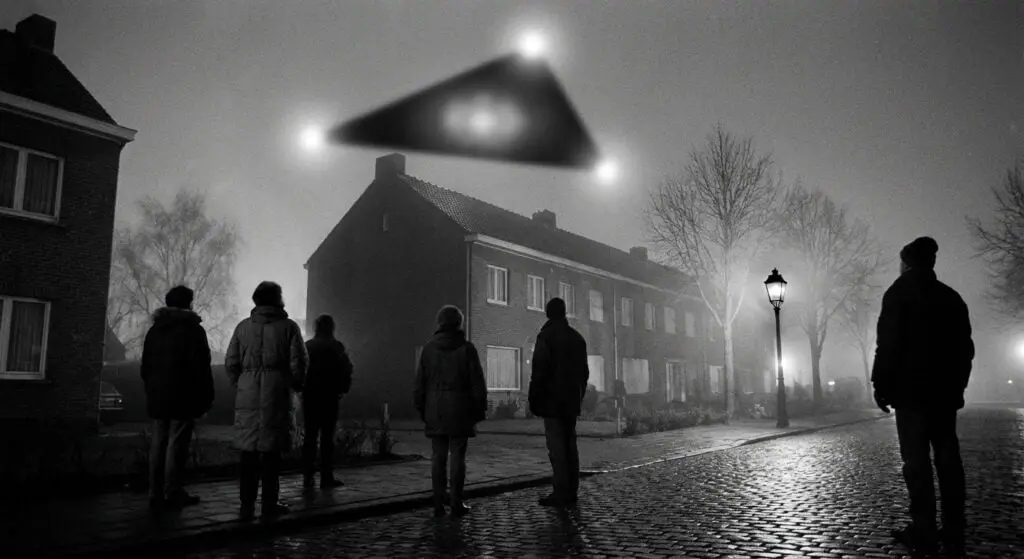
Across the wave, witnesses commonly reported a triangular configuration paired with prominent lights and motion described as silent or unusually slow. Those elements recur often enough in accounts to form the “Belgian triangle” shorthand, but the shorthand is looser than it sounds. Some observers described the lights as scattered and seemingly separate rather than a single related group, which is a meaningful complication: people were not always describing one rigid craft with fixed geometry, even when the overall impression was triangular.
This variability is the disciplined way to read the pattern. The overlap is real at the level of recurring themes in reports, while the disagreements in structure, spacing, and coherence of the lights are equally real at the level of individual testimony. Treating the entire wave as one perfectly consistent description misrepresents what witnesses actually said.
Belgium’s dense population and small geography make repeated reporting and pattern recognition easier: more observers can be looking at the same general airspace, and similar accounts can surface quickly across nearby towns. Once a motif becomes recognizable, additional observers are more likely to describe what they saw using the same reference frame, which strengthens the sense of a unified wave even when the underlying accounts vary.
Documentation also gets amplified by the ecosystem around it. Media attention gives people a shared vocabulary for what to report. Police reports and police engagement occurred, which adds a layer of perceived seriousness without automatically settling what any given sighting was. And organized civilian collection matters because it turns scattered stories into a structured archive: SOBEPS case-file archive functioned as a central node for gathering case files and publishing materials related to the wave, which helped stabilize a narrative simply by standardizing what got recorded, compared, and circulated.
Use “the Belgian UFO wave (1989 to 1990)” as a time-bounded label, anchored to the 29 November 1989 Eupen cluster and the persistence through March, commonly reported into April. Two specific operational date anchors that recur in primary and secondary material are early in the wave (2 December 1989, when F-16s were reportedly dispatched to the Liège area) and the peak night of 30-31 March 1990, when at least one unknown object was tracked on radar and two Belgian Air Force F-16s were involved in an intercept attempt (see timelines summarized in public records and archival highlights). These dates improve specificity without implying that every cited source agrees on every detail of those scrambles.
That report-based foundation matters because it sets up the moment the episode crossed from public description into air-defense procedure. When recurring reports intersected with radar and command-and-control, the vocabulary shifted from what witnesses thought they saw to what authorities attempted to track and manage.
F-16 Scramble and Radar Puzzle
An F-16 launch toward an unknown track is an air-defense response to ambiguity: something is on a controller’s scope that does not reconcile cleanly with the recognized air picture. An intercept (air-policing intercept) is the tool for turning that ambiguity into an operational decision, not a declaration that the target is extraordinary.
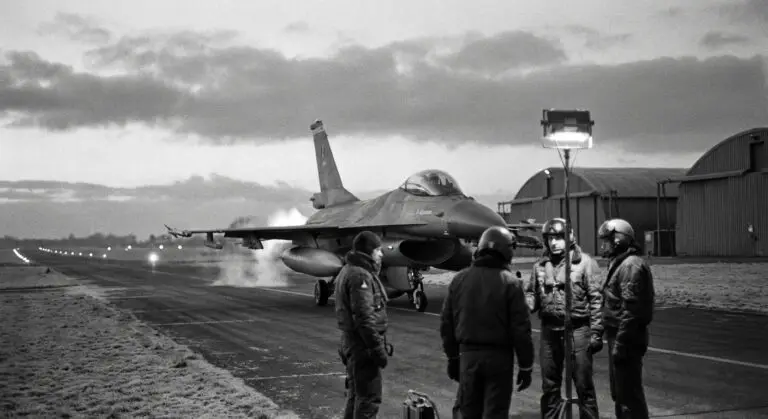
Operationally, the scramble exists because time matters. Scrambles are designed to get fighters airborne within minutes, with the intercept guided by radar centres that can see far more of the airspace than any single cockpit can. That division of labor is the point: controllers manage the air picture and vector the jets; pilots execute the approach and verify what can actually be verified.
The controller’s job is risk management first: prevent an unknown track from colliding with civil traffic, crossing sensitive airspace, or forcing reactive closures. That means building track continuity (is it one object or several returns?), assigning altitude blocks and headings for deconfliction, and positioning the fighters where their sensors can either confirm the track or disprove it.
The pilot’s job is identification and control. “Success” in practice looks mundane: establish radio contact if appropriate, obtain a visual identification when rules and geometry allow, and confirm whether the track behaves like a conventional aircraft (stable heading, predictable speed, transponder response) or like a radar problem (intermittent, geometry-dependent, mode-dependent). Even when the intercept ends without a visual ID, it still accomplishes the core mission if it reduces airspace risk and forces the unknown into a managed box instead of letting it roam unchecked.
That is why intercept outcomes are often binary in the real world: either the fighter achieves a visual ID, or it does not. Everything else is sensor interpretation and should be treated as such.
For readers evaluating “lock-on” claims, the key interpretation pitfall is simple: a lock indicates the radar found something trackable within its chosen mode and geometry. It does not, by itself, establish what that something was. Radar tracks are built from signal processing choices, and different systems, modes, and environmental conditions can produce or break tracks for reasons unrelated to an object’s intrinsic performance. In practice, the questions you should demand are the same: which system, what mode, how long, and is there corroboration across independent sensors. Without those items, “lock-on” remains evidence of an attempted track, not an identification of origin or capability.
What the NATO Press Brief Actually Confirmed
In stories like the Belgium intercept claim, the strongest public confirmation you can reliably extract from an official press setting is typically procedural: aircraft were scrambled, authorities responded, officials briefed the press. That kind of acknowledgment is compatible with routine air-defense operations and says nothing, by itself, about what the object was. The moment you jump from “response confirmed” to “extraordinary identity confirmed,” you are no longer reporting what the communication actually establishes.
Primary briefing/reference (exact item): “Unidentified Flying Objects Briefing Document [The Best Available Evidence]” – section titled “1989-1990: UFO Sighting Wave in Belgium” (archive copy). This is a compiled briefing document available via Archive.org; the item is a compilation that covers the 1989-1990 Belgian wave rather than a single dated NATO press conference. Archive.org briefing document.
Named person appearing in the material: “Marc Valckenaer” is named in the briefing document and is referenced in connection with the SOBEPS study of Belgian sightings; the document cites SOBEPS material. (See the Archive.org link above for the occurrence of the name and the section heading.)
Transcript / primary archive links: Archive.org item above for the briefing compilation; contemporaneous archival highlights that reference operational activity are summarized in UK National Archives highlights (see National Archives highlights guide), and public summaries of the wave are collected on the Belgian UFO wave page (see Wikipedia: Belgian UFO wave).
Verbatim excerpts from primary/archival material (categorized):
- Confirmed data: “1989-1990: UFO Sighting Wave in Belgium” (section heading, quoted from the Archive.org briefing document).
- Confirmed action: “March 1990 the Belgian Air Force scrambled F-16 fighters to intercept reported UFOs.” (summary statement recorded in archival highlights and file summaries; see the UK National Archives highlights guide linked above.)
- Confirmed identity: No verbatim identity-confirming language stating an object identity (for example “this was X”) was found in the cited briefing document or in the archival highlights; the materials document responses and observations but do not contain an explicit authorized identity statement attributing the contacts to a nonconventional source.
“NATO press conference” gets used as shorthand, but it can describe three different things that carry very different evidentiary weight.
(1) NATO as issuer means NATO, as an institution, published the statement or transcript under its own communications apparatus. NATO does have institutional communications and press reference frameworks, which is exactly why provenance matters: you must verify whether the material is an official NATO product or not.
(2) NATO as venue means the briefing took place at a NATO-associated location, without implying NATO authored the claims. This is where location cues mislead. Some source excerpts are tagged with a location reference “Brussels, Belgium,” and Brussels is strongly associated with NATO headquarters. A Brussels dateline tells you where something was said or filed, not who officially asserted it.
(3) NATO as media frame means the event gets described as “NATO-related” because it touches NATO member forces, air policing, or alliance context, even if NATO itself never made a claim. That phrase is not a guarantee of institutional authorship. The NATO Handbook (2001), published by the NATO Office of Information and Press, explicitly uses the phrase “NATO-related information,” illustrating how easily “NATO-related” can function as a category label rather than an issuing authority (see the NATO Handbook (2001) for the published usage: NATO Handbook 2001).
A practical way to keep official-sounding claims in bounds is to sort them by what is actually being asserted:
A) Confirmed action: What was done. Scrambles launched. A response occurred. A briefing was held.
B) Confirmed data: What was recorded or documented. Not interpretations, but the existence of logs, plots, reports, or named sensor outputs as described in an attributable record.
C) Confirmed identity: What the object was. This is the hardest rung to earn, and the one that requires the clearest, most explicit language.
Applied to the Belgium press-claim at a high level: a NATO-associated press context can credibly validate A (official response acknowledged) and sometimes parts of B (officials refer to recorded contacts). It almost never establishes C unless an authorized issuer explicitly states an identification. “NATO confirmed a UFO” is an identity claim; it demands identity-grade wording from an actual issuer, not venue-grade or framing-grade shorthand.
- Identify the issuer: Is the document stamped as a NATO Office of Information and Press product, a NATO HQ release, a Belgian defense communication, or a journalist write-up?
- Lock the date and location: Capture the full dateline (including any “Brussels, Belgium” tag) and treat it as geography, not authorship.
- Name the spokesperson: Find the person, title, and organization affiliation as printed in the transcript or lower-third in the clip.
- Extract exact quotes: Copy the sentence that allegedly “confirms” the claim, verbatim, and classify it as action, data, or identity language.
- Verify the archive path: Note where it lives (official NATO archive, a ministry site, or a media repost) and prefer primary hosting over screenshots and compilations.
- Separate transcript from summary: Mark whether you are reading a full transcript/recording or a reporter’s paraphrase labeled “NATO-related.”
Responsible phrasing follows the ladder: “intercepts and official responses were publicly acknowledged in a NATO-associated press context” stays inside what official communications usually establish. “NATO confirmed a UFO” claims an issuer and an identity that the words on the record rarely, if ever, provide.
Once the press language is sorted into action, data, and identity, the center of gravity shifts back to the evidence itself. That is where Belgium 1990 becomes less a single claim to accept or reject and more a problem of weighing different record types without letting any one of them do work it cannot do.
Evidence, Critics, and Open Questions
Decades after the Belgian wave, disagreement persists for a simple reason: the evidence does not answer one question, it answers several. Some materials speak to what people thought they saw, others to what instruments recorded, and others to how the story was later packaged. The friction starts when a high-confidence answer in one lane (for example, many witnesses reporting a similar shape) gets treated like it settles a different lane (for example, what a primary sensor actually tracked).
| Evidence category | What it can establish well | Limits you cannot paper over |
|---|---|---|
| 1) Witness testimony | Volume and consistency of reported experiences across places and times; the social footprint of the event (who saw, when, and how reports spread). | Perception under low light, distance and stress; memory drift; social reinforcement when a “triangle” narrative becomes the default frame. |
| 2) Police records and notes | Contemporaneous documentation that an officer received a complaint, responded, and recorded particulars (times, locations, directions, basic descriptions). | Variable detail from report to report; not a technical identification; written entries often preserve “what was said” more reliably than “what it was.” |
| 3) Radar, ATC, and military records | Instrumented traces tied to timestamps and system settings; the strongest pathway to reconstructing track behavior independent of human perception. | Interpretation is non-trivial (artifacts and filtering exist); incomplete public release can block independent review; a trace is not an identity label. |
| 4) Photographs and video | Potential visual capture that can be examined repeatedly; a durable artifact that anchors public discussion. | Provenance and replication problems (who shot it, with what, and whether the original exists); later disputes can dominate the artifact’s meaning. |
| 5) Later analyses and summaries | Synthesis across scattered materials; cross-referencing timelines; highlighting internal inconsistencies worth auditing. | Secondary sourcing; selective quotation; conclusions can outrun what the primary records actually contain. |
The clearest example of “imagery dominance” is the widely circulated Belgian UFO photograph attributed to Petit-Rechain (Patrick) in the referenced source, which that source describes as a picture of the Belgian triangle. Treat it as contested terrain: a single image can become the case in the public mind because it is easy to share and easy to remember, even when it carries less probative value than a dull, time-stamped log entry.
On the specific Petit-Rechain photograph, reporting from 2011 states that the image was admitted to be a hoax. Public accounts widely circulated in July 2011 describe a confession or admission that the famous Petit-Rechain photo had been fabricated; see the summary discussion in the Belgian UFO wave literature and public reference pages for the July 2011 reporting and reaction. Because that photograph has acknowledged provenance problems, it should be treated as non-probative for establishing the physical reality of the wave: a hoaxed image cannot corroborate independent radar or police logs, and it must be removed from any evidentiary stack that claims instrumented confirmation. That does not, however, negate independently documented witness reports or contemporaneous police and military logs; it only removes the Petit-Rechain image from the set of reliable primary artifacts (see the public summaries and SOBEPS materials for the broader documentation of the wave and the 2011 reporting on the photo’s provenance).
Critics focus on provenance and independence. Testimony can be abundant and still be mutually reinforcing rather than mutually verifying, especially when a consistent shape vocabulary takes hold. Police documentation is valuable, but it generally records reports and responses, not technical identifications. Radar and military materials are the right category for adjudicating “tracked object” claims, yet interpretation and partial public release make it hard to close the loop. Photographs, including the Petit-Rechain image, attract scrutiny because weak chain-of-custody and replication gaps make them easy to doubt, even when they are culturally iconic.
Proponents lean on convergence: multiple streams that appear to point in the same direction. Many witness accounts line up on broad features, official paperwork demonstrates real-time institutional attention, and instrumented records suggest something worth scrambling to investigate. Later summaries amplify this by presenting a coherent narrative. The persuasive move is cumulative, but the vulnerability is also cumulative: if one stream is over-weighted (especially a famous photo), it can distort how the whole stack is evaluated.
Good records win on two properties: contemporaneity and traceability. Documentary evidence is commonly described as written or typed materials such as reports and log files, and it is strongest when it is time-stamped, authored, and preserved in its original form. Field notes are detailed records made by law enforcement officers during or after an event capturing observations and actions taken; they can prove what an officer observed and did, but they cannot, by themselves, transform a sighting narrative into a technical identification.
Chain-of-custody is the gatekeeper for high-impact artifacts. If a key photo, tape, or plot lacks a clear path from capture to archive, disputes are guaranteed. If primary sensor logs exist, the standard is straightforward: identify which systems produced them, what exactly was released, and whether independent analysts can examine the original outputs rather than a retold conclusion.
- What primary radar, ATC, and military sensor logs exist, and which specific files or printouts were publicly released?
- For widely cited materials (especially imagery), what is the documented chain-of-custody from capture to publication?
- Where do visual reports, radar traces, and later reporting diverge, and which stream is being treated as the “tie-breaker” without earning that role?
Rank evidence by provenance, contemporaneity, and independence. Time-stamped primary records with known authorship and preserved originals deserve priority over retellings and over de-contextualized imagery. Treat identity claims as the highest bar: they require the cleanest chain-of-custody and the most direct, instrumented documentation, not the most memorable photograph.
Put differently, Belgium 1990 is well-supported as a sequence of reports and responses, but not automatically self-resolving as an identification. That distinction is what the final section formalizes: how to talk about what is confirmed without importing an identity claim that the record does not explicitly make.
A Case Study in Official Ambiguity
Belgium 1990’s enduring lesson is procedural: an official response can be acknowledged without any official identification of an anomalous craft.
That is why the headline vocabulary needs discipline. The wave is built from recurring reports across the November 1989 to spring 1990 window, not from a single dispositive instrument reading. The intercept language matters for the same reason: “intercept” and “lock-on” describe a tracking effort, not an identity claim. The NATO press context is where summaries routinely overreach: “confirmed” has to be parsed by what was confirmed (an action, a data point, or an identification) and by who issued it versus where it was said (issuer versus venue). The evidence mix never proves the same thing, either; radar logs, pilot accounts, and imagery each support different conclusions, and imagery tends to dominate public memory even when its interpretation is disputed.
The archival reality is simpler than the mythology. The NATO Archives has two processes by which documents can be declassified and made public, and guidelines for citation and public disclosure of NATO documents are available on the NATO Archives website (see NATO Archives Online and the NATO archives overview at NATO – Official texts and resources: NATO archives). Even then, originator control governs what you will ever see: the originator of information controls classification and is responsible for deciding if and when it can be declassified, which is why high interest does not translate into full documentary access. For general guidance on NATO declassification pathways and archives access, see the NATO Archives portal and library guides collected at NATO Archives Online guide.
- Demand primary records: the transcript, the communiqué, the logbook entry, or the archival reference, not a secondary quote.
- Verify provenance: issuer, date, chain of custody, and whether the document is complete or excerpted.
- Check release constraints: citation rules, classification markings, and whether originator control blocks release even if a repository holds the file.
- Use declassification pathways: look for the NATO Archives’ documented processes and the specific record series they apply to.
Frequently Asked Questions
What time period does the Belgian UFO wave cover, and what date anchors the first major cluster?
The Belgian UFO wave spans late November 1989 into the spring of 1990, commonly reported as lasting until April 1990. The first widely reported major cluster is tied to 29 November 1989 near Eupen.
What did witnesses most commonly report seeing during the Belgian UFO wave?
Witnesses commonly reported a triangular configuration with prominent lights and motion described as silent or unusually slow. Some accounts also described the lights as scattered and seemingly separate rather than a single rigid craft.
What does an F-16 scramble or intercept actually confirm in air-defense terms?
An F-16 scramble toward an unknown track confirms an air-defense response to an ambiguous radar/air picture and an attempt to manage risk in controlled airspace. It does not, by itself, confirm the identity or origin of what was tracked.
What does a radar “lock-on” mean, and why doesn’t it confirm an object’s identity?
A radar lock-on is a tracking state where the system commits to keeping something tracked rather than continuing to search. The article states lock indicates tracking effort and stability, and notes it can break or shift to other reflectors (for example chaff), so “we had a lock” is not the same as “we had the target’s identity.”
What did the NATO-related press context actually confirm about Belgium 1990?
The article says an official press setting can reliably confirm procedural points such as aircraft being scrambled, authorities responding, and officials briefing the press. It emphasizes that this supports “confirmed action” and sometimes “confirmed data,” but not “confirmed identity” unless an authorized issuer explicitly identifies the object.
How can you tell whether “NATO confirmed a UFO” is an issuer claim, a venue claim, or just a media frame?
The article distinguishes NATO as issuer (an official NATO-published statement), NATO as venue (said at a NATO-associated location like Brussels), and NATO as media frame (“NATO-related” context without NATO authorship). It advises verifying the issuer, dateline, spokesperson, exact quote, archive path, and whether you have a transcript versus a paraphrased summary.
What should you look for before sharing a “Belgium 1990 confirmed UFO” claim?
The article recommends demanding primary records (transcript, communiqué, logbook entry, or archival reference) and verifying provenance such as issuer, date, and chain-of-custody. It also says to classify the “confirmed” language as action, data, or identity, and reserve identity claims for cases with direct, instrumented documentation and a clear record trail.