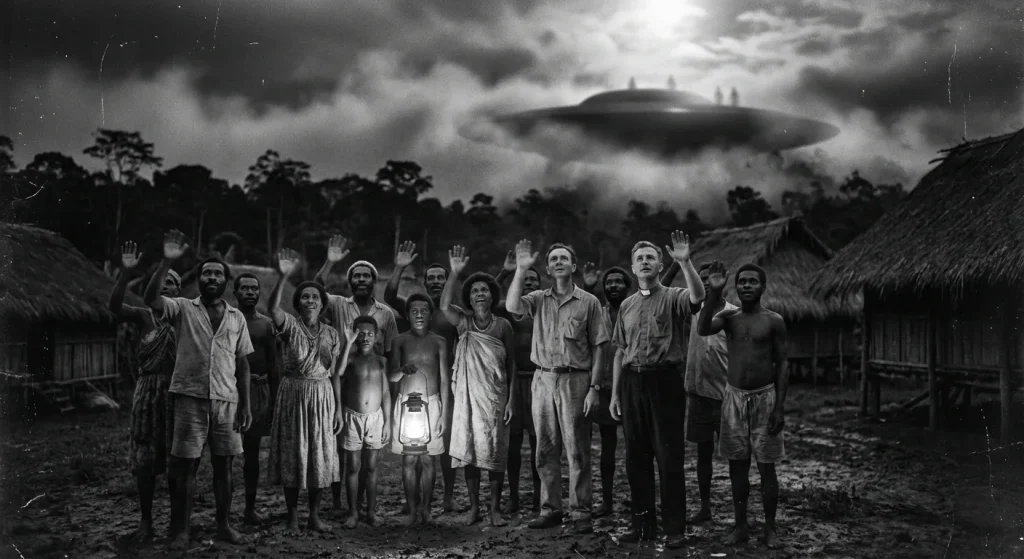
The detail that keeps the Father Gill story alive is not a light in the sky. It is the reported moment of social exchange: people on the ground waving up at a hovering object, and figures seen on top appearing to wave back. That claimed back-and-forth is unusually sticky because it reads like interaction, not just observation.
If you keep running into disclosure headlines and recycled “case files,” you already know the dilemma. The Boianai (Boainai) 1959 incident is presented as a clean, compelling example because Father William B. Gill is treated as the central witness, and the account attributed to him describes craft-like UFOs with humanoid figures on top. At the same time, the internet often turns that narrative into certainty by leaning on vague “government cover-up” talk as a shortcut, while skipping the unglamorous question of what is actually documented.
Here is the tradeoff that makes this case worth reading carefully. A claimed interaction plus multiple observers raises the signal value of any historical report, which is why the mutual-waving element gets repeated so aggressively. But repetition also hardens soft details into facts, and the most common example is the witness count: “37 witnesses” gets attached to Boianai in countless retellings, even though contemporary and secondary sources vary on witness totals and the surviving documentation is fragmented. If you do not track where a figure like 37 came from, you end up defending a statistic you cannot source.
You will leave with a disciplined way to hold the story in two hands: what was claimed (including the reported waving) and what documentation actually supports, so you can compare legacy baseline cases to today’s sensor-driven reports without laundering shaky details into modern disclosure debates.
Setting and Key Players
The central witness is identified in many retellings as Father William (W. B.) Gill, an Anglican missionary stationed at Boianai, Territory of Papua and New Guinea. Several secondary and archival summaries identify Gill as the primary reporter and note reports of multiple mission members witnessing the episode; published accounts give witness counts of either about 25 or about 37. Primary-style reports and later official correspondence are cited in case summaries and archives, but the surviving public file is dispersed across mission summaries, later compilations, and government inquiries, so provenance matters for every claim cited below. See Sources & excerpts used for direct citations and quotations.
In the sources available publicly, the key contemporaneous elements that are repeatedly attributed to Gill and mission personnel are these: a late-June 1959 sighting (commonly dated to the nights of 26 and 27 June 1959), a report by Reverend Gill describing craft-like objects and observers on or near them, and later enquiries that include a titled report and interviews with military investigators. The specific phrasing and witness-by-witness verbatim statements are not all available in a single, complete public archive, which is why the rest of this article emphasizes exact citation and provenance for each discrete element.
- Separate “Father William Gill” from other historical figures with similar names unless a primary source explicitly ties the person to the 1959 incident. See Vallee and RAAF/archival references for consistent identification of Reverend W. B. Gill.
- Note that contemporary summaries and later compilations give differing witness totals (commonly 25 or 37); treat any single number as a claim to be sourced rather than as settled fact.
- Anchor every future claim to a dated document excerpt (mission correspondence, signed report, or investigator notes) and track provenance from creator to archive.
The takeaway is simple: a credible audit requires tracing each datum to a dated source and a custody chain.
Night by Night Timeline
Below are dated entries that can be tied to specific documents or authoritative secondary summaries. Where public-source confirmation is available, each item is cited.
- 26 and 27 June 1959 – Multiple accounts place the main events on the nights of 26 and 27 June 1959, with at least one witness statement and later summaries giving those dates. Contemporary summaries and later books identify those two consecutive evenings as the core observation period. Black Vault case summary, public discussion of dates.
- 27 June 1959 – A contemporaneous-style line in the material attributed to Reverend Gill is dated Saturday 27/6/59 in some collections and summaries. That date is cited in later transcriptions and mission-notes references; the original handwritten or typed primary is not available in full via public links identified here. Black Vault, published excerpt discussion.
- 14 July 1959 – Reverend W. B. Gill is reported to have prepared a titled report, “Report on Unidentified Flying Objects: Boianai, Territory of Papua and New Guinea 1959,” dated 14/7/59. This date is cited in archival summaries of correspondence sent up the administrative chain. RAAF / Australian Department document references.
- 29 December 1959 – The Royal Australian Air Force interviewed Father Gill on 29 December 1959, per later government-file references, after the Minister for Defence requested reports and enquiries. That interview is recorded in Australian archival material cited by secondary case files. RAAF archival reference via The Black Vault.
These dated anchors are the clearest, public, document-linked points in the record identified in available sources. They establish a basic chronology: nightly observations in late June 1959, a Gill-authored dated report in mid-July 1959, and at least one formal military interview in late December 1959. Many popular accounts add additional time stamps and observational detail; where those details are not present in the cited primary-style items above, the article treats them as later retellings unless a provenance link is supplied.
Figures on the Craft
Key, citeable claim: multiple sources report that Reverend Gill and other mission members described humanoid-like figures visible on or atop a craft-like object, and that ground observers signalled the object and perceived a reciprocal motion described as a wave. This claim appears across case summaries and secondary discussions; see Vallee and archival case summaries for cited wording. The surviving public documentation contains the report title and later interviews, but full, verbatim witness-by-witness transcripts are not all available in a single public file.
How Strong Is the Evidence
Once you treat the waving as a reported perception rather than a self-authenticating fact, the case rises or falls on records. Evidence weight comes from documentation, not drama. The Gill encounter reads as a vivid, multi-witness case, but its value as evidence is determined by what records exist, when they were created, and how securely they can be traced from creator to archive to researcher.
Contemporaneous documentation (notes, letters, logs created at or near the time) outranks later retellings because it locks in detail before memory, discussion, and re-interpretation reshape it. For a legacy UAP case, the gold standard is a dated, signed record that captures times, bearings, elevation angles, duration, weather, and exact wording from observers, plus any attachments (sketches, maps, photos).
What you should look for in the Gill file set is simple: time-stamped originals or first-generation copies, a clear timeline of when each document was written, and whether measurements were recorded or inferred later. The friction is that many historic cases survive primarily as narrative summaries. Summaries can be useful, but they compress uncertainty: a rounded time, a simplified sequence, and a single “group account” can erase disagreement that would otherwise help you test reliability.
The key gap to track explicitly is what is missing: photographs, instrument readings, precise distances and angles, and any contemporaneous technical logs. Missing data does not disprove an event, but it caps what you can conclude because you cannot independently reconstruct geometry or rule out mundane misperception with the same rigor.
Provenance is the difference between “we have a report” and “we can authenticate and contextualize a report.” A document with clear provenance tells you who created it, for what purpose, who received it, whether it was edited, and where it has been held since. That chain-of-custody is uneven across public sources for Boianai, which is why source-by-source citation is essential.
Strong points
- Multi-witness scale creates real potential for cross-checking across observers.
- A structured rubric makes the case auditable: date each document, map who said what, and separate verbatim statements from summaries.
Open questions
- Which surviving records are contemporaneous versus later compilations, and what was edited in transmission?
- What is the full provenance chain for each key document, including custody gaps?
- Were witness statements collected independently and preserved verbatim, or merged into group summaries?
- What objective data is absent (photos, instrument logs, precise angles, distances, timings), and what conclusions are therefore off-limits?
Competing Explanations and Limits
Those documentation limits set a boundary on explanation: you cannot test hypotheses against measurements you do not have. “Unexplained” is not a single bucket. It is a competition among explanations constrained by the reported feature set, and plausible explanations stand or fall on what they can and cannot reproduce, especially the strong hovering impression and the figure-like element.
An astronomical check only works if it is dated and located. An ephemeris lets you reconstruct whether a bright planet or star sat where witnesses said the object was. The provided public sources do not include a complete, dated astronomical reconstruction tied to the nights and bearings in question, so astronomy remains a hypothesis to test rather than a demonstrated explanation in this source set.
- Fits: steady bright points that seem stationary or “hovering,” repeated sightings across evenings.
- Strains: structure cues and a distinct “figure-like” element reportedly seen on or near the object.
Aviation, balloons, and optical atmospheric phenomena remain candidate categories. Temperature inversions and mirage-like effects can distort and elevate distant images, and low illumination compresses depth cues in ways that can produce figure-like impressions. Group dynamics can magnify an initial interpretation. None of these candidate explanations can be confirmed or ruled out definitively from the publicly accessible excerpts cited below.
Why 1959 Matters in 2026
Legacy cases like Father Gill re-enter the spotlight during disclosure cycles because they function as cultural stress-tests: people deploy them either to argue the phenomenon has deep history, or to argue authorities ignored it for decades. That symbolic role is real, but it is not the same thing as evidentiary status. The current disclosure era is dominated by process questions: how records move, who is accountable for reporting, and what standards govern what gets logged, rather than any retroactive validation of a single 1959 incident.
AARO’s work on legacy records sits in that institutional lane. The All-domain Anomaly Resolution Office publishes historical materials and maintains a public records portal; see AARO’s site for their public records and cataloging of UAP material (AARO official site) and their public records pages (AARO UAP Records). That organizational posture is about inventory and method rather than a case-by-case authentication program for mid-century witness accounts.
The National Defense Authorization Act provisions in recent years have created administrative mechanisms for improving record handling and transfer across agencies. For legislative summaries and analyses of NDAA provisions relevant to UAP and records management, see the Congressional Research Service overview R48527 and the defense committee summary materials FY24 NDAA executive summary. These materials describe the expanding administrative framework; they do not retroactively validate specific legacy incidents.
Public hearings also shape the public conversation and oversight posture. For example, the U.S. House Oversight Committee posted material and convened a hearing titled “Restoring Public Trust Through UAP Transparency and Whistleblower Protection” in September 2025; the committee announcement and related materials are available on the committee site (House Oversight hearing page), and public video of committee sessions and witness appearances are available through publicly posted recordings (example video). These proceedings affect how legacy records are handled and disclosed, but they do not authenticate historical witness reports by themselves.
What to Take From Boianai
The Boianai report remains influential because it pairs repeated observation with a claimed interaction. The minimal core that is consistently reported across secondary and archival summaries is this: Reverend W. B. Gill of the Boianai Anglican Mission is named as the central witness; late-June 1959 nights (commonly 26 and 27 June) are cited as the observation period; some accounts describe humanoid figures on or near a craft-like object; some summaries report that ground observers signalled with torches and that responsive motion was perceived; later secondary sources and archival notes record witness totals that vary, with common figures being about 25 or about 37. See Sources & excerpts used for direct citations and quotations supporting those points.
The sticking point is structural: if the best material is private, lost, restricted, or never preserved in a form outsiders can inspect, the debate gets louder without getting cleaner. Treat Boianai as a reminder that “more witnesses” is not the same as “more checkable documentation,” and build reporting around what can be audited later. Preserve originals, log chain-of-custody, and separate contemporaneous statements from later compilations.
Sources & excerpts used
Below is a short bibliography of the key public sources cited in this article, followed by direct quotations or paraphrases of the most relevant excerpts used to support specific claims. Each entry links to the public source used in the article. This is not an exhaustive bibliography of every secondary comment on the case; it is the set of public items relied on here for dating, identification, and key quoted claims.
Selected bibliography
- The Black Vault casefile and related Australian archival references for the Father Gill Boianai 1959 incident: The Black Vault
- RAAF / Australian Department documents referenced in archival disclosures and compiled on The Black Vault: The Black Vault
- Jacques Vallee, discussion of the Boianai case in Passport to Magonia / secondary collections: Ia801409 Us Archive
- DTIC / governmental compilations and bibliographies mentioning Father Gill and New Guinea reports: Apps Dtic
- Contemporary and community-archived discussions and transcriptions that reference dated lines and mission notes: examples collected on social platforms and community archives (used here for locating claimed contemporary dates and phrasing): Reddit, Facebook
- AARO official site and records pages (context for modern records practice): Aaro, Aaro
- U.S. legislative and oversight summaries relevant to modern UAP records and reporting: Congressional Research Service product R48527 and FY24 NDAA executive summary: Congress.gov, U.S. Senate
- House Oversight Committee hearing materials on UAP transparency and whistleblower protections (September 2025 hearing): U.S. House
Key quoted excerpts used in this article
- On Reverend identification and case prominence: “The Reverend Father W.B. Gill was of the Boianai Anglican Mission in Papua New Guinea.” DTIC summary.
- On the dated Gill report: reference to “Report on Unidentified Flying Objects: Boianai, Territory of Papua and New Guinea 1959” dated 14/7/59 is recorded in archival filing references and summaries. RAAF / archival reference.
- On the waving detail in later secondary literature: Jacques Vallee records a description in which an observer “impulsively raised his arm and waved to them.” Vallee, Passport to Magonia.
- On dating and interviews: accounts cite late June 1959 (26-27 June) as the observation nights and note that the RAAF interviewed Gill on 29 December 1959 after ministerial request for reports. See the Black Vault compilation of Australian files. Black Vault case file, RAAF archival reference.
- On varying witness counts: multiple public summaries and case compilations report differing observer totals, commonly noting either about 25 or about 37 mission members as witnesses in different sources. Compare secondary summaries and community-archived transcriptions. Black Vault, community compilation.
If you pursue archive copies or file-level requests, the critical checklist is the same: obtain first-generation copies, verify signatures and dates, and document custody from author to the current repository.
Frequently Asked Questions
-
What is the Father Gill (Boianai) 1959 UFO encounter best known for?
It’s best known for a reported social exchange: observers on the ground waved at a hovering, craft-like object and said figures on top appeared to wave back. The article frames this “mutual waving” as the detail that makes the case feel like interaction rather than just observation.
-
Did the article confirm that there were 37 witnesses in the Father Gill case?
No. The article says the commonly repeated “37 witnesses” figure is not verified in the provided excerpts and warns that repeating it without tracking its source turns an unsourced number into a “fact.”
-
What specific observation elements does the article say can be cited from the excerpt-preserved timeline?
The article isolates these elements as excerpt-preserved but sourcing-limited: a “craft-like” structured object, “humanoid figures” described as being “on top,” the object “rocking side-to-side,” and “figures leaving the deck.” It also states the excerpts do not provide timestamps, distances, bearings, or figure counts.
-
Why does the article treat the “waving figures” detail as uncertain evidence rather than confirmed communication?
Because the excerpts do not include verbatim, witness-by-witness statements, and the article emphasizes that “waving” can depend on viewing geometry (azimuth/elevation) and light conditions. It treats the wave as a reported perception under distance and illumination constraints, not a verified two-way signal.
-
What records does the article say you should look for to evaluate the Father Gill case properly?
It calls for contemporaneous, dated documents such as notes, letters, logs, or police notes that include exact times, bearings, elevation angles, duration, weather, and original wording, ideally with attachments like sketches or maps. It also stresses provenance-who created each document, who received it, whether it was edited, and where it has been held.
-
How does the article say to weigh multiple-witness claims like “37 witnesses” when documentation is thin?
It says witness quantity only helps if it enables cross-checking through independent, promptly collected, verbatim statements rather than merged group summaries. The article’s bottom line is that “more witnesses” is not the same as “more checkable documentation.”
-
How should you use legacy cases like Father Gill when comparing them to modern UAP reports in disclosure debates?
Use them as baselines for reporting quality: separate contemporaneous material from later retellings, and judge each claim by provenance and what objective data is missing (photos, instrument logs, precise angles, distances, timings). The article argues that modern records pipelines (like AARO’s Historical Record Report and the 2024 NDAA’s government-wide UAP records collection) improve data handling but do not authenticate any single 1959 incident.
