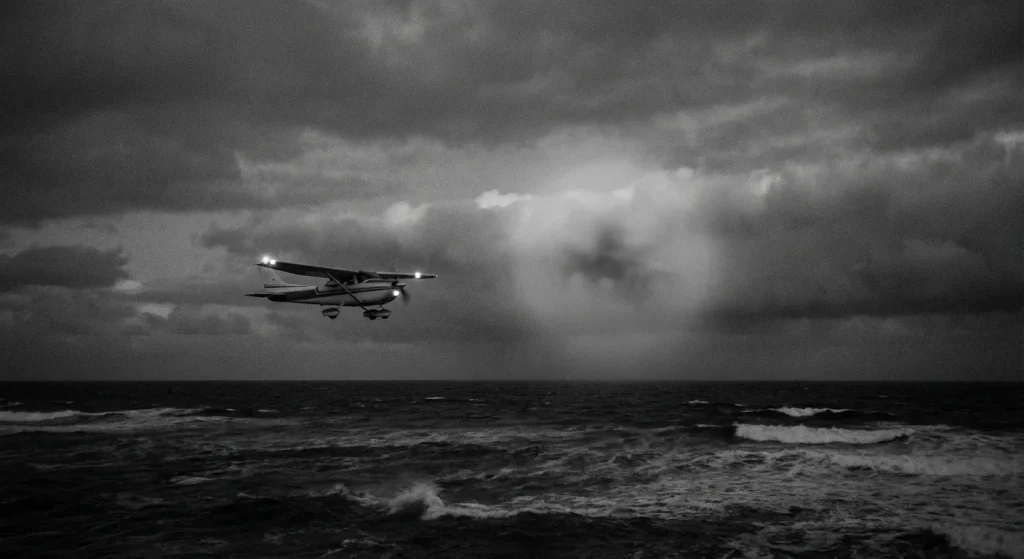
Every retelling sounds certain until you look for what’s actually documented. The Frederick Valentich disappearance keeps getting sold as a closed narrative: a routine evening hop over Bass Strait, a calm radio exchange that pivots into an “unknown object” report, and then silence where the next transmission should be.
The stakes were never abstract. Valentich was 20 years old in October 1978, born 9 June 1958, flying at night over open water with about 150 total hours in his logbook. He held a Class Four instrument rating, a credential documented in official case material, but that qualification is not the same thing as a Night VFR endorsement and does not, by itself, permit or guarantee safe night-over-water VFR operations without the appropriate training and recency.
This case stays hard for a reason. Aviation incident analysis is built to weigh physical evidence: wreckage, radar tracks, verified weather, maintenance records, confirmed sightings with traceable positions. When those anchors are missing, disciplined investigators are forced to rank possibilities without the one thing aviation wants most, a recoverable aircraft. The vacuum invites a second lens: UFO lore, where repetition turns inference into “what happened,” and where confident details spread faster than the paperwork that can confirm or kill them.
Modern UAP news cycles keep re-magnetizing the Valentich story because it sits cleanly at the intersection of aviation mystery and UFO or UAP culture. One audience is drawn to an unresolved disappearance with operational constraints; the other is drawn to an “unknown object” report that reads like a precursor to today’s headlines. Both groups tend to inherit the same problem: later additions arrive bundled with the original event, and the bundle feels authoritative.
This article treats Valentich as an evidence-weighting exercise, not a verdict on UFOs. You’ll get a disciplined way to separate primary documentation from later narrative upgrades, and to judge competing explanations against one consistent baseline: what’s known, what’s claimed, and what the record leaves unknowable.
The Night of the Disappearance
The Valentich disappearance cannot be evaluated on retellings. It only becomes analyzable when the flight is pinned to verifiable aviation details: the identified aircraft, the stated intent of the route, the operational reality of night flying over water, and the contemporaneous Melbourne Flight Service communications that provide the only hard timeline spine. Anything not anchored to those records is, by definition, later narrative.
The aircraft associated with the disappearance is registered VH-DSJ, described in public summaries as a rented Cessna 182L on the night of 21 Oct 1978. That identification matters because it constrains what “normal” performance and avionics could look like, even if the publicly circulated documents do not, by themselves, settle every configuration detail on that specific airframe.
The pilot context is equally practical: he was 20 years old with roughly 150 hours reported, and he held a Class Four instrument rating. That rating is recorded in official investigative material, but it should not be conflated with the separate Night VFR endorsement that governs night VFR privileges in Australia. Holding an instrument rating does not automatically equate to being qualified for every type of night VFR operation; see official records for the certification details in this case and contemporary Australian licensing guidance for the distinction between instrument and Night VFR endorsements (Dept. of Transport case summary and records) and (CASA Night VFR rating guidance).
Performance figures sometimes get pulled into debates, but they must be attributed correctly. Typical POH figures for Cessna 182 variants indicate standard fuel tank capacities on many POHs in the roughly 61 gallon total, about 56 gallon usable range for standard tanks, while optional or long-range tanks increase usable capacity into the high 70s to low 90s gallons depending on model and installation; at least one Cessna 182L POH in circulation lists 88 gallons usable. Typical POH cruise speeds under common power settings fall broadly into the 120 to 145 knot range: for example, a 2300 RPM / 20 inHg cruise near 4000 ft is documented in POH extracts as roughly 127 KIAS with a corresponding fuel flow near 10.8 GPH, while economic settings around 2200 to 2300 RPM with 19 to 21 inHg commonly produce roughly 130 to 143 KTAS depending on altitude and configuration. These are typical POH figures and may not reflect VH-DSJ’s specific configuration or installed auxiliary tanks; they are cited here as representative POH-derived ranges rather than aircraft-specific facts (Cessna 182 POH examples), (182P POH extract), and (POH cruise extract).
A similar discipline applies to surveillance. A functioning transponder can respond to radar interrogation with a discrete code and, when equipped for altitude reporting, pressure altitude. That matters because it determines traceability: if there is no return, you do not get to treat “no radar contact” as a conclusion about location without also accounting for coverage, equipment fit, and whether the unit was operating. For this case, investigators relied on the available Melbourne Flight Service voice record and related notes as the primary contemporaneous trace of the flight (official transcript and case material).
The flight plan is a primary administrative artifact for this event and it does record specific case facts. Frederick Valentich filed a plan departing Moorabbin Airport for King Island, Tasmania, with the planned route filed via Cape Otway then direct to King Island, and a planned cruise altitude below 5,000 feet. The filed estimate for total route time was about 69 minutes. The recorded sequence of events in official records lists a departure from Moorabbin at approximately 18:19 local time, a radio call to Melbourne Flight Service reporting his position over Cape Otway at about 19:00, a subsequent transmission at 19:06:14, and the last acknowledged transmission recorded in the official logs near 19:12 local time (Dept. of Transport transcript and case summary) and (TAHS archival file). These are the case-specific flight-plan and timeline facts documented in the official record, and later narratives should be compared back to them rather than restated without citation.
The documentary baseline is only half the picture, because the last confirmed moments of the flight are not in the plan but in the radio record. The clearest timeline anchor is the documented set of radio communications between Valentich and the Melbourne Flight Service Unit on the night of 21 Oct 1978; contemporaneous transcripts and audio copies of those communications are available in the official case file and archival reproductions (official transcript/audio reference). These are contemporaneous operational records, not memoir, and they define the last-known-contact window in a way that later retellings cannot improve upon.
A time-sequenced, minute-by-minute transcript of those transmissions exists in circulation and official case summaries, and published versions summarize the exchange as including reports of an unidentified craft and subsequent engine trouble. The critical point for reconstruction is the existence of a time-ordered comms record at all: it establishes that a real-time conversation occurred, and it provides a structured clock for what was said and when, independent of later embellishment. See the Department of Transport investigation summary and the archived transcript for the official wording and timestamps (official summary and transcript).
What Valentich Reported in Real Time
The radio exchange is the one place the case offers a contemporaneous first-person account, and that makes it uniquely valuable. It also has hard limits: it captures what he said he was observing while it was unfolding, but it does not by itself establish what the object was, because the report is descriptive rather than measured and the surviving public record is an audio and transcript chain with known failure modes. The primary recording and transcript reproduced in the official file are the best available source for what was said and when (official transcript/audio).
Kept to the core observable claims, Valentich reported that an “aircraft” was accompanying him and that it was about 300 metres above his position. He described the situation as an ongoing presence relative to his aircraft rather than a single fleeting sighting, which is why the transmission reads like a real-time tracking attempt: he is trying to locate and classify something by its position and movement as he perceives it.
He also mentioned engine running and noise issues. That detail matters because it is a contemporaneous self-report about his aircraft’s state, recorded in the same channel as the sighting claims. It is evidence of what he said he was experiencing in the cockpit, not evidence of the cause of the experience.
The final transmission contains the sentence, “It’s not an aircraft.” As a data point, that line is a classification judgment made at the end of the exchange, not a measurement. It tells you his conclusion in the moment, not what an external observer or instrument confirmed.
The same attributes that make the transmission compelling also limit it. “About 300 metres above” is a relative estimate without an independent reference, and the transcript does not supply the geometry you would need to turn it into a reliable distance or altitude solution. Without that geometry, a reported position can be sincere and still be wrong by a wide margin.
Stress and workload also distort perception in predictable ways. A pilot who is simultaneously flying, navigating, and communicating has fewer attention cycles available to cross-check a moving light or shape against stable references. Add a self-reported engine running or noise issue, and the cockpit becomes a worse environment for careful visual discrimination, even when the person reporting is trained and trying to be precise.
Finally, the transcript is not a sensor suite. It does not, by itself, provide independent corroboration such as radar data, contemporaneous weather bounds, or matched reports from other observers. If you want the report to do more than preserve what was said, you need evidence that exists outside the radio exchange.
Publicly circulated recordings and transcripts can exist in multiple generations and formats, and those format shifts matter. Audio may be copied between media like discs, tapes, cassettes, wire, or film, and each transfer can change what a listener thinks they hear. The further a copy chain gets from the original fixation, the more confidently people will argue about artifacts of reproduction as if they were features of the event.
Archives routinely hold copies that are generations removed from the original, and they may hold first-generation copies of selected portions rather than the full original tape. That means a widely shared “complete” version can still be incomplete, and a “cleaner” sounding version can be the product of later handling rather than a better window into the moment.
This is where interpretive drift enters. When segments are missing, when timing is uncertain, or when the sound has been filtered, the public tends to overweight tone, pauses, and emphasis as if those cues were objective measurements. They are not. A transcript is even more vulnerable: it freezes wording into a single authoritative-looking line, even though the underlying audio may be degraded, partial, or copied from a copy.
Used correctly, the audio and transcript are a claim log: what he reported, in real time, in his own words. Used incorrectly, they become a mechanism for certainty that turns ambiguous perception and a noisy copy chain into something it cannot support.
Search, Investigation, and Missing Evidence
The moment the record shifts from voice to silence, the case stops being about interpretation and becomes a recovery problem. That is where the Valentich file becomes structurally difficult: no wreckage found narrows what can be concluded, but it does not automatically validate extraordinary explanations.
Once an aircraft is overdue or missing, the immediate objective of search and rescue is to locate, retrieve, or provide medical assistance to people in distress. That focus shapes what gets logged first: last known position and time, the intended route, fuel endurance, persons on board, aircraft description, and any irregular communications that affect where rescuers look.
Search and rescue escalation follows established phases and principles that move from uncertainty to alert to distress as evidence and time progress. The specific timing and procedural triggers can vary by jurisdiction and era, but the operational consequence is the same: the longer precise location is uncertain, the larger the geographic area that must be searched. For background on SAR phases and widely used terminology, see ICAO guidance on emergency phases (ICAO emergency phase summary) and historical Australian SAR practice as documented in ATSB and archival materials (historic ATSB/ASD reference).
Over-water searches fail for reasons that have nothing to do with exotic causes and everything to do with physics and time. Sea state and visibility dictate how much an aircrew can actually see from a given altitude. Currents and wind then spread floating material, meaning the highest-probability area at the moment of last contact is rarely the highest-probability area a day later.
Even when debris does float, it does not float neatly. Light items disperse, heavier items can sink quickly, and anything that remains on the surface becomes a moving target. Add uncertainty about the last known position, and search planners must cover far more ocean than any finite number of aircraft and vessels can visually clear. Maritime aviation incidents can yield little or no recoverable wreckage under exactly these conditions: uncertain position, large search area, changing conditions, and time delay.
Even when an ELT is fitted, outcomes at sea can defeat detection: an ELT can be damaged on impact, submerged, shielded by wreckage, or simply unheard if reception and monitoring coverage do not align with where the signal ends up.
A SAR operation is inherently multi-agency, mixing designated ships, aircraft, and boats with augmentation from other government entities and sometimes the military under “not-to-interfere” constraints. That diversity is operationally necessary, but it also produces a case file built from many streams: radio logs, mission reports, sighting calls, interviews, and tips that arrive after the fact.
Investigative reality is that these files typically contain a mix of verified evidence, unverified claims, leads, and interviews. A reported “find” remains a claim until it is tied to the missing aircraft through provenance, location, and forensic confirmation. Investigators triage accordingly: they privilege data with timestamps and independent corroboration (radio/radar traces, recorded transmissions, documented sightings), then use drift modeling and probability mapping to decide what to search next, and they treat single-source stories as leads to be tested rather than conclusions to be adopted.
Use “no wreckage found” as a constraint on confidence, not as proof of any one narrative. Disciplined language sounds like this:
- “With no confirmed debris, we cannot exclude multiple outcomes, including a conventional accident over water.”
- “The lack of an ELT, radar, or radio trace limits what can be verified after last known contact.”
- “Later reports are leads until they are independently verified and tied to the aircraft.”
That framing keeps the reasoning honest: absence of physical evidence reduces what investigators can prove, while leaving plenty of room for the most ordinary explanation to remain viable.
Theories That Compete With Each Other
Credible analysis applies the same standards to ordinary and extraordinary explanations: start with what requires the fewest new assumptions, test whether it fits the operational context and the contemporaneous report, then escalate only if the simpler mechanisms fail. In this case, the constraint is the same for every theory: limited physical evidence means no explanation gets to “win” by default, but some explanations need far less added machinery to stay plausible.
Night VFR over water is a known setup for spatial disorientation, a causal mechanism where a pilot’s inner-ear and visual cues can disagree with the aircraft’s actual attitude, altitude, or motion because the outside world offers an unreliable horizon. In dark conditions, a stable “what I feel” can be wrong, and that mismatch can drive unrecognized descents, overbanking, or loss of control without any mechanical trigger. NTSB and other safety literature document dark-night disorientation events as a recurrent risk in general aviation; that parallel is not proof here, but it establishes the mechanism as real and recurrent in aviation safety literature.
| Theory | Explains well (fit to context + report) | Struggles to explain (friction with baseline + gaps) | Decisive confirming or disconfirming evidence |
|---|---|---|---|
| 1) Spatial disorientation (night VFR over water) | Matches the highest-risk environment: dark featureless water, minimal horizon cues, and the possibility that perceived motion or “a light” drives an inappropriate maneuver. Can also accommodate abrupt loss of control without a long radio narrative. | Does not inherently explain a structured description of an external object; it treats that description as perception under stress, not an independent craft. The lack of wreckage neither supports nor refutes it, but it prevents confirmation via impact signatures. | Confirm: flight instrument data or recovered wreckage showing a high-energy water impact consistent with loss of control. Disconfirm: independent tracking showing controlled flight continuing well beyond expected endurance or leaving the area. |
| 2) Mechanical failure | Explains sudden changes in sound/feel, possible vibration reports, and rapid outcome without requiring an external actor. Fits the general aviation reality that single-engine failures at night over water compress decision time. | Has to map onto the specific contemporaneous description rather than hand-waving it as “something felt wrong.” Without parts, you cannot tie the event to a known failure mode, maintenance issue, or overstress pattern. | Confirm: recovered components with diagnostic fracture patterns, heat damage, or control-system separation signatures. Disconfirm: evidence of a normal-power, controlled profile until the last moment. |
| 3) Fuel/endurance issues | Fits outcomes where an aircraft simply stops flying: fuel exhaustion, fuel starvation, or a leak can end a flight cleanly and quickly. It also explains why a pilot might be task-saturated and less precise in descriptions. | Fuel narratives live or die on modeling fidelity. Endurance reconstructions depend on accurate fuel-flow assumptions; small deviations from the planned profile, extended loitering, or an undetected leak can flip the conclusion. Without fuel receipts, verified preflight quantity, or engine data, the theory stays plausible but unproven. | Confirm: documentation of fueling and verified consumption consistent with the timeline; wreckage consistent with fuel starvation (for example, no power at impact). Disconfirm: independent evidence of substantial fuel remaining late in the event. |
| 4) Misidentification of celestial or aviation objects | Fits the human factors: bright stars, planets, and ordinary traffic lights can appear to “pace” an aircraft at night when there is no horizon and no reliable motion reference. A serious investigation can run a standard misidentification check using astronomical resources to reconstruct what bright objects could have been visible from the reported area and time. | The friction is evidentiary completeness: the provided excerpts do not include time-and-place astronomical positions/brightness or any corridor traffic schedule, so “it was Venus” or “it was another aircraft” is a claim that requires additional data, not a conclusion. | Confirm: a reconstruction showing a bright celestial object at the right bearing/elevation plus radar/ATC data excluding conflicting traffic. Disconfirm: independent sensor data (radar, multiple witnesses, recordings) showing a maneuvering object inconsistent with known celestial motion or standard aircraft performance. |
| 5) Deliberate disappearance | Explains why physical evidence might stay scarce if the aircraft diverted and was concealed, and why a narrative could be shaped to delay response or redirect attention. | Requires strong agency assumptions: planning, intent, and execution without leaving the usual logistical traces. It must also explain why no later confirmation, communications, or financial/identity footprint surfaced. | Confirm: documented preparation (maps, fuel planning inconsistent with stated route, communications, accomplice traces) or verified post-event activity. Disconfirm: recovered wreckage and impact evidence showing an accident sequence. |
| 6) Extraordinary UAP interpretation | Explains the report literally: an external craft with unconventional motion and proximity. | Has the highest evidentiary burden because it introduces the most new assumptions. With no confirmed wreckage and no independent sensor record presented here, the theory rests on a single-channel account under high workload in a high-illusion environment. | Confirm: independent corroboration (radar primary returns, multiple witness alignment, recordings) with a kinematic profile that cannot be matched to aircraft, balloons, satellites, or celestial objects. Disconfirm: a complete conventional reconstruction (astronomical plus traffic plus aircraft-performance) that fits the report without adding new entities. |
Spatial disorientation, mechanical failure, and fuel issues share a key advantage: they are common enough that you do not need a bespoke story to make them work. The catch is specificity. Without recovered parts, you cannot distinguish “lost control after illusion” from “power loss then impact” with confidence, so the right standard is not certainty but fit: does the theory match night over water operations, and does it explain a rapid terminal outcome without inventing extra actors?
Misidentification is not a debunking tactic; it is an audit step. USNO’s celestial navigation data and similar astronomical resources exist precisely because bright objects are predictable and reconstructable, which lets investigators test whether a “moving light” was actually a fixed object revealed by motion and illusion. Passing that check does not prove anything extraordinary. Failing it raises the bar for more exotic claims.
Deliberate disappearance stays on the table only if it earns its complexity. In practice, the theory becomes credible when it produces documentation: preparation, means, and a traceable post-event footprint. Without that, it functions as a gap-filler, not an evidence-led explanation.
Extraordinary interpretations are evaluated the same way as ordinary ones, but the evidentiary requirements are stricter because the claim is bigger. A single report can be sincere and still be wrong under night illusions. The decisive move is independent corroboration that survives conventional cross-checks: radar, multiple observers, and a kinematic profile that cannot be mapped to known objects.
- Fix the baseline facts you can defend (environment, aircraft type, pilot constraints, confirmed communications) and treat missing wreckage as a constraint, not a conclusion.
- Start with the least-assumption mechanisms (spatial disorientation, mechanical failure, fuel) and ask what each would predict if wreckage or data were found.
- Run a misidentification check using reconstructable sky and traffic inputs before treating “a light” as an external craft.
- Stress-test fuel and performance claims with real fuel-flow modeling discipline; small profile changes, loitering, or leaks can dominate endurance.
- Demand corroboration proportional to the claim: the more extraordinary the explanation, the more it must be supported by independent sensors and cross-validated timelines.
Why This Case Still Resonates Today
That evidence-weighting framework is exactly what gets stressed when the case re-enters the public spotlight. Modern UFO disclosure and UAP disclosure headlines do not resolve legacy disappearances; they change the interpretive frame, meaning what people look for first, what they treat as credible, and what they accept as “evidence” worth circulating. Even the shift to UAP (Unidentified Anomalous Phenomena) signals that institutions prefer an umbrella label that does not presuppose origin, whether “non-human intelligence” or mundane misidentification, because the term itself is meant to keep analysis inside the evidence boundary.
1) Institutional filtering raises the documentation bar. The Pentagon’s All-domain Anomaly Resolution Office (AARO) Historical Record report work explicitly revisits historical UFO and UAP accounts, and it has assessed some anecdotal “alien” narratives as inauthentic. That pattern matters because it trains audiences to expect provenance, chain of custody, and corroboration, not just a compelling story.
2) Congressional and media spikes manufacture certainty. The 2022 U.S. congressional hearings were the first public congressional hearing into UFO sightings in over 50 years, so they functioned as a cultural reset button for UFO news. A congressional subcommittee then met on June 26, 2023, to hear testimony from several military officers alleging concealment. Sworn allegations are not the same thing as verified corroboration, and the evidence burden does not drop because the venue is formal.
3) Social media compresses uncertainty into a plot. Viral “UFO sightings” edits strip out caveats, collapse timelines, and promote a government UFO cover-up frame because it performs well, not because it adds documentation.
When a legacy case trends during UAP news, ask one question: what new primary evidence was added this week, documents, data, recordings, or verified records, that did not exist last month? If the answer is “none,” the spike is attention-driven, not evidence-driven, no matter how loud the disclosure headlines get, even with recent NDAA language that includes UAP reporting and briefing requirements.
What We Know and What We Don’t
The Valentich disappearance remains unresolved because contemporaneous testimony exists, including a real-time radio report, but decisive physical corroboration does not.
The strongest anchors are the ones this article has treated as non-negotiable: documented intent and a contemporaneous communications timeline, followed by a search record that never converges on confirmed wreckage. Within that last known exchange, Valentich reported a nearby object and offered a concluding classification judgment that has been repeatedly quoted in public summaries; those communications and the official investigation summary are available in the archived case file (Dept. of Transport case summary and transcript) and in related archival collections (TAHS archive).
What keeps the file from closing is structural, not rhetorical. Search and rescue exists to locate and retrieve people in distress, but it cannot recover what is never detected, and it cannot turn absence of finds into a positive identification. Add incomplete physical evidence, the limits of contemporaneous detection and search coverage, and decades of retellings that blend verified items with unverified add-ons, and the case becomes resistant to clean resolution.
The comparative-theory frame matters because it forces every explanation to compete under the same constraints: one pilot’s reported perception, a tight timeline, and missing corroboration. The best-fitting classes are the ones that explain a deteriorating situation without needing extra entities: aviation accident mechanisms plus human factors, potentially amplified by misidentification of a light or aircraft and escalating workload. Claims of an extraordinary external craft do not fail because they are “too strange”; they fail because the record never supplies independent confirmation commensurate with the claim.
- Identify primary sources: prioritize official summaries, ATC transcripts, and SAR documentation; treat books, documentaries, and posts as retellings until proven otherwise.
- Separate perception from event: label what was reported in real time versus what was externally verified by radar, wreckage, logs, or independent witnesses.
- Test least-assumption aviation mechanisms first: fuel, weather, navigation error, spatial disorientation, mechanical failure, and controlled flight into terrain should be ruled in or out using data, not intuition.
- Run a misidentification check: geometry, lighting, angular motion illusions, and expectation effects can produce confident but wrong interpretations.
- Demand independent corroboration: extraordinary claims require corroboration independent of the witness, and investigative files routinely mix allegations, leads, interviews, unverified claims, and verified evidence, so mark every secondary detail by verification status.
Frequently Asked Questions
-
Who was Frederick Valentich and when did he disappear over Bass Strait?
Frederick Valentich was a 20-year-old pilot (born 9 June 1958) who disappeared on 21 Oct 1978 during a night flight over Bass Strait. He had about 150 total flight hours and held a class-four instrument rating described as enabling night VFR.
-
What aircraft was Frederick Valentich flying when he went missing in 1978?
Public summaries identify the aircraft as a rented Cessna 182L with registration VH-DSJ on the night of 21 Oct 1978. The model and registration matter because they constrain normal performance and avionics expectations even when configuration details aren’t fully documented publicly.
-
What did Valentich report to Melbourne Flight Service during his final radio transmissions?
He reported an “aircraft” accompanying him, estimating it was about 300 metres above his position, and he also mentioned engine running/noise issues. The final quoted line from the exchange is: “It’s not an aircraft.”
-
Why does night VFR over water increase the risk of spatial disorientation in cases like Valentich’s?
Over open water at night, outside visual references and the horizon are often degraded, which makes perception errors more likely under VFR. The article flags spatial disorientation as a known dark-night risk mechanism that can drive unrecognized descents or loss of control without a mechanical trigger.
-
Why didn’t the search and investigation resolve the Valentich disappearance if radio reports exist?
After the last transmission, the case became a recovery problem and no confirmed wreckage was found, which sharply limits what can be proven. Over-water conditions, drifting debris, and potential ELT failure or submersion can prevent detection even in conventional accident scenarios.
-
What are the main competing theories for the Valentich disappearance, and which ones require the fewest assumptions?
The article compares spatial disorientation, mechanical failure, fuel/endurance issues, misidentification of celestial/aviation objects, deliberate disappearance, and an extraordinary UAP interpretation. It states the least-assumption mechanisms are spatial disorientation, mechanical failure, and fuel issues because they are common aviation outcomes and don’t require adding new entities.
-
How can you evaluate UFO/UAP claims in the Valentich case using primary evidence rather than later retellings?
Tag each claim to a primary bucket-flight plan content, ATC log/audio/transcript, or radar/surveillance-and treat anything else as later witness lore by default. The article’s decision rule is to treat the transcript/audio as a claim log and require independent corroboration (radar, weather bounds, multiple witnesses, or physical evidence) before treating it as a conclusion.
