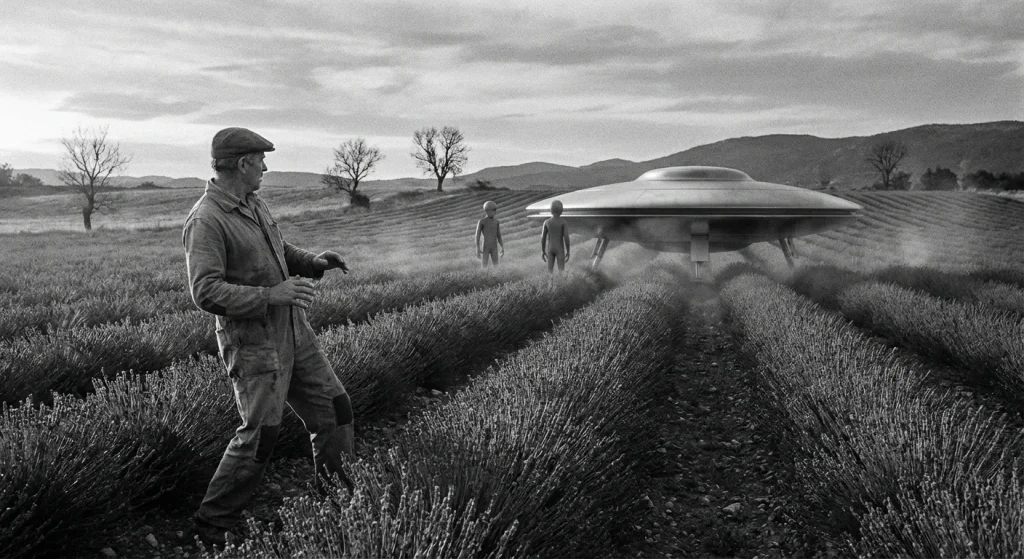
You’re trying to separate serious historical Unidentified Anomalous Phenomena (UAP) cases from the churn of UFO disclosure headlines, and you keep seeing Valensole used as a trump card, usually without clarity on what’s actually known. The setting is always the same: a rural Provence morning, a field outside Valensole, and a label that spreads faster than the source material, “The Lavender Encounter.”
The decision point is practical, not academic: what you’re willing to believe, repeat, or cite, and how you handle “government cover-up” claims when someone insists the case is already settled. Valensole is commonly dated to July 1, 1965, in Valensole, Alpes-de-Haute-Provence, France, and it persists because it’s framed as a close-range report that includes alleged immobilization, which makes it feel less like a distant light-in-the-sky story and more like an intimate event with stakes.
That intimacy is also where the evidentiary friction starts. The best-known retellings amplify details, while the most durable core is what can be anchored to testimony and to whatever contemporaneous handling exists. Even within investigator-facing summaries, the immobilization language itself gets scrutinized: Jacques Vallée records that the witness, Maurice Masse, said he was left alone in his field and “paralyzed,” while an investigator remarked that “paralysis” may be an inappropriate term for such incidents.
- Start with witness testimony, because it’s the spine of the case and the source of most quoted details.
- Confirm contemporaneous documentation and official handling, because timestamps, names, and routing determine what’s checkable.
- Weigh physical or medical traces separately, because “a trace existed” and “a trace proves an explanation” are different claims.
- Separate what none of the above can prove on its own, especially motive, origin, or identity.
This discipline is easier in France than most readers assume: GEIPAN (CNES), created in 1977 to collect, analyze, and archive UAP reports and make information publicly available, sits behind a real transparency trail, including CNES publicly opening UFO/UAP case files online on 22 March 2007 (New Scientist report) and maintaining an overview of GEIPAN’s mission and methods (CNES/GEIPAN). That institutional context does not resolve Valensole by itself, but it does clarify what “checkable” can mean when a file exists and can be audited against standards.
What Masse Reported That Day
Maurice Masse’s account is remembered because it describes a close-range encounter that includes alleged beings and a reported immobilization effect. That combination is why the case is often discussed under the “Close Encounter of the Third Kind (CE3)” label, a classification used for reports that include alleged occupants or entities rather than a distant light or ambiguous object.
The only time anchor supported by accessible summaries is “early morning” (published summaries frequently cite a dawn time around 5:45 to 6:00 AM (HowStuffWorks summary)). Within that limited anchor, Masse reportedly placed himself alone in his field at the start of the incident, which frames much of the account as single-witness narrative with no internal cross-check from a second observer at the scene.
In Masse’s own telling, the sequence runs: he noticed an unusual object and moved toward it; as he neared it he reported seeing beings associated with it; he described an inability to move during the encounter; and after a period the object departed, after which he took immediate steps to report or address what had happened. Many later secondary retellings add operational details about positioning, timing, noise, or exact departure mechanics. Those particulars are not time-stamped in the public summaries and should be treated as later overlay unless tied to a primary, dated document. Vallée’s cataloging preserves the immobilization claim while also preserving an investigator’s caution that the shorthand term “paralysis” may be imprecise rather than a clinical diagnosis.
Physical Traces and Medical Questions
Masse’s story explains why Valensole is repeatedly filed under “humanoid encounter” discussions. The other reason it stays in circulation is the claim that the site itself showed effects that could, at least in principle, be examined.
Valensole still carries weight because it is commonly discussed as more than testimony: a physical trace case, meaning a report that includes alleged tangible effects at a location or on a body, not just a story retold. The catch is simple: trace claims live or die on documentation quality. If the record is thin, the case stops being investigable and starts behaving like folklore.
Think of the evidentiary spectrum in three tiers. Testimony-only cases rise and fall on consistency, timing, and corroboration. Trace-supported cases add claimed physical changes like marks in soil, disturbed vegetation, or unusual residues, but still require careful scene work to be persuasive. Lab-documented cases go further, tying properly collected samples to reported analytical results and clear provenance. In the publicly available documentation I can verify, and in GEIPAN’s public case search and CNES descriptions of methodology, Valensole is best treated as trace-claimed rather than lab-documented, because primary documentation tying specific samples, chain-of-custody, and test reports to the site is not established in the accessible records (GEIPAN case search) (CNES/GEIPAN).
Landing-site discussions usually center on ground impressions, altered soil structure, and vegetation anomalies. In forensic terms, those start with impression evidence, which consists of items that have obtained the characteristics of other objects through direct contact. That definition matters because it tells you what a competent inquiry tries to capture: the transferred shape, the edge detail, and the pattern relationships that can be compared over time.
A robust documentation package would include high-resolution photographs with a scale, overall and close-up shots from multiple angles, and written notes describing substrate conditions (dry, wet, crusted, cultivated). Investigators would measure and map the full pattern geometry, not just one mark, and would record depth or compaction using repeatable methods. Just as important, they would sample controls: soil and plant material from unaffected areas nearby, collected with the same tools and logged the same way, so any claimed anomaly has a baseline.
Preservation is not clerical busywork; it is the action that prevents evidence decay, and documentation artifacts can be altered or deleted far more easily than physical items. A trace claim that relies on later-retold measurements or uncited photographs is structurally fragile, even if something unusual happened at the scene.
Soil and plant questions are testable in principle, but capability is not proof. Example families of methods that could be applied to a suspected landing site include loss on ignition (organic matter estimation), Atterberg limits (consistency and plasticity behavior), colorimetric tests (targeted chemical indications), dry combustion (elemental carbon and nitrogen), thermal analyses (heat-driven mass or phase behavior), and X-ray diffraction (mineral phase identification). These are examples only unless primary documents explicitly tie them to the Valensole case.
The line to hold is strict: “a test exists” does not equal “this case was tested,” and “a sample was taken” does not equal “results are interpretable” without dates, sampling locations, handling notes, and a clear chain-of-custody.
Physiological complaints associated with Valensole are typically described as post-incident symptoms such as fatigue and sleep disruption. Decades later, these narratives are hard to audit because clinical records and patient memory do not capture the same thing. In one recent media-reported study of sleep and anomalous experiences, sleep disturbance was more common in self-reported witness symptoms versus clinician documentation, with headline figures reported as 24 percent versus 10 percent in different reporting streams (The Independent summary). That kind of documentation difference shows how easily a real complaint can be under-recorded or summarized away.
Clinical guidance also draws a sharp distinction that matters for interpretation: fatigue must be separated from muscle weakness and from daytime sleepiness. If a record collapses those categories into a single word, later readers can over-infer severity, mechanism, or duration that was never actually documented.
For any claimed trace-supported UAP case, demand the basics: contemporaneous photos with scale, mapped measurements, clear sampling notes with controls, and documented handling from collection to analysis. If the “evidence” cannot be independently checked from the record, it is not trace-supported in a meaningful forensic sense.
Investigators, Gendarmerie, and Paper Trails
Once you move from “what was said” to “what could be checked,” the case stops being primarily a narrative and becomes primarily a file. For Valensole, the credibility debate turns on paperwork as much as testimony.
The question is not only what was seen in the field, but what was written down while memories were fresh, sites were intact, and any physical traces still had context.
An investigation that starts locally usually begins with the gendarmerie: an initial interview, a site visit, and a formal report. The document readers should look for is a gendarmerie procès-verbal, the official French police report record that captures statements, observations, and actions taken, because it fixes dates, locations, and who did what.
In a clean paper trail, the procès-verbal is supported by attachments: witness statements signed close in time to the event, sketch maps and measurements that pin down distances, photographs with clear provenance, and notes describing any sampling. If anything is collected, the integrity of the case depends on handling details: when the sample was taken, how it was labeled, who possessed it at each step, and where it was stored. Without those controls, later lab claims become untestable narratives.
In the accessible records cited here, I find no verifiable names, ranks, or unit identifiers for responding gendarmerie officers that would let an auditor locate original station logs or match an officer to a specific procès-verbal. For researchers, the GEIPAN public case list and CNES descriptions are the first places to check, but those sources do not, in the accessible public records, provide the original gendarmerie paperwork for Valensole (GEIPAN case search) (CNES/GEIPAN).
The same limitation applies to physical evidence. Accessible public records contain no chain-of-custody notes for any physical items associated with Valensole in the material I can verify, and missing paperwork, incomplete sampling logs, and lost originals create the exact conditions where “government UFO cover-up” claims thrive: not because a cover-up is proven, but because the audit trail needed to disprove one is absent.
Civilian ufology channels often keep a parallel record by collecting and re-cataloging cases. Jacques Vallée, for example, is associated with compiling “landmark” investigations and developing a five-type classification system, which illustrates how later secondary files can grow even when primary police documentation is thin.
CNES opened online case files on 22 March 2007, a move reported in contemporary press coverage (New Scientist), and GEIPAN now provides a public case search that is the logical first stop for any researcher looking for archived French cases (GEIPAN case search). In the GEIPAN public case list accessible at that search page there is no direct public GEIPAN URL for a Maurice Masse Valensole dossier that I can verify from the sources cited here; researchers should check GEIPAN directly for updates. If a GEIPAN Valensole entry is not present in the public list, the best available near-primary references include contemporary press and later investigator summaries such as the HowStuffWorks Valensole summary and a localized reconstruction and commentary on the encounter (HowStuffWorks) (VerdonXP reconstruction).
Read any Valensole file like an auditor, not a fan:
- Prioritize contemporaneous documents over retellings, starting with the gendarmerie procès-verbal and dated witness statements.
- Check for diagrams, measurements, and photo provenance that can be independently reinterpreted.
- Demand sample logs and preservation notes; without chain-of-custody, “evidence” is just material with an uncertain story.
Could It Have Been Something Else
When the paper trail is incomplete, the next honest step is not to declare certainty; it is to compare competing explanations under the same constraints. Prosaic explanations are not an insult to Maurice Masse; they are the baseline competitors in any serious investigation.
Valensole works better as an evidence problem than as an identity war between “believers” and “skeptics,” because the same standards that can support an extraordinary claim can also support a mundane one.
A skeptical evaluation is criteria-driven, not conclusion-driven. Three standards do most of the work:
Independent corroboration: a second witness, an uninvolved observer, or instrumentation that converges on the same core event without sharing the same story pipeline.
Contemporaneous documentation: notes, logs, photographs, or official records created close to the time of reporting, before memory consolidation and retelling pressures reshape details.
Handling integrity and reproducibility: trace claims only become testable if samples and records can be audited end-to-end. “Chain of custody” matters because it is the documented, continuous control of an item from collection to analysis, and without it you cannot separate the sample’s history from the hypothesis you want it to support.
The complication is symmetrical: gaps in documentation limit “proof,” but they also cap the strength of debunking. If the file is thin, sweeping certainty fails on both sides.
Misidentification fits any case built primarily on a single observer’s interpretation of an unusual sight. It strains when the account includes close-range interaction claims, because those are harder to rewrite as distance, scale, or angle errors without importing new assumptions.
Hoax incentives are always worth checking: money, publicity, local grudges, or later commercialization can create motive. In the accessible records cited here, there are no named skeptical analyses with concrete, Valensole-specific claims about motive, contradictions, or trace alternatives; any such argument would need to be sourced externally and attributed explicitly rather than asserted as a “known debunk.”
Sleep inertia and early-morning perception can compress attention, distort time-sense, and encourage confabulation around ambiguous stimuli. The strain is that this explanation must still account for why the report persisted as a stable narrative rather than dissolving under later reflection and questioning.
Psychological stress responses can produce freezing, narrowed attention, and intense certainty without implying pathology. The terminology dispute preserved in investigator commentary-whether “paralysis” is the right word-shows how to question interpretation without discarding the entire report.
Environmental explanations for alleged traces are plausible competitors whenever the physical record is incomplete or poorly documented. They strain when proponents claim specificity that the existing handling and documentation cannot actually support.
Decisive progress would come from primary-source records: original gendarmerie paperwork (not summaries), dated investigator notes, lab reports with methods and sample IDs, and any surviving photographs or negatives with provenance. On the trace side, only archived samples with a documented chain of custody, plus the ability for independent re-analysis, would let environmental versus anomalous interpretations be tested rather than argued.
Keep Valensole open, not inflated. Treat it as unresolved unless and until independent corroboration, contemporaneous documentation, and reproducible, well-handled evidence close the gap between story and proof.
Why Valensole Became a Landmark Case
Valensole remains a landmark for reasons that have little to do with a single decisive document and a great deal to do with how the case functions in UFO culture. It sits where the topic gets sticky: a vivid “humanoid encounter” narrative that stays legible in retellings, plus the promise of physical evidence that sounds checkable.
That combination travels well across books, catalogs, documentaries, and social sharing. The catch is that repetition itself becomes a kind of proof, and uncertain details can harden into “common knowledge” simply because a later summary gets cited more than the earliest documents.
Aimé Michel helped fix Valensole into the canon by treating it as a named, self-contained reference point in a piece explicitly titled “The Valensole Affair.” That move matters culturally: once a case has a stable label, it becomes easy to quote, index, and reuse, even when the underlying documentation is uneven.
Jacques Vallée, working with collaborators across his cataloging projects, positioned Valensole inside a wider class of “physical trace” reports, where the alleged residue, impressions, or physiological effects become the organizing frame. In Vallée’s recording of the file, the immobilization claim is preserved alongside the caution that the standard shorthand (“paralysis”) may be an imprecise description rather than a diagnosis.
Three motifs keep Valensole reusable: a rural-witness credibility archetype (ordinary work, low incentive to fabricate), a landing plus humanoids motif that reads like an encounter template, and an enduring emphasis on alleged traces that invites “what would the lab say?” thinking even when the paper trail is incomplete. As background, French humanoid reports clustered in Sept to Oct 1954, and some described figures exiting craft and collecting plants, a narrative pattern that primes later readers to treat similar details as part of a recognizable genre rather than a one-off. That broader 1954 wave and the plant-collecting motif are documented in contemporary and later surveys of the 1954 French and worldwide waves (academic survey) (Complete France historical overview).
The Sept to Oct 1954 French wave shows how motifs spread: plant-collecting humanoids appear across accounts, which accelerates pattern recognition but also encourages witnesses and writers to narrate toward the template.
Trace-forward “landing” cases in Vallée-style catalogs show a second pitfall: once a report is filed under physical traces, later retellings often center the residue and quietly downgrade messy provenance and documentation limits.
Disclosure-interest cycles add a third: each spike in UAP news appetite pulls reference cases off the shelf, and the most shareable summary tends to outrun the earliest sourcing.
The takeaway is procedural: when a case becomes a reference point, track citation chains back to the earliest available documents, watch for motif-driven embellishment across editions, and notice how database framing (humanoids, traces, landings) can steer what later readers think is “the core” of the event.
What Today’s Disclosure Debates Change
Valensole is often invoked in disclosure arguments precisely because it predates modern policy frameworks and modern expectations about record release. Modern disclosure debates change the questions we ask about old cases more than they change the old cases themselves.
The core shift is procedural: the public now expects records to be released, data to be handled through standardized practices, and institutions to separate what someone says from what a file, chain of custody, or lab report can actually support. The complication is that political momentum and media attention often move faster than the underlying documentation. The practical result is a higher bar for evaluation, not retroactive certainty.
In the U.S., the most concrete disclosure touchpoint is legislation. The UAP Disclosure Act of 2023 was proposed legislation whose text urged faster records release and included language framing federal UAP records with a “presumption of immediate disclosure” in its congressional amendment language; this was proposed as legislative language and not enacted as a standalone law (proposed amendment text) (congressional amendment record). That framing matters because it treats access as the default and continued secrecy as something that must be justified within a defined process.
Alongside legislation, modern disclosure runs through institutions and formal testimony. David Grusch testified under oath that he was informed of a multi-decade crash retrieval program and alleged recovered “non-human” craft and biologics. Those statements are testimony claims, and officials have contested them; they are not, by themselves, documentary releases. On the institutional side, AARO sponsored and released a report on a workshop titled “UAP Workshop: Narrative Data, Infrastructures, and Analysis” in August 2025 with partner organizations including Associated Universities, Inc.; the workshop emphasized that progress depends on building shared data and involved civilian researchers, universities, and government agencies (AUI report on AARO workshop) (AARO UAP records) (news coverage).
Modern mechanisms help most when they unlock files that already exist. A records-release process with a presumption of disclosure can surface government correspondence, analytical notes, or archival holdings that earlier generations never saw. But it cannot manufacture what was never collected, cannot restore samples that were degraded or discarded, and cannot retroactively impose today’s metadata, chain-of-custody discipline, and documentation standards on a 1960s event.
The 1965 problem is structural: even perfect modern transparency leaves legacy cases constrained by the completeness of the original paper trail. Better frameworks clarify what documentation should exist and where to look, but they do not guarantee that the decisive originals were created, preserved, or recoverable decades later.
The disciplined way to follow UAP news is to treat each disclosure update as a lead to primary material. Track what is actually released (documents, exhibits, datasets), separate sworn testimony from documentary support, and prioritize primary-source publication over summaries or interpretations.
What We Can Say With Confidence
Valensole ultimately functions as a case study in how far a famous report can travel beyond its paperwork. The opening framing and the “What Masse Reported That Day” timeline show how a clean, memorable narrative can remain stable even while documentation is uneven, and the later sections demonstrate how that gap shapes every subsequent interpretation-especially around traces, medical claims, and “cover-up” rhetoric.
Here is the confidence ladder, using the accessible records cited above: solid anchors include the commonly cited date and location, the “early morning” framing, the report’s existence as a widely cited case, and Masse’s own account that he was left immobilized in the field. What does not stay anchored, because the public archival record is thin where it matters, are the specific measurements attributed to traces, any lab results with verifiable provenance, the officer identities within the public records, and chain-of-custody or evidence-handling specifics that would let an outsider audit the file end to end (GEIPAN case search) (CNES/GEIPAN).
Decades later, re-analysis is structurally limited by preservation: preservation is the step in the forensic process that stops evidence from decaying. Digital evidence can be easily altered or deleted, so preserving it is not the same task as handling physical items, and practitioners explicitly question the long-term trustworthiness of post-upload digital images. Digitization guidance helps collections survive, but it cannot recreate missing custody notes, missing originals, or missing contemporaneous documentation.
The prosaic-evaluation framework, the explanation for why the legacy persists, and the limits of what modern disclosure can and can’t do all converge on one reader habit: follow primary files and official releases first, then treat unsourced specifics as unverified, no matter how often they get repeated-especially when a case is being used as a headline-era “trump card” rather than as an auditable historical file.
Frequently Asked Questions
-
What happened in the Valensole UFO encounter in 1965?
The case is commonly dated to July 1, 1965, near Valensole in Alpes-de-Haute-Provence, France. Farmer Maurice Masse reported an early-morning close-range encounter involving an unusual object, alleged beings, and an experience of being immobilized before the object departed.
-
Why is the Valensole case classified as a Close Encounter of the Third Kind (CE3)?
It’s often labeled CE3 because Masse’s account includes alleged beings associated with the object, not just a distant light or ambiguous craft. The article emphasizes that the durable core claim is that he reported seeing beings at close range during the same early-morning incident.
-
Did Maurice Masse actually get “paralyzed” during the Valensole encounter?
Jacques Vallée recorded that Masse said he was left in his field and “paralyzed,” but an investigator noted that “paralysis” may be an inappropriate term for incidents of this type. The anchored point in the article is the reported experience of being unable to move, not a confirmed medical diagnosis.
-
What physical evidence is claimed in the Valensole landing site, and how strong is it?
Valensole is frequently discussed as a physical-trace case with claims such as ground impressions, altered soil, and vegetation anomalies. The article says it should be treated as “trace-claimed” rather than lab-documented because primary documentation tying specific samples, chain-of-custody, and test reports to the site isn’t established in the provided materials.
-
What lab tests could be used to analyze a suspected UFO landing site like Valensole?
The article lists methods that could be applied in principle, including loss on ignition, Atterberg limits, colorimetric tests, dry combustion (carbon and nitrogen), thermal analyses, and X-ray diffraction. It also states that “a test exists” does not mean the case was actually tested without documented sample IDs, locations, and handling notes.
-
What official records should I look for to verify the Valensole case details?
The key document to seek is the gendarmerie procès-verbal, supported by dated signed witness statements, sketch maps/measurements, and photographs with clear provenance. The article notes the provided research set lacks verifiable officer identities and chain-of-custody notes, which blocks basic auditing.
-
How do I evaluate Valensole claims versus “government UFO cover-up” stories?
Use three criteria from the article: independent corroboration, contemporaneous documentation, and handling integrity with reproducible chain-of-custody for any trace claims. It also points to France’s transparency pathway via GEIPAN (created in 1977) and CNES opening UFO/UAP case files online on 22 March 2007 as the kind of archival trail that can make claims checkable when files exist.
