You keep seeing “UK MoD secret UFO files” headlines and the same implied promise: this release finally moves UFO disclosure, or UAP disclosure, from speculation to certainty. What you actually need to know is simpler and more useful: does this dump change the evidence base in a way that survives scrutiny, or is it just louder noise with official letterhead?
The tradeoff is real. Official provenance and sheer volume create credibility because you can trace what was recorded, who handled it, and how it moved through the system. Archival reality cuts the other way: much of what gets released is administrative paperwork, coverage is uneven across years and topics, and deletions or missing material cap what anyone can responsibly conclude.
Read “UFO/UAP” here as a practical umbrella for reported unusual aerial observations regardless of explanation, because these files primarily document reporting and handling, not final answers. A large, messy archive dump can change the debate by expanding breadth, traceability, and context: what citizens and service personnel reported, what officials logged, what units were tasked, and what questions were treated as worth time. It cannot, on its own, establish proof of non-human intelligence, deliver definitive “alien disclosure,” or represent a complete view of all government activity related to anomalous phenomena.
The tension the headlines gloss over is the one that matters: volume plus official sourcing increases confidence in what you can verify, while incomplete runs, inconsistent cataloging, and redactions limit certainty about what you cannot see. The commonly repeated framing that these materials were released “over five years” matters because multi-year tranches change how you interpret gaps, edits, and shifting internal policy. Anchor any timeline claim to The National Archives’ coverage and tranche announcements, for example The National Archives media overview and the final tranche release notice (The National Archives media page, final tranche release PDF).
The same discipline applies to “250,000 pages.” Some summaries and institutional publications reference large totals; check The National Archives’ UFO research guide and media materials when verifying any page-count claim (TNA UFO research guide, TNA media page). Headlines and broad reporting can overpromise; verify counts against TNA or MoD official statements before treating a page-count as definitive.
The quickest way to test the biggest headline claims is to start with the simplest question the documents can actually answer: what, exactly, is in the files, and what were those pages written to do?
What’s Inside the Declassified Pages
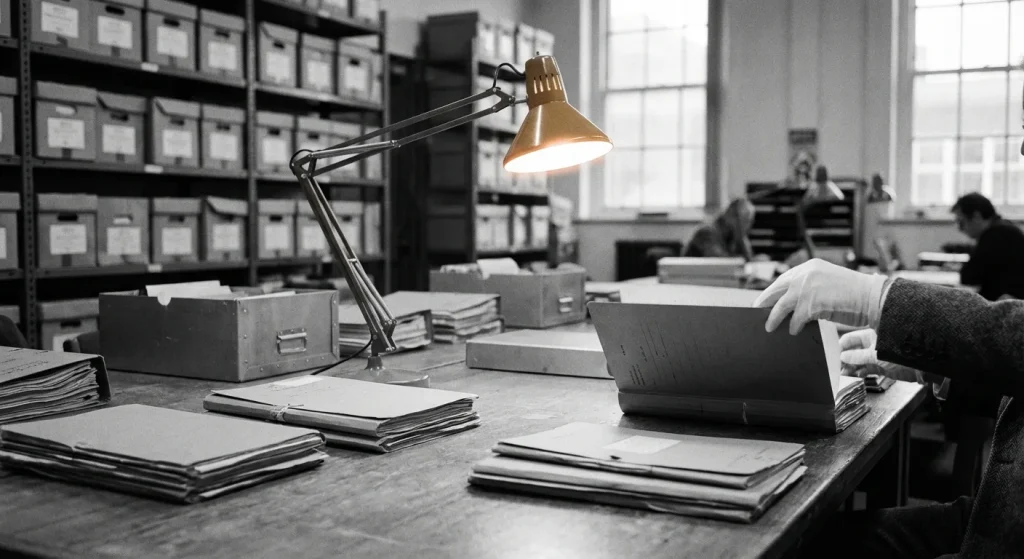
The core insight of the MoD UFO archive is procedural, not revelatory: most pages show how reports entered the building, how they were routed, and how they were closed out. You will see far more memoranda, correspondence, and handling notes than you will see decisive “evidence packages,” and that reality sets hard limits on what the pages can prove about any single incident.
If you read the files with an archivist’s eye, the document mix is familiar: memoranda, correspondence, inventories and indices, and report-style summaries dominate. That’s consistent with how large government collections tend to preserve workflow: lots of paper about managing information, and relatively little primary material that can be independently tested.
| Bucket | What it usually looks like on the page |
|---|---|
| 1) Public sighting reports and witness correspondence | Letters and emails from members of the public, short “I saw X at Y time” narratives, occasional sketches, and follow-up questions about outcomes. The key friction is that many accounts are one-person observations with limited corroboration, so they read more like intake than investigation. |
| 2) Aviation, RAF and civil aviation-adjacent material (where present) | Items tied to flight safety and airspace awareness: pilot or aircrew statements, reports that reference alleged near-misses, and notes that mention radar contact as reported or unverified. These tend to be handled more cautiously in tone because aviation claims carry immediate risk implications even when the underlying “object” remains unclear. |
| 3) Internal MoD correspondence and routing or handling notes | Minute sheets, “please advise” memos, distribution lists, and short internal summaries. This is where you see the machine at work: who owned the problem, who just needed to be informed, and what language was safe to use when closing a file. |
| 4) Media monitoring and public-facing response considerations | Clippings, press query handling, and draft lines for responses. The complication is reputational: even when a report is assessed as low defence value, it can still generate headlines and parliamentary mail, so comms handling becomes part of the work product. |
| 5) Policy and process discussions about what to record, ignore, and how to respond | Guidance about what information to ask for, what thresholds justify further action, and how to answer recurring public questions. Where these look “handbook-like,” they resemble other military public affairs and organizational guidance documents: role definitions, responsibilities, and standard response logic more than case-by-case detective work. |
That last bucket matters because it reveals institutional incentives. Formal guidance documents and handbooks in military settings are built to standardize responses and define responsibilities; in practice, they push organizations toward repeatable handling patterns rather than bespoke inquiry.
The MoD’s posture, as described across its own handling notes and internal framing, is screening and risk assessment: sort reports for defence and intelligence relevance, then filter out the rest. The aim is not open-ended explanation-seeking; it’s determining whether a report signals an air defence issue, an intelligence concern, or a flight safety hazard that needs escalation.
Inside that posture sits a concrete operational detail: documents released and annotated by The National Archives indicate that, until December 2000, the Defence Intelligence Staff branch DI55 and its predecessors handled screening of UFO sighting reports to determine whether they contained information of value to defence intelligence analysis. See The National Archives’ briefing and research material on the MoD “UFO desk” and example DEFE series files for context (TNA briefing guide, TNA postwar UFO reports overview, example file extract DEFE 24 example). Read that role as analytic triage for defence relevance, not as an investigative “X-Files unit.”
The practical consequence is predictable on the page: a great many reports are processed, acknowledged, and then administratively concluded because they do not meet a defence-relevance threshold. The archive is therefore strongest as evidence of institutional filtering and weakest as a repository of testable physical data.
The first repeating pattern is mundane explanation pressure. Many entries resolve, explicitly or implicitly, into ordinary categories: misidentified aircraft lights, astronomy, balloons, satellites, or atmospheric effects. The files often do not need to “prove” the explanation; they only need enough plausibility to classify the report as non-threatening and move on.
The second pattern is constrained follow-up capacity. The files read like an intake-and-screen pipeline because that’s what they are: limited staff time, uneven report quality, and no operational mandate to run field investigations for every claim. You will see closure language that prioritizes administrative completeness over empirical certainty, because the institutional job is to manage risk and correspondence, not to build a scientific case file.
The third pattern is selective friction. A small minority of reports trigger more careful handling: multiple witnesses, time-and-location specificity, alleged radar involvement, photographs described by the witness, or aviation proximity framed as a near-miss. Even then, the language stays disciplined: radar contacts are reported or unverified, performance claims are alleged, and extraordinary interpretations are treated as assertions to be triaged, not conclusions to be adopted.
Finally, reputational management shows up as a quiet throughline. Media monitoring and public-response drafting sit alongside the technical intake because public interest is an operational variable: the MoD has to answer letters, brief officials, and keep messaging consistent even when the substantive assessment is “no defence significance.”
Start with the hard anchors: time, date, and location, then check duration and direction of travel. Note the witness vantage and conditions, because “I saw it from a moving car at night” constrains what any human can reliably judge. Treat photos, video, and radar as reported or unverified unless the document includes contemporaneous corroboration you can evaluate. The fastest way to separate signal from noise is to ask whether independent sources, not just additional storytelling, align on the same timeline.
The actionable takeaway is simple: before interpreting what a report “means,” identify what the document is and what job it was written to do. An internal routing minute is evidence of handling, not of craft performance; a press line is evidence of reputational calculus, not of ground truth; and a witness letter is evidence of a claim, not confirmation. Read purpose first, and the archive becomes legible on its own terms.
That framing also clarifies the dispute that tends to swallow everything else: whether the parts you cannot read-redactions, deletions, and missing attachments-should be treated as routine governance or as evidence of concealment.
Do the Files Prove a Cover Up
The secrecy artifacts in this archive are real: black bars, missing pages, and a public posture that looks defensive. Those features are compatible with routine government information control. They are not, by themselves, evidence of non-human intelligence or a covert retrieval programme. The standard that matters is simple: evidence is specific, attributable, and corroborated across independent references; routine records handling is selective disclosure justified under known exemptions and uneven archival practice.
A redaction is an intentional obscuring of information in a released record, typically to protect privacy or security. Under the Data Protection Act 2018 (DPA 2018), organisations can be exempt from particular UK GDPR provisions, meaning they do not have to comply with all UK GDPR rules in some circumstances. That matters because a black bar can reflect a lawful, review-driven decision to withhold personal data or other protected content, not confirmation that the hidden text contains extraordinary secrets.
The same logic applies to defence sensitivity. Section 26 of the DPA 2018 provides a national security and defence exemption that can justify withholding or redacting information for national security or defence purposes. If a passage touches capabilities, procedures, or operational details, redaction is an expected outcome of a normal review process, not a signal that the underlying subject is “alien” rather than simply sensitive.
The Information Commissioner’s Office (ICO) publishes guidance on the national security exemption and on DPA exemptions generally. Use that guidance as your baseline: it explains how exemptions operate in practice, which lets you separate ordinary compliance behaviour from claims of extraordinary secrecy. See the ICO guidance on data protection exemptions for organisations (ICO guide to data protection exemptions).
Deletions and black bars. The strongest argument here is cumulative: repeated redaction patterns can block reconstruction of a narrative. The disciplined read is narrower: a redaction tells you withheld information exists; it does not tell you what it is. Treat the visible context as the evidence, and treat the obscured content as an unknown that requires corroboration before you assign it a story.
A practical rule: if the redacted line plausibly maps to security or safety categories, assume routine protection first. Guidance discussing exemptions commonly lists security plans, procedures, and other security or safety records as categories treated as exempt and therefore candidates for redaction. That is exactly the kind of material that produces dense blacking-out without implying anything non-human.
Missing annexes or attachments. This is where frustration is justified. An annex often contains the detail that turns a summary into a testable claim. Missing annexes also have a mundane failure mode: they were never transferred, never scanned, or were separated during archival handling. Redaction practices can also be mishandled, and guidance warns that improperly handled redactions can create significant problems in document review, which is a reminder that “messy” does not automatically mean “malicious.”
Institutional reluctance and reputational management. Readers often interpret minimal public engagement, or internal sensitivity to embarrassment, as proof of a cover-up. Read it as risk management unless you can tie it to a specific, corroborated concealment act. Bureaucracies protect credibility; that motive explains cautious language and limited comment without proving a secret programme.
- Record the full file reference and page number where the gap appears.
- Describe the immediate context (what the paragraph was doing).
- Name the missing item exactly as cited (“Annex A”, “Attachment”, “Appendix”).
- Check whether other pages in the same file refer back to the missing annex.
- Cross-reference The National Archives notes or cross-file references before claiming intentional concealment.
This approach matches normal UK records governance: departments and The National Archives must be able to justify the application of exemptions when reviewing records for release or responding to FOI. Your job as a reader is to turn “something is missing” into a documented, checkable gap.
The clean distinction is the one most arguments blur: “withheld information exists” is often true; “withheld information equals alien disclosure” is an extra claim that requires extra proof. Apply a two-step test every time: first, ask whether the deletion or gap fits routine privacy or national security and defence handling; second, only escalate to cover-up allegations when the same missing content is corroborated across independent archival references. Absence of proof is not proof of absence, and absence is not proof of presence.
That caution doesn’t just apply to UK material. It becomes even more important when people treat very different national processes as if they were one continuous “disclosure” story.
How This Fits Global UAP Disclosure
The UK MoD UFO file release reads like an administrative record because that is what it largely is: historical case files, correspondence, and internally handled paperwork that was later processed for public release, sometimes with national-security withholdings and standard declassification markings. The current U.S. disclosure dynamic is different in kind. It is governed by standing offices, formal reporting pipelines, and oversight cycles that keep producing new, time-bound public outputs.
In the U.S., “official disclosure” is operational: recurring deliverables, defined owners, and a repeatable public cadence. The All-domain Anomaly Resolution Office (AARO) is the clearest example of how UAP reporting has been institutionalized into an office that publishes products intended for Congress and the public, not just internal consumption.
Concrete, citable U.S. anchors include ODNI and DoD public reports and AARO products. Examples include the “Fiscal Year 2023 Consolidated Annual Report on Unidentified Anomalous Phenomena” (Office of the Director of National Intelligence and Department of Defense, 17 October 2023) (ODNI DoD FY2023 consolidated report), the “Unclassified 2022 Annual Report on Unidentified Aerial Phenomena (UAP)” (Office of the Director of National Intelligence, 2022) (ODNI unclassified 2022 report (PDF)), and AARO’s “Report on the Historical Record of U.S. Government Involvement with Unidentified Anomalous Phenomena, Volume 1” (AARO / historical record, publicly available, 2024) (Volume 1 (Wikisource)). See the All-domain Anomaly Resolution Office site for related materials (AARO).
The oversight environment now drives much of what becomes “UAP news,” because hearings and deadlines create measurable pressure for agencies to brief, document, and respond. When a congressional hearing is scheduled, verify whether it occurred and what records were published by checking official committee pages and the congressional record; transcripts and materials often appear on committee websites or on Congress.gov. Follow those primary sources rather than relying on summaries or social-media threads (Congress.gov hearing transcripts).
This is also where public attention concentrates around named figures such as Grusch, Elizondo, Mellon, and Knapp. Treat that attention as a media amplifier, not as an evidentiary substitute. Oversight only changes the disclosure picture when it yields formal outputs: sworn testimony, documentary submissions, and mandated reporting.
NDAA-style provisions matter because they rewire the mechanics of disclosure even when they do not settle any ultimate claims. Mandates can impose timelines (for example, a report due within a defined window after enactment), require recurring reporting, and establish channels and standards for how UAP information is collected, handled, and transmitted across agencies. They also frequently include whistleblower protection concepts, which changes who can report and how safely they can do it.
Unless you have the enacted text in hand, treat specific legislative language as proposals and iterations. The practical question is not what a draft promises, but what a final statute compels an agency to deliver, by when, and in what format.
The clean way to read UAP news is to follow governance signals: published AARO and ODNI deliverables with dates and versions, verified hearing records, and statutory deadlines that force reporting behavior. Viral anecdotes move attention; official outputs move the disclosure baseline.
Against that backdrop, the UK archive is best approached less like a “revelation” and more like a body of records you can cite, compare, and audit-if you read it with the same discipline you would apply to any other government dataset.
How to Read the MoD Archive
Method beats mythology. The Ministry of Defence material only becomes useful when you treat it like a dataset: searchable, loggable, cross-checkable. One-off browsing produces vibes; a disciplined workflow produces citations you can defend in public.
The friction is that the record set is uneven: duplicate reports, missing context, and variable document quality are normal in real archives. Some files were declassified with minimal deletions and transferred for public release, but “available” does not mean “clean, complete, or comparable” across cases.
The National Archives (TNA) catalog matters because its metadata is the backbone of verification: it tells you what a file is, when it was created, and how to reference it unambiguously (TNA Discovery search). For UK MoD UFO files see TNA’s postwar UFO overview and example DEFE series references such as DEFE 24 and DEFE 31 that contain many MoD UFO records (TNA postwar UFO reports, example DEFE file extract DEFE 24 example, example extract DEFE 24/2087 extract).
When you locate a relevant entry, capture the same fields every time. Your goal is to be able to reconstruct your path back to the source without reopening a browser history.
- Series and file reference: the formal catalog identifier you will cite
- Date range: the catalog span plus the specific incident date inside the file
- Places: towns, counties, bases, airfields, coastal markers
- Keywords: the catalog terms plus your own controlled tags (for example: “airport”, “radar mentioned”, “multi-witness”)
- Page identifiers: page number, image number, or a consistent “PDF page X” note
Use a download to index to analyze flow, not manual one-off reading. This is anchored in how the TNA catalog exposes some digitized records: certain entries support bulk-download listings and catalog-export formats such as JSON. The bulk-download listing that includes “Book Unidentified Flying Object (UFO) Investigations, 1953-1967” also exposes an associated JSON export (catalog-export-1142703.json), which is exactly the kind of machine-readable hook that makes indexing practical.
- Download every relevant digitized file (and any bulk listing or export you can obtain) into a single local folder structure keyed by series and reference.
- Index your metadata in a single local table (spreadsheet-style): one row per incident, with columns for date, time, place, witnesses, duration, and document pointers.
- Analyze only after you can filter and sort. Pattern-finding (repeat locations, repeat descriptions, repeat reporters) requires structured notes.
Start by validating the pieces witnesses usually get wrong: weather, visibility, and timing. The UK Met Office is a long-standing provider of weather and climate data services, and it publishes national and regional climate statistics plus gridded UK climate datasets such as HadUK-Grid, which you can use to sanity-check claims like “unusually clear skies” or “persistent low cloud” at the right time of year (Met Office HadUK-Grid datasets). For deeper verification, the Met Office archive holds original meteorological data and weather charts that you can view by appointment, which is where “what the sky actually did” stops being an argument and becomes a document request.
Astronomy and aviation logs are also valid cross-check categories for timing and location (for example, bright astronomical events or scheduled traffic patterns), but treat access as variable and cite what you can actually retrieve.
| Factor | What to record | How to rate it fast |
|---|---|---|
| Witnesses | Count; relationships; whether accounts are independent | Higher if multiple independent observers |
| Duration and timing | Start time, end time, stated precision (exact vs “about”) | Higher if time is precise and duration is stated |
| Location context | Proximity to airports, military sites, flight corridors | Higher if location is specific and operationally relevant |
| Environment | Cloud cover, visibility, wind, precipitation (as reported) | Higher if conditions are documented and corroborable |
| Official signals | Radar, ATC, police, military follow-up | Rate as “reported” unless documented |
| Contemporaneous docs | Photos, logs, charts; where they would normally live | Higher if you can point to the likely repository |
People searching “UFO sightings 2025” and “UFO sightings 2026” are usually looking for a narrative. Your job is to produce an audit trail: cite the TNA reference, quote the document precisely, separate the original claim from your corroboration (weather, timing, context), and label anything else as inference. That is how you discuss sightings publicly without laundering speculation into “evidence.”
Once you’re working this way-logging references, rating evidence quality, and documenting gaps-you can also see more clearly what would count as a meaningful update after the release, versus mere recycling of the same pages.
What to Watch After the Release
The MoD archive matters most as a scale dataset showing how reports were received, routed, and handled, not as a final answer on non-human intelligence.
The release-timeline-and-scope framing is the right way to read it: tranches and series context determine what you are actually looking at, and the practical friction is real when duplicates and incomplete scans muddy counts and narratives. Inside the files, the highest-signal pattern is administrative handling: logs, memos, minutes, and letters dominate, and the Ministry of Defence posture was triage, with DIS review of sighting reports focused on information value for analysis rather than confirmation of extraordinary claims.
That scale creates interpretive noise unless you stay disciplined about deletions and gaps. Redactions and removals often align cleanly with privacy and security rules, so treating every blank page as a “cover up” is a category error. The defensible approach is the one laid out in the workflow section: log what is missing, cite the catalog reference for every claim, and corroborate mundane variables like weather before you elevate any single report into “UFO news” or “UAP news.”
For forward-looking transparency, track recurring official deliverables you can measure: the Office of the Director of National Intelligence published a FY2023 consolidated annual report on unidentified anomalous phenomena (ODNI and DoD, October 2023) and ODNI published an unclassified 2022 annual report on UAP; AARO has published historical-record material and maintains a public repository of UAP-related outputs (ODNI UAP reports page, ODNI/DoD FY2023 consolidated report, ODNI unclassified 2022 report (PDF), AARO). On the UK side, check The National Archives and the Ministry of Defence directly for current tranche schedules and holdings rather than assuming finality.
Read the primary documents, cite catalog references, and separate claim from corroboration before you share.
Frequently Asked Questions
-
What are the UK MoD UFO files that were declassified?
They are Ministry of Defence records documenting how UFO/UAP sighting reports were received, routed, assessed, and closed out. The article describes the release as roughly 250,000 pages made public in multi-year tranches, with The National Archives (TNA) catalog used to verify file references.
-
Did the UK MoD UFO file release prove alien disclosure or non-human intelligence?
No-these files primarily document reporting and administrative handling, not definitive explanations or proof of non-human intelligence. The archive is strongest for traceability (who recorded what and when) and weakest as a repository of testable physical data.
-
What kinds of documents are inside the MoD UFO archive?
The collection is dominated by memoranda, correspondence, inventories/indices, and internal routing notes, plus public sighting letters, some aviation-adjacent material, media monitoring, and policy/process guidance. The article emphasizes that most pages show workflow and screening rather than “evidence packages.”
-
What role did the Defence Intelligence Staff (DIS) play in MoD UFO reports?
Until December 2000, the Defence Intelligence Staff examined UFO sighting reports received by the MoD to see if they contained information of value to DIS analysis tasks. The article frames this as analytic triage for defence relevance, not an open-ended investigative “X-Files unit.”
-
Are redactions and missing pages in the UK MoD UFO files evidence of a government cover-up?
The article says black bars and missing material are compatible with routine UK information control, especially privacy and national security/defence withholdings under the Data Protection Act 2018. A redaction indicates withheld information exists, but it does not specify what it is without independent corroboration.
-
How do you verify a specific MoD UFO case using The National Archives catalog?
Log the TNA series/file reference, date range (plus the incident date), place names, keywords, and a consistent page identifier (page/image/PDF page). The article recommends treating the archive like a dataset: download files, index incidents in a table, then analyze only after you can sort and filter.
-
How does the UK MoD UFO archive compare to U.S. UAP disclosure like AARO reports?
The UK release is largely historical administrative records processed for public release, while the U.S. approach is described as operational with recurring deliverables and oversight-driven outputs. The article cites trackable U.S. products such as AARO Historical Record Report: Volume 1 (2024), the UAP Annual Report (2023), and a 2025 “UAP Workshop: Narrative.”
