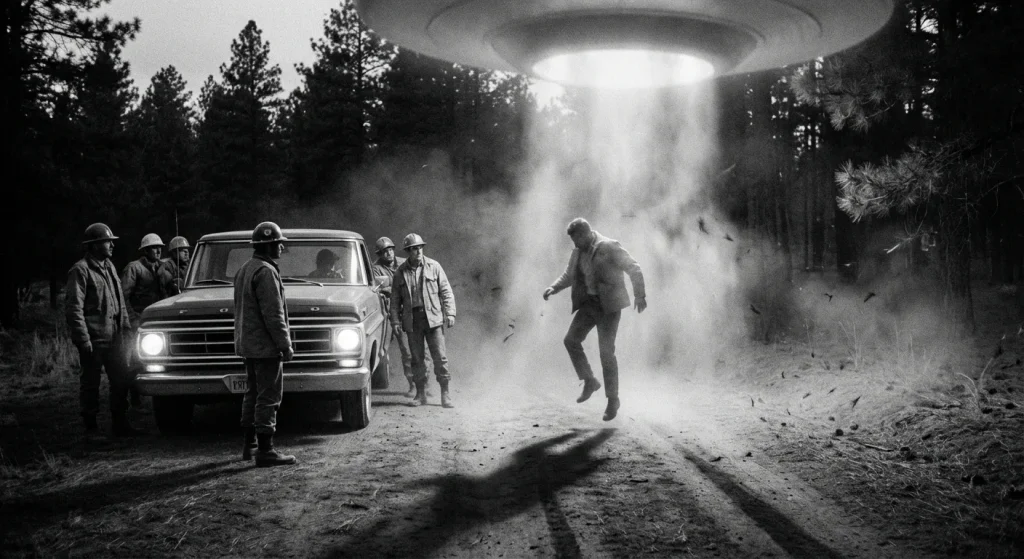
You keep running into the same whiplash: one side calls the Travis Walton episode the best abduction case on record, the other dismisses it as an enduring hoax, and both camps talk in absolutes. The case persists because it presents as evidentially strong at a glance while remaining stubbornly hard to verify in a way that satisfies skeptics and believers alike.
Start with the tight, reported core: an object described as a UFO was reported in the forest near Heber, Arizona, on November 5, 1975, in the Apache-Sitgreaves National Forest area; a logging crew reported a beam striking Travis Walton; he then disappeared. Multiple witnesses is the hook, because it sounds like built-in corroboration rather than a single-person tale, and that is exactly why the story never dies. The five-day gap is the accelerant, because absence creates narrative space that later retellings fill, revise, and harden into “what happened,” even when the underlying record stays thin. Add decades of repetition, plus media amplification that culminated in the 1993 film Fire in the Sky based on Walton’s book, and you get a case where the cultural version can crowd out the documentary version, even though the written account and the movie are not the same story. Skepticism targets documentation and incentives, while believers point to the group report and the disappearance, and the argument keeps resurfacing whenever UAP disclosure debates spike.
You will leave this article able to separate what is anchored to dates, places, and stated claims from what is interpretive, disputed, or amplified by repetition.
A day by day timeline
The Travis Walton case spawns endless scene-by-scene retellings, but the only part that can be cleanly structured is the calendar: a reported incident on Nov 5, 1975 near Heber, Arizona, a missing-person window described as five days, and a reported return dated to Nov 10, 1975. That date scaffolding is where documentation strength matters, because the closer you get to precise times, exact routes, and the order of interviews, the thinner the verifiable record gets in most popular summaries.
The practical way to read the case is to separate “anchor points” that most retellings agree on from everything else. The anchors are simple: the general location (near Heber, in the Apache-Sitgreaves National Forest area), the people (Walton, his logging crew, law enforcement and searchers, then the media), and the five-day gap. Nearly every other detail you will see, especially minute-by-minute claims, is verification-dependent unless it is tied to contemporaneous documents like dated police reports, dispatch logs, or period newspaper coverage.
- Reported incident near Heber, Arizona (Apache-Sitgreaves area). Most retellings place the initial event on Nov 5, 1975 on a road in the forested region near Heber. This is an anchor point repeated across later accounts; the exact road segment, mile marker, and coordinates are verification-dependent unless backed by an original report or map from the time.
- Walton and his logging crew are the primary first reporters. The standard chronology has Walton with a logging crew returning from work when the sighting is reported. The involvement of the crew as the core witness group is an anchor point; who said what first, in what order, and with what phrasing is typically drawn from later retellings unless a contemporaneous statement transcript is produced.
- Disappearance follows the reported encounter. The widely repeated sequence is: sighting, a rapid escalation, and then Walton is not with the crew afterward. The exact duration between sighting and separation is verification-dependent when a retelling includes specific times like “early evening” or a precise clock time.
- Report to law enforcement and initial interviews. Most summaries state that the crew contacted law enforcement the same night and were interviewed. The fact pattern “reported, then interviewed” is broadly consistent; the sequence of interviews, who conducted them, whether they were recorded, and what questions were asked is verification-dependent without primary documentation.
- Early public framing begins immediately. Even when later narratives focus on the sighting itself, the more checkable fact is that a missing-person report triggers a different kind of response: investigative process, search planning, and information control. Claims that “the crew was treated as suspects” are common in later retellings; specific assertions about what officers concluded on Nov 5 are verification-dependent without dated statements.
- Walton is treated as a missing person while search activity is pursued. Most accounts describe a multi-day missing-person period beginning Nov 6, involving law enforcement and searchers operating in and around the Apache-Sitgreaves National Forest area. The anchor point is the multi-day absence; who led the search, what grids were assigned, and what resources were deployed is verification-dependent unless supported by sheriff logs, search-and-rescue rosters, or dated news coverage.
- Parallel investigative attention on the logging crew. Retellings frequently pair “searching for Walton” with “investigating the crew’s report.” The general involvement of law enforcement with both threads is plausible and consistent with missing-person procedure; any precise timeline of repeat interviews across Nov 6-9 is verification-dependent without contemporaneous records.
- Public response and media attention escalate during the gap. It is commonly stated that the story began spreading beyond local channels during the missing-person window. The anchor point is “media enters the story while Walton is still missing”; the first outlet to publish, the date of first publication, and the exact wording of early headlines are verification-dependent without copies of period articles.
- The five-day duration is central to Walton’s own framing. In Walton’s published account, the absence is described as lasting five days, which is why most popular summaries treat Nov 6-9 as the core missing-person window between the reported Nov 5 incident and the Nov 10 return.
- Detailed day-by-day search claims are where accuracy most often degrades. This is the period where retellings tend to accumulate specifics: exact search areas, who said what to the press on which day, and what investigators privately believed. Without contemporaneous documentation, treat those details as later retelling and keep the scaffold: Walton missing; search and investigation ongoing; public awareness growing.
Walton’s later published account frames this interval as an alleged abduction and is the source of the widely repeated “five-day disappearance” description, even though the surrounding search-and-investigation specifics are often relayed through secondary summaries.
- Return dated to Nov 10, 1975. The other anchor point is the return date: most retellings place Walton’s reappearance on Nov 10, 1975. Treat the exact hour of first contact as verification-dependent unless it is tied to a dated call record, dispatch entry, or a contemporaneous media report that can be checked.
- Initial contact and who he reached first are often asserted, rarely documented. Many summaries claim a phone call, a specific person contacted, and a specific pickup sequence. Without primary records, the first person he contacted and the exact sequence of calls should be labeled later retelling.
- Reappearance location is commonly named but should be treated as verification-dependent. Retellings often specify a town and even a particular phone booth or payphone. Unless a contemporaneous law enforcement report or dated press account is produced, the precise location of reappearance stays verification-dependent even if it is repeated widely.
- Post-return medical or official processing is part of the standard story, but specifics need records. Accounts frequently include transport for evaluation and some form of official intake. Without hospital intake notes, dated clinician documentation, or official statements from the time, details like where he was examined, what tests were performed, and what was recorded remain verification-dependent.
- Media and public narrative hardens immediately after the return. Once Walton is no longer missing, the story shifts from search to explanation. Early quotes and press statements are often paraphrased in later sources; treat verbatim-sounding lines as later retelling unless you can trace them to a dated recording or original article.
The usable takeaway is simple: treat the Nov 5 to Nov 10 timeline as the case’s scaffolding. Dates, the general location near Heber in the Apache-Sitgreaves area, the people involved, and the five-day absence hold the structure together. Any minute-by-minute timeline, exact reappearance location, or tightly ordered interview sequence is verification-dependent unless it is anchored to primary records created at the time.
That scaffolding also clarifies what the witnesses can plausibly corroborate: a shared event before the disappearance, and then a return after it. The contested material sits in the gap between those two endpoints.
What Walton and the crew claimed
The Walton case stays persuasive because it combines two different kinds of claims: multiple witnesses describing an external event they say they all saw, followed by a single person describing an interior experience nobody else can directly observe. That split matters because the strongest parts of the story are shared and observable in principle (a light, a craft, a sudden departure), while the most consequential parts are private and non-repeatable (what one person says happened while missing).
In most versions of the story, everything begins with the crew’s report of an unusual object or intense light ahead in the trees as they traveled through the forest near Heber.
Within the way the incident is commonly presented, the logging crew’s story is built from a consistent set of scene-level elements: a bright object or intense light source seen ahead in the trees; a stop to look; and a sense that the object was near enough, and visually defined enough, to warrant one crew member leaving the truck and moving toward it rather than treating it as a distant light.
The turning point in their shared narrative is a reported beam or directed light event. In this version, the light is described as interacting with Walton in a sudden, incapacitating way, and the crew’s reaction is described as immediate fear rather than curiosity. Their flight is typically framed as a self-preservation decision made under the belief that staying put risked their own safety, not as an organized plan to abandon a coworker.
Just as important as the departure is the later decision to return. That return is commonly described as driven by a mix of remorse and urgency: fear got them moving, then the implications of leaving someone behind forced a reversal. The crew’s account, as it is usually told, is therefore not only “we saw something,” but also “we reacted badly, then tried to correct it,” which is one reason the scene reads as psychologically legible to many readers.
Walton’s own narrative is usually summarized in a tight sequence of claimed beats: a beam strike followed by a loss of consciousness; waking up in an unfamiliar environment; encountering non-human beings; and eventually being returned. The crucial distinction is that, after the initial exterior event, the story becomes a first-person report with no co-observers.
At a high level, his account functions like a continuity bridge between two public facts he asserts about himself: being present immediately before the incident and being present again after the period of disappearance. Everything in between is claimed as experienced memory. The case’s interpretive tension sits right there: the crew’s story, even if accepted at face value, only reaches the moment he is separated from them, while his story begins precisely where theirs stops being able to verify anything.
Public memory of the case is heavily shaped by “Fire in the Sky,” a 1993 American science fiction drama directed by Robert Lieberman and adapted by Tracy Tormé. The film is based on Travis Walton’s book about his alleged abduction, but adaptation choices change what audiences think the “Walton story” is, because viewers often remember the movie’s imagery more vividly than any written account.
A key point repeated in discussion of the case is that Walton’s written account is commonly described as substantially less negative and horrific than the movie depiction.
That gap is a media-literacy issue, not a forensic one. A film has incentives to externalize fear, compress timelines, and intensify threat to keep tension on screen. A memoir can spend more time on confusion, interpretation, and aftereffects. If you do not separate the book claim set from the film’s amplified tone, you end up evaluating an emotional experience created by an adaptation rather than the contours of what is actually being alleged.
The practical way to keep your footing is simple: sort claims into “shared external observations” (what multiple people say they saw and how they reacted) and “private experiential claims” (what one person says happened while separated) before you start weighing credibility.
Once you make that sorting step, the next problem is straightforward but unforgiving: which parts of each claim set are backed by checkable records, and which parts survive mainly through repetition.
Evidence, tests, and disputed details
The argument turns on evidence quality, not just story intensity. The Walton case gets debated as a single true or false proposition, but the record people actually argue from breaks into tiers: a thin layer of contemporaneous documentation (records created close to the events), a larger layer of later retellings, and a set of claims that are inherently difficult to test decades later.
Start with what a paper trail can settle. A missing-person investigation leaves artifacts that are easy to check when they exist in accessible form: dispatch logs, dated reports, signed witness statements, search documentation, and correspondence between agencies. Those materials do not prove an extraordinary claim on their own, but they do lock down basics like who contacted law enforcement, when, what was reported at the time, and how investigators responded.
The friction is that most public debate doesn’t run on those artifacts. It runs on summaries of them, and summaries get fuzzier as they travel. If readers can’t see primary documents or clear archival references, even “law enforcement was involved” becomes a vague claim, because involvement ranges from taking an initial report to conducting an extensive search with interviews and follow-up documentation.
Media coverage creates a second reliability cliff. Early local reporting tends to preserve dates, names, and immediate reactions because it is built from near-term interviews and official statements. Later accounts, especially national features and retrospective pieces, often inherit errors from earlier summaries and add narrative cohesion that real investigations rarely have. The actionable point is simple: if two articles disagree, the earlier, closer-to-event account is usually the better baseline, and the later one has to earn trust with citations and document reproductions.
Medical-check claims sit in the “often mentioned, hard to verify” bucket. People regularly cite hospital exams, medical testing, or records as if they are decisive, but without the actual primary documents, those claims are just assertions about documents. A medical record, if it exists and can be produced with provenance, would anchor timing and condition. Without it, “there were medical checks” stays untestable in practice, because nobody can audit what was examined, by whom, and what was recorded.
A polygraph is an instrumented interview that records physiological signals while an examiner asks structured questions; it does not detect lies, it detects patterns that can correlate with stress and attention. That distinction matters because the evidentiary weight comes from the test format and methodology, not from the headline “passed.”
Two main polygraph test types commonly discussed in research are the Control Question Test (CQT) and the Concealed Information Test (CIT/GKT). The CQT hinges on comparing responses to relevant questions versus “control” questions designed to provoke concern, which makes outcomes highly dependent on question construction and examiner practice. The Concealed Information Test (CIT/GKT), by contrast, tests recognition of specific, non-public details, and it is described in the literature as the most accurate polygraph approach for discriminating guilty from innocent individuals (relative to other polygraph formats).
The catch is that the CIT (CIT/GKT) requires investigators to possess details that only the involved party would recognize, and it works best when those details have not been broadcast widely. High-publicity cases are structurally hostile to CIT-style inference because the “concealed” information stops being concealed.
Polygraph accuracy and conclusions depend heavily on test format and methodology; they are not universally treated as definitive proof. That cuts both ways. A failed polygraph does not equal guilt, because anxiety, misunderstanding, and examiner effects are real. A passed polygraph does not equal truth, because countermeasures, question design, and base-rate problems are real. Treat polygraph claims as a lead about what should be documented, not as the documentation itself.
The strongest skeptical critiques focus on incentives and documentation gaps, not on mocking the story. Publicity and money are obvious incentives when a case becomes marketable, but skeptics also point to quieter pressures that can shape behavior: job contracts, workplace dynamics, and the reputational gravity of sticking with an early statement once it becomes public. Skeptics also emphasize inconsistencies across retellings, especially when later versions add crisp details that are absent or ambiguous in earlier accounts, and they treat “passed a polygraph” as weak proof unless the format (CQT vs CIT/GKT), examiner credentials, and full paperwork are available for scrutiny.
The best proponent arguments are not “it sounds compelling.” They are structural. Multiple witnesses raise the cost of coordination for a false report, because every additional participant is another failure point. Public reporting creates social and legal risk, since filing a false report and sustaining it under attention can bring serious consequences even if it never becomes a courtroom case. Proponents also argue that the core points remain stable across time even when peripheral details shift, and they treat that stability as the main signal.
What can be verified now is mostly procedural and documentary: what law enforcement received, what was documented at the time, what the press reported in the earliest accounts, what records exist for any medical evaluation, and what the underlying polygraph materials actually show. What cannot be verified now, without new primary sources, is the content of any missing documents and the reliability of tests reported only through hearsay or secondary summaries.
- Identify the polygraph format claimed (CQT vs CIT/GKT).
- Confirm who administered it, and whether the examiner and paperwork are independently traceable.
- Demand the documentation trail: question list, scoring method, charts, and chain of custody.
“Passed a polygraph” is never the endpoint. It is a prompt to ask which format, who administered it, and what primary documentation exists to support the claim.
Those constraints-fixed anchor points paired with a thin, unevenly accessible record-are also why the Walton case remains so recyclable. It can be reintroduced with a clean hook without resolving the disputes that hinge on documentation.
Why it resurfaces in UAP disclosure
Modern disclosure talk revives old cases, but it doesn’t authenticate them. The 1975 Travis Walton story keeps resurfacing because today’s UAP and UFO attention economy rewards legacy narratives with a clean hook and a built-in mystery, even when the evidentiary gaps from 1975 remain exactly where they were.
The current news cycle runs on volume, institutional language, and familiar characters, so older cases with cinematic premises get algorithmic lift. “UFO” (Unidentified Flying Object) is culturally welded to alien spacecraft and abduction lore, which both drives clicks and historically triggered dismissal in serious settings. “UAP” (Unidentified Anomalous Phenomena) is the broader, lower-stigma label that keeps the topic inside official and mainstream conversations, which expands what people search for and share: “alien disclosure,” “non-human intelligence,” and “government UFO cover-up.”
The modern “disclosure” ecosystem also creates repeating amplification nodes: David Grusch’s testimony and the commentary orbit around it, Lue Elizondo’s media presence, Christopher Mellon’s advocacy, and George Knapp’s long-running reporting pipeline. Add the House Oversight Committee UFO hearing environment, and you get a system that constantly pulls recognizable legacy stories back into circulation because they already read like a finished plot.
Institutional attention is real, and it is measurable. AARO reviewed 757 new UAP reports between May 2023 and June 2024 and identified 21 cases that merit further analysis. A congressional subcommittee met on June 26, 2023 to hear testimony from military officers alleging concealment of UFO-related evidence. Those are timeline anchors for modern interest, not retroactive verification of any specific 1970s claim.
The friction is that official processes are optimized for triage and categorization, while the public conversation keeps snapping back to alien narratives. The result is predictable: more headlines, more searches, more recycled legacy cases, and no automatic closure on old evidentiary disputes.
- Separate “more hearings and more reports” from “validated historical event.”
- Prioritize primary documentation and chain-of-custody over commentary ecosystems.
- Use modern disclosure milestones to demand clearer standards for evidence, not as retroactive proof.
If disclosure cycles can amplify a case without improving its record, the durable question becomes methodological: what standards keep you from mistaking circulation for verification?
How to assess extraordinary claims
The fastest way to get fooled is to treat a vivid story as evidence. Abduction claims are hardest to evaluate at the intersection of human memory, attention-driven media, and thin evidence pipelines, so the only way to stay oriented is to use a disciplined method that rewards traceable records over compelling narration.
Use a documentation hierarchy: prioritize what exists near-time over what appears years later. Near-time material includes time-stamped call logs, dispatch records, contemporaneous notes, original photos or video with intact metadata, and any preserved physical items with a documented chain-of-custody. Later material includes books, documentaries, conference talks, and recycled clips, which are useful for context but weak for establishing what happened. Evidence-handling guidance, including frameworks like the CII General Principles, centers on documentation, integrity, and traceability: if you cannot show who collected an item, when, how it was stored, and whether it was altered, you treat it as unverified.
Walton illustrates why this matters: the account has been amplified through publishing, film, TV, and online formats, while the near-time, checkable artifacts that could lock down disputed specifics are far less visible in most popular treatments. That imbalance between retelling volume and accessible documentation is exactly where disciplined evaluation beats gut reaction.
Memory contamination is the process where post-event information, repeated retellings, and social feedback reshape recall, producing confident narratives that feel consistent while drifting from what was originally perceived. Forensic interviewing best-practice guidelines explicitly recommend memory-informed and trauma-informed interviewing to reduce contamination and improve reliability, which means: record interviews, start with free narrative, avoid leading questions, and separate witnesses before they compare details. Incentives and group dynamics also matter in abduction stories: publicity cycles, financial motives, and group pressure can harden a story even when the evidence stays thin.
Polygraph claims belong in this same bucket: useful as a procedural data point, never a verdict. As with the Walton debate, the evidentiary weight comes from what format was used and what documentation exists, not from the headline summary of the outcome.
Better evidence pipelines in 2025 and 2026 are simple: report quickly, preserve originals, and document provenance. Your phone already captures timestamps, location signals, and file metadata; the job is keeping that data intact and keeping your timeline clean before the internet writes it for you.
- Anchor the claim: what is the earliest record, and how close in time is it to the event?
- Verify provenance: can each file or object be traced through a clear chain-of-custody?
- Separate sources: are witnesses independent, or have they shared details and converged?
- Stress-test the timeline: do timestamps and sequences stay consistent across records?
- Audit incentives: who benefits from attention, bookings, monetization, or affiliation?
- Interrogate interrogation: were interviews recorded, non-leading, and memory-informed, and if polygraphs are cited, what format was used (CQT vs CIT/GKT)?
If you cannot answer most of these before you share a clip or take a position, you are evaluating a story, not an abduction claim.
What the Walton case represents now
The Walton case remains the benchmark not because it is resolved, but because its anchor points are endlessly repeatable while its mechanism and meaning stay contested.
The reported incident date and location, Nov 5, 1975 near Heber, Arizona, still pins down most retellings, and the five-day framing still supplies the story’s punch even for readers who reject the explanation. Public memory then gets filtered through “Fire in the Sky” twice over: first as a book basis, then as a 1993 film adaptation that hardened a specific visual narrative into default “what happened.” Against that cultural footprint, the evidence section’s tiering matters: different claim layers rest on different kinds of support, and polygraph claims don’t settle the question because they don’t convert a disputed story into preserved, checkable data. Modern UAP attention amplifies legacy cases without resolving their evidentiary gaps, which is exactly why disciplined method beats reflexive belief or dismissal.
When the next “alien disclosure” headline hits, treat it like a documentation problem: demand standardized reporting, preserved raw records and data, and incentives for transparency before you grant certainty.
Frequently Asked Questions
-
What is the Travis Walton abduction case?
It refers to a reported incident on Nov 5, 1975 near Heber, Arizona (Apache-Sitgreaves National Forest area) where a logging crew said a UFO beam struck Travis Walton and he then disappeared. Most retellings frame his absence as a five-day missing-person window followed by a return dated Nov 10, 1975.
-
Where and when did the Travis Walton incident reportedly happen?
The article’s main anchor point is Nov 5, 1975 in the forest near Heber, Arizona, in the Apache-Sitgreaves National Forest area. It notes that exact road segments, mile markers, and coordinates are verification-dependent unless backed by contemporaneous documents.
-
What are the key timeline anchor points in the Travis Walton case?
The scaffold is a reported encounter on Nov 5, 1975, a five-day missing-person period (commonly treated as Nov 6-9), and a reported return on Nov 10, 1975. The article emphasizes that minute-by-minute sequences and exact reappearance details require primary records like dispatch logs or dated reports.
-
What did the logging crew and Walton each claim, and what can multiple witnesses corroborate?
The crew’s shared claim is an external event: seeing an unusual object or intense light and a beam/direct light striking Walton, followed by their flight and later return. Walton’s claimed abduction experience covers the private, unobserved gap-loss of consciousness, waking in an unfamiliar environment, encountering non-human beings, and being returned.
-
How is ‘Fire in the Sky’ different from Travis Walton’s written account?
The article states the 1993 film Fire in the Sky (directed by Robert Lieberman, adapted by Tracy Tormé) is based on Walton’s book but uses adaptation choices that change what audiences think the story is. It specifically notes Walton’s written account is commonly described as substantially less negative and horrific than the movie depiction.
-
What polygraph test formats does the article mention, and which is described as most accurate?
It distinguishes the Control Question Test (CQT) from the Concealed Information Test (CIT/GKT). The article describes CIT/GKT as the most accurate polygraph approach in the literature for discriminating guilty from innocent individuals relative to other polygraph formats, but notes high-publicity cases undermine the “concealed information” requirement.
-
What should you look for to evaluate the Travis Walton case or similar abduction claims?
Prioritize near-time, checkable records such as time-stamped call logs, dispatch records, dated reports, signed witness statements, and any medical documentation with provenance and chain-of-custody. For polygraphs, the article’s checklist is: identify the format (CQT vs CIT/GKT), confirm who administered it, and demand the full documentation trail (question list, scoring method, charts, and chain of custody).
