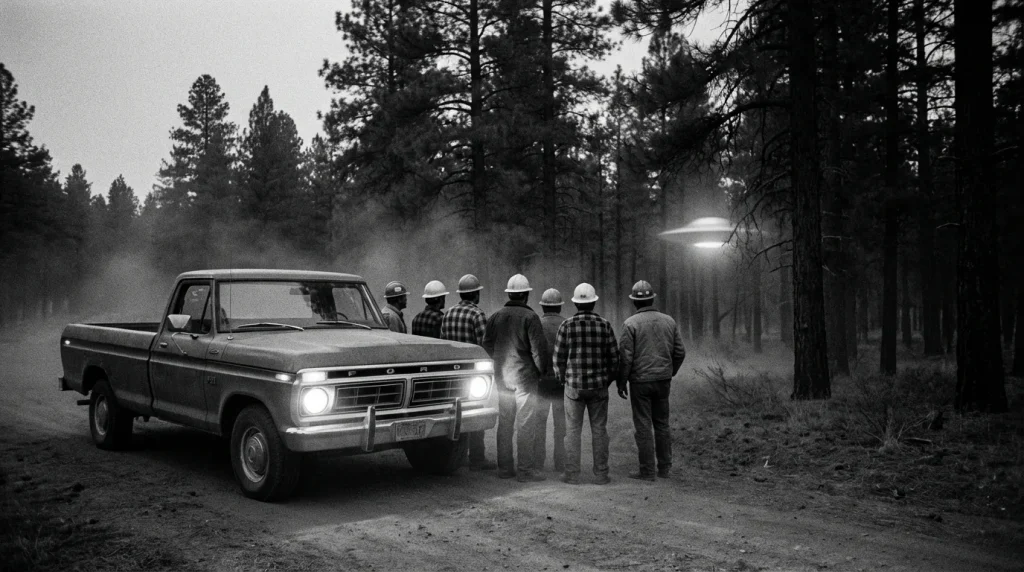
In November 1975, a 22-year-old logging worker, Travis Walton, disappeared near Snowflake, Arizona, after coworkers reported a close encounter with a bright, hovering object in the Apache-Sitgreaves National Forest. Walton reappeared five days later, saying he had been taken aboard a craft and examined by non-human beings—an account that rapidly moved from local police bulletins to national headlines and a long-running public dispute. The case remains one of the most widely cited UFO-abduction claims in U.S. history, with supporters pointing to witness consistency and some polygraph results while skeptics emphasize contradictions, incentives, and contested testing.
Balanced framing: Certain facts are broadly documented (Walton’s disappearance and later return; initial law-enforcement involvement; and extensive contemporary media coverage). Other elements are disputed or unverified, including what exactly the crew saw, whether any hoax planning occurred, and what the polygraph record reliably indicates. No publicly available evidence has conclusively verified Walton’s extraordinary claims, and the case is best understood as a mix of documented events and contested interpretations.
Background: The Logging Crew
Travis Walton was working with a logging crew contracted for forest thinning near Snowflake, Arizona. The group included crew chief Mike Rogers and several coworkers who later became central witnesses because they reported seeing a bright object and, in some tellings, a beam of light striking Walton. Their accounts—told to law enforcement, journalists, and later in interviews—became the primary basis for the initial UFO claim, along with Walton’s later narrative.
The incident quickly became entangled with practical pressures: a work contract, local scrutiny, and fear among the crew that they would be blamed for Walton’s disappearance. Those pressures matter because they shape both skeptical and supportive interpretations of how the story formed and why it persisted.
What Happened on November 5, 1975
On the evening of November 5, 1975, Walton and his coworkers were driving back from the job site when they reported seeing a glowing object in the woods off the road. Multiple versions of the story describe Walton leaving the truck and approaching the object; witnesses then reported a sudden flash or beam of light, after which they fled in panic and later returned to find Walton gone.
What is generally consistent across accounts is that Walton did not go home that night and could not be located immediately, leading his family and coworkers to report him missing. The details that vary—and thus remain disputed—include the object’s precise shape and distance, the sequence of the crew’s movements, and what the witnesses saw at the moment Walton vanished.
Incident timeline (night of November 5)
- Early evening: Logging crew finishes work and departs the job site near Snowflake, Arizona.
- En route: Crew reports a bright object in the forest; the truck stops.
- Moments later: Walton approaches; witnesses report a sudden light/flash and then a rapid retreat.
- Same night: Walton is not located; a missing-person report is initiated as concern escalates.
The Five-Day Disappearance
Walton remained missing for five days, a period that intensified law-enforcement suspicion and media attention. Publicly reported details during this window focused on search efforts, interviews with the crew, and questions about whether a crime had occurred.
Walton reappeared on November 10, 1975. Reports commonly state he made contact by telephone and was then taken for medical evaluation. He later described regaining consciousness in a room with unfamiliar beings, an attempted escape, and subsequent interactions with other humanoid figures before he found himself back near where the incident began.
Five-day timeline (November 5–10, 1975)
- Nov 5: Walton disappears after the crew reports a close encounter in the forest.
- Nov 6–9: Searches and questioning continue; the crew remains under suspicion in some reporting because Walton is missing.
- Nov 10: Walton returns and is evaluated; he later shares his account of abduction and examination.
Key Witnesses and Their Statements
The key witnesses were Walton’s coworkers in the logging truck, including crew chief Mike Rogers. Their importance is straightforward: aside from Walton, they were the only direct observers of the alleged object and the immediate circumstances of Walton’s disappearance.
Supporters argue that the presence of multiple witnesses makes the case harder to dismiss than a single-witness report. Skeptics counter that group stories can converge over time—especially under stress, media pressure, or shared incentives—and that later retellings sometimes differ on critical details.
Walton’s Account
Walton’s narrative, as presented in interviews and later publications, describes an initial injury or incapacitation associated with a bright light, followed by awakening in an enclosed environment where he was examined by beings he characterized as non-human. In later portions of his account, he describes encountering more human-like figures and being returned, disoriented, to the area near his disappearance.
Because Walton’s account includes extraordinary claims, it has been evaluated primarily through consistency checks, interviews, medical impressions reported at the time, and—most controversially—polygraph examinations involving Walton and/or members of the crew.
Investigative Responses
Law enforcement treated Walton’s disappearance as a potential crime until he was found. The crew’s initial report placed them under suspicion during the missing-person phase, and investigators sought to determine whether Walton had been harmed, hidden, or had staged a disappearance.
Once Walton returned, the case shifted toward evaluating competing explanations: misidentification or hallucination, deliberate hoax, or (as proponents argue) an anomalous event. No official conclusion has ended the debate, in part because the central claim is difficult to corroborate with physical evidence and because public accounts of testing and documentation are disputed.
Polygraph Tests and Disputes
Polygraph testing became a major talking point because it offered a seemingly objective way to evaluate witness truthfulness—yet polygraphs are also widely criticized as imperfect and susceptible to interpretation, administration differences, and countermeasures. In this case, different examinations and summaries have been cited by different sides, leading to ongoing disagreement about what the tests “proved.”
Supporters often cite polygraph results reported as favorable to Walton or to members of the crew, arguing this supports sincerity. Skeptics emphasize that not all tests are equally documented, that results can conflict, and that polygraphs do not verify an underlying extraordinary event even if a subject appears truthful.
For general context on the scientific and legal controversy over polygraphs, see the U.S. National Research Council’s review: The Polygraph and Lie Detection.
Media Coverage and Public Reaction
The story’s national profile was amplified by contemporary press coverage and later by books and film adaptations. Mainstream and wire-service reporting helped move the incident beyond Arizona, while UFO-focused organizations and researchers treated it as a marquee case to investigate and debate.
Concrete evidence of broad public attention includes sustained coverage in national outlets and continuing institutional documentation. For example, the case is summarized in a historical context by Encyclopaedia Britannica’s overview of UFOs (which discusses the broader phenomenon and notable reports) and is also discussed in long-running public records and archival reporting on UFO claims. Additionally, the case became widely known through Walton’s later book and its 1993 film adaptation, which renewed public discussion and media retrospectives.
Skeptical Critiques vs. Supporters’ Arguments
Supporters’ arguments commonly emphasize: (1) multiple eyewitnesses to an unusual aerial object; (2) the seriousness of the missing-person period and the risk the witnesses took by reporting it; and (3) claims of favorable polygraph outcomes and long-term consistency in core elements of the story.
Skeptical critiques commonly emphasize: (1) inconsistencies across retellings and the difficulty of independently verifying key moments; (2) the limitations of polygraph evidence; (3) the possibility of social contagion and memory consolidation in a group; and (4) potential incentives created by publicity, publishing, and entertainment adaptations.
Independent, skeptical assessments of prominent UFO cases—including discussion of why cases can remain unresolved—have been published by investigators and organizations focused on critical inquiry. A frequently cited skeptical reference point is the Committee for Skeptical Inquiry (CSI), which has published analyses of extraordinary claims and investigative standards: Skeptical Inquirer.
Why the Case Became Nationally Debated
The Walton case became nationally debated because it combined several ingredients that reliably drive sustained controversy: multiple witnesses, a missing-person interval that invited criminal suspicion, a vivid and unusual personal narrative, and later media retellings that reached audiences far beyond the original event. Unlike many UFO reports that end after a single sighting, this incident generated an extended chain of claims (disappearance, return, medical and investigative follow-up, and polygraph disputes) that kept the story in circulation for decades.
Its enduring status is also tied to broader cultural questions that were especially salient in the 1970s and later revived in subsequent waves of UFO interest: what constitutes evidence, how to evaluate eyewitness testimony, and whether official investigations can resolve events that lack clear physical traces.
FAQ
Was Travis Walton ever found?
Yes. Walton reappeared five days after his disappearance, on November 10, 1975, and later gave a detailed account of what he said happened during the missing period.
What did the polygraphs show?
Different tests and summaries have been cited over the years, and interpretations vary. Some examinations have been reported as supportive of Walton or members of the crew, while skeptics argue that documentation, methodology, and the inherent limits of polygraphs prevent them from serving as definitive proof of the underlying claim.
Is there consensus on what happened?
No. There is broad agreement that Walton disappeared and returned, and that the case received extensive attention. There is no consensus on whether the experience reflected an extraordinary external event, a misinterpretation, or a hoax, and key pieces of the story remain disputed or unverified.
