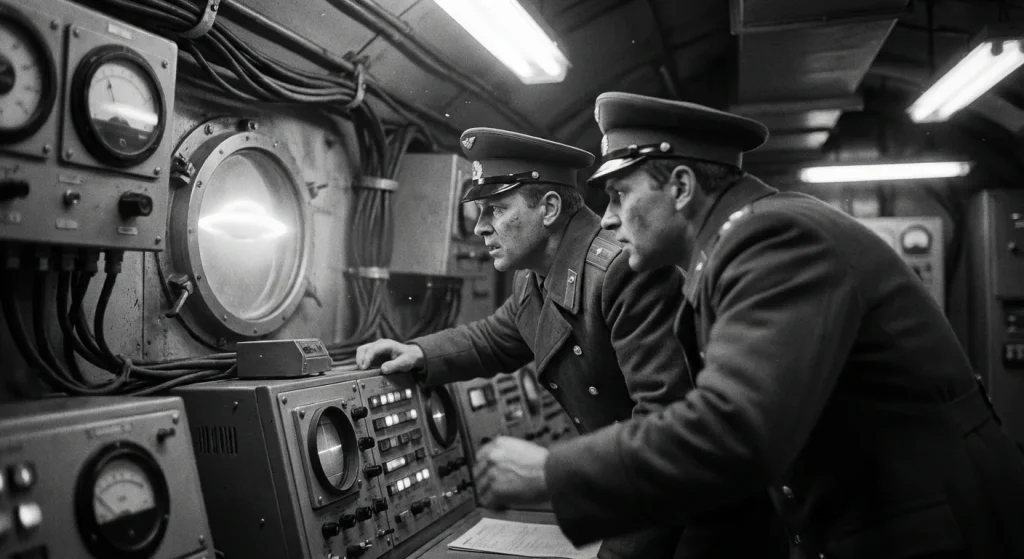
You keep seeing the same UAP news headline recycled: a “mysterious craft” over a Soviet nuclear site in 1982, missiles allegedly moving toward launch, and no clear way to tell what is contemporary documentation versus repeating rumor. This article treats the claim as an allegation to be verified, and it emphasizes what would be needed to test it against primary records instead of accepting repeated retellings.
The responsible conclusion from the seven-source research set used here is cautious: the sources used to support this article do not provide verifiable identifiers for a specific base, nearest town, oblast, or missile unit tied to the 1982 claim. They do, however, document Cold War false-alert incidents and the broader command-and-control context that make such claims consequential if true.
Here is the core allegation in one clean line, framed as a reported claim: a luminous object is said to have appeared near a Soviet ICBM-related installation in 1982 and coincided with changes in launch-related indicators that were reported to revert afterward. Treat that as an unverified report until concrete primary records and attributable witnesses are produced.
Cold War Nuclear Hair Trigger
That reported versus verified split matters most in systems where minutes can decide outcomes and where false warnings have a documented history. The November 1979 NORAD false-warning episode and subsequent investigations show how sensor and computer errors can produce highly escalatory displays; see the National Security Archive summary of the 1979-1980 false-warning history and the U.S. Government Accountability Office review of command-and-control computer management problems for background on those systemic risks (National Security Archive, 2020; U.S. GAO, MASAD-81-30).
Similarly, the June 1980 false alarm that the Pentagon attributed to a faulty integrated circuit in a communications multiplexer is documented in contemporaneous diplomatic records and later reviews; investigators attributed the event to a hardware failure though they could not fully reproduce the failure mode (U.S. Department of State FRUS, D202).
Operator judgment is the last filter in a warning chain, but that judgment operates under doctrine and severe time pressure. Open-source analyses of nuclear command procedures illustrate that short detection-to-decision windows are an operational reality for both NATO and Soviet-era postures and that those windows make false alarms especially dangerous (PBS NOVA; National Security Archive, launch-warning analysis).
What Allegedly Happened in 1982
The 1982 “Soviet nuclear UFO” claim circulates primarily as secondary retellings. From the supplied research set, the responsible way to present the storyline is as a reported timeline built from later retellings, with each step labeled by evidentiary status rather than presented as a single, verified incident.
Summary of the reported sequence (status: reported or asserted unless otherwise noted)
- Appearance: A luminous, saucer-like object is reported near a Soviet military installation associated in popular accounts with strategic forces. Status: reported; the sources used here do not provide a verifiable base name, geographic coordinates, or a bounded date window beyond the year 1982.
- Behavior: The object is said to hover or hold position rather than transit. Status: reported; no contemporaneous sensor metrics (altitude, duration, radar track) are provided in the source set.
- Personnel reaction: Accounts describe heightened attention and reporting within the base. Status: asserted; there are no named first-hand witnesses with rank, unit, or duty position in the supplied material.
- Readiness indications: Retellings claim launch-related indicators moved toward a higher posture and later reverted. Status: asserted/inferred; the supplied excerpts do not include console logs, message traffic, or technical artifacts that would identify which indicators, consoles, or interlocks were involved.
The absence of location, unit designation, duty rosters, and technical records in the quoted source material is the core verification problem. Without those elements, the account remains a high-velocity narrative rather than an incident that can be reconstructed against primary records.
Sources, Witnesses, and Dispute Dynamics
Repetition is not corroboration. To convert “nearly launched” rhetoric into a verifiable incident, the minimum metadata set includes named, attributable witnesses with roles and dates, contemporaneous unit records (duty logs, message traffic, maintenance/fault reports), and technical artifacts (console prints, telemetry, authentication logs). The article’s checklist below summarizes those required elements.
- Demand a named, attributable witness with role, location, and dates.
- Require primary records: duty logs, event logs, maintenance logs, message traffic, alarm summaries, and incident investigation files with identifying numbers.
- Trace the transmission chain: identify the earliest public source, the language of the original account, and intermediate translators or republishers.
- Separate independent corroboration from outlets copying the same script.
- Interrogate translation: identify the original phrasing and competing renderings.
- Assume mixed-truth packaging is a red flag; demand provenance documentation such as scanned originals and archive references.
Some prominent recent amplifications of the 1982 framing include a congressional hearing witness cited in a Fox News report and viral social posts such as a Times of India Facebook entry; those are amplifications and not, on their own, primary records linking an event to a verifiable base, unit, or logs (Fox News report; Times of India Facebook post). Global and broadcast clips of congressional testimony also circulated; see a representative broadcast reposting of hearing material in public video outlets (Global News video; public video repost).
Formal records practices matter for verification. If a claim is tied to an archived file, the MDR/FOIA and accessioning pathways are the routes to follow. For example, the Department of Justice Freedom of Information Act reference materials describe FOIA and declassification request mechanics, and the National Archives explains accessioning and records scheduling that govern how permanent records are transferred and described (DOJ FOIA Reference Guide; NARA accessioning guidance). Scholarship on post-Soviet archival access shows why specific fond/opis/delo references and provenance matter when tracing Soviet-era documents (RAND analysis of archival structures).
How Could Launch Systems Be Affected
Headlines compress many technical layers into “launch codes.” To evaluate any claim, ask which layer allegedly changed: launch authorization (a lawful order), launch enablement (technical readiness and arming), or alert status (posture and messaging). Each layer leaves different records. Safeguards like Permissive Action Links are use-control systems intended to prevent unauthorized arming rather than a single “master password,” and code narratives in popular accounts often conflate enablement with authorization.
Historical notes relevant to popular claims:
- False-warning history and systemic causes in the late 1970s and early 1980s are documented in declassified and archival summaries that explain why erroneous indicators could appear and why reforms were pursued (National Security Archive; U.S. GAO).
- The June 1980 Pentagon-account of a failed integrated circuit in a communications multiplexer is documented in diplomatic records and contemporaneous reviews (FRUS D202).
- Claims that Minuteman launch codes were literally eight zeroes have been examined in secondary and institutional analyses; see a focused debunking/clarification on the Princeton “SGS” page about the “00000000” claim (Princeton SGS analysis).
- Open-source treatments of Soviet command-and-control evolution, including discussion of systems such as Kazbek, are available in archived reports and overviews of nuclear C3 systems (archived C3 report).
Why This Story Matters Now
The story reappears in part because public debates about disclosure are pushing institutions to adopt better records practices for UAP-related material. Senate Amendment S.Amdt.2610 in the 118th Congress proposes creating an “Unidentified Anomalous Phenomena Records Collection” at the National Archives, which reflects a policy interest in consolidating and managing UAP records for future review (S.Amdt.2610 text).
AARO has also discussed case-management and record-tracking approaches in public information papers; AARO briefing materials outline information-handling and declassification issues relevant to how UAP reports are cataloged and reviewed (AARO Declassification Info Paper, 2025).
What Would Confirm or Debunk It
The standards that would convert this narrative into testable history are strict and concrete:
- Named, attributable first-hand witnesses with duty positions and verifiable service records;
- Contemporaneous unit records: duty journals, alert logs, C2 message traffic, maintenance/fault reports, and incident investigation files with identifiers;
- Independent corroboration across separate repositories or sensor chains, including radar or telemetry archives;
- Translation and provenance chain: scanned originals, archive references, and translator documentation that show how the account reached modern outlets.
Absent that combination, treat the 1982 claim as unverified. The Cold War context makes any anomaly near strategic forces a high-stakes allegation, but high stakes do not substitute for primary records.
Sources
-
National Security Archive, George Washington University; “False Warnings of Soviet Missile Attacks During 1979-80 Led Alert Actions by US Strategic Forces”; (March 16, 2020); URL: Nsarchive Gwu.
What it provides: documented narrative and analysis of the November 1979 false warning and related 1979-1980 incidents that illustrate how false alerts can appear in early-warning systems.
What it does not provide for the 1982 UAP claim: no verifiable base name, unit designation, named witnesses tied to the 1982 allegation, or console logs tying a visual event to launch-control artifacts. -
U.S. Government Accountability Office (GAO); “MASAD-81-30” (computer/command-and-control management review); (1981); URL: Gao.
What it provides: analysis of management fragmentation and problems with the Worldwide Military Command and Control System (WWMCCS) and related computer systems in the period leading up to late-1970s/early-1980s false-warning events.
What it does not provide for the 1982 UAP claim: no incident-level documentation tying any alleged 1982 visual event to specific launch-control logs, unit identifiers, or named eyewitnesses. -
U.S. Department of State / Foreign Relations of the United States, 1977-1980, Volume IV; “Document D202” (contemporaneous reporting on a June 1980 communications hardware failure and related investigations); (1980); URL: History State.
What it provides: contemporaneous documentation on the June 1980 false alarm attributed to a faulty integrated circuit affecting communications/multiplexer hardware and the recommendations to improve error detection and communications routines.
What it does not provide for the 1982 UAP claim: no primary evidence linking the 1982 account to named units, logs, or technical artifacts. -
Archived U.S. report on command-and-control (DTIC archive); “C3 – Nuclear Command, Control, and Communications” (archived report, c3nuclearcommand00vale); (date not listed in source metadata); URL: Ia803107 Us Archive.
What it provides: open-source description and historical overview of nuclear C3 systems, useful context for understanding components such as Kazbek and how command authorization versus execution are separated in practice.
What it does not provide for the 1982 UAP claim: no incident-level logs, named witnesses, or archive identifiers tied to the reported 1982 event. -
PBS NOVA; “Missileers” / first-hand and analytical reporting on launch-warning timelines and the decision time constraint; (publication date as listed on site); URL: PBS.
What it provides: accessible explanation of the compressed timelines involved in launch-warning and the operational pressures that create risk in launch-on-warning postures (context for “about 10 minutes” decision windows).
What it does not provide for the 1982 UAP claim: no primary-source logs tying a claimed 1982 visual event to launch-control indicators. -
Princeton University (SGS); “00000000” (analysis of the Minuteman ‘00000000’ launch-code claim and its history); (date on site); URL: Sgs Princeton.
What it provides: an institutional analysis addressing claims that the Minuteman ICBM launch code was literally eight zeroes, clarifying the history and limits of that claim.
What it does not provide for the 1982 UAP claim: no corroborating evidence that a 1982 Soviet incident involved literal code-entry or a specific launch authorization tied to named logs. -
Congress.gov; “S.Amdt.2610 to S.4638 (118th Congress) – Text” (Senate amendment proposing an Unidentified Anomalous Phenomena Records Collection at NARA); (118th Congress, 2023-2024); URL: Congress.gov.
What it provides: the amendment text proposing creation of a consolidated UAP records collection at the National Archives, which is relevant to record-management and declassification standards for future UAP-related releases.
What it does not provide for the 1982 UAP claim: no primary archival proof or incident-specific documents for the 1982 allegation.
Frequently Asked Questions
-
What is the Soviet nuclear UFO incident in 1982 that people keep citing?
It’s a widely repeated claim that a luminous, saucer-like object appeared near a Soviet ICBM-related installation in 1982 and that launch-related indicators shifted toward readiness before reverting. The article states that, in its seven-source research set, there are no verifiable identifiers for a specific base, nearest town, oblast, or missile unit tied to the story.
-
Did a UFO really “activate launch codes” at a Soviet missile base in 1982?
The article says “activate launch codes” is used ambiguously in popular retellings and often functions as dramatic shorthand rather than a precise technical description. In the provided source set summarized, there are no named first-hand witnesses, no technical artifacts (logs, telemetry, transcripts), and no concrete indicator descriptions to support a literal code-entry or authorization event.
-
What details are missing that would let investigators verify the 1982 Soviet ICBM UFO story?
The article says the minimum needed metadata includes a unit name and higher command, a base/facility identifier and region, and at least a bounded date range tied to a duty roster. It also calls for duty positions and primary records such as shift/event logs, maintenance logs, message traffic, alarm summaries, and communications transcripts.
-
What does “launch codes” actually mean in nuclear command-and-control terms?
The article breaks the phrase into three distinct layers: launch authorization (a lawful decision transmitted through the national command chain), launch enablement (technical/procedural readiness to execute an authorized order), and alert status (observable posture and warning activity). It notes that Permissive Action Links (PALs) are code-based use-control concepts intended to prevent unauthorized arming or launch, not a single “master password.”
-
How fast could Soviet nuclear release authority be obtained according to open-source descriptions cited in the article?
The article says open-source descriptions characterize nuclear-weapons release authority as obtainable within about 10 minutes from top leadership. It specifies that this authority could come from the President, the Defense Minister, or the Chief of the General Staff.
-
What is the practical test for evaluating headlines that claim a UAP triggered a nuclear launch sequence?
The article’s rule is to ask which layer changed-launch authorization (permission), launch enablement (readiness), or alert indicators (signals)-because each should leave different records. It says authorization claims require orders, enablement claims require technical logs, and alert claims require time-synced sensor and message data.
-
What evidence would confirm or debunk the 1982 Soviet nuclear UFO incident most decisively?
The article says the key requirements are named, on-record first-hand witnesses (duty officers/technical crews) plus contemporaneous unit records like duty journals, alert logs, C2 message traffic, and maintenance/fault reports. It also calls for independent corroboration across separate repositories and a translation/provenance chain with scanned originals and archive references.
