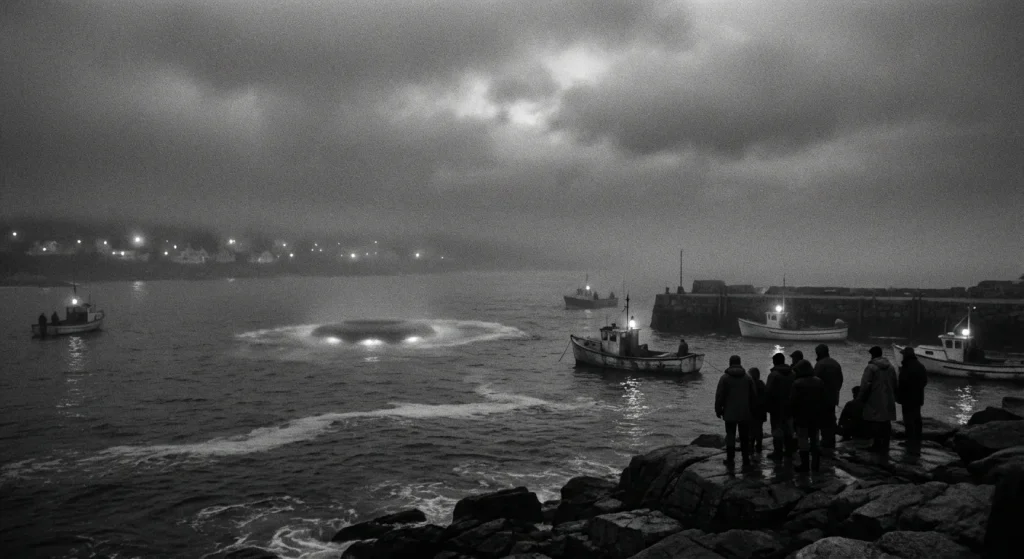
You keep seeing “UFO disclosure” and “UAP news” headlines, and the choice is always the same: chase the newest claim or pick one older case that actually has friction, names, and paperwork attached.
Shag Harbour fits that second category because it is tied to a specific place and a tight time window: Shag Harbour, a small fishing community on Nova Scotia’s Atlantic coast, on October 4, 1967, with contemporaneous reports placing the event shortly after 11:00 PM. In today’s UAP (Unidentified Anomalous Phenomena) reporting, the cases that hold up under scrutiny are the ones with timestamps, multiple independent witnesses, and first responders showing up in the real world, not just on a message board. Shag Harbour keeps getting reopened because it is repeatedly described as having those ingredients: civilians who saw something, local authorities who treated it as an incident, and later claims of wider government attention that pushed it beyond small-town rumor.
The hard part is that “documented” is not the same as “resolved.” Shag Harbour is routinely labeled one of Canada’s more paper-trailed legacy cases, but a paper trail can preserve disagreement just as easily as it preserves clarity. The central question still lands the same way every time: what went into the water, and what did Canadian authorities, and potentially allied authorities, do next?
After reading, you’ll be able to separate what is anchored (date, location, time window, and the fact of an incident taken seriously enough to generate follow-up) from what is asserted later as lore, and judge for yourself whether Shag Harbour deserves your attention amid the latest disclosure cycle.
What witnesses reported that night
This incident survives scrutiny only when it is rebuilt as a time-ordered sequence with uncertainty visible. The reconstruction below uses explicit tags, reported (said by witnesses at the time), documented (captured in contemporaneous or official records), and alleged (asserted later, often from memory or retellings).
Contemporaneous reports place the core event shortly after 11:00 PM; the exact minute varies by source, so the timestamps are treated as time-windows rather than a single fixed second.
Reported, roughly 10:55 PM to shortly after 11:00 PM: residents and people out on the roads describe seeing one or more bright lights moving low over the waterline or descending toward the harbour area. The recurring structure of these accounts is consistent: a light is noticed, it appears to travel on a directed path, and attention shifts from “odd light in the sky” to “something coming down toward the water.”
Reported nuance: fishermen and shoreline residents tend to describe the light relative to familiar reference points (headlands, the harbour mouth, the darker band of open water). People farther inland more often describe “direction of travel” and “drop” rather than precise position. This is where the timeline starts to blur, because these are real-time impressions without synchronized clocks.
Reported, shortly after 11:00 PM: multiple accounts converge on an apparent water-impact moment: a sudden drop, a flare or brightening, and a splash or disturbance on the surface. This is the spine of the night’s narrative, and it is consistently anchored to “just after 11.”
Reported friction: what people think they heard and saw at that moment diverges sharply. Some descriptions emphasize a distinct splash sound; others emphasize silence and a visual “settling” on the surface. Trajectory descriptions also split: some place the motion as a shallow approach; others describe a steeper descent. Those differences do not negate the event, but they do limit how precisely the final seconds can be reconstructed from memory alone.
Documented (archival reference): Library and Archives Canada listings and related secondary sources reference an RCMP occurrence report with identifier RCMP 67-400-23-X (Royal Canadian Mounted Police, October 4, 1967). A related scan/image is hosted on Wikimedia Commons with the descriptive title “Sighting of Sambro Light, NS by Capt. Leo Howard Mersey on October 4, 1967, RCMP 67-400-23-X” (see the hosted image for the scanned page text). See Library and Archives Canada record listing: Recherche Research Bac Lac Gc and the image on Wikimedia Commons: Commons Wikimedia. Secondary sources cite wording in archival references that has been summarized as indicating responding officers, but counts and phrasing vary among secondary accounts; researchers should consult the scanned image and LAC listing directly for the primary text.
Reported, time-window shortly after 11:00 PM: witnesses commonly place the first calls to authorities after the apparent impact, not before it. The practical reason is straightforward: people call when the light stops being “unusual” and becomes “in the water.” The dispatch sequence is often retold as fast and local, but in this section the only safe timestamp claim is the ordering: impact first, calls next, then first on-scene actions.
Reported, shortly after impact and into the immediate response period: residents and fishermen describe scanning the surface from shore and from boats. The most repeated physical-observation claims are a patch of foam, a yellowish residue, and an unusual odor near the disturbed area. These descriptions are treated here as reported elements, not settled physical findings, because they are difficult to document reliably after the fact.
Water-condition irregularities are notoriously hard to lock down as evidence because smell, surface sheen, and foam are transient, subjective, and heavily dependent on wind and angle of view. Even “foam” is not a single, stable thing; sea-surface foam at the air to water interface presents differently than conditions below the surface, which complicates later attempts to infer what was actually present from secondhand descriptions.
A separate investigative constraint is that the tools used to control surface contamination, such as floating booms and rigid corrals, exist as standard practices in oil-on-water containment. That matters because later retellings sometimes blend “what people saw” with “what people assume must have been deployed,” and the timeline cannot treat those assumptions as documentation without records tying them to that specific night.
Alleged, from later first-person recollection: one account describes on-water handling details, including a request to reduce power and drift while talking. Read as operational color rather than a timestamp anchor: it supports that responders were close enough to manage a boat deliberately, but it does not, by itself, lock in exact minutes for the earliest actions.
Consistency vs variance (what repeats, what doesn’t): across residents, fishermen, and responders, the repeating pattern is a bright light moving toward the harbour, an apparent impact shortly after 11:00 PM, then calls and a rapid shift to on-scene checking of the water. What varies is the sensory layer: whether there was a loud splash or near-silence, whether the light “skipped” or “dropped,” and whether foam, yellowish residue, or odor were strong and localized or faint and uncertain.
This timeline does establish a disciplined sequence: reported sightings lead into a reported impact window shortly after 11:00 PM, followed by documented involvement of police personnel (see archival references above) and reported immediate surface observations. It does not prove a specific object type, a precise impact coordinate, or the chemical reality of foam, yellowish residue, or odor without records or preserved samples, and it treats those after-effects as low-confidence unless tied to documentation.
Canadian government search and documentation
That last distinction-sequence versus proof-is where Shag Harbour becomes a records problem. Once an event is treated as actionable enough to bring in responders, the question shifts from what people remember to what procedures would have generated in writing.
Once government responders show up, the evidentiary stakes change: routine public-safety work tends to generate paperwork. A claim like “authorities investigated” is only meaningful if it can be audited through the kinds of records a real incident response normally produces.
In a coastal incident, the first layer of “government involvement” is usually municipal or provincial public safety, plus the RCMP where jurisdiction and capacity fit. The operational point is not the spectacle of the event, but the administrative conversion of a call into a case: dispatch receives a complaint, assigns resources, records times, and documents outcomes. That progression is what turns a story into an event that can be checked later against logs, notebooks, and reports.
The friction is that early records are often thin on interpretation. Dispatch and patrol documentation is built to answer practical questions: who called, where, what was observed, what resources were sent, and whether anyone needed rescue. That can frustrate readers looking for a definitive “what it was,” but it is exactly why first-response records matter. They anchor timing, locations, and participants, and they show what officials actually did rather than what later retellings assume.
When people say “the military got involved,” they often mean several different things: a request for assistance, an exchange of information, or an operational tasking. Those are not interchangeable, and each leaves a different paper trail. A real operational tasking produces traceable artifacts: tasking messages, unit logs, communications summaries, and entries tied to specific assets and personnel.
The complication is that capability and deployment get conflated. Canada has maritime and diving capability that could be tasked for a coastal search, but capability alone is not evidence of use. The Royal Canadian Navy (RCN) is the maritime component of the Canadian Armed Forces (CAF). Canada also has two operational diving units, RCN Clearance Divers and Port Inspection Divers. Those facts explain what could exist on paper if federal support was requested: naval signal traffic, operational logs, diving task documentation, search-area notes, and post-task reports. They do not, by themselves, establish that any of those records exist for Shag Harbour.
On the flip side, absence is informative only when you know where you looked. If a search of the right institutions, date ranges, and record series turns up nothing, that narrows what can be responsibly claimed. If records exist but are withheld or redacted, that points to a different conclusion: not “mystery solved,” but “a specific file series likely exists, and access is constrained by policy.”
At the federal level, a practical way to map “what should exist” is to start with the Government of Canada’s Info Source descriptions of programs and information holdings. Info Source helps you identify which institutions are likely custodians of dispatch-type records, operational summaries, or defence-related files before you file any request.
For defence-specific searching, the Government of Canada also maintains an official list of Canadian Forces units. That matters because unit identity is how many operational records are organized. If an allegation hinges on “a navy ship” or “a specific unit,” the verification step is to translate that claim into a unit name that could plausibly appear in logs and tasking records.
Access is the other constraint. Library and Archives Canada (LAC) accepts ATIP (Access to Information and Privacy) requests for restricted archival government records. When a case is said to have a paper trail, ATIP is the mechanism that lets researchers test that claim against federal records, subject to exemptions and redactions. Process-wise, that means thinking in categories and custodians: dispatch logs and occurrence reports (policing), situation reports and tasking messages (defence), search documentation (coast and maritime agencies), and internal memos that capture who called whom and what was decided.
The hard limitation in the publicly available records cited here is straightforward: it does not supply specific Shag Harbour report titles, agencies’ file numbers, named vessels, or archival call numbers, and it does not provide documentary citations that would let a reader jump directly to an identified government file. Some secondary discussion frames “government involvement” as speculative rather than supported by a clearly cited record trail. Treat that as an explicit research gap, not as permission to fill in details.
You can conclude one thing with confidence: if public authorities responded in any capacity, the right question is not “what did they believe,” but “what records would their procedures generate, and where would those records be held.” A response implies the potential for dispatch entries, incident reporting, communications notes, and follow-up documentation. It does not, on its own, prove extraordinary claims. “Government investigated” is a prompt to demand specific record types and custodians, then verify through identified files, not a substitute for them.
Planes, meteors, or something else
Once you frame Shag Harbour as a record-generating incident, the competing explanations become testable rather than rhetorical. Instead of arguing over labels, you can ask what each hypothesis should leave behind in logs, traces, and administrative “shadow,” and then compare that expectation to what is actually surfaced.
Most Shag Harbour arguments stall because they debate stories. The disciplined way to reduce uncertainty is to debate expected evidence: if a hypothesis is true, what records, physical traces, and operational footprints should it normally generate, and do the reported observations line up.
The complication is that Shag Harbour contains real signal, not just rumor: a reported low-flying lighted object, an apparent water impact, reported surface anomalies, and a documented authorities-responded search. But in the publicly available records cited here, the disclosed paperwork is not complete enough to close the loop, so the right move is to benchmark each hypothesis against an evidence matrix and mark the gaps.
For aviation specifically, the baseline expectation is not guesswork. Transport Canada states the Transportation Safety Board of Canada (TSB) is the official source of aviation accident and incident data, and incidents reported to Transport Canada can be viewed through CADORS. Those are the first places you would check to confirm or falsify an aircraft-incident theory. For “what evidence should exist,” the norm-setter is ICAO Annex 13-oriented accident-investigation practice and major investigation guidance: preserve primary records, identify wreckage and impact points, document notifications and command decisions, and track search actions.
| Evidence channel (expected evidence matrix) | What “should exist” if the event was real | What the Shag Harbour narrative appears to contain (high-level) |
|---|---|---|
| Wreckage / debris | Recoverable fragments, identifiable materials, drift patterns, salvage chain-of-custody | Reported surface anomalies; no widely disclosed, identified wreckage in the publicly available records cited here |
| Official notifications | Time-stamped notifications, situation reports, tasking orders, interagency calls | Authorities responded; details of who notified whom are not complete here |
| Radar / flight logs | Primary/secondary radar hits, flight plans, overdue aircraft checks, ATC notes | Not shown conclusively in the publicly available records cited here |
| Maritime logs | Vessel positions, navigation-light configurations, radio traffic, weather/sea state logs | Water-impact framing exists; underlying vessel log corroboration is not established here |
| Physical residues | Fuel slick sampling, burn/heat indicators, unusual residues with lab notes | Reported surface anomalies; lab-verified residues are not shown here |
| Duration and pattern of search | SAR area definitions, tracklines, asset logs, termination rationale, negative findings recorded | A search occurred; full trackline-level documentation is not complete here |
An aircraft impacting coastal water reliably produces an administrative shadow: an accident or incident entry, alerting and coordination logs, and a “what aircraft is missing” reconciliation against flight plans and expected arrivals. ICAO Annex 13-oriented practice also implies a recoverable chain of custody for parts, even when recovery is limited.
The Shag Harbour narrative provides the cue that fits an aircraft frame: an apparent water impact plus a real response. What it does not provide in the publicly available records cited here is the usual anchor point that closes aircraft cases: a specific aircraft identity tied to flight logs, radar, or an accident listing you can point to in the TSB record set or, at the incident level, CADORS.
The sticking point is mismatch between a response-scale event and the absence here of the normal aviation record spine (identification, notification trail, and disposition). That absence is not proof by itself, but it is the exact gap a serious aircraft hypothesis must fill.
A bright meteor or fireball produces fast, wide, and mostly passive evidence: many independent sky observations across a region, a brief duration, and typically no prolonged surface target for search assets. If fragments reach the surface, you expect a dispersed fall pattern and, if water entry occurs, no persistent “object” to shadow under the surface.
Shag Harbour’s high-level narrative leans the other way: a low-flying lighted object with an apparent water impact and a search that treated the location as actionable. That is a poor fit for a transient atmospheric event unless the observation set is actually two events being conflated (a sky flash plus an unrelated on-water cue), which would need documentation to support it.
The sticking point is duration. Fireball cases are over quickly; search-and-track behavior implies operators believed there was something to locate. Large searches can still recover nothing, but “zero trace” outcomes are documented as outcomes of extensive search operations in other contexts, which is why negative findings must be weighed against what evidence should have been produced and recorded.
Maritime misidentification has a clear evidence signature: known vessel traffic near the line of sight, navigation-light configurations that match reported colors or spacing, and loggable movements. If witnesses interpreted lights as “descending” when a vessel was actually crossing, you expect the “impact” to be explainable as a loss of line-of-sight, a wave trough, or shoreline perspective effects.
Shag Harbour’s narrative contains the ingredient this hypothesis needs: a coastal setting and water-surface attention. What is missing, in the publicly available records cited here, is the decisive maritime corroboration: vessel identities, positions, course changes, and radio traffic that cleanly account for both the low-flying impression and the apparent impact cue.
The sticking point is the impact claim. Vessel-light explanations succeed when the “impact” reduces to perception. If the authorities’ response was driven by reported surface anomalies at a specific point, the vessel theory has to explain why the surface looked wrong in a way consistent with ordinary marine traffic.
Test activity can be real and still leave an oddly shaped public record: training area notifications, restricted-area enforcement, range logs, recovery operations, and controlled communications. The key is that operational discipline still generates internal logs, even when public disclosure is limited.
The Shag Harbour narrative contains the one element that fits: competent response behavior. What it does not contain, at least here, is the typical “edge evidence” of planned activity, like pre-briefed warnings, routine range scheduling, or an obvious recovery chain that later shows up as ordinary disposal or maintenance paperwork.
The sticking point is that secrecy does not erase logistics. If something was tested and went into the water, something usually gets tasked, logged, retrieved, transported, and stored. Without those traces, “secret test” remains an explanation-shaped label, not a closed account.
“Anomalous craft” (UAP) only earns consideration if it explains the combined package better than conventional alternatives. The expected evidence is not science fiction; it is operational: consistent multi-sensor tracking, unusual residues with credible chain-of-custody, and a response pattern that cannot be reconciled with aircraft, meteors, or vessels once the underlying logs are surfaced.
Shag Harbour’s narrative supplies the minimum condition to keep this bounded hypothesis on the table: the report bundle is not just a single distant light, it includes an apparent impact and a search response. What it does not supply here is the decisive differentiator: independently checkable records that survive contact with routine audit, like radar returns tied to times and bearings, or physical materials that can be examined outside storytelling.
The sticking point is that “anomalous” is not a positive claim until the ordinary record sets are exhausted. If the TSB and CADORS baselines resolve aircraft involvement, and maritime logs resolve vessels, the anomaly space narrows sharply. Until then, it is conditional by definition.
- Pull the aviation spine: TSB occurrence confirmation for the date and region, and CADORS incident entries that match timing and location; then tie any candidate aircraft to flight plans, overdue checks, and ATC notes.
- Obtain radar and comms extracts: primary/secondary radar plots, station logs, and time-synced communication summaries that either show a tracked target to the impact point or show nothing consistent with one.
- Reconstruct the maritime picture: vessel position logs, port movement records, and radio traffic to identify who was where and whether any navigation-light geometry matches the reports without requiring an “impact.”
- Document the search like an investigation: asset tasking, tracklines, start-stop times, and termination rationale, plus any recorded negative findings that show what was actually ruled out.
- Verify any physical trace: residue sampling notes, lab reports, and chain-of-custody documentation, including photographs and storage disposition.
- Check for planned activity indicators: restricted-area notices, training schedules, range logs, and recovery tasking that would exist if the event was connected to testing, even if the payload details were controlled.
Why Shag Harbour matters in 2025
Those steps sound procedural because they are-and that is exactly why the case keeps resurfacing. Shag Harbour is argued over in public, but it is also one of the legacy incidents that can, at least in principle, be pushed back into auditable record systems.
Shag Harbour still matters in 2025 because UAP disclosure debates reward cases that can be audited, not just retold. The public expectation has shifted from “What do witnesses remember?” to “What can be verified against records, timelines, and official actions?” That shift doesn’t retroactively add evidence to 1967, and it doesn’t upgrade unresolved gaps into new proof. It changes the standard of what a responsible, modern discussion demands: show the paper trail, reconcile conflicts, and separate what is documented from what is inferred.
Legacy incidents cycle back into headlines for three durable reasons. First, they predate today’s media ecosystem, so the early narrative often hardened before basic sourcing norms became routine, which creates room for fresh re-review. Second, many include first-responder involvement, the kind of participation that typically produces logs, dispatch notes, memos, or after-action summaries. Third, they can be tested against records in a way that newer internet-native stories often cannot: dates, locations, agency jurisdictions, and archival holdings can be checked, requested, and compared. The friction is that re-review is slow and unglamorous, and it often produces a clean boundary between “confirmed in records” and “unconfirmed,” rather than a dramatic resolution.
AARO’s Historical Record Report and annual UAP reporting represents a modern, report-driven approach to UAP handling, useful as a benchmark for what “transparency” looks like even when it doesn’t answer legacy mysteries. Concretely, AARO released an unclassified Historical Record Report Volume I in March 2024, and AARO produced a Consolidated Annual Report on UAP dated November 2024 that is hosted via DNI channels. AARO’s site also includes UAP Case Resolution Reports, which function as public-facing artifacts of how an institution closes out individual cases.
That packaging matters because it standardizes outputs: a historical review, a recurring annual snapshot, and discrete resolutions that show the logic of disposition. It also has a hard limitation that needs to be stated plainly: the existence of AARO’s reporting system does not mean Shag Harbour is included in its scope, addressed in its volumes, or resolved through its process.
U.S. institutional moves shape global attention because they create a recognizable template for what “serious” UAP transparency looks like: dated reports, defined categories, and explicit case outcomes. Canadian interest in cases like Shag Harbour rises in the same current, not because Canada needs U.S. validation, but because disclosure discourse is now benchmarked against publishable, reviewable artifacts.
When Shag Harbour resurfaces under “UFO news” or “UAP disclosure,” translate the headline into concrete checks. What new record was released, by whom, and with what date? What specific question did the release answer: timeline, jurisdiction, search actions, or identification of an object? What standard is being applied: witness recollection, institutional documentation, or a formal case-resolution rationale? If the story can’t point to a record, it’s not a disclosure update, it’s a retelling under a modern label.
How to assess the evidence today
That insistence on records is easy to say and harder to do, especially when a case has decades of retellings layered over a small set of primary anchors. The practical fix is to apply the same grading rules to every claim, whether it supports a mundane explanation or an exotic one.
Most UAP arguments collapse for one boring reason: people don’t rank sources. Verification beats belief in every serious legacy case, and the fastest way to cut through 2025 and 2026 “new revelations” is to grade every claim by its documentation quality, not its shock value.
Start with contemporaneous sources, meaning materials created at or near the time of the event, because hindsight distortion is the engine that mutates old UFO stories. A same-week police occurrence log, dispatch entry, or signed witness statement stays anchored to what someone actually knew then; a decades-later recollection is shaped by media retellings, community lore, and today’s vocabulary. If a claim can’t point to a dated record created in the original window, treat it as narrative, not evidence.
Corroboration only counts when it is independent. Two people repeating the same newspaper article is one source, not two. Look for multiple witnesses whose accounts were recorded separately, plus at least one independent record system that wasn’t “in the room” with the witnesses (for example: logs, dispatch records, operational reports). Aviation-style documentation norms are ruthless here: FAA Order 8020.11D outlines procedures for aircraft accident and incident notification, and it’s a useful model for what timely, structured reporting looks like even outside the FAA’s jurisdiction. ICAO guidance also pushes uniform application of Annex 13 Standards and Recommended Practices for accident and incident investigation, which is another reminder that consistency and traceability beat storytelling. These documents are cited here as procedural analogies for what structured investigative records look like; see FAA Order 8020.11D (Faa) and ICAO Annex 13 background (Icao).
Chain of custody decides what you can trust because it shows whether evidence could have been altered, swapped, or selectively excerpted. “Someone had a document” is not a claim; it’s an admission that provenance is unknown. You want: who created it, who held it, when it changed hands, and whether you are reading the complete record or a clipped screenshot.
- Is this primary or secondary, and can I name the primary record?
- How early is the record relative to the event (same night, same week, decades later)?
- Is the author or custodian named, or is it “sources say”?
- Is there independent corroboration from a separate system (logs, dispatch, operational reporting)?
- Can I trace chain of custody from creation to what I’m seeing?
- Do I have the full document, or only excerpts with no pagination/context?
Where to look: work outward from official record-keepers and their release mechanisms (records offices, access-to-information workflows, archival catalogs), then verify through credible journalism that publishes document images with sourcing notes. The RCMP maintains information resources and records tied to its enforcement and investigative functions, which is the kind of institutional starting point that can support a real document trail. Use process guides to avoid dead ends: Canada and Canada.
Limitations: the publicly available records cited here do not include specific Shag Harbour RCMP/DND memo titles, ATIP package IDs, archival call numbers, or URLs for every claimed file, so the right move is to follow the process above and insist on identifiers before treating any online claim as verified.
Sources reviewed / Key references
- Transportation Safety Board of Canada, Marine occurrences
- Transport Canada, CADORS overview
- Government of Canada Info Source (example Info Source page)
- Library and Archives Canada, ATIP and access guidance
- Government of Canada, Canadian Armed Forces units directory
- All-domain Anomaly Resolution Office (AARO) official site
- AARO Historical Record Report Volume I (PDF)
An enduring case with open questions
Shag Harbour endures because it is investigable on a clock and a paper trail, not because it is loud.
The anchors hold: Oct 4, 1967, Shag Harbour, Nova Scotia, shortly after 11:00 PM. This article treated the case as a timeline problem first, then a response and records problem, using an evidence-matrix mindset to separate witness accounts, apparent ocean impact details in those accounts, and what official actions and documentation footprints actually exist. It also put the modern disclosure context in its proper place: useful for prioritizing records work, not a substitute for it. The secondary-source ecosystem is real, including “Impact to Contact,” which is widely described as a definitive re-examination, but primary records still outrank retellings when they are available.
What remains unknown is bounded: the identity of the object, what entered the water, and what, if anything, was recovered. The fastest way to settle that is public access to the RCMP occurrence report file ID for Oct 4 to 5, 1967, the RCN/CAF operational log file IDs for the search tasking, and the DND archival file ID covering inter-agency messages and disposition of any material evidence, none of which are fully public or confidently identified in the publicly available records cited here.
If you want real updates, subscribe to our newsletter and treat every new “UFO news” claim as unconfirmed until it maps to a specific, verifiable record release.
Frequently Asked Questions
-
What was the Shag Harbour incident in 1967?
The Shag Harbour incident refers to reports of a bright light or object moving low toward Shag Harbour, Nova Scotia, and an apparent water impact on October 4, 1967. Contemporaneous accounts place the core event shortly after 11:00 PM, followed by calls to authorities and an on-scene response.
-
When and where did the Shag Harbour UFO crash allegedly happen?
The article anchors the event to Shag Harbour, a fishing community on Nova Scotia’s Atlantic coast, on October 4, 1967. The primary time window is shortly after 11:00 PM, treated as a time-window rather than an exact minute.
-
What did witnesses say they saw and what happened on the water at Shag Harbour?
Witnesses commonly described one or more bright lights moving on a directed path toward the harbour area, followed by an apparent impact shortly after 11:00 PM. Reported surface observations included foam, a yellowish residue, and an unusual odor near the disturbed area.
-
How many police officers responded to the Shag Harbour incident?
A documented description of the responding contingent states there were four officers involved. It specifies two RCMP officers and two officers from a neighbouring force.
-
What government records should exist if Shag Harbour was investigated as a real incident?
The article says a real response should generate dispatch entries, incident/occurrence reports, communications notes, and follow-up documentation tied to named custodians and date ranges. For defence involvement, it lists tasking messages, unit logs, communications summaries, and diving or search documentation as the kinds of records an operational tasking would produce.
-
How can you check if Shag Harbour was an aircraft crash instead of a UAP?
The article recommends checking the Transportation Safety Board of Canada (TSB) as the official source of aviation accident/incident data and reviewing incident reporting via CADORS for the date and region. It also says an aircraft-impact theory should be supported by the usual “aviation spine,” including flight logs/radar/ATC notes and a traceable notification trail.
-
What should you look for in 2025 “UFO disclosure” claims about Shag Harbour?
The article says to treat a real update as a specific, dated record release that identifies what question it answers (timeline, jurisdiction, search actions, or identification). It also emphasizes verification mechanisms like ATIP requests and archival searching through Library and Archives Canada (LAC), rather than relying on retellings without file identifiers.
