You keep seeing “Roswell: case closed” cited as proof nothing happened, yet the “bodies” claim never goes away. That disconnect is the real story. The Air Force did not just publish an analysis in 1997; it put a credibility stake in the ground with an official document titled The Roswell Report: Case Closed. The slogan delivered certainty. The public response delivered something else entirely: a permanent argument over what the government says versus what witnesses insist they saw.
That credibility gap still runs the modern disclosure conversation. People do not evaluate unidentified anomalous phenomena (UAP), the government’s label for incidents that remain unidentified after initial review, in a vacuum. They evaluate UAP claims through a trust filter built by prior “final answers” that did not end the debate. Every new video, briefing, leak, or whistleblower allegation lands inside that old frame: if Roswell was “closed” and still feels unresolved, then current statements also read like messaging, not disclosure.
Institutionally, the government has already conceded the trust problem by building new machinery around it. The All-Domain Anomaly Resolution Office (the Pentagon’s UAP office) was established in July 2022 because the reporting burden and public scrutiny did not fade; it intensified. Congress treated transparency as a governance issue, not a tabloid cycle, when the House Oversight Committee held a hearing titled “Restoring Public Trust Through UAP Transparency and Whistleblower Protection” in early September 2025; the committee’s hearing page and the printed hearing record are available from the Committee and the Congressional Record (hearing page, printed hearing record). Those are not the signals of a closed subject. They are the signals of contested legitimacy.
The tension this article resolves is simple and durable: an official narrative packaged as definitive closure versus persistent, high-impact witness claims about “bodies.” That unresolved gap is the fuel for “government UFO cover-up” beliefs, because it teaches audiences to treat certainty as a sales pitch. By the end, you will be able to separate what the Air Force actually asserted in 1997 from what people assume “Case Closed” proved, and you will see exactly how that difference shapes today’s UAP disclosure expectations.
To understand why the Air Force aimed its 1997 closure message where it did, you first have to see how Roswell itself became the template for this kind of credibility fight.
How Roswell Became the Template
Roswell became the archetype for “government UFO cover-up” claims for one basic reason: the public record starts with a sensational claim about unusual debris, then snaps to a mundane explanation, and decades later re-emerges as a much bigger story about recovered craft and “bodies.” That mismatch is what culture remembers. The case’s staying power is not that 1947 contained every element of the modern myth; it’s that later versions retrofit new elements, then treat the 1947 confusion as proof of concealment.
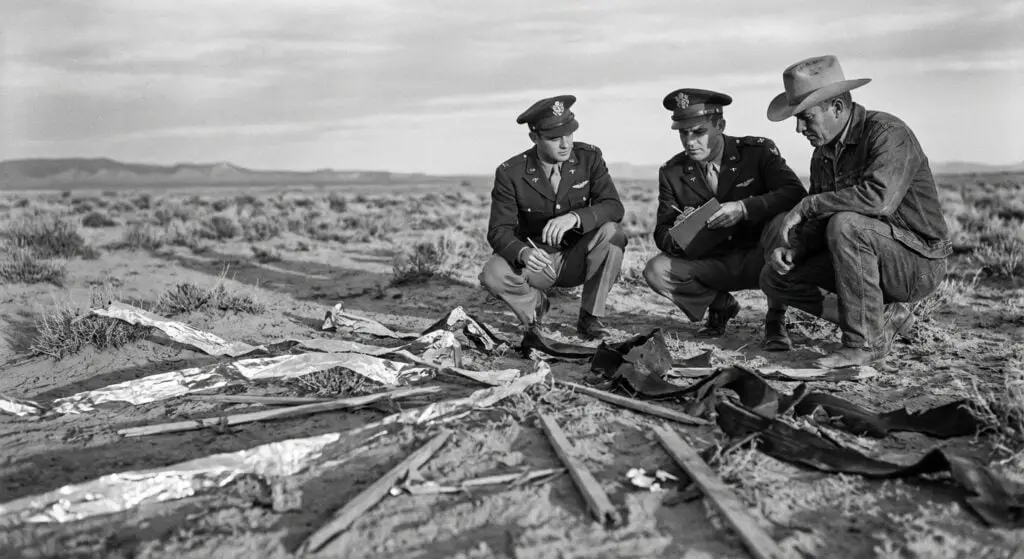
In July 1947, the story that hit headlines was fundamentally a debris story. The initial military messaging framed the recovery as something extraordinary enough to be described to the press in “disc” terms, and newspapers followed that lead. The public got the impression of an unusual object, handled by an Army Air Forces unit, with officials speaking on the record.
The retraction mattered more than the first splash. The official line quickly shifted to an ordinary explanation consistent with balloon debris, and the incident was rhetorically closed almost as soon as it opened. Just as important as what was said is what was not said: the 1947 coverage did not include alien bodies, a second crash site, or a non-human recovery narrative.
Roswell’s modern storyline is a product of narrative accretion: the longer the gap between an event and the public’s access to records, the easier it is for later retellings to expand the cast, add locations, and raise the stakes. Over the decades, accounts broadened from a single debris field into a two-site story, then into claims of a recovered craft, and finally into the most culturally sticky claim of all: recovered non-human bodies.
Once “bodies” enters the picture, everything else in the Roswell file gets reread through that lens: routine base secrecy becomes “containment,” incomplete paperwork becomes “sanitization,” and inconsistent memories become “coached testimony.”
Jesse Marcel sits at the center of this evolution because he is consistently placed near the debris in nearly every version of the story. He matters because he is a bridge figure: close enough to the original incident to anchor the tale, famous enough in later retellings to carry it. But his importance cuts both ways. In the research record summarized for this section, Marcel denied the specific claim about alien bodies, which undercuts the idea that the “bodies” element was present in the original incident as he experienced it.
Roswell happened inside a national-security culture that treated aerial surveillance and detection programs as classified by default. That secrecy did not need to be an extraterrestrial cover story to have an effect. It was enough that officials could not fully explain what certain materials were, why they were in the air, or what missions they supported. The result was an information vacuum, and vacuums get filled.
One useful way to keep this straight is to separate the explanations people cycle through. Coverage commonly groups Roswell into three buckets: weather balloons, UFO claims, and Cold War espionage devices.
Those three frames capture the durable tension of Roswell: the debris can look banal, the headlines sounded sensational, and the era rewarded silence.
Project Mogul matters here because it shows how a balloon explanation can be both true and hard to sell in 1947. Mogul was a classified high-altitude balloon-array effort intended to detect Soviet activity, and later investigations tied Roswell’s debris to balloon-array materials rather than an extraterrestrial craft. Once Mogul’s existence and documentation became accessible, it provided a concrete Cold War program that fit the “strange debris, limited disclosure” pattern without requiring a spacecraft. See contemporary Air Force documentation for the Mogul framing (Air Force report, 1994).
The Roswell timeline only becomes legible when you separate layers: the 1947 incident as publicly framed (debris, then a balloon-style reset) versus the later myth (second site, recovered craft, and especially “bodies”). The “bodies” claim is not a constant; it is the escalation that arrives later and then rewrites the meaning of the original confusion. That layered structure is also why an official response decades later ended up treating the “bodies” question as the part that had to be answered directly.
What the 1997 Report Actually Said
The 1997 Air Force publication is marketed as finality, but its real work is narrower: it targets the “bodies” allegation that kept the Roswell narrative alive after earlier explanations for the debris. Even the packaging leans into that message, presenting The Roswell Report: Case Closed as an official statement that the Air Force considered the bodies storyline solvable without changing its position on non-human intelligence.
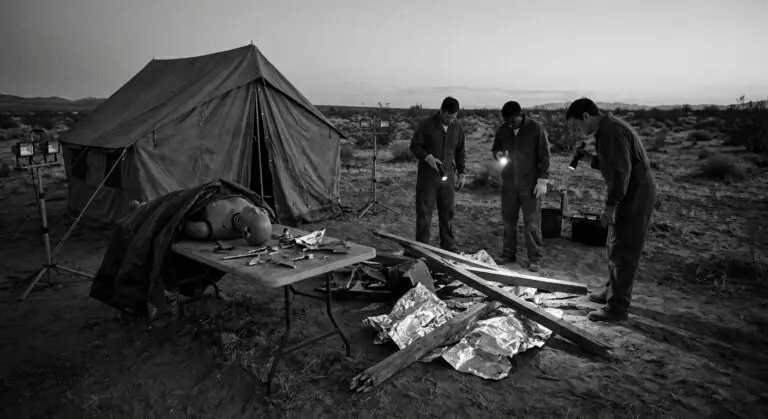
The document is titled The Roswell Report: Case Closed and it is a United States Air Force report issued in 1997. In the Library of Congress cataloging data, James McAndrew is listed as the author, which is why the report is commonly indexed under his name even though it is an Air Force product (library/catalog reference).
As an institutional move, the timing mattered: it was released in mid-1997, positioned to land as an authoritative resolution during the 50th anniversary cycle when “bodies” claims were getting the most public oxygen.
The report’s central reconciliation is direct: the “bodies” that witnesses described are reframed as misidentified anthropomorphic test dummies and, in some accounts, recovery personnel associated with later high-altitude research and recovery activity. An anthropomorphic test dummy is a human-shaped instrumented surrogate used to measure forces and injury risk, which gives the report a concrete way to map “small bodies,” “odd features,” and recovery handling onto test artifacts rather than biological remains.
- Reclassify the reported “bodies” as dummies or as misread observations of real people involved in recoveries, removing the need for non-human entities while still acknowledging that witnesses were describing something they experienced as physical and handled.
- Separate the stories into multiple events, with the report treating many witness narratives as composites built from different years and different programs rather than a single 1947 incident.
- Explain the stitching mechanism as time-driven distortion: interviews conducted decades later are presented as vulnerable to memory drift, rumor reinforcement, and narrative blending, producing a 1947 “bodies” account out of later test activity that had similar surface features.
That logic chain is how the report attempts to reconcile testimony without conceding non-human intelligence: it does not require witnesses to be inventing details, only to be misidentifying what they saw and misplacing it on the timeline as separate episodes collapsed into one remembered story.
The dummy-and-conflation approach is also the cleanest institutional explanation available when the underlying reality includes classified programs, strict compartmentalization, and uneven record access across decades. If personnel in different units only saw their slice of an operation, later interviewers can end up assembling a narrative from partial views, and witnesses can sincerely fill gaps with the most coherent story they have heard since. Within that environment, “misidentified artifacts plus mistaken timeframe” is a practical reconciliation tool, not a rhetorical flourish.
When someone cites “case closed,” track the target: the 1997 Air Force report is specifically explaining how “bodies” reports could emerge without aliens, by tying them to anthropomorphic test dummies and related personnel from later high-altitude activity, then attributing the 1947 placement to conflation and memory distortion over time. Any later argument for or against the Air Force’s conclusion has to engage that mechanism, not just repeat that an official report existed.
On paper, that mechanism is tidy. The debate concentrates on whether it can be made to fit specific claims tightly enough to persuade rather than merely explain.
Where the Crash Dummy Theory Strains
The crash-dummy theory works as an explanatory tool because it offers a real-world pathway for “strange bodies” stories to enter the Roswell orbit without requiring an extraterrestrial premise. The structural weakness is that it depends on a tight match across time, place, and description, and that match is often asserted more cleanly than it is demonstrated. The Air Force’s 1997 position, presented in The Roswell Report: Case Closed, explicitly ties “alien bodies” narratives to witnesses who allegedly saw parachute-borne crash test dummies and then retold what they saw through decades of cultural noise. That makes the dummy explanation a bridge between mundane programs and extraordinary claims, but it also loads the argument onto a chain of inferences where any weak link keeps the case contested.
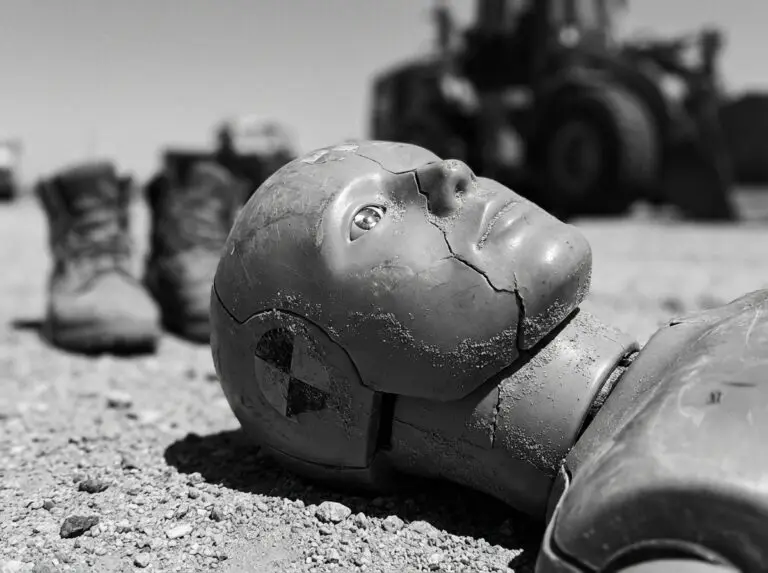
The 1997 report describes a long series of experiments over decades in which instrumented, lifelike anthropomorphic dummies were dropped. That “over decades” framing is exactly what critics target: the major critique is that many dummy-related activities cited to explain “bodies” occurred years after 1947, which undercuts a clean same-event explanation. If the debris is anchored to summer 1947 but the most relevant dummy drops are anchored later, the theory stops being “this is what people saw in 1947” and becomes “this is what people could have seen at some point, later, and then mentally attached to Roswell.”
That distinction matters because Roswell’s body stories are typically treated as event-specific: a single episode, a single recovery, a single moment of confusion. A chronology mismatch forces a different model of how the myth formed: not misidentification at the scene, but retrospective conflation across different eras of base activity, different kinds of recoveries, and different stages of Cold War secrecy. That model can be true, but it is a harder claim. It requires you to accept that the “bodies” layer is not contemporaneous evidence; it is a later narrative layer that latched onto an older debris story.
The second pressure point is logistical fit. Test drops and recoveries are operationally structured: a launch or release area, a predicted impact footprint, tracking, range safety, and a recovery team working a known exercise. That reality can collide with how Roswell “body” accounts are often described in the broad: surprise, isolation, and improvised handling of unfamiliar remains. Skeptics argue that a planned dummy recovery, even when messy on the ground, tends to look like an exercise, with personnel behaving as if they expected to retrieve hardware and instrumentation rather than as if they stumbled into an unprecedented biological discovery.
Defenders of the Air Force position respond with a simpler operational point: outsiders do not experience an operation as “structured” if they are not read in. Compartmentalization can make a controlled activity look inexplicable to anyone who arrives late, hears it secondhand, or is kept at arm’s length. Secrecy also creates a specific kind of confusion: people fill gaps with whatever mental model is available. In 1947, that could be “disc.” In later decades, after Roswell hardened into a cultural template, that could be “alien bodies.” The logistics question is not “were test recoveries orderly,” but “could a limited vantage point plausibly produce the same kind of story that later circulates as a Roswell body recovery.”
The third pressure point is description consistency. Critics argue that some reported details do not map neatly onto test-dummy narratives: size claims, proportions, how the bodies were handled, and the surrounding context (medical setting versus field setting, quick viewing versus extended contact). The argument is not that dummies cannot be mistaken for bodies in principle, but that “bodies were dummies” needs a closer one-to-one fit than it usually provides: which model, which drop, which recovery, and which observer, tied to a date that matches when the account says it happened.
The strongest defense of the Air Force position is not that every description matches perfectly. It is that secondhand accounts and retellings drift. Memory compresses timelines, merges separate events, and substitutes culturally familiar imagery for ambiguous sensory details. Once a narrative becomes a story that gets repeated, the story’s internal logic starts to matter more than the original observations. In that environment, an anthropomorphic dummy can function as the seed crystal: a real object, encountered under secrecy, later reinterpreted through the Roswell frame. That is a coherent mechanism. It just does not automatically validate any specific “I saw bodies in 1947” claim without additional anchors.
The July 8, 1947 FBI Dallas teletype is useful because it grounds at least one strand of the story in contemporaneous paperwork: a “flying disc” report that, when examined, resembled a high-altitude weather balloon found near Roswell. That supports a narrow proposition: a 1947 debris episode can be argued as balloon-related without invoking later programs. It also supports a structural separation that the dummy theory implicitly needs: debris in 1947, “bodies” as a separate narrative layer that arrives later through conflation. See the FBI Vault Roswell collection for the July 8, 1947 teletype (FBI Vault).
What the teletype does not do is carry the bodies claim. It does not establish that any body recovery occurred in 1947, and it does not connect the Roswell debris to anthropomorphic dummy operations. As a result, it strengthens the “debris was mundane” side of the ledger while leaving the “bodies were dummies” side dependent on later reconstruction.
- Pin the date: Identify the specific year and month of the alleged sighting and show it aligns with documented dummy activity, not just “decades of tests.”
- Pin the place: Tie the claim to a specific range, corridor, or recovery area and show that area matches how the sighting is described operationally.
- Demand contemporaneous records: Look for logs, memos, shipping manifests, range reports, or teletype traffic created at the time, not summaries built later.
- Count the inference links: Track how many steps it takes to get from “someone saw something” to “it was a dummy,” and treat each step as a potential failure point.
Apply those tests and the dummy explanation remains plausible, but it stops being a slogan. It becomes what it has to be to persuade a serious reader: a tightly matched, documented account where chronology, logistics, and descriptions all converge instead of merely sounding compatible.
From Roswell to AARO Messaging
The dummy explanation shows why “case closed” can function as an institutional endpoint without becoming a public endpoint. Once a definitive-sounding answer fails to persuade, the residual effect is not closure; it is a lesson that future certainty will be treated as messaging.
After the crash-dummy narrative starts to feel like a patch rather than a persuasion tool, the bigger pattern comes into focus: institutions changed tone. The 1997 posture was built around closure, signaled in plain language as “CASE CLOSED,” because certainty is administratively efficient and politically clean.
The problem is that closure without persuasion does not end a controversy; it industrializes skepticism. Once audiences learn that a confident answer can arrive without answering the hard questions they care about, every future statement inherits that credibility debt. Modern UAP messaging reflects that lesson: it optimizes for defensible claims under scrutiny, not for rhetorical finality.
The All-Domain Anomaly Resolution Office (AARO) was established in July 2022 as a process office, not a narrative office: it is responsible for receiving, processing, and adjudicating UAP reports. It also accepts reports about UAP-related programs and activities from current or former U.S. Government employees, service members, and contractors; see AARO guidance on submitting reports (AARO Submit-A-Report). That remit matters because it forces an institutional posture where the public output is downstream of intake, triage, and adjudication, rather than upstream of a preselected conclusion.
Modern public-facing assessments lean hard on “insufficient data” because it is the only phrasing that survives two competing incentives. First, analysts need to preserve epistemic discipline: if the dataset cannot support a claim about identity, intent, or capability, the institution cannot responsibly imply one. Second, leadership needs to keep reporting channels open: a tone that overcommits trains operators and witnesses to stop reporting because they expect dismissal or distortion.
There is friction in that stance. “Insufficient data” reads like evasiveness to anyone expecting a verdict. In practice, it is a gatekeeping phrase that separates what is observed from what is inferred. It signals that the office is treating UAP as an information problem with varying data quality, not as a debate to be won with a headline.
The 1997 era could afford a single public story delivered on a deadline, including timing the release close to a media moment. Modern offices operate under a different constraint: classification (sources and methods), meaning the protected ways information is collected and the technical capabilities behind it. Even when analysts can resolve a case internally, the specific evidence that would convince the public can be inseparable from sensitive sensors, collection platforms, or operational patterns.
That is why public transparency hits a hard ceiling that is not rhetorical. The institution can either speak vaguely in public or disclose details that burn capabilities. Managed uncertainty is often the only sustainable choice.
When an official statement sounds certain, treat it as a claim that the institution is willing to defend publicly, not proof that the underlying file is simple. When it leans on “insufficient data,” read it as a flag about evidentiary limits and disclosure limits, not as a coded confession. The tone is the tell: certainty signals a chosen public position; uncertainty signals a constrained record, a constrained release, or both.
Those messaging constraints do not stay inside the Pentagon. They spill into lawmaking, deadlines, and the argument over who gets to see which records and when.
Disclosure Politics in 2025 and 2026
By 2025 and 2026, “alien disclosure” politics is not organized around a single cinematic reveal. It is organized around who controls government records, who gets access to them, and whether whistleblowers believe the system will protect them long enough to testify through official channels. Roswell stays in the middle of that fight because it functions as the symbolic test case: if the government cannot persuade the public it has handled the most famous legacy file transparently, every delay in modern UAP transparency gets interpreted through the same lens of mistrust.
The friction is structural. Classification rules, compartmentalized programs, and interagency equities make quick, clean releases rare even when there is no “smoking gun” to protect. The political cost, though, is immediate: slow-roll timelines look like concealment to a public primed by decades of unresolved perception. The result is a durable incentive for lawmakers to build process that survives any single news cycle.
Congressional disclosure efforts have been framed around “expeditious disclosure” because speed is not the only objective. Standardization is. A Senate amendment filed in the 118th Congress states its purpose is to provide for the expeditious disclosure of unidentified anomalous phenomena records, signaling a records-first approach rather than a personalities-first debate.
That framing also explains why the Schumer-Rounds UAP Disclosure Act bipartisan disclosure concepts mattered even when specific mechanisms became negotiating terrain. Schumer conducted a floor colloquy with Senator Mike Rounds on UAPs and advancing bipartisan legislation, and the thrust was procedural: move UAP-related records toward a more predictable disclosure pathway and create formal avenues for testimony that do not depend on ad hoc committee interest.
The complication is that “expeditious” becomes contested the moment agencies have to operationalize it. Speed, in practice, competes with classification review, privacy constraints, and the bureaucracy’s instinct to narrow scope. The policy intent is to make that narrowing visible and contestable, not invisible and discretionary.
Congress has used the National Defense Authorization Act process to force coordination and reporting discipline across a large defense enterprise. For example, Section 866 of the FY2026 NDAA is one provision that imposes cross-departmental coordination requirements and includes calendared milestones; see the enacted text and legal analyses for details (bill text, BDO analysis, Holland and Knight summary). Those kinds of provisions are intended to make program handling more legible and auditable, though some specific administrative proposals reported in public commentary remain matters of agency implementation and subsequent oversight.
Related NDAA process language and oversight efforts aim to reduce inconsistent classification handling by making procedures and deadlines visible to Congress. Treated as governance, that is significant because it pushes toward consistent classification handling instead of inconsistent, program-by-program interpretations that invite suspicion. The catch is enforcement: timelines and matrices matter only if they change what gets released and how reliably Congress can track compliance.
High-profile voices shape expectations even when lawmakers are writing process. David Grusch, Lue Elizondo, Christopher Mellon, and George Knapp have helped set the public’s baseline assumption that dramatic information exists and is being withheld, and media amplification converts each procedural delay into a perceived confirmation. In that environment, Roswell remains the cultural shorthand: not because 1947 needs re-litigating, but because it has become the public’s benchmark for whether government explanations close files or prolong doubt.
Ignore viral “breakthrough” claims and watch for measurable movement in three places: release of primary records (not summaries), durable channels for protected testimony that do not rely on informal backchannels, and timelines that are specific enough to enforce. When the record pipeline speeds up, when reporting channels persist across administrations, and when deadlines produce concrete outputs, transparency improves. When those signals stall, the public will keep reading the delay the same way it reads Roswell: as a process problem that looks indistinguishable from a cover-up.
Why Roswell Still Won’t Stay Closed
Roswell persists because closure was asserted without producing the kind of evidence the public treats as dispositive: independently corroborated data, preserved records, and a trail that can be audited end to end. That is why a 1997 document branded as final can still function, decades later, as a trust stress-test for every new UAP statement.
The 1997 Air Force framing tried to close the “bodies” gap by recasting decades of retellings as a blend of crash dummies, recovery personnel, and multiple events collapsing into one story. Critics argue that move answered a narrative problem more than an evidentiary one. If you already believed the “bodies” accounts were anchored to a single, extraordinary incident, a reframing that depends on memory drift and conflation reads as institutional explanation, not forensic closure, especially where the dummy line strains in broad, common-sense ways around timing, handling, and what witnesses thought they saw.
Modern UAP institutions operate inside the trust deficit Roswell helped create, so your filter has to be stricter than the headline. Best-practice UAP evaluation frameworks prioritize multi-sensor data because one channel can lie to you, glitch, or be misread; independent sensor agreement is what turns a sighting into a trackable event. Those frameworks also treat careful video analysis as mandatory, not optional: you need the original file, metadata, lens and sensor characteristics, stabilization steps, and a documented analysis chain you can reproduce. When physical material is claimed, UAP evaluation frameworks require verification of physical materials when available, with laboratory methods and documentation that survive outside scrutiny.
How reports enter official pipelines matters, because it determines what gets time-stamped and preserved. AARO receives UAP-related pilot reports (PIREPs) contributed by the FAA; AARO’s guidance currently accepts reports from current or former U.S. Government employees, service members, and contractor personnel (see AARO Submit-A-Report). Unclassified ODNI and AARO reporting indicates that many of the most durable reports originate from Navy and Air Force aviators and operators, which means many of the most trackable reports begin as operational safety documentation rather than social content (AARO consolidated annual report).
Use three non-negotiables. First: corroboration, meaning two or more independent sources or sensors that agree on time, location, and motion. Second: documentation quality, meaning originals, timestamps, metadata, and contemporaneous notes that can be checked. Third: chain of custody for any alleged material, meaning a continuous, written record of who collected it, who handled it, where it was stored, and what tests were run, with no undocumented gaps. Those standards are the practical antidote to the Roswell pattern: they reduce the space where confident closure can be asserted without a record strong enough to persuade.
Sources / Further Reading
- The Roswell Report: Case Closed (USAF, 1997)
- The Roswell Report: Fact vs. Fiction in the New Mexico Desert (Air Force, 1994)
- FBI Vault: Roswell UFO collection (including July 8, 1947 teletype)
- AARO Submit-A-Report guidance
- AARO consolidated annual report on UAP (unclassified, FY23)
- House Oversight Committee hearing page: “Restoring Public Trust Through UAP Transparency and Whistleblower Protection”
- Printed hearing record / transcript (Congressional Record)
- FY2026 NDAA text (see provisions cited in analysis)
Frequently Asked Questions
What did the Air Force claim in the 1997 Roswell report “Case Closed” about the reported bodies?
The 1997 U.S. Air Force report titled “The Roswell Report: Case Closed” said witnesses’ “bodies” accounts were misidentified anthropomorphic test dummies and, in some cases, recovery personnel from later high-altitude research and recovery activity. It presented the bodies narrative as explainable without non-human intelligence.
Who authored the 1997 Roswell “Case Closed” report?
The report is a United States Air Force publication, and the Library of Congress cataloging data lists James McAndrew as the author. That is why it is commonly indexed under his name even though it is an Air Force product.
Why did the Air Force release the Roswell “Case Closed” report in 1997 instead of earlier?
The article says it was released in mid-1997 to land as an authoritative resolution during the 50th anniversary cycle of the 1947 incident. It specifically targeted the “bodies” allegation that was getting the most public attention.
What is an anthropomorphic test dummy, and why is it central to the 1997 Roswell explanation?
An anthropomorphic test dummy is a human-shaped, instrumented surrogate used to measure forces and injury risk. The 1997 report uses dummies to map witness descriptions like “small bodies” and “odd features” to test artifacts rather than biological remains.
What are the main weaknesses critics point out in the Air Force crash dummy theory for Roswell bodies?
The article says critics target chronology, noting many dummy-related activities cited occurred years after 1947, creating a time mismatch. It also highlights logistical and description-fit problems, arguing planned test recoveries and specific body descriptions don’t always align cleanly with witness narratives.
What is AARO and when was it established for UAP disclosure?
The All-Domain Anomaly Resolution Office (AARO) is the Pentagon’s UAP office responsible for receiving, processing, and adjudicating UAP reports. The article states it was established in July 2022 and also accepts reports about UAP-related programs from current or former government employees, service members, and contractors.
What evidence should you look for to judge UAP or Roswell-style material claims more reliably?
The article’s non-negotiables are corroboration (two or more independent sources or sensors matching time, location, and motion), documentation quality (originals, timestamps, metadata, and contemporaneous notes), and chain of custody for any material. It also recommends seeking contemporaneous records like logs, memos, manifests, range reports, or teletype traffic rather than later summaries.