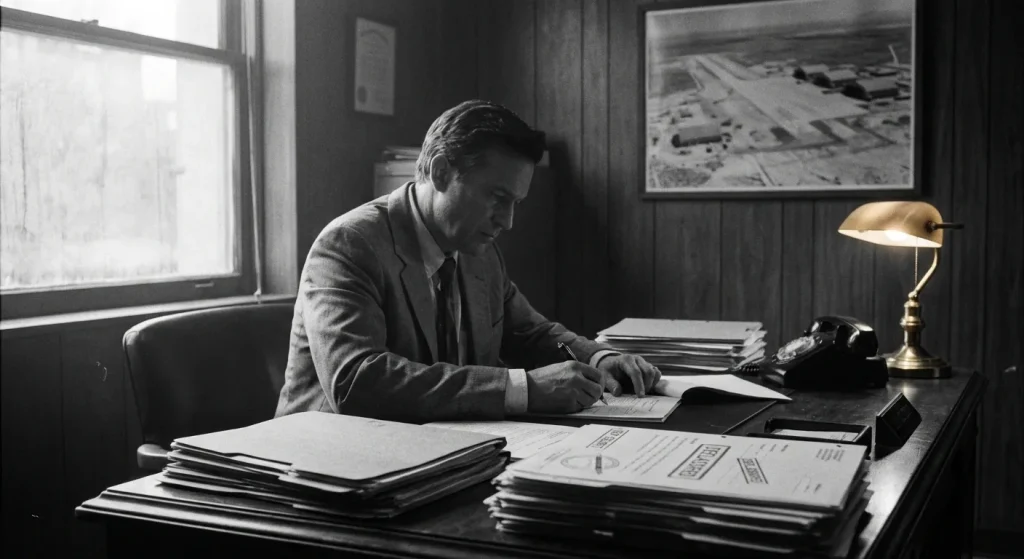
Schiff’s 1993 demand forced a paper trail. If you feel buried under daily UFO and UAP headlines, that single year matters more than a thousand hot takes, because it marks a moment when the Roswell story moved from barroom certainty to a records-driven fight you can actually track.
The problem is speed: sensational claims travel instantly, while documentation crawls. A contemporary news account framed the resulting study as an effort to determine whether the government covered up an alleged removal of bodies from a crashed flying saucer, a claim presented as public perception rather than verified fact. That gap between what people repeat and what the government can be forced to document is where most “disclosure” conversations collapse into noise.
Schiff’s involvement is the pivot point because it ties rumor to accountability. The Roswell records probe was initiated at the request of New Mexico Congressman Steven Schiff, turning constituent pressure into an official search for records instead of another round of recycled anecdotes. In practice, that is the real tension in every disclosure cycle: voters and media reward the most dramatic version of the story, while federal systems only move when someone creates a traceable demand that triggers recordkeeping and follow-up.
Here is the frustrating part, and it is exactly why paper trails matter: the excerpts provided here do not include the exact date or dates, the recipient or recipients, or the full wording of Schiff’s 1993 written request. You cannot anchor the moment to a line-by-line document from these materials alone. Treat that gap as a filter: if a claim cannot be tied back to auditable documentation, it is entertainment, not disclosure.
Track disclosure the same way auditors do, not the way timelines trend: watch which actions create records you can cite, file, and compare over time. A viral “insider” story is frictionless; a documented request that forces agencies to search, respond, and log what they did is the signal.
That standard is the through-line here: how constituent pressure reached a Member of Congress, how GAO gets pulled into a records problem, why the Roswell findings section is constrained by what is actually documented in the provided excerpts, and how the same logic shows up today in AARO intake channels and NDAA-driven reporting requirements.
Schiff, Roswell, and 1993 Pressure
Steven Schiff, a U.S. Congressman from New Mexico (R-NM) in 1993, faced a straightforward political reality: constituents were asking for a government answer, not another round of talk-radio debate. Roswell had accumulated decades of rumor about a 1947 incident, and by the early 1990s those claims were durable enough that voters expected their representative to at least try to pin down what the government’s own files did or did not show.
The key point is operational. Constituents were not in a position to subpoena archives, query agency record systems, or compel interagency coordination. A Member of Congress was. When the question is framed as “what does the government have in its records,” constituent pressure naturally funnels toward the one actor who can credibly force the question into official channels.
The friction in any Roswell inquiry is structural: the public argument runs on stories, while the government’s truth-claims run on documentation. If records exist, the dispute becomes one of retrieval, classification, retention, and provenance. If records do not exist, the dispute shifts to whether they were never created, were destroyed under routine schedules, or were never retained in a way that can be found decades later.
This is also where popular “context” tends to get misused. People often reach for tourism narratives, local economic stakes, or a neatly dated “resurgence” to explain why pressure spikes when it does. The provided source excerpts do not supply verifiable Roswell tourism or economic metrics, and they do not provide a Roswell-specific resurgence timeline with checkable dates. Any attempt to anchor Schiff’s 1993 decision to visitor counts, museum milestones, or a precise early-1990s media cycle would be speculation dressed up as history.
In 1993, Congressman Steven Schiff began an investigation of the Roswell incident. His inquiry sought information regarding an alleged 1947 crash of an unidentified flying object, and it prompted involvement by the General Accounting Office. Note: at the time the agency was known as the General Accounting Office; it was renamed the Government Accountability Office in 2004 (GAO history).
The takeaway for readers is a decision rule you can apply to any disclosure push: judge it by which official channel it forces to respond and what documentation that response creates. Public controversy can run forever; institutional responses leave artifacts you can interrogate later.
That decision rule also sets up the next question: what, mechanically, has to happen for a congressional inquiry to become a GAO engagement rather than a press-cycle gesture.
How a GAO Investigation Gets Triggered
GAO involvement is the moment a story stops being a narrative and becomes an auditable question: what records exist, where they sit, and whether federal agencies can account for their handling of public resources.
A GAO investigation starts with Congress, not with an agency press office or a public petition. GAO accepts requests for reports and testimonies only when they come from congressional committees, subcommittees, or individual Members of Congress; see GAO guidance on requests and Congressional relations (Requests to GAO: Process at a Glance and What GAO Does: Reports and Testimonies).
The request arrives as a congressional request letter, meaning a formal written request that sets the work’s scope and expected deliverables. GAO’s guidance directs requesters to route request letters to GAO’s Congressional Relations office and to describe the nature of the request and requester contact information (Requests to GAO: Process at a Glance).
In practice, the requester’s position matters for how work is triaged: GAO gives special attention to requests coming from committee chairs or ranking members, because those letters typically signal broader committee priorities and oversight intent (GAO: Reports and Testimonies).
GAO also publishes quick-reference material that summarizes process and timing for congressional requests; those materials clarify expectations about scope, timing, and deliverables (Requests to GAO: Process at a Glance).
The Government Accountability Office (GAO) is a congressional support agency that serves as Congress’s audit and investigatory arm over federal programs and actions. Its statutory authority to obtain agency records is grounded in Title 31 of the U.S. Code, including 31 U.S.C. 716, which authorizes the Comptroller General to obtain agency records as required to perform GAO’s duties (31 U.S.C. 716 (text)).
The roots of that design are older than modern disclosure politics. The Budget and Accounting Act of 1921 authorized the oversight role that evolved into GAO, and GAO’s current public materials describe how congressional requests, statutory authorities, and internal processes fit together (GAO: Reports and Testimonies).
A records search inquiry is operational work. GAO stands up an engagement, logs key information, and tasks the relevant internal teams and subject matter offices to run down leads and documentation across organizational lines. The practical steps GAO follows and the expectations for request letters are summarized in its public process guidance (Requests to GAO: Process at a Glance).
On the ground, that translates into four repeatable workstreams: collecting and reviewing documents, interviewing knowledgeable officials, coordinating requests across multiple agencies and components, and testing whether the record trail supports the stated handling of the matter under review. The output is not a “verdict.” It is a GAO product that states what GAO could locate, what agencies reported, what documentation supports those representations, and where gaps remain (GAO: Reports and Testimonies).
GAO’s access is broad, but it is not magic. Classification and compartmentation can limit what can be shared, even if GAO can review certain material in controlled settings. A second friction point is record reality: missing, destroyed, misfiled, or never created records cannot be conjured into existence by an audit standard. A third problem is organizational fragmentation: interagency silos and component-level recordkeeping can produce “no record found” answers that reflect structure, not intent.
Even when agencies cooperate, they often do so through their own internal engagement rules. For example, the Department of State maintains internal guidance governing how it handles GAO-conducted engagements and routing, approvals, and spokesperson roles (State Department FAM search: “GAO engagement”).
- Ask for the written scope: the request letter should specify what records, timeframes, and agencies are in bounds (Requests to GAO: Process at a Glance).
- Check the statutory hook: credible oversight explicitly invokes Title 31 U.S.C. access rights (31 U.S.C. § 716), not informal “requests for information” (31 U.S.C. 716).
- Identify the deliverable: a GAO report, testimony, or letter product tells you whether you are reading audited findings or political interpretation (GAO: Reports and Testimonies).
This process-focused lens is also why the next section matters: readers naturally want the Roswell-specific bottom line, but the public GAO materials constrain what can be responsibly claimed about findings and gaps.
What We Can Verify From Public GAO Materials
Based on GAO’s public product about the Roswell records search and related declassified Air Force reporting, the following points summarize what is documented in those official materials.
- GAO produced a records-search product on Roswell: The GAO product titled “The GAO Report: Results of a Search for Records Concerning the 1947 Crash Near Roswell, New Mexico” (GAO/NSIAD-95-187) documents GAO’s effort to identify relevant records and includes reproduced material such as the “Combined History, 509th Bomb Group and Roswell Army Air Field, 1 July 1947 to 31 July 1947” (GAO/NSIAD-95-187 PDF).
- The GAO report documents limits in the surviving record: GAO’s search found gaps and noted that some contemporaneous records from Roswell Army Air Field—specifically certain outgoing messages for the period—had been destroyed without proper authority, constraining what GAO could verify from original 1947 files (GAO/NSIAD-95-187 PDF).
- Air Force investigative reports concluded the recovered material was not extraterrestrial: The Air Force’s own historical examinations produced authored reports (for example, the report by Col. Richard L. Weaver and 1st Lt. James McAndrew) that concluded the material recovered in 1947 was not the remnants of an extraterrestrial craft; those Air Force analyses are publicly available in Department of Defense/NSA/DTIC-hosted documents (Report of the Air Force Research Regarding the “Roswell Incident” (NSA-hosted PDF); ADA326148 (DTIC PDF)).
- GAO reproduced contemporaneous unit histories: GAO’s product includes the 509th Bomb Group/Roswell AAF Combined History for July 1947, which is one of the primary contemporaneous documents the GAO located and reproduced in its report (GAO/NSIAD-95-187 PDF).
What GAO did not and could not do, based on its public product, was invent missing records or resolve all substantive controversies about the event itself. GAO’s role in that report was to document what it could locate in agency holdings, reproduce found materials, and identify gaps where records were missing, destroyed, or not discoverable under available authorities (GAO/NSIAD-95-187 PDF).
Actionable checklist for readers working from GAO products:
- Read GAO’s scope paragraph to see what offices, timeframes, and records were in bounds (GAO/NSIAD-95-187 PDF).
- Note reproduced contemporaneous materials (for Roswell, the 509th/RAAF Combined History is explicitly included) and treat those as primary sources (GAO/NSIAD-95-187 PDF).
- Look for GAO notes on destroyed or missing records; those statements explain whether gaps are a function of retention policy, unauthorized destruction, or file loss (GAO/NSIAD-95-187 PDF).
- Cross-reference agency-authored analyses reproduced or cited in GAO products (e.g., the Weaver/McAndrew Air Force analysis) to understand how agencies explain what they found (ADA326148 (DTIC); Report of the Air Force Research Regarding the “Roswell Incident” (NSA)).
Roswell’s Shadow Over UAP Disclosure Today
Today’s disclosure fight is still won or lost on documented pathways, not viral stories. The difference is that modern UAP claims have somewhere specific to go inside government: the All-Domain Anomaly Resolution Office (AARO), established in 2022 to investigate unidentified anomalous phenomena, functions as an institutional intake and coordination node that can route allegations into an actual process instead of leaving them as free-floating rumors (AARO; AARO Historical Record Report, Vol. 1 (2024)).
AARO’s value is procedural, not evidentiary. It is accepting reports from current or former U.S. Government employees, service members, or contractor personnel with direct knowledge, which creates a defined channel for insiders to put information on the record. That channel does not validate what gets submitted. It changes the claim’s posture from “someone said” to “someone reported through a government intake pathway,” which is the minimum threshold for any later accountability to become traceable (AARO: Submit a Report).
The friction is obvious: an intake office can only act on what it receives, what it can legally access, and what it can memorialize into reports. The actionable move for anyone tracking disclosure is to stop scoring stories by how extraordinary they sound and start scoring them by whether they enter a system that can generate auditable artifacts.
The July 26, 2023 House Oversight and Accountability subcommittee hearing on UAP put that tension in public view. The hearing included sworn testimony, which creates on-the-record claims, but testimony is not the same thing as producing the underlying documents, sensor logs, chain-of-custody records, or tasking orders that make a claim verifiable.
Hearings generate heat quickly because they compress complex allegations into soundbites. Documentation generates light slowly because it forces specifics: who held what, when, under what authority, and where the record sits today. Even NDAA-linked briefings, which keep showing up as the connective tissue in modern UAP oversight, only matter to the extent they compel agencies to show work in a format Congress can later interrogate.
Schiff’s lasting contribution was never a particular conclusion. It was the discipline of forcing a paper trail, then judging government behavior by what it can produce on demand. That approach aligns with how federal accountability actually moves: GAO operates under statutory access rights to agency records and conducts audits and investigations under authorities in Title 31, which makes “show the documents” more than a slogan when oversight is properly triggered (31 U.S.C. 716).
Practical rule of thumb: rather than chasing trending search terms, ask which formal channel logged the claim and what record it produced; that will move you from rumor to a verifiable lead.
Today’s Transparency Levers and Roadblocks
Modern UAP disclosure rises or falls on two things Congress can actually enforce: which committee has jurisdiction, and whether the law creates a reporting duty an agency cannot ignore. Without jurisdiction, even the loudest demand turns into a voluntary briefing.
The House Armed Services Committee (HASC) is a gatekeeper because its jurisdiction is anchored in the Rules of the House. HASC retains jurisdiction over the subjects listed in Rule X, clause 1(c) and clause 3(b), which is the procedural “keyring” that determines what it can write into the NDAA and what it can compel in defense oversight.
HASC also treats that jurisdiction as operational, not symbolic. Its 119th Congress authorizations and oversight plan states the committee has jurisdiction over laws, programs, and agencies under permanent authority in numerous titles of the U.S. Code, including Title 10 (the Department of Defense). That matters because most UAP-relevant collection, analysis, and security classification decisions live inside Title 10 systems.
On the Senate side, the Senate Armed Services Committee (SASC) conducts oversight of the Military Intelligence Program (MIP) in the Senate, and HASC shares that responsibility in the House. Oversight lanes outside armed services still matter, but armed services jurisdiction is where defense programs get authorized, fenced, and audited in recurring cycles.
Even when multiple committees assert interest, standing committees operate with documented oversight and investigative authorities. The practical constraint is that those authorities attach to committee mandates, not to the general public appetite for “disclosure.”
Congress uses three levers to turn “tell us what you know” into a compliance problem: mandated record collection, required declassification review, and recurring reporting with deadlines.
Legislation can change the reporting posture. For example, the FY2026 National Defense Authorization Act effort in the Senate was considered under Senate bill S.2296; the Senate Armed Services Committee reported and advanced the measure (committee action and report language appears on congressional record pages for S.2296), and the enacted FY2026 NDAA was signed into law as Public Law 119-60 on December 18, 2025 (S.2296 / FY2026 NDAA (Congress.gov)). Provisions across recent NDAA text and AARO’s public reporting materials are where to look for specific changes to reporting cadence and inventory obligations (AARO Historical Record Report, Vol. 1 (2024)).
House members are also using the NDAA amendment channel as a forcing function. An NDAA vehicle matters because it is the recurring authorization bill that defense components plan around, and it is where Congress can tie requirements to funding and program permissions.
Whistleblower protections are the third lever, because they widen the intake of credible leads that trigger record searches and oversight follow-up. Proposed whistleblower protection measures focus on disclosures tied to the use of taxpayer funds and official action, which places them squarely in the domain Congress can audit and legislate.
Classification is the first hard wall. Even when Congress mandates reporting, the executive branch controls classification decisions and can insist the most sensitive material stays compartmented and briefed only in secure spaces. That turns “disclosure” into a split pipeline: some material is suitable for public release, and the rest becomes classified annexes and closed briefings.
Jurisdictional fragmentation is the second wall. Armed services committees can push defense reporting, while intelligence committees (SSCI and HPSCI) sit on intelligence oversight; the seams between those lanes are where programs often remain opaque because no single committee automatically owns the full chain from collection to storage to declassification.
The last roadblock is implementation lag. Proposing amendment language, even filing it, is not the same thing as enacting it. Enacted text still has to be interpreted, resourced, staffed, and enforced, and agencies can satisfy the letter of a reporting requirement while minimizing what they release publicly.
- Check jurisdiction by identifying which committee owns the program space (armed services for Title 10 defense, intelligence for IC holdings, oversight for investigative pressure).
- Check enacted status by confirming the language made it into a passed bill signed into law, not just an amendment announcement or purpose statement (S.2296 / FY2026 NDAA (Congress.gov)).
- Check deadlines and recurrence by looking for dates and repeating reports that force continuous record collection and follow-up.
- Check the reporting audience by seeing whether the requirement demands public release, a classified annex, or closed briefings only.
Those are contemporary tools, but they rest on the same basic premise Schiff exploited in 1993: if you want a claim to become traceable, you have to force it into an official process that produces records.
Why Schiff’s Move Still Matters
Process is the only reliable disclosure signal, and Representative Steven H. Schiff proved it in 1993: his request for information on an alleged Roswell-related crash triggered a formal records search that involved GAO. The Department of the Air Force’s internal materials acknowledge pressure from congressional inquiry and related reviews; for example, an Air Force memorandum and related Air Force research documents note GAO engagement and Air Force efforts to respond to congressional concerns (Report of the Air Force Research Regarding the “Roswell Incident” (NSA-hosted PDF); Air Force historical memorandum).
The Air Force research product commonly cited in discussions of Roswell is publicly available through DTIC (for example, ADA326148), and those documents state they were produced in response to congressional and public interest in the alleged 1947 event; see ADA326148 (DTIC PDF) and related DTIC records.
The institutional reflex to which Schiff’s request speaks is still visible today in how Congress writes reporting requirements. The FY2026 National Defense Authorization Act work in the Senate—recorded under Senate bill S.2296—was advanced by the Senate Armed Services Committee and was ultimately enacted as Public Law 119-60 on December 18, 2025; recent NDAA language and AARO’s public materials are the correct places to look for concrete changes to reporting cadence or inventory/accounting obligations (S.2296 / FY2026 NDAA (Congress.gov); AARO Historical Record Report, Vol. 1 (2024)).
The headlines will keep moving faster than the documentation, but the discipline does not change. Track the mandates, inventories, security classification guidance (SCG) inventories, and audits with the same attention you give headlines, because those artifacts are where accountability actually leaves fingerprints.
Frequently Asked Questions
-
Who was Rep. Steven Schiff and what did he do in 1993 about Roswell?
Steven Schiff was a U.S. Congressman from New Mexico (R-NM) in 1993 who began an investigation into the alleged 1947 Roswell crash by seeking what the government had in its records. The article notes the provided excerpts do not include the exact date(s), recipient(s), or full wording of Schiff’s written request.
-
Why did Rep. Schiff’s 1993 Roswell request lead to a GAO investigation?
Schiff’s request pushed the Roswell controversy into a records-driven process by triggering an official search for documentation rather than relying on witness stories. The article describes GAO involvement as the point where the question becomes auditable: what records exist, where they are, and what agencies can account for.
-
How do you trigger a GAO investigation or report from Congress?
GAO accepts requests only from congressional committees, subcommittees, or individual Members of Congress, submitted as a formal written request letter. GAO’s guidance says the requester should email the request letter to GAO’s Congressional Relations office and include the nature/scope of the request plus requester contact information.
-
What legal authority lets GAO access federal agency records?
The article says GAO’s statutory authority to conduct and supervise audits and investigations, along with broad access rights to agency records, is set out in Title 31 of the U.S. Code. It also notes GAO’s oversight design traces back to the Budget and Accounting Act of 1921.
-
What does GAO actually do during a records-search investigation?
The article lists four repeatable GAO workstreams: collecting and reviewing documents, interviewing knowledgeable officials, coordinating requests across multiple agencies/components, and testing whether the record trail supports how the matter was handled. The output is a GAO product (report, testimony, or letter) describing what was found, what agencies reported, what documentation supports it, and where gaps remain.
-
What is AARO and how does it affect UAP disclosure today?
The All-Domain Anomaly Resolution Office (AARO) was established in 2022 to investigate unidentified anomalous phenomena and to serve as an intake and coordination node inside government. The article says AARO accepts reports from current or former U.S. government employees, service members, or contractor personnel with direct knowledge, creating a traceable pathway even though intake does not itself validate claims.
-
What should I look for to tell if a UAP disclosure claim is real oversight or just hype?
Use process signals the article lists: ask for the written scope (the request letter), check the statutory hook (Title 31 access rights), and identify the deliverable (a GAO report/testimony/letter). For modern disclosures, also check committee jurisdiction (e.g., HASC under House Rule X for Title 10 defense issues vs. SSCI/HPSCI for intelligence holdings), whether requirements are enacted into law, and whether they impose deadlines/recurring reporting with public release versus classified annexes.
