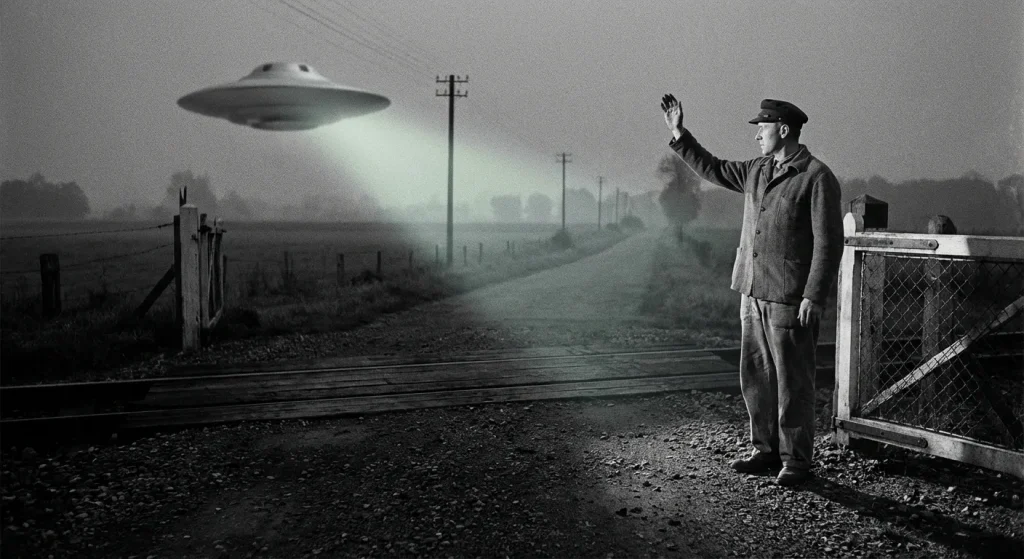
You’ve seen the headline-grade version of Quarouble on repeat in UFO news and UAP news loops: a close-range encounter near a rail or track area, a directed “beam,” and a moment of immobilization that reads like a scene written for maximum impact. You’re not deciding whether it sounds dramatic; you’re deciding whether it holds up as evidence once you strip away the retelling.
The tradeoff is simple and unforgiving: the more extreme the claim, the more the case lives or dies on documentation quality. If you accept the story at face value because the imagery is vivid, you risk building your worldview on a narrative that the record shown does not confirm. If you dismiss it because “beam and paralysis” sounds too cinematic, you miss how older cases can expose real weaknesses in how claims are recorded, repeated, and upgraded over time. Start with the boundary line: none of the five provided sources listed below explicitly give the witness’s full name or confirm an SNCF or railway occupation for the Quarouble witness, even though later tellings often present the protagonist as a specific kind of rail employee. See the “Sources in this audit” section for the five provided sources cited in this article.
Quarouble also sits inside what many compilations describe as the 1954 French UFO wave, a countrywide surge that creates both volume and noise, because a flood of reports invites fast repetition, selective copying, and story-hardening. Some secondary sources and compilations characterize autumn 1954 as a major wave of sightings in France, and some describe it as among the first major full-scale waves outside the United States. Where possible below, these characterizations are attributed to compilations and summaries rather than treated as unqualified fact. For example, modern podcast and bibliographic summaries discuss the French 1954 wave in that language. See the “Sources in this audit” list and the podcast cited below for examples.
You’ll leave with a practical way to separate what can be stated from what gets retold, so you can read Quarouble as an evidence-audit instead of a belief test.
Sources in this audit
- Purdue Online Writing Lab. “Reference List: Electronic Sources” (APA 6 guidance). Date not specified in provided excerpt. URL: Purdue OWL
- Columbia College Library. “Journal Articles” (APA guidance note on assigning lowercase letters after the year for multiple works). Date not specified in provided excerpt. URL: Columbiacollege Ca Libguides
- APA Style. “References: Elements of a Reference List Entry” (elements list entry guidance). Date not specified in provided excerpt. URL: Apastyle Apa
- Carleton University / University of Victoria APA style guidance (cited in the provided set for including author, year, and page(s) with full citations in the reference list). Date not specified. URL: [URL NOT FOUND]
- George Brown College research guides (formatting of article titles and journal citation elements). Date not specified. URL: [URL NOT FOUND]
Case File and Primary Claims
Quarouble is best handled as a controlled case file: separate what is asserted from what is consistently repeated, and keep disputed or drifting details labeled as variable until a dated, attributable source supports them. The Quarouble case is a textbook example of uneven documentation, where a compact core story stays recognizable while later retellings expand the edges and sometimes overwrite the original framing.
At the highest defensible resolution, the encounter is placed at Quarouble in northern France near the Belgian border. That geographic orientation does real work for the case file because it anchors the story to a border-region industrial and transport corridor without pretending we have exact coordinates, an exact spot along a right-of-way, or an evidentiary map reference in the provided materials. The only stable environmental context across common summaries is a railway or tracks-adjacent setting, described as close-range and ground-level rather than a distant light seen across open sky.
The narrative elements most often retold as the core are three claims: a close-range encounter in a tracks or railway-area setting, an alleged directed beam or concentrated light, and an alleged immobilization effect on the witness. Those three are the operational “minimum set” because they define the incident as an interaction, not just an observation. Beyond that, retellings sometimes gesture at a craft and sometimes at a figure or figures, but the provided excerpts do not evidence stable specifics such as distance to an object, the presence of any animals, where any entities stood relative to the tracks, or a described takeoff path. In a disciplined case file, those specifics stay out of the baseline until they appear in a primary document you can cite by date and provenance.
Later retellings introduce “missing time” as a plot mechanism, meaning an interval the witness cannot account for that is later narrated as recoverable through hypnosis. That matters methodologically because hypnosis-driven reconstruction is a known pathway for narrative expansion: one retelling explicitly escalates into hypnosis-recovered missing time and an abduction story involving four-foot-tall aliens and medical experimentation. That is not “more detail”; it is a different class of claim layered onto the same incident label, and it has to be tracked as later accretion rather than assumed original content.
The phrase “missing time” also appears in multiple non-UFO contexts across disparate sources, including ordinary literary or personal-expression usage and academic writing in fields like literary analysis and phenomenology. A social-media excerpt even uses it as image-language (“the missing time stretched out behind me”) rather than as a report of amnesia linked to an anomalous encounter. In other words, the mere presence of the phrase in a retelling is not automatically evidentiary; what matters is how the term is defined in that specific source and what documentation accompanies it.
For this baseline, timing has to stay inside what the available record actually supports. Some later summaries and online case catalogs give dates ranging from late August through mid-September 1954 and times around 21:30 to 22:30. For example, an online ufology catalog for the Quarouble incident lists the date as 10 September 1954 with a time of 22:30, and modern summary entries for the witness Marius Dewilde commonly give similar mid-September dates. See the ufology catalog and the Marius Dewilde summary cited below for those variants. Treat month and day as variable fields until a traceable primary source fixes them.
| Stable across common retellings (baseline assertions) | Variable across retellings (documentation-dependent) |
|---|---|
| Close-range encounter described near tracks or a railway area | Precise date and month (including attempts to fix it to October) |
| Beam or directed-light motif as the triggering event | Exact time anchoring beyond the excerpted “9:30 p.m.” window |
| Immobilization or paralysis claim as the central effect | Witness identity details (name, job title, employer) when unsourced |
| Interaction framing (something happens to the witness, not just sighting) | Abduction escalation, including hypnosis-recovered “missing time” |
| General mention of an object or presence at a high level (where stated) | Four-foot-tall aliens and medical experimentation narrative elements |
Carry this baseline into any sourcing audit with a hard rule: stable elements can be used as the working synopsis, while every variable detail is a hypothesis that earns its place only when a dated, attributable document supports it. That single discipline prevents the Quarouble file from silently absorbing later hypnosis and abduction motifs as if they were part of the original report.
Once you draw that baseline, the next question is unavoidable: what, if anything, in the available record actually anchors those elements to a date, a document, and an identifiable chain of reporting?
Sources, Investigators, and Documentation
The Quarouble story carries exactly as much weight as its paper trail can support. For legacy UFO reports, repetition is cheap and lineage is decisive: if you cannot show who recorded what, when, and from whom, you are not evaluating an event anymore, you are evaluating a narrative.
A reliable audit starts by ranking documents by how tightly they constrain later embellishment. A contemporaneous source, meaning a record created at the time of the alleged event (same day or immediately after) by an identifiable author or institution, outranks later narratives because it locks key details before retellings have time to converge on the most dramatic version.
| Source type | Evidentiary weight and what it can establish |
|---|---|
| Same-day local press (first report) | Best for timestamps, named witnesses, location specifics, and whether the report claims direct interview versus hearsay. |
| Official notes (police, gendarmerie, railway security, military) | Best for identity verification, formal statements, and administrative traceability (file numbers, sign-offs, routing). |
| Early investigator files (letters, field notes, interview transcripts) | Best for verbatim witness language and discrepancies preserved before harmonization. |
| Later books and catalogs | Useful for aggregation and pointers, but typically filtered through author selection, translation, and compression. |
| Internet retellings | Fastest to spread, least stable in detail, and often detached from citations that can be checked. |
The key audit finding is straightforward: none of the five provided sources listed in “Sources in this audit” are identified as contemporaneous press items that first reported the Quarouble story. In other words, the set does not include a first-day newspaper account that anchors the case to an initial publication, headline language, page placement, or a claimed interview chain.
The second gap is just as consequential: no verified official report is identified in the provided material. There is no evidenced gendarmerie, police, railway, or military report in the excerpts, and no file reference or administrative metadata that would let a reader confirm an institutional record exists behind the narrative.
What the provided set does contain are later standalone works and non-press materials rather than a first-day newspaper account for Quarouble. As a provenance matter, that means you are starting downstream of the event. Downstream sources can still be valuable, but only when they point back to upstream documentation with enough specificity to retrieve it. In the provided excerpts, that bridge is not present, so the story is not locked to an origin point the reader can independently inspect.
Once a case lives primarily in later retellings, detail shift becomes normal, even without bad faith. The mechanism is structural: each intermediate step has incentives to simplify, clarify, or intensify, and those edits compound.
Translation drift is the most common. Small choices in tense, modality, and technical vocabulary can harden soft statements into hard claims, or swap a witness’s everyday phrasing for a term that sounds more “official.” If you cannot compare a later translation against the original-language wording, you cannot tell which details are witness-supplied and which are translator-supplied.
Secondary citations create citation laundering. A late author cites an earlier author, who cited a newspaper, but the newspaper is never surfaced with a date and issue. After a few iterations, the story appears “well sourced” because it has many footnotes, even though all footnotes terminate in the same missing primary item.
Editorial compression also changes meaning. When a multi-paragraph account is reduced to a catalog entry, uncertainty markers, qualifiers, and contradictions are the first casualties. The result reads cleaner than the underlying record ever did.
The “best story wins” effect is the final accelerant. When multiple versions circulate, the most vivid phrasing tends to be the one reprinted. Over time, selection pressure favors the version that feels most complete, not the version that is most documentable.
- Identify the first local press appearance by searching municipal and departmental newspaper archives around the reported date range, capturing publication name, date, edition, page, and whether it claims a direct interview.
- Retrieve the original article images (not just transcriptions) to preserve headline wording, bylines, and any corrections or follow-up notices.
- Request gendarmerie or police logs for the relevant jurisdiction and timeframe, specifically asking for incident registers, intake notebooks, and any administrative file numbers tied to the witness name or location.
- Query railway documentation where it could exist: station incident books, security reports, maintenance logs, or internal memos tied to unusual events near the tracks. SNCF or local station records would be a natural target in France for an incident described as tracks-adjacent.
- Locate early investigator correspondence and field notes, prioritizing documents that preserve verbatim witness statements, signatures, dates, and chain of custody.
- Map every later retelling back to its cited predecessor until you hit a document created at the time of the event, and flag any link in the chain that cannot be produced.
This is the same discipline used in other high-consequence investigations: compile what exists, then do field work to close the gaps. In France, practical targets include municipal and departmental archives, contemporary local newspapers (many of which are digitized on national or departmental platforms), gendarmerie incident registers, SNCF station logs, and hospital or general practitioner records where available under French archival rules. National or regional digitized collections such as Gallica and departmental archive portals are typical starting points for French historical press and administrative records.
Even if you locate a better paper trail, Quarouble still hinges on a second, separate question: what does the record actually support about the claimed physical effect?
Paralysis Claims and Physical Effects
“Paralyzed by a beam” is not just vivid language; it is a medical and physiological claim about abrupt loss of voluntary movement, often with implied neurologic compromise. Without clinical documentation, the only responsible move is to map what would need to be true, in what order, and what corroboration would be required to separate paralysis from other forms of immobilization.
A serious investigator treats symptom order as primary evidence because the timeline changes interpretation. Research guidance is explicit: when multiple symptoms are present, record and present them in chronological order.
- Anchor the onset: exact time, distance, and line-of-sight to the reported source; whether the effect was instantaneous or built over seconds.
- Document movement capacity: what could and could not move immediately (hands, legs, head, eyes); whether posture changed (collapse, stiffening, kneeling, freezing in place).
- Document speech and breathing: ability to speak, shout, swallow, or control breathing; presence of choking sensation or inability to phonate.
- Capture consciousness and awareness: fully alert vs confused; ability to follow commands; presence of “missing time” or memory gaps beginning at a specific moment.
- Time the duration: when the inability peaked, when it began to ease, and when normal function returned; note whether recovery was sudden or gradual.
- Record residuals: weakness, numbness, tingling, tremor, gait instability, headache, visual changes, tinnitus, nausea, or ongoing fatigue, with start and stop times.
- Check for pain and skin findings: localized pain, redness, blistering, patterned marks, hair singeing, or clothing damage, with photographs and measurements taken promptly.
- Log sensory effects: glare, temporary night blindness, color distortion, perceived “beam” width and edge sharpness, and any audible hum, crackle, or pressure sensation.
No document in the provided source set contains or cites a specific medical evaluation for the witness. There is no doctor visit, hospital record, employer medical office record, or sickness or leave record documented in the materials reviewed. The file also contains no verified physical-trace test results: no radiation readings, no instrumented measurements, and no numeric results from any device or lab process are documented.
That absence matters because objective findings are the hinge between narrative and injury. In France, employment and health records are handled under specific administrative and archival rules, and the natural documentary targets for a claimed physiologic effect would include hospital admission notes, general practitioner records, employer incident or sick leave files, and any gendarmerie or administrative medical certificates. These are the French-appropriate documentation categories analogous to the types of records investigators cite in other jurisdictions.
- Shock or acute stress response: immobility with preserved awareness. Distinguish with contemporaneous witness statements, observed breathing pattern, and rapid, complete recovery without focal neurologic deficits.
- Startle or freeze response: brief motor inhibition triggered by threat or sudden stimulus. Distinguish with precise duration (typically seconds), intact speech after the peak, and consistent descriptions from multiple observers taken promptly.
- Transient neurologic episode: seizure, syncope, or focal neurologic deficit. Distinguish with clinician notes documenting neurologic exam, vitals, and any post-event confusion, tongue injury, incontinence, or persistent unilateral weakness.
- Lighting and visibility effects: glare, dark adaptation loss, and depth-perception errors misread as immobilization. Distinguish with environmental reconstruction, angle-to-light source, and whether “inability to move” tracks “inability to see safely.”
- Misperception under high arousal: time compression, memory discontinuity, and retrospective sharpening of a “beam” narrative. Distinguish with time-stamped accounts recorded soon after the event and consistency across retellings.
The corroboration threshold is simple: a paralysis claim rises beyond narrative only when it is backed by (1) a time-locked symptom timeline recorded in order, (2) an identifiable medical evaluation or equivalent occupational-health record, and (3) any instrumented, numeric physical-trace documentation if a “beam” is asserted as a causal agent.
Those constraints do more than limit certainty; they also show why Quarouble is so often pulled into broader motif comparisons, where similarity can be mistaken for support.
Patterns Across Close Encounter Reports
Pattern-matching is an investigator’s shortcut to better questions, not a certificate of truth. The same motif comparison that helps you notice what is unusual about Quarouble can also trap you into “pattern-affirmation,” where an account looks persuasive mainly because it resembles other well-known accounts rather than because it is independently supported.
Hynek close encounter classification is useful because it forces you to sort reports by proximity and claimed effects, which immediately changes what you try to corroborate. Hynek-style close encounter categories commonly referenced include Close Encounters of the First Kind, Second Kind, and Third Kind. That framing does not identify anything by itself; it simply disciplines your reading by separating “what was reportedly seen nearby” from “what was reportedly done to the environment or a person.” In parallel, some UFO classification schemes list categories such as nocturnal lights, daylight discs, radar/visual cases, and close encounters. Treat that taxonomy landscape as filing systems, not as labels that solve Quarouble. And keep the basic constraint in view: by definition, UFOs remain unidentified, meaning classification organizes uncertainty rather than eliminating it.
The point of classification is to standardize what questions get asked across cases, not to convert an unidentified report into an identified one.
Quarouble is routinely discussed alongside recurring close-encounter motifs: reported humanoid proximity, a directed light or beam motif, and themes of temporary incapacitation. Motif comparison is productive when it separates diagnostic details from decorative ones. A “directed light” detail, for example, is diagnostic only if the account also gives enough structure to test it: directionality, distance, duration, and whether the light is described as acting like illumination or like a bounded beam. Likewise, “temporary incapacitation” becomes investigable only when you can translate it into time-bounded, observable effects such as inability to move, confusion, or after-effects, rather than treating it as a narrative beat. The actionable move is to use motifs to generate a checklist of missing particulars, not to treat the motif itself as confirmation.
The catch is circular reasoning: once certain templates become famous, later retellings tend to drift toward them. Writers and secondary sources can unconsciously regularize messy details into cleaner motif language, which makes an account read “more classic” over time even if the underlying documentation has not improved. This is a known problem in studying how narratives shift across versions, and it is exactly why investigators track wording changes and provenance rather than relying on pattern resemblance alone.
Methods exist for tracing narrative shifts over time; the lesson for Quarouble is to treat motif convergence as a risk factor, not as added evidentiary weight.
Use patterns to produce testable questions, not to “prove” non-human intelligence: what specific observations would discriminate between a directed light as illumination versus a bounded beam, what independent records would anchor the timing of incapacitation, and what is actually documented versus repeated because it matches a familiar close-encounter script.
That same pressure toward templates is not confined to mid-century retellings; it is amplified by modern disclosure-era framing, where old cases are routinely drafted into today’s arguments.
Why Quarouble Matters in Disclosure Era
Quarouble matters in the 2020s for a simple reason: disclosure-era attention changes how people read old reports. A thinly documented 1954 account gets treated as either courtroom-grade “proof” or as folkloric “myth,” when the only defensible move is to audit what can be traced, what can be measured, and what cannot.
The terminology shift is part of the standards shift. “UFO” historically functioned as a catch-all for aerial observations lacking conclusive identification, which made it easy for one label to cover radically different quality levels of reporting. The modern government and defense umbrella term “UAP” tightens that context: it standardizes the category institutions talk about, and it raises the expectation that claims should be anchored to identifiable records, timestamps, and instrumentable data whenever possible.
A practical reference point for how modern institutions handle historical allegations is the AARO historical record report. The exact title of the document cited here is “Report on the Historical Record of U.S. Government Involvement with Unidentified Anomalous Phenomena – Volume I.” The report is publicly available from the Department of Defense media distribution site and is dated March 2024. URL: Department of Defense. The AARO report describes its historical-record approach and states that it “successfully located the USG and industry programs, officials, companies, executives” that were relevant to legacy allegations. Treat the AARO report as a benchmark for paper-trail substantiation practice, not as evidence about Quarouble itself.
In the disclosure conversation, legacy cases like Quarouble get deployed in two predictable rhetorical ways. Advocates use clusters of older reports to argue persistence: if similar stories show up across decades, the phenomenon looks less like a single era’s fad and more like a durable signal. That argument can motivate real archive work, but the cluster itself is not the data; it is a pattern claim that still has to be supported case by case.
Skeptics use the same legacy record differently: documentation gaps become the point. When a case lacks contemporaneous medical records, instrument readings, original notes, or verifiable chains of custody, skeptics treat later retellings as narrative propagation. That critique correctly targets evidence quality, but it can also slide into dismissing any historical report as inherently worthless, which is a category error. Rhetoric is not evidence, on either side.
The rule for consuming “UFO sightings 2025 / 2026” chatter without getting dragged into certainty theater is straightforward: prioritize cases with traceable documentation and measurable data (sensor logs, primary records, authenticated imagery, clear provenance). Treat legacy cases like Quarouble as prompts for archive verification and standards comparison, not as substitutes for the better-instrumented reports modern UAP discourse claims to demand.
Those standards are workable only if they are operationalized, which is where a compact framework becomes more useful than another round of dramatic summaries.
A Framework for Reading Legacy UFO Cases
Quarouble reads as a compelling legacy report, but its evidentiary weight is capped by what can be dated, documented, and independently corroborated. The disciplined way to handle it is as an evidence-bounded case file, not as a solved mystery.
The strongest element is the case-file discipline: separating stable points from variable retellings, and treating later “missing time” or hypnosis-driven expansions as a known inflation pathway rather than automatic upgrades in certainty. The ceiling stays low for three concrete reasons: the provenance reality in the provided set does not surface identifiable contemporaneous press or official reporting; no later follow-up interviews with the witness are documented in the provided source set; and the medical-evidence boundary remains hard, with no documented medical evaluation or instrumented traces to anchor physiology or physics.
That constraint matters even more under a disclosure-era lens: modern rhetoric pressures every legacy “UFO” story to resolve into a verdict. “Unidentified” is not “alien,” and treating it as “alien” is how analysis turns into ideology.
- Rank sources by hierarchy: contemporaneous records first, later summaries last.
- Verify contemporaneity: ask what was written down at the time, by whom, and where it appeared.
- Demand corroboration: independent witnesses, formal reports, and actual medical records beat narrative coherence.
- Require measurement: photos with provenance, instrument logs, trace samples, or chain-of-custody documentation.
- Flag inflation indicators: missing-time additions, hypnosis-derived detail, and escalating specifics across retellings.
- Control disclosure-era bias: separate “what happened” from “what today’s discourse wants it to mean.”
Apply this framework to the next wave of UFO news or UAP (unidentified reports) headlines, and follow our publication if you want case files audited to the same standards.
Frequently Asked Questions
-
What is the Quarouble UFO encounter (1954)?
It’s a legacy close-encounter report placed at Quarouble in northern France near the Belgian border, commonly described as occurring in a railway or tracks-adjacent setting. The core retold claims are a close-range encounter, a directed “beam” or concentrated light, and a temporary immobilization/paralysis effect on the witness.
-
Was the Quarouble witness confirmed to be an SNCF railway worker, and is the witness name known?
No-none of the provided source excerpts explicitly give the witness’s full name or confirm an SNCF or railway occupation. Later retellings often present a specific rail-employee identity, but the article flags that as unsourced in the provided record.
-
What details are stable vs variable in the Quarouble case across retellings?
Stable baseline elements are the tracks/railway-area setting, a beam/directed-light motif, and an immobilization claim framed as an interaction rather than a distant sighting. Variable elements include the precise date/month (including attempts to fix it to October), exact time beyond a cited “9:30 p.m.” window, witness identity/job details, and later additions like hypnosis-recovered “missing time” and abduction narratives.
-
When did the Quarouble encounter happen, according to the article’s documented window?
The article says the provided record supports only a late August or early September 1954 window with a reported time of 9:30 p.m. It specifically notes the excerpt shown does not, on its face, pin Quarouble to October 1954.
-
What primary documentation is missing for the Quarouble UFO report?
The article reports that none of the five provided sources are identified as contemporaneous first-day local press items for Quarouble, and no verified official report (police/gendarmerie/railway/military) is evidenced. It also notes the set lacks traceable administrative metadata like file references that would let readers confirm an institutional record exists.
-
What medical or physical-trace evidence supports the claim of paralysis from a UFO beam?
The article states no document in the provided source set contains or cites a specific medical evaluation (doctor visit, hospital record, or employer medical record). It also reports no verified physical-trace test results such as radiation readings or other numeric instrument measurements.
-
How do you audit a legacy UFO/UAP case like Quarouble to avoid embellished retellings?
The article’s framework is to rank sources with contemporaneous records first, verify who recorded what and when, and demand corroboration like independent witnesses, formal reports, and measurable data (photos with provenance, instrument logs, trace samples, chain of custody). It also says to flag inflation indicators such as hypnosis-derived “missing time” and escalating specifics across later retellings.
