Today’s nonstop UFO news and UAP news creates a familiar fatigue: constant claims, constant counterclaims, and no stable standard for what “official” even means. The shock is that the U.S. military faced the same dilemma in 1947, and it had to operationalize uncertainty fast, not debate it as entertainment.
The tradeoff was immediate and unforgiving. Treat the reports as noise and you risk missing a real aircraft, a foreign capability, or a safety hazard in controlled airspace. Treat the reports as threat indicators and you risk burning institutional credibility, misallocating resources, and training the public to read every anomaly as an invasion.
June 24, 1947 is the catalytic date because it put a single, legible incident in front of the country. Near Mount Rainier, pilot Kenneth Arnold reported nine objects moving fast in a formation often described as a “V.” The headline result was not one sighting, it was volume: a surge of follow-on reports that forced commanders and analysts to confront a practical question, what do you do with a flood of credible narratives when you cannot verify them on demand?
That pressure hit at the worst possible time for tidy answers. The National Security Act of 1947 created the Department of the Air Force, and the U.S. Air Force became a separate service on September 18, 1947. A new institution built to deliver air superiority and strategic warning suddenly inherited a messy input stream: reports coming from civilians, pilots, and military personnel that were too numerous to ignore and too uncertain to dismiss.
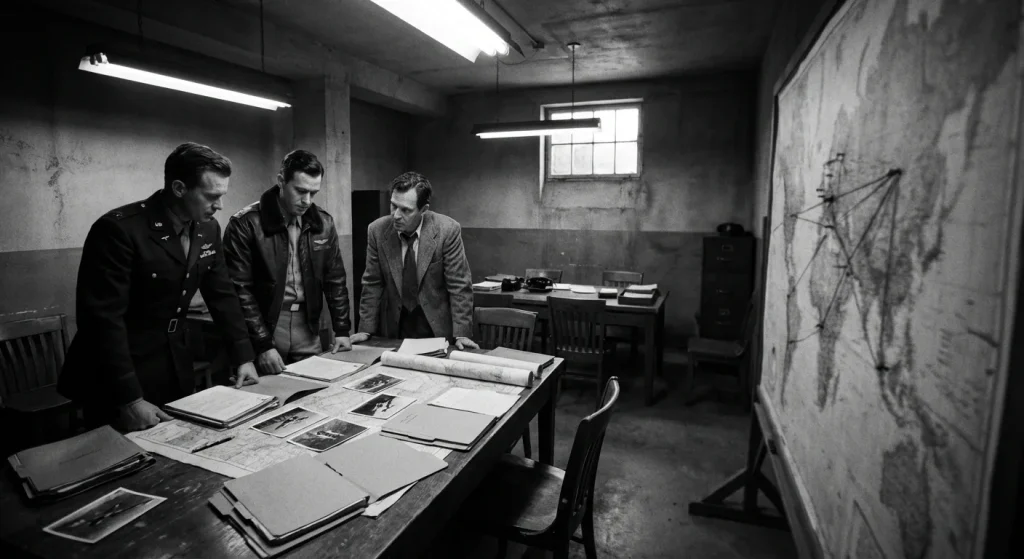
Project Sign, the U.S. Air Force’s first organized, official investigation program evaluating reports of unidentified aerial phenomena in the late 1940s, mattered because it moved the issue out of rumor and into a military workflow where reports get screened, compared, and judged against security questions. In that context, “UFO” functioned as a filing category, not a conclusion: the term was popularized by Capt. Edward J. Ruppelt in his 1956 memoir, and Air Force records note that the service adopted the formal label “unidentified flying object” in the early 1950s, with an Air Force historical record describing the adoption and usage in that period. For further reading see Ruppelt’s account and the Air Force historical review of early UFO programs The Report on Unidentified Flying Objects and the Air Force Historical Record Report AFD-110719-005.pdf.
Modern coverage prefers “UAP,” a broader umbrella term that fits everything from aerial objects to sensor-driven anomalies, but the 1947 moment lived in the language of “flying saucers” and UFOs because the problem first arrived through visual reports and urgent press attention.
You will leave this with a clear grasp of what Project Sign actually was, what it did and did not prove, and how to read modern disclosure claims by separating “official investigation” from “official conclusion.” The place to start is the Air Force’s rationale for building an intake-and-triage system at all.
Why the Air Force launched Sign
Project Sign’s real significance is bureaucratic, not mythical: it treated ambiguous aerial reports as an intelligence problem that required a repeatable threat-assessment workflow. The point was not to validate extraordinary beliefs. The point was to take a sudden volume of reports, assume some fraction could signal a national-security risk, and build a process that could sort signal from noise fast enough to be useful to commanders.
The timeline matters because it reveals intent. Project Sign is commonly summarized as beginning in late 1947 and running into early 1949, with most activity concentrated in 1948. That window sits immediately after the U.S. Air Force became a newly independent service, which amplified pressure to demonstrate competent control of airspace issues and competent handling of intelligence uncertainties. A separate service cannot treat recurring reports as somebody else’s administrative problem; it needs a system for intake, triage, and disposition that can survive leadership turnover and competing priorities.
Sign’s institutional home explains its posture. Its work is strongly associated with the Air Technical Intelligence Center (ATIC), located at Wright-Patterson Air Force Base, operating under Air Materiel Command (AMC). ATIC and AMC placement mattered because those organizations were embedded in technical intelligence workflows focused on capabilities assessment rather than publicity. See the National Air and Space Intelligence Center heritage summary and ATIC historical reports for context NASIC heritage and an ATIC historical overview HistATIC 01Jul-31Dec1957.pdf.
Sign’s core mandate can be summarized as a set of routing questions built for risk management. Analysts were expected to separate reports into misidentifications, hoaxes, foreign technology, psychological factors, and a residual “unknown” category. Each bucket served a different operational purpose. Misidentifications told the Air Force where training, optics, or procedures were creating predictable errors. Hoaxes flagged manipulation and wasted resources. Foreign-technology candidates demanded escalation because they implied an adversary capability problem. Psychological factors mattered because perception, rumor, and stress can create report clusters that look like patterns until you test them. The “unknown” category existed because intelligence work cannot force certainty out of incomplete data; it can only document what remains unexplained after standard explanations are exhausted.
This sorting logic created a built-in tension that never goes away in military intelligence. Every report dismissed too easily carries an obvious cost: you can miss a real adversary platform, an air defense vulnerability, or a collection opportunity. But every “unknown” also carries costs in the opposite direction: it implies a gap in awareness, invites alarm, and can damage the institution’s credibility if leadership looks unable to account for activity in its own domain. Sign was created to manage that two-sided risk, not to pick a preferred story and defend it.
Use Sign’s institutional incentives as your filter. When you evaluate any claim about an early “government UFO cover-up,” start by asking a stricter question: what threat-assessment question was the organization structurally incentivized to answer? An ATIC-style program under AMC is rewarded for reducing uncertainty into actionable categories, escalating anything that looks like foreign technology, and closing out what can be explained. Read its outputs as risk triage under bureaucratic constraints, not as a confession of any single explanation.
How Project Sign investigated UAP
Project Sign’s hardest problem was not persuading skeptics or validating believers. It was building a defensible conclusion from late 1940s evidence that arrived uneven, inconsistently recorded, and hard to cross-check quickly. In that environment, an “unresolved” file often meant “the record cannot support an identification,” not “the investigation found something extraordinary and stopped.”
Sign’s paperwork and procedures were not a single modern, standardized pipeline you can map cleanly onto a form number. The more accurate way to understand the work is as a cautious, generalized investigative workflow that any technical unit would recognize: collect what exists, test credibility, try to corroborate, consult specialists, then assign the least-ambiguous disposition the file can support.
- Intake reports from military and civilian channels, preserving the original description, timing, location, and any available records.
- Screen credibility by separating first-hand witnesses from hearsay and checking whether the account is internally consistent and time-anchored.
- Corroborate by looking for independent confirmation: multiple observers, multiple sites, or independent records that refer to the same event.
- Consult technical expertise to test conventional explanations against the reported characteristics (flight behavior, lighting, weather, astronomical factors, aircraft operations).
- Dispose the case into a conservative bucket: explained, insufficient data to decide, or unknown after scrutiny (unidentified).
This structure mirrors how mature technical organizations protect themselves from overconfident conclusions: they lean on documented methods, standard data collection, and repeatable evaluation steps. A directly relevant comparator from the Air Force record is the Project Blue Book procedures and Air Force Regulation guidance that attempted to standardize reporting and disposition; see the Project Blue Book procedures document and AFR 200-2 for an example of Air Force procedural standardization Project Blue Book procedures.
Most case files started as witness narratives: a pilot’s description of relative motion and distance cues, a guard’s estimate of bearing and elevation, or a civilian’s timing against local landmarks. Those narratives mattered, but they were also fragile. If the report lacked a precise time, direction-of-view, and duration, you could not reliably align it to air traffic, weather, or astronomical conditions, and the case slid toward “insufficient data” even if the witness sounded sincere.
Military reporting channels helped by adding structure: duty logs, communications records, and command reporting could at least establish when an event was noticed and who was on shift. The catch was that retention and logging practices were not optimized for later forensic reconstruction. A missing log entry, an overwritten record, or a report written from memory after the fact could break the chain that turns a sighting into evidence.
Technical consultation was the pressure test. Once you hand a narrative to people who live in the constraints of aircraft performance, optics, weather, and astronomy, vague language becomes a liability. “Shot upward” needs angles and timing. “Paced the aircraft” needs headings, speeds, and reference points. Without those anchors, even competent experts end up doing exclusion work rather than identification.
Pilot sightings are a classic “high-value, high-friction” category. Aviators are trained observers with a strong sense of relative motion, but they are also moving platforms with limited reference points at night, through haze, or above cloud layers. A report can sound precise and still be impossible to reconstruct without contemporaneous headings, altitude, and exact time stamps.
Reports from military installations change the evidentiary mix. A base can supply multiple witnesses, fixed vantage points, and sometimes a duty timeline. That sounds like a straightforward upgrade, until you run into coordination issues: witnesses are dispersed, statements are taken at different times, and the file depends on whether shift logs and local weather observations were recorded and retained in a way that later investigators can actually retrieve.
Then you get “wave” conditions, where clustered sightings arrive from different places over a short period. The volume increases the chance of coincidence, rumor contamination, and inconsistent descriptions. It also increases the need for rapid, centralized cross-checking, the exact capability that was weakest in the late 1940s.
A radar-visual report, meaning a case where radar indications and human observation appear to refer to the same target, is treated as stronger because it is not a single point of failure. It also fails in predictable ways. Radar errors, anomalous propagation, scope interpretation mistakes, and gaps in logging can leave you with a story but no recoverable track history. Visual observers can misjudge range and speed, and if the radar plot was not preserved with timestamps and settings, the “two-source” advantage collapses under review.
Uncertainty in Sign-era files traces back to infrastructure limits: uneven radar coverage, imperfect logging and retention, limited ability to rapidly cross-check astronomical and meteorological explanations, and practical interagency coordination limits. Those are not romantic obstacles. They are exactly how investigations end up with a small number of cases that remain unidentified after scrutiny because the record cannot support an identification.
This is also where the “UFO” label fits without implying alien disclosure. It is a disposition category, not a theory: unidentified means the file did not clear the evidentiary bar for “explained,” not that it cleared a bar for “non-human.”
When someone cites a Project Sign style “case” as proof of anything, apply an evidence audit, not an intuition test. Ask: What contemporaneous records exist (logs, timings, weather, radar documentation)? What independent corroboration exists (multiple observers, independent records, consistent timelines)? What specific missing data would be required to move the case from “unknown” to “identified”? If those questions do not have concrete answers, the honest conclusion is not drama. It is data quality.
That same discipline becomes even more important when the historical record itself is incomplete, which is why the next controversy-the Estimate-absorbs so much attention.
The Estimate and its fallout
The “Estimate of the Situation” is the episode most often used to argue the Air Force “knew” early, and chose secrecy anyway. The problem is that the confidence of the retelling is stronger than the documentation behind it. In the research set provided for this article, none of the sources explicitly reference or document an item titled “Estimate of the Situation,” which means the most dramatic memo in the Project Sign story is also the hardest to audit as a record.
In UFO historiography, the Estimate of the Situation is reported to have been an internal Project Sign assessment that argued for an extraordinary explanation of the best cases, commonly summarized as an “interplanetary” or “extraterrestrial” conclusion, and that senior leadership rejected it. The rejection is typically framed as doctrinal and political: the conclusion was unacceptable to endorse, so the document was allegedly killed, buried, or ordered out of existence. That alleged inflection point is then used as the seed crystal for “government UFO cover-up” narratives, a single decisive moment when clarity supposedly met suppression.
Treat this controversy as a sourcing exercise, not an intuition test. Primary documentation means a located, citable record or a written account created by a first-hand witness at the time, the category with the highest leverage for historical confidence. A primary document you can point to can be checked against dates, authorship, routing, and context, and it can be rechecked by other researchers.
By contrast, the Estimate story usually arrives in two weaker forms: first-hand recollections (someone later saying “I saw it” or “I briefed it”), and secondhand narratives (someone later saying “I was told it existed”). Those forms can be informative, but they do not substitute for a producible record, especially when the claim is that a document was rejected, suppressed, or destroyed. A missing memo cannot be cross-examined.
Archives cannot confirm what they cannot produce. That is not stonewalling, it is method. Provenance is the origin and custody history of records, who created them, where they were held, and how they moved over time. Finding aids are the collection guides that tell you what a repository holds and where items sit within a collection. If a title never appears in finding aids, accession lists, or other collection descriptions, you can still believe a story, but you cannot claim archival confirmation.
There is also a mundane reason famous documents vanish: records are managed under retention and disposition rules, and not everything is kept forever. Even when records do survive, many holdings are already public and declassified, which is why researchers expect to see at least a traceable reference if a document truly circulated through formal channels.
People want a single decisive memo because it turns ambiguity into plot. Intelligence work rarely produces tidy narrative artifacts, and bureaucracies rarely move through one clean “tell the boss, boss says no” beat. Under incomplete and ambiguous information, human judgment defaults to coherent stories, and repeated stories start to feel like evidence.
- Separate “a located, citable record” from “a memory about a record” from “a story about a memory.”
- Demand provenance: who held the document, when, under what file series, and how it entered a collection.
- Weight “I saw it” above “I was told,” and weight both below a produced document you can cite and others can retrieve.
Even without a clean, auditable Estimate memo, Project Sign did not occur in isolation. It sits at the front edge of a sequence of Air Force programs that had to make similar choices under growing public attention.
From Sign to Grudge and Blue Book
The name changes were not cosmetic. They signaled a shifting set of assumptions about what the Air Force could say publicly, what it needed from its analysts, and how much ambiguity it was willing to tolerate in the official record while reports of unknowns continued to arrive.
| Program | Approx. window | Commonly characterized posture and messaging constraints |
|---|---|---|
| Project Sign | Late 1947/1948 to early 1949 | More open-ended framing of unknowns; exploratory threat assessment (ATIC, small shop) with fewer settled public lines |
| Project Grudge | 1949 to 1951/1952 | More skeptical tone and more reputationally defensive case disposition as commonly reported in later summaries |
| Project Blue Book | 1952 to 1969 | Long-running program with tighter public-facing messaging and greater pressure to present closure, even as a residue of “unknowns” persisted |
The practical difference between Sign and its successors was the interpretive environment around conclusions. Sign is commonly characterized as comparatively open-ended, treating “unknown” as an actionable outcome that justified continued analysis. Grudge and later Blue Book are commonly characterized as leaning more skeptical and more PR-managed, emphasizing identification, reducing the apparent space for unresolved cases, and constraining how uncertainty was described outside the file room. That is not mind-reading. It is an observed pattern in how later summaries, press interactions, and institutional habits are described by historians and in declassified fragments. See the Air Force historical volume and the published Project Grudge report for contemporaneous and declassified context AF Historical Record Report and the Project Grudge report Project GRUDGE Report 1949. For a first-hand memoir of organizational posture and changes, see Edward J. Ruppelt’s account The Report on Unidentified Flying Objects.
The Air Force entered this period as a newly independent service, and new institutions protect credibility the way new products protect a brand: they avoid narratives that imply loss of control. An “unknown” label is not just an analytical endpoint. It is an incentive problem. It attracts public attention, triggers foreign-technology fears, invites political scrutiny, and forces leaders to answer questions they cannot close cleanly. Internally, unresolved cases also create security concerns because they encourage speculation about sensor gaps, readiness, and vulnerabilities. In that incentive landscape, tightening tone and narrowing public messaging is rational risk management, even when analysts still face the same stream of puzzling reports.
Outside audiences rarely see the full context that shaped an internal conclusion. Selective declassification, uneven record survival, and ordinary legal constraints on information release all reshape what the public thinks was “decided.” FOIA requests themselves do not guarantee production: agencies and requesters negotiate scope, agencies must conduct a reasonable search for records as described in the FOIA statutes and guidance, exemptions can justify withholding or redacting material, and processing constraints such as backlog and the need to segregate exempt information can delay or limit what is released. For guidance on the FOIA process, searches, exemptions, and segregability see the Department of Justice FOIA guide DOJ FOIA Guide and general FOIA guidance at FOIA.gov.
The long arc of UFO news coverage and public trust turns on this dynamic. When the public hears certainty while seeing continued sightings, confidence erodes. A better reading strategy is to treat institutional statements as outputs of constraints. Ask what problem is being optimized: threat clarity for commanders, public calm, resource limits, or reputational risk. Then ask what counts as “evidence” under that posture, including what level of uncertainty is allowed to remain on the record.
That framing-workflow, constraints, and what counts as evidence-maps directly onto the modern UAP debate, where the argument is often less about objects in the sky than about rules, records, and thresholds.
Why Project Sign matters today
The modern UAP “disclosure” fight runs on paperwork, authorities, and evidentiary thresholds, not on belief. The real conflict is structural: how the government ingests inconsistent reports, triages national-security risk, and decides what level of uncertainty the public will tolerate without degrading operations, sources, or methods.
Project Sign’s core move was threat-assessment logic applied to messy data; today that same logic is formalized as a risk-and-reporting mission inside AARO.
AARO was established in July 2022 to do three things the Sign-era pipeline struggled to do at scale: improve data collection, standardize reporting requirements, and mitigate potential risks associated with anomalous phenomena. Congress also set a recurring oversight rhythm: AARO’s reporting requirements to Congress. That cadence matters because it turns “disclosure” into an auditable process with deadlines, formats, and accountable recipients.
The friction is that process does not automatically create clarity. Standard forms cannot fix low-quality sensor captures, incomplete chain-of-custody, or events that never get reported through official channels because crews fear ridicule or classification consequences.
The July 26, 2023 House Oversight and Accountability subcommittee hearing shows how modern UAP claims enter the public record. Maj. David Grusch testified under oath, and the hearing discussion referenced the experiences associated with David Fravor and Ryan Graves. The official transcript is publicly available on congress.gov, which means the claims, questions, and answers can be checked verbatim instead of laundered through summaries and clips.
That still leaves the same gap Sign faced: sworn testimony establishes what a witness asserts and what lawmakers asked; it does not, by itself, substitute for corroborating documentation, data, or released case files. Classification boundaries and public narrative incentives widen the gap, especially when “UFO sightings 2025” or “UFO sightings 2026” spikes as a search term and coverage races ahead of records.
- Start with primary records: official reports, congressional transcripts, and published directives.
- Separate testimony from documentation: treat sworn statements as claims until matched to records, data, or traceable case materials.
- Track the rules for coming forward: proposed mechanisms like H.R. 5060 in the 119th Congress, introduced as the UAP Whistleblower Protection Act to provide whistleblower protections for federal personnel disclosing taxpayer-funded UAP evaluation or research, indicate attempts to close reporting gaps. See the bill text and summary on Congress.gov H.R. 5060 (119th): UAP Whistleblower Protection Act.
Those modern mechanisms are easier to track than 1940s files, but the interpretive problem is similar: official activity is not the same thing as an official conclusion, and missing documentation still caps what can responsibly be claimed.
What we know and what we don’t
Project Sign’s lasting importance is procedural, not sensational: the U.S. military treated UFO reports seriously enough to stand up an official U.S. Air Force program and evaluate sightings through a national-security lens. That combination of formal tasking plus unresolved cases is the historical takeaway, because it shows real investigative intent alongside conclusions the surviving record cannot fully lock down.
What’s confirmed is the baseline: Project Sign was an official U.S. government, U.S. Air Force study of unidentified flying objects. It was active for most of 1948, and one authoritative summary places its run from December 1947 to February 1949 AF Historical Record Report. Those dates and that official status matter more than any single anecdote because they anchor Sign as a real institutional response, not folklore.
What’s disputed is the clean, document-driven version of the “Estimate of the Situation.” It’s widely discussed, but in the record provided here there is no accessible primary document to evaluate directly. Confidence in the stronger claims therefore rises or falls on how much weight you assign to later recollections, rather than on a surviving report you can read, date, and attribute.
Uncertainty persists for a mundane reason: historical judgment collapses when the paper trail is incomplete. Once records are missing, unreleased, redacted, or never archived in a retrievable way, you are forced to reason under incomplete and ambiguous information, and that hard limit should constrain what any responsible reader concludes.
Use Project Sign as your evidence standard for future UFO disclosure and UAP disclosure claims: prioritize primary sources (documents and firsthand written accounts) over summaries; treat testimony as valuable but classify it by how directly it’s attributable (on the record versus background or off the record); and keep “unknown” in its lane instead of upgrading it to “extraordinary.” If you want updates that track this standard, subscribe for archival-based reporting rather than headline-driven interpretation.
Frequently Asked Questions
-
What was Project Sign?
Project Sign was the U.S. Air Force’s first organized, official investigation program for reports of unidentified aerial phenomena (UFOs) in the late 1940s. It moved sightings into a military workflow where reports were screened, compared, and judged against national-security questions.
-
When did Project Sign operate?
Project Sign is commonly summarized as starting in late 1947 and running into early 1949, with most activity concentrated in 1948. One authoritative summary cited in the article places its run from December 1947 to February 1949.
-
Why did the Air Force create Project Sign after the 1947 UFO wave?
After the June 24, 1947 Kenneth Arnold sighting near Mount Rainier and the surge of follow-on reports, the Air Force needed a repeatable threat-assessment process to sort signal from noise. The risk was symmetric: dismissing reports could miss a real aircraft or foreign capability, while treating every report as a threat could waste resources and harm credibility.
-
How did Project Sign investigate UFO reports (intake-to-disposition steps)?
The workflow described is: intake reports, screen credibility, corroborate with independent confirmation, consult technical experts (weather, astronomy, aircraft performance), then dispose cases as explained, insufficient data, or unknown after scrutiny. The article emphasizes that “unidentified” often meant the record couldn’t support an identification, not that something extraordinary was proven.
-
What categories did Project Sign use to triage sightings?
Analysts were expected to sort cases into misidentifications, hoaxes, foreign technology, psychological factors, and a residual “unknown” category. The “unknown” bucket existed because incomplete data can leave cases unexplained even after standard explanations are tested.
-
What was the “Estimate of the Situation” and why is it disputed?
It is often described as an internal Project Sign assessment that argued an “interplanetary” or “extraterrestrial” explanation for the best cases and was rejected by senior leadership. The article notes that in the research set provided, no source produces or explicitly documents a memo titled “Estimate of the Situation,” making it hard to audit as a primary record.
-
How do Project Sign, Project Grudge, and Project Blue Book compare?
The article describes Sign (late 1947/1948 to early 1949) as more open-ended about unknowns, Grudge (1949 to 1951/1952) as more skeptical and reputationally defensive, and Blue Book (1952 to 1969) as long-running with tighter public messaging. The shift is framed as increasing pressure to present closure and manage ambiguity publicly even while reports continued.
