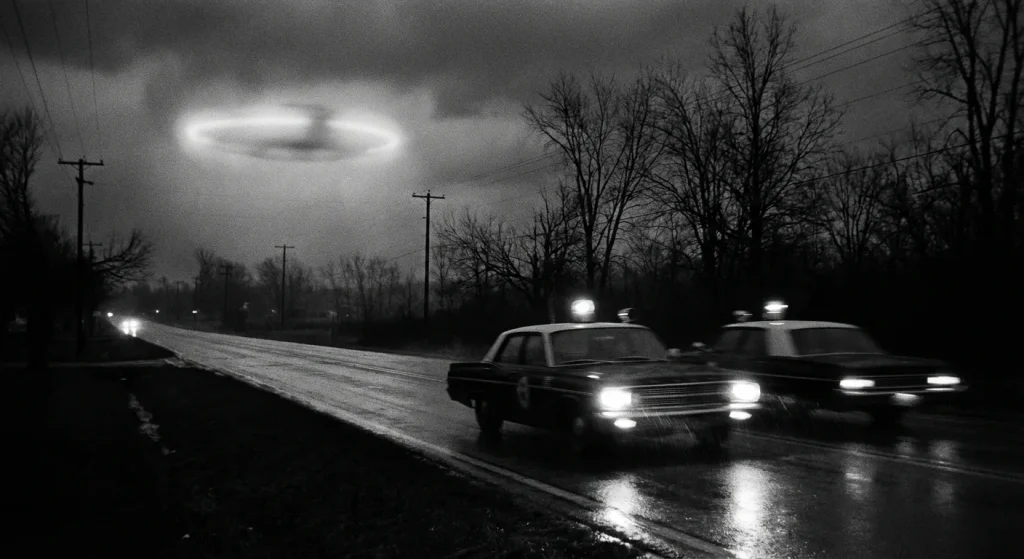
The pattern is familiar: fresh UFO news, rebranded as UAP (unidentified anomalous phenomena), and a recycled headline about a “100 MPH police chase.” The problem is never the headline itself. The problem is the sourcing. One version reads like a filed report; the next reads like a meme, with the same numbers repeated louder and fewer receipts attached.
The Portage County 1966 incident endures for a simple reason: it is tethered to records and law enforcement reporting, not just a late-night retelling. Multiple officers are part of the original account, and the story’s durability is tied to contemporaneous documentation types: police reporting, radio and dispatch references, early newspaper coverage, and a Project Blue Book file. Those anchors matter because they freeze what was said close to when it was said, before decades of repetition can sand down qualifiers and sharpen claims that were never measured.
Start with the number everyone remembers. The case is commonly summarized as a police pursuit reaching roughly 100 MPH, but that figure refers to the patrol car’s speed during pursuit, not a measured object speed. It is a reported vehicle speed, not instrumented data about the object itself. Treating “100 MPH” as an object performance spec is how a documented incident turns into an exaggerated one, and this article keeps that line bright: reported versus measured is not a semantic difference, it is the difference between evidence and storytelling.
This is the tension the case forces you to hold: witness accounts can be compelling, and official paperwork can be real, while precise measurement can still be absent. Project Blue Book investigated UFO reports from 1947 to 1969, placing this incident inside an official, archivable government investigative program rather than folklore alone, but an investigation is not the same thing as instrumentation or certainty.
The approach here is deliberately procedural: separate what happened from what is documented, and separate both from what remains uncertain, before a modern disclosure debate – or a viral “100 MPH” claim – does that sorting for you. That begins with timeline discipline and ends with source discipline.
Minute by Minute Through Portage County
The only reliable way to talk about the Portage County event is to keep it strictly chronological and to label each beat as either documented in near-primary material or repeated later through secondary retellings. That discipline matters because the most-circulated details are routinely repeated without clarifying what was actually measured, who said it, and whether a number reflects a speedometer glance or an after-the-fact estimate.
The anchor points in publicly available documentation are basic but firm: the incident is tied to April 17, 1966, and the deputies most commonly named in connection with the Portage County chase are Dale Spaur and Wilbur “Barney” Neff, operating out of Ravenna in Portage County, Ohio (see contemporaneous and later coverage, for example: Times Leader summary of the chase).
The moment-by-moment “who saw what first” sequence is where the record thins. A clean chronology would normally start with the initial observation (an officer or a caller reports an object), then the first call-in to the communications center, then the first dispatcher acknowledgement and unit assignment. The problem is straightforward: none of the publicly available documentation cited below include quoted radio traffic, a dispatch log entry, or a contemporaneous time stamp that would let you state, in minutes, who made the first report and exactly when it hit the radio.
Later secondary retellings still supply tidy opening beats, including a Medium account that frames the chase as running “from near Akron to near Pittsburgh” (see the author profile and related posts on Medium). Treat that as a secondary narrative structure, not a documented starting point, because the Blue Book file and contemporaneous local records are the primary materials required to validate the opening location, the precise first caller, or the first dispatcher entry.
The next chronological beat, after an initial report is broadcast, is pursuit escalation: an officer transitions from “checking a report” to actively trying to keep an object in view while updating dispatch. In a properly sourced reconstruction, this is also where you would pin down the first mention of speed, the first request for additional units, and the first indication that the event crossed patrol areas.
Publicly available summaries and the Blue Book file consistently characterize the episode as a long-distance pursuit in spring 1966, with a commonly cited distance of roughly 86 miles (Times Leader). Beyond that high-level description, the details most readers ask for – the roads, towns, unit join points, and the termination location – are not reconstructable from the documentation available in the Blue Book file and widely circulated secondary accounts. That limitation is hard, not interpretive: the available material does not contain primary or near-primary details allowing a chase route reconstruction (roads/towns/join points/termination). Any account that names specific highways, lists a sequence of towns, or maps an exact end point is drawing on material beyond the publicly accessible documents cited here.
Speed reporting is the other place where language discipline matters. You can responsibly write, “patrol car speed reached ~100 MPH (as reported),” because that frames the number as a reported patrol-car reading, not the object’s true airspeed. What you cannot responsibly write, without a near-primary citation, is “the object traveled 100 MPH,” because that converts an in-car speedometer context into a claim about the object’s measured velocity. When a source does not specify whether the 100 MPH figure came from a speedometer glance, a dispatcher paraphrase, or a later estimate, the only accurate label is “as reported,” with the measurement method explicitly marked as unspecified.
Multi-unit involvement belongs in the same bucket. A pursuit described as “long distance” typically implies additional units at least becoming aware of the event, and many retellings describe more than one agency engaging. The available records do not include the unit-by-unit participation record, the “unit en route” timestamps, or the radio requests that would let you document when other cars joined, where they joined, or whether they were actively in pursuit versus monitoring.
A dispatch log matters because it pins a pursuit narrative to a shared clock instead of memory alone. Dispatch centers routinely announce time on radio transmissions so all units reference the same clock, which is exactly why time-stamped reconstructions are possible when logs or quoted transmissions exist. In practice, “time checks” and time-stamped CAD events let investigators align what Car A reported with what Car B heard, even when units are miles apart and moving fast.
That shared-clock advantage also clarifies what “chronology” can and cannot do. If you have time-stamped transmissions, you can say things like: at 10:42 a unit called out an observation; at 10:44 dispatch acknowledged; at 10:47 a second unit requested to join; at 10:49 a unit reported patrol car speed reached ~100 MPH (as reported), and you can specify whether that was a speedometer reading or a dispatcher paraphrase. Without those time anchors, later narratives tend to collapse separate moments into a single continuous “chase,” which is how misconceptions harden into “facts.”
Every pursuit chronology needs a final beat: how the encounter concluded. Was the pursuit terminated by policy, did the object depart from view, did units run out of jurisdictional authority, or did the event simply fade into intermittent sightings? The publicly available Blue Book references and local summaries do not include a near-primary end-state description, a termination location, or a final radio exchange that would let you document the conclusion with precision. The only defensible statement, based on those materials, is that the event is repeatedly framed as a pursuit involving Portage County deputies, not that it ended at a particular road, town, or jurisdictional boundary.
The same limitation explains the “where’s the tape?” question. Some jurisdictions retain 911 and radio recordings, but recordings may not be retained long-term; recordings may lack embedded timestamps; and not every call or channel is recorded or retrievable. Even when audio exists, a recording without verifiable time marks cannot do the job a dispatch log does, because you cannot align an exciting narrative moment to the shared operational clock that units actually used.
The clean takeaway for readers is simple and actionable: read chase narratives like an incident report, not like a campfire story. Keep the events in time order, label each beat as documented versus later retelling, and treat speed claims as patrol-car reporting unless a source clearly documents the measurement method. That checklist protects you from the most common error in this case: turning a repeated line into a precise fact without the timeline evidence to support it.
Reports, Records, and Official Responses
Chronology can tell you what a story claims to be, but records tell you what was actually captured at the time. The Portage County 1966 incident is analyzable decades later because a record trail exists, even if it is incomplete in key operational details.
What makes the Portage County 1966 incident analyzable decades later is the record trail. You can trace it through local law-enforcement documentation, early newspaper coverage that moved through press distribution networks, and an Air Force investigative file created under Project Blue Book, the Air Force program that logged reports into case files specifically so they could be reviewed and compared over time. Each layer preserves real inputs, but each layer also compresses them.
At the county level, the most checkable materials are routine and procedural: officer or agency reporting (incident reports, supplemental narratives, and later administrative notes), plus communications records that show how information moved in real time (dispatch references, call logs, and any surviving radio or telephone documentation). Even when an event is widely discussed later, the primary value of local records is simple: they anchor who reported what, when it was recorded, and which agency handled it. The friction is that communications artifacts are not always retained long-term, and surviving files can be incomplete without a report number, exact date, and names, which is why requesters should include incident location, incident date, and persons involved.
Early newspaper coverage can amplify fast because it rides on distribution mechanics built for speed, not depth. Wire services relayed news via telegraph lines, radio, and later digital means, allowing a story written once to be republished widely with minimal local reporting behind it. That efficiency is the catch: a short early item often preserves only the most repeatable elements and can drop qualifiers, sourcing detail, and corrections. Treat early press as a timestamped transmission of claims, not a substitute for the underlying police paperwork.
The official federal layer exists because the incident was investigated by officials from the State Police and the Air Force, and it entered Blue Book’s tracking system as Project Blue Book case number 10798 (see Blue Book case indexes). In Blue Book terms, the case file is where you look for what the Air Force recorded it received, what investigative steps it documented, and the case disposition, meaning the outcome label assigned in the file (for example: explained, insufficient data, or unidentified). The file can document an investigation and its assigned outcome, but it does not guarantee it captured every local artifact, every dispatch exchange, or every document created outside the Air Force’s collection path.
For primary-source access, Project Blue Book case files are available as part of NARA microfilm publication T1206 (T1206 microfilm index). Separately, the FBI maintains a Vault page for Project Blue Book (UFO) records, which is useful for confirming what the Bureau has posted from its own holdings without assuming it is the complete record of what every agency had (FBI Vault: Project Blue Book).
If you want to verify specific claims against local paperwork, request copies directly from the Portage County (Ohio) Sheriff’s Office Records Division. It accepts written requests at 8240 Infirmary Rd., Ravenna, OH 44266 (Portage County Sheriff’s Office Records Division), and the county’s public records request form and court fee pages list copying at $0.10 per page (as posted on county materials with no effective date shown) (Portage County public records request form).
- Write a request that includes the incident date, location, and the names of involved persons (and a report number if you have it).
- Mail it to the Records Division at 8240 Infirmary Rd., Ravenna, OH 44266.
- Budget for per-page copying at $0.10 per page, plus any mailing costs.
Use official-era documents first, not later summaries: start with local records you can request in writing, then compare them to the Blue Book (case 10798) file on NARA microfilm (T1206), then check how newspapers and wire copy paraphrased those inputs. FOIA (Freedom of Information Act) requests can also expand the paper trail when federal records exist, but FOIA has exemptions and redactions, so absence of a detail in a release is not proof it never existed.
The practical takeaway is to treat documentation as layers with different failure modes. Local reports and communications records are closest to the originating agencies; the Blue Book file is the formal federal investigative wrapper with an assigned disposition; media summaries are fast-moving digests. Verify from the bottom up, and you will separate what was recorded at the time from what was repeated later.
Leading Explanations and Their Limits
The record trail can establish who reported what and where it landed in official files, but it does not automatically supply the measurements needed to identify the source. Here, the data limits – not the drama – decide what can be concluded.
The data limits, not the drama, decide what can be concluded here. The headline-grabbing “about 100 MPH” figure is part of the pursuit narrative, but it does not function as instrument-measured performance data for the object itself. Typical retellings do not provide a measured object distance, angle, or time-synchronized velocity, which means the most repeated claim – apparent speed – rests on inference layered on top of night observation and a moving viewpoint.
A serious explanation has to cover the same core observations without smuggling in extra precision: a conspicuous light (brightness and color as described), apparent motion relative to the cruisers (including any reported station-keeping or direction changes), duration long enough to sustain attention, continuity across multiple witnesses, and the fact that most viewing occurred under pursuit conditions (high speed, frequent acceleration and braking, and a constantly shifting line of sight).
Astronomical sources can fit more of the “steady bright light” component than people expect. Bright stars or planets hold position against the landscape while a vehicle turns and crests hills, which can read as “tracking” when the observer is the one moving. That same strength becomes a weakness if the reports insist on rapid, structured maneuvering over short intervals; a fixed celestial source cannot execute it, and a meteor cannot sustain a long, interactive pursuit because meteors are brief by nature.
Aircraft and helicopters are the most elastic conventional bucket because they can present as a single dominant light, a pair of lights, or an intermittently blinking pattern depending on aspect and distance. Slow movement, holding patterns, or flying toward the observer can look like hovering, and distance compresses speed cues until the observer has reliable range data. The friction point is not that aircraft exist; it is what the narrative asks an aircraft to do. If witnesses reported close-range behavior, sharp directional reversals, or altitude changes tied tightly to the cruisers’ movements, those are harder to reconcile without corroboration from flight activity records, radar, or a clearly identified aircraft type and route.
Satellites can match steady movement and, at times, surprising brightness, but they do not perform rapid turns. Any claim of abrupt directional change pushes a satellite explanation toward “misperceived motion” rather than “object maneuver.”
Atmospheric and optical effects can amplify confusion by diffusing light, smearing contrast, or shifting apparent position near the horizon. The hard limit in the publicly available documentation is explicit: none of the cited material contains local meteorological measurements for the incident window, so any weather-based mechanism remains speculative unless separately sourced.
Night driving at high speed reliably degrades perception in specific, well-understood ways. Attention tunneling narrows what the brain prioritizes under stress, parallax makes distant lights seem to slide against near objects as the viewer moves, and the autocinetic illusion can make a fixed point of light appear to drift when stared at in darkness. Those constraints are not an attack on the officers; multiple trained observers can share the same geometry, the same stress load, and the same perceptual traps.
“Unknown” is a data-status, not a theory about non-human intelligence. In practice it means the case lacks enough measured information to confirm a conventional source with confidence. If distance, bearing changes, and timing are not instrumented, you cannot reliably convert “it kept up with us” into a physical speed, and you cannot distinguish true maneuver from viewpoint-driven apparent motion.
- Separate what was measured (timestamps, bearings, radar) from what was inferred (speed, range, acceleration).
- Require geometry: distance estimates with method, or triangulation from separated observers.
- Cross-check with operational flight activity through the FAA, the appropriate authority to consult for air carrier operational confirmations and records. The FAA is the appropriate agency to consult for operational activity confirmations, so an “aircraft” hypothesis should be tested against FAA-accessible records, not treated as a vibe-based rebuttal.
- Document weather with local observations for the exact window before leaning on refraction, haze, or inversion claims.
Why the 1966 Case Still Resonates
Those limits are exactly why the case persists: it offers credible witnesses and real paperwork, yet leaves enough unresolved to be re-used in later arguments. Portage County persists as a reference point because it sits at the intersection of credible civic witnesses, repeatable media retellings, and institutional ambiguity. Police officers are not anonymous storytellers, and the case has enough documentation layers to keep it in circulation without requiring consensus on what the object was. That combination has become an enduring template for UAP discourse: trustworthy-seeming observers, a narrative that travels well, and just enough official texture to keep the file “open” in the public imagination.
In public discussion, law-enforcement and military sightings are treated as “high-signal” because the witnesses are trained observers operating inside a reporting culture: they log incidents, they coordinate by radio, and they work in units that can corroborate what was seen across multiple officers and vehicles. Those factors raise the floor on credibility. They do not replace measurement. A well-documented observation can still lack instrumented data that locks down range, altitude, speed, or identity, and without those variables, even credible testimony leaves room for multiple competing explanations.
Legacy cases also endure because modern reporting volume makes standards, not novelty, the scarce resource. RAND conducted a geographic analysis of public reports of UAP sightings using a dataset of 101,151 reported sightings across U.S. Census Bureau areas; the RAND report offers the full methodology and counts (RAND Research Report RRA2475-1). A dataset that large shifts the practical question from “Have people reported this before?” to “What documentation separates this report from the rest?” Portage County stays useful in that environment because it illustrates how a case can remain culturally “alive” on witness authority and paperwork, even when the underlying measurements are thin.
UFO and UAP literature further stabilizes the case as a reusable reference. J. Allen Hynek’s The UFO Experience is frequently cited in broader UAP literature, and the Portage County incident is often summarized in later retellings as a long-distance police pursuit. That influence is real, but it functions as amplification, not confirmation. Contemporary media cycles create fresh attention spikes as well; for example, local and regional outlets have revisited the chase over time, renewing interest in legacy cases while treating claims of “non-human intelligence” and long-running cover-ups as part of the discourse rather than settled documentation (see regional coverage such as the Times Leader summary).
When Portage County is cited to frame new UAP sightings in current discussion, the correct move is procedural: ask what primary documentation the citation actually rests on, and separate what the records show from what the retelling implies.
Disclosure Politics in 2025 and 2026
That same procedural habit matters even more in today’s disclosure cycle, where official channels and public attention interact continuously. In 2025 to 2026, “disclosure” is driven less by a single blockbuster revelation and more by repeatable institutional mechanisms: a standing Pentagon office that publishes updates, recurring congressional attention that amplifies claims and demands records, and annual National Defense Authorization Act (NDAA) cycles that keep UAP language moving through defense policy. The upside is continuity. The catch is that the volume of narrative heat often outpaces the evidentiary standard behind any given headline.
AARO (All-domain Anomaly Resolution Office) was established in 2022 as the Department of Defense’s standing office for UAP (unidentified anomalous phenomena). In this period, the office’s most important disclosure function is procedural: it creates a repeatable channel for information to be collected, summarized, and put on the record in a form that is legible to policymakers and the public.
A concrete example is reporting and workshop outputs tied to an AARO-AUI workshop in August 2025; participants and summaries are discussed by affected community organizations and participants such as NUFORC (NUFORC summary of AARO/AUI workshop participation), which helps date and contextualize institutional outputs from that period.
Congressional attention follows a recognizable pattern: hearings recur, witnesses offer testimony, and members press for documentation. The friction is that “what was said” and “what is in the record” are different categories. Treat sworn testimony as one bucket, and treat claims reported in interviews or secondary summaries as another.
David Grusch, a former U.S. Air Force intelligence officer, is a narrative-shaping figure in this ecosystem because he testified before the U.S. Congress and multiple outlets describe him as a whistleblower. CBC reported that Grusch alleged concealment of longstanding UAP information; those are reported allegations and should not be confused with independently produced records.
The recurring cycle is reinforced by defense policy. The FY2026 National Defense Authorization Act is listed on Congress.gov as Senate bill S.1071 (Congress.gov: S.1071), and the White House issued a statement confirming that the enrolled bill S.1071 was signed into law in December 2025 (White House: S.1071 signed into law), illustrating how UAP-related language persists through annual authorization and oversight rhythms even when public attention spikes and fades.
That same rhythm is why older incidents like the Portage County case get re-litigated: each new report, hearing, or statute creates a fresh prompt to re-check what the official record actually contains. Read disclosure headlines by first identifying the mechanism, report, hearing, or statute, then matching it to the evidence standard it implies: institutional findings, sworn statements, or binding policy requirements.
What the Chase Teaches Us Now
The Portage County chase stays instructive because it proves a dramatic event can be well-documented in some ways and still evidentially incomplete in others. The real lesson is evidence discipline, not just enduring mystery.
That discipline directly answers the sourcing problem raised at the start: a repeated headline is not the same thing as a measured claim. Chronology is what keeps a narrative testable, and it forces careful labeling around figures like “about 100 MPH,” which belong to patrol-car reporting rather than to instrumented object performance. The same timeline framing leaves room for hard gaps, including the possibility that some recordings were never retained or are no longer available. On documentation, the existence of an official Project Blue Book file sits on top of layered records: local reports, press coverage, and an official investigation thread. On the “what-was-it” question, the central limitation remains unchanged: typical retellings lack instrument-measured speed and distance for the object, which is why explanations stay contested instead of resolved. Even adjacent corroboration can remain unclear in the public record; for example, dispatch tapes or FAA confirmations may be unavailable or difficult to verify, despite the FAA’s formal records management and FOIA channels for accidents, incidents, and enforcement records.
Future cases need a higher bar: treat UAP materials like evidence, not content. Without chain of custody, the documented record of who collected, handled, transferred, and stored evidence, video, radar, and logs stay persuasive but never become truly verifiable. In digital forensics, chain of custody is critical to preserve integrity and admissibility, and evidence management guidance emphasizes standardized practices that avoid gaps in item history or custody.
For the next viral UAP clip tied to sightings in the current reporting cycle, use one rule: no timestamped originals and no documented handling means no firm conclusions. Insist on timestamps, original files, documented transfers, and clear provenance of every copy.
Frequently Asked Questions
-
What happened in the 1966 Portage County police UFO chase?
On April 17, 1966, Portage County, Ohio deputies (most commonly named Dale Spaur and Wilbur “Barney” Neff) reported pursuing and observing a bright object during a long-distance incident. The case persists because it is tied to law-enforcement reporting, early newspaper coverage, and a Project Blue Book file.
-
Did the UFO in the Portage County 1966 case really go 100 MPH?
The “about 100 MPH” figure refers to the patrol car’s speed during the pursuit, not a measured speed of the object. The article emphasizes this is a reported vehicle speed without an instrumented measurement method for the object.
-
How far did the Portage County 1966 police chase reportedly go?
The incident is consistently characterized as a long-distance pursuit with a commonly cited distance of roughly 86 miles. The provided material does not include near-primary route details like specific roads, towns, or a precise termination location.
-
What official records exist for the Portage County UFO chase?
The article ties the case to local law-enforcement documentation, early newspaper coverage, and a federal investigative file under Project Blue Book. It identifies the Blue Book entry as case number 10798, with files held at NARA on microfilm publication T1206.
-
How can I request the Portage County Sheriff’s records for the 1966 UFO chase?
Send a written request with the incident date (April 17, 1966), location, and involved names to the Portage County Sheriff’s Office Records Division at 8240 Infirmary Rd., Ravenna, OH 44266. The article states copies cost $0.10 per page (plus any mailing costs).
-
What are the leading conventional explanations mentioned for the Portage County 1966 sighting?
The article discusses astronomical sources (bright stars or planets), aircraft/helicopters, satellites, and atmospheric/optical effects as candidate explanations. It notes typical retellings lack instrument-measured distance, bearing changes, and time-synchronized velocity needed to confirm any single explanation.
-
What should I look for to judge whether a UAP “police chase” story is well-sourced?
Use timeline discipline and prioritize near-primary records such as dispatch logs, quoted radio traffic, and time-stamped communications over later summaries. Treat speed claims as patrol-car reporting unless a source documents the measurement method, and verify against local records and the Blue Book file (case 10798).
