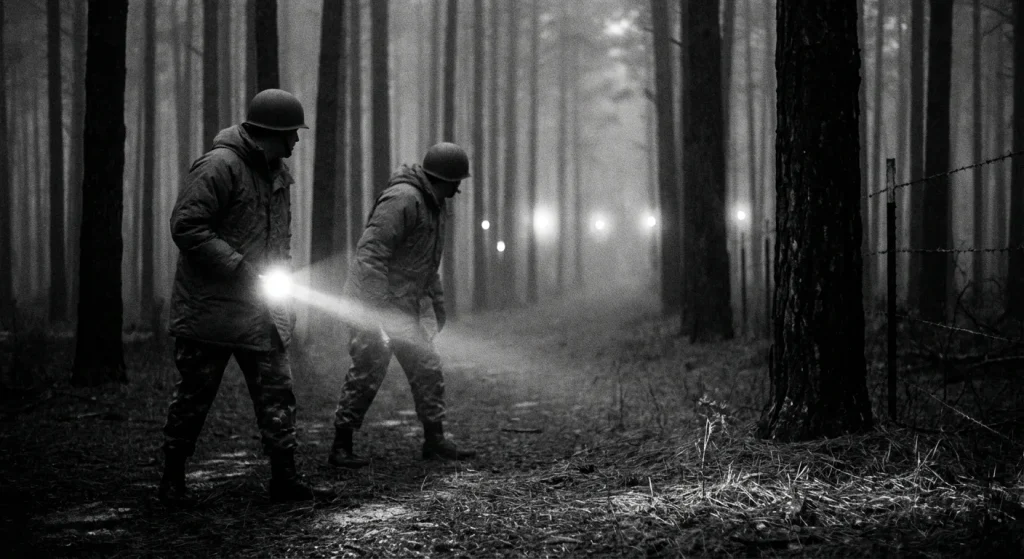
Travis Walton was a 22-year-old logging crew member in northeastern Arizona who said he was struck by a beam from a hovering craft near Snowflake/Heber-Overgaard on November 5, 1975, then disappeared for about five days before reappearing on November 10, 1975. Walton’s account—reported by his coworkers to local law enforcement and later amplified through books, television, and a feature film—became one of the most publicized alleged alien-abduction cases in the United States. What is confirmed is that Walton was reported missing and that his coworkers made statements about seeing a light/craft; what remains alleged is the abduction narrative itself and the nature of what the witnesses saw.
What Happened in 1975 (Timeline)
Confirmed (documented in reports and contemporaneous coverage): On the evening of November 5, 1975 , Travis Walton did not return home after work and was reported missing. Members of his logging crew told authorities they had seen a bright object/light in the woods near the town of Snowflake (often associated with the broader Heber-Overgaard area) in Navajo County, Arizona. The case drew immediate attention because multiple coworkers came forward and because Walton remained missing for several days.
Alleged (from Walton’s later account): Walton said he approached a disc-shaped craft, was struck by a beam of light, lost consciousness, and later found himself inside a craft and/or a facility with humanoid figures. He said he eventually escaped and made a phone call after regaining his bearings.
Reappearance (widely reported): Walton resurfaced on November 10, 1975 , and the reported time missing is commonly described as approximately five days. Accounts vary on exact timing details depending on the source, but the multi-day disappearance itself is a key, checkable part of the public record.
Witness Accounts and Investigation
Who the witnesses were: Walton was working as part of a logging crew. The core witness group consisted of the coworkers who were with him that evening and who later said they saw a bright object and fled after Walton was allegedly hit by a beam. These men reported the incident to authorities the same night, which is a major reason the event became a high-profile case.
What is confirmed vs. alleged: It is confirmed that the crew reported Walton missing and gave statements describing an unusual light/object; it is alleged that the object was an extraterrestrial craft and that Walton was taken aboard and examined.
Testing and disputes: The case is frequently discussed in relation to polygraph testing conducted in the aftermath; supporters cite certain results as bolstering credibility, while critics argue that polygraphs are not reliable proof of extraordinary claims and note disputes over administration and interpretation. The existence of testing and controversy around it is well documented, but it does not independently confirm what occurred.
Media Coverage and Public Debate
The Walton story became nationally known through extensive media attention and later through Walton’s own publications. Walton wrote The Walton Experience (later reissued as Fire in the Sky), which presents his version of events; a Hollywood adaptation, Fire in the Sky (1993), dramatized the story and is often cited as increasing public awareness while also diverging from Walton’s description in notable ways.
For context and primary-source framing, Walton’s official site provides his version and materials, while mainstream reference works summarize the case and its disputed status.
Skeptical Critiques and Responses
Skeptical analyses have argued that the incident fits patterns of folklore, misperception, or fabrication, and they highlight inconsistencies and the lack of physical evidence that can be independently verified. Proponents respond that multiple witnesses reporting a dramatic event the same night is unusual, and they emphasize the case’s persistence over decades as a cultural and investigative touchstone. Neutral assessment generally distinguishes (a) the documented missing-person report and witness statements from (b) the extraordinary claims about non-human entities and onboard experiences, which remain unproven.
In modern UAP discourse, the Walton case is sometimes cited as a classic “multiple-witness” abduction narrative, but it is not typically treated as official evidence in contemporary government-led UAP reporting; rather, it functions as a frequently referenced historical case in public debate.
-
Who is Travis Walton and what is his 1975 UFO encounter known for?
Travis Walton is a former logging crew member who said he was taken after an encounter with a hovering craft in northeastern Arizona on November 5, 1975. The case is best known because his coworkers reported him missing and said they saw a bright object/light, and because Walton was reportedly gone for about five days before reappearing on November 10, 1975.
-
What year did the Travis Walton UFO abduction claim happen?
The event is associated with November 1975, with the incident reported on November 5 and Walton’s reappearance reported on November 10, 1975.
-
Why is the Travis Walton case still discussed in UFO news and UAP news?
It remains widely discussed as a historically prominent alleged abduction case involving multiple witness statements and a documented missing-person period, followed by decades of disagreement over what those facts mean. In modern UAP conversations, it is usually referenced as a well-known historical narrative rather than as confirmed evidence.
-
How does the Travis Walton story connect to UFO disclosure and UAP disclosure discussions?
The Walton case is sometimes referenced in disclosure debates as an example of a high-profile, long-running public claim that never received definitive official resolution. However, no public record has established that it was part of any confirmed government UAP “disclosure” program; the connection is mainly cultural and rhetorical—used by advocates and skeptics to argue about standards of evidence and how claims are investigated.
-
What themes are commonly associated with Travis Walton’s abduction claim?
Common themes include alleged non-human entities, missing time/disappearance, multiple-witness testimony, and disputes over evidentiary standards (including polygraph controversy). Claims of a definitive government cover-up are frequently asserted in broader UFO culture but are not confirmed by publicly available documentation specific to the Walton incident.
-
What should you look for when comparing older cases like Travis Walton’s to modern UAP reports?
Focus on what can be independently checked (dates, locations, police reports, contemporaneous reporting, consistency of witness statements) versus what remains personal testimony. Modern UAP reporting also often includes sensor data and aviation/military records; older cases like Walton’s are typically more dependent on eyewitness accounts and later retellings.
References (external): Encyclopaedia Britannica: Alien abduction (context for the genre of claims); IMDb: Fire in the Sky (1993) film entry; Travis Walton official site (Walton’s account and materials); Skeptical Inquirer (skeptical investigations and commentary); JSTOR (for scholarly/cultural analysis of UFO/abduction narratives; search terms include “Travis Walton” and “alien abduction”).
