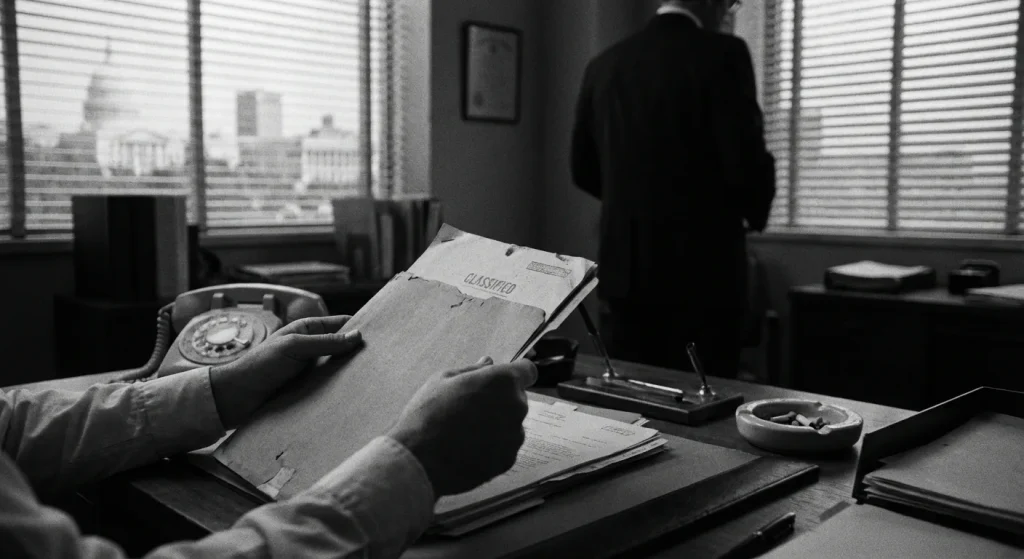
There is primary 1977 documentary evidence indicating NASA declined to pursue a UFO (Unidentified Flying Object) study. That evidence is limited in scope and context, so readers should treat the episode as a dated, checkable decision point rather than as proof of broader, coordinated direction from other agencies. If you are trying to separate real disclosure movement from recycled rumor, this is the kind of dated, checkable episode that helps explain how “silence-by-default” can arise: not through a single cinematic order, but through an institutional choice you can trace to specific records and public statements.
The frustration is simple: this topic is saturated with allegations and thin on primary documentation. Trust does not hinge on someone’s confidence or credentials; it hinges on what agencies wrote down, what they refused to fund, and how they justified that refusal in public-facing channels. One useful contemporaneous record to consult is the Congressional hearing volume titled “1977 NASA authorization: hearings before the Subcommittee on Space Science and Applications,” cataloged in HathiTrust and available via government archives, where budget, mission scope, and reputational risk were argued on the record.
This matters now because NASA has re-entered the conversation in a documentable way: on June 9, 2022, it announced an independent study of UAP, and on September 14, 2023 it published the final report.
Alongside that 2023 report, NASA announced a Director of UAP Research, explicitly tasked with implementing NASA’s scientific vision and centralizing how the agency engages the issue.
UAP (Unidentified Anomalous Phenomena) is the term U.S. government entities commonly use in official contexts because it is an umbrella for anomalies that are not limited to “flying” objects, and that terminology shift is itself a clue about what institutions think they can responsibly study. The tension this article resolves is whether NASA’s 1977 refusal was a straightforward boundary decision about mission, credibility, and security, or a telltale example of how intelligence and defense priorities can shape what civilian science agencies will touch. You will leave with a source-driven framework for reading historical refusals and modern UAP actions without doing the rumor-cycle’s work for it. To understand why a refusal can be the path of least resistance, it helps to start with why silence is so often treated as the safest recommendation inside the national-security system.
Why silence was recommended
Silence was a rational recommendation inside a national-security system. The same “say less” posture that protects real capabilities also corrodes public trust, because it creates an information vacuum that speculation will always fill. The incentives that push intelligence and defense organizations toward quiet are institutional and repeatable, from the kind of interagency posture implied by the 1977 record to later formalization in DoD’s “Establishment of the All-Domain Anomaly Resolution Office” memorandum.
Open scientific inquiry forces you to show your work. Intelligence work survives by hiding it, and that gap is not philosophical, it’s procedural: a serious public study quickly drifts from “what was seen” to “how we know what we know,” including which sensors, what frequency bands, what processing, what cueing chain, what collection geometry, and what error bars. That is exactly the map adversaries use to probe, spoof, or route around U.S. collection, which is why sources-and-methods protection is treated as a first-order constraint in official historical treatments of the UFO/UAP topic (for example, CIA historian Gerald K. Haines’ “CIA’s Role in the Study of UFOs, 1947-90,” published in CIA’s Studies in Intelligence).
The non-obvious friction is that even “innocent” transparency can be operationally revealing. A single well-intentioned chart can disclose detection thresholds; a seemingly boring location can expose coverage; a request for raw data can expose tasking priorities. The clean institutional solution is controlled messaging: reduce public engagement so you do not create pressure to publish the very details that make the data valuable, even if the underlying explanation is ultimately mundane or simply classified.
Air defense treats ambiguity as a condition to manage, not a seminar topic, which is why the modern mission language around anomalies is framed in operational verbs like “detect and identify.” Publicly debating specific cases invites two outcomes that defense planners avoid: telegraphing what triggers attention and normalizing adversary “gray zone” tactics that live below the threshold of obvious attribution.
The catch is that a public-facing posture rewards certainty, while operational reality is often probabilistic. When officials cannot explain a track without exposing collection or tactics, the safest bureaucratic move is to say as little as possible. That can look like stonewalling, even when the internal driver is preserving an air-defense posture shaped by compartmentalization and controlled release, the same logic baked into formal DoD tasking for an office created explicitly to handle anomalies.
NASA’s default model is public science, and it has executed that model in the open: it publicly announced an independent study team to examine UAPs on June 9, 2022, then published the study team’s final report on September 14, 2023 and announced a Director of UAP Research role, described by NASA as centralizing communications and leveraging agency resources and expertise for UAP engagement.
That is exactly why intelligence and defense organizations would see NASA involvement as an exposure risk. A NASA-led workflow pressures disclosure of inputs, methods, and limitations to satisfy scientific norms like open data, peer review, and reproducibility. Intelligence norms run on need-to-know, compartmentalization, and controlled messaging. When these cultures collide, “cover-up-like” outcomes can emerge from incentive alignment, not because anyone has to intend a cover-up.
Stigma is not just a social accident; it is a pressure valve with documented precedent. In the declassified historical account by CIA historian Gerald K. Haines (“CIA’s Role in the Study of UFOs, 1947-90,” Studies in Intelligence), the government’s posture is described in part as a way to reduce public agitation and limit the operational consequences of mass reporting, including recommended “debunking” dynamics that function as reputational containment.
In that same account, Haines also describes how the government at times chose to debunk or downplay UFO reports to avoid undue public concern and, in that process, misinformed the public about what it considered the reports’ true importance. That is not proof of “alien disclosure,” and it does not validate non-human-intelligence allegations; it shows how bureaucratic risk management can justify public minimization even when internal attention remains serious.
Interpret agency silence with one rule: treat it as risk management first. Even NASA’s recent public posture paired transparency commitments with explicit limits on disclosure, and the same tradeoff applies inside defense and intelligence. Silence is not, by itself, proof of alien disclosure and not proof of nothing; it’s the default output when openness creates exposure risk and the control side has veto power. That same logic also helps explain why, over time, institutions changed the label and the handling of the problem rather than simply arguing about “UFOs” in public.
From UFO stigma to UAP era
The UAP era is a governance shift, not just new vocabulary. The shift mattered because the old “UFO” frame trained professionals to avoid the topic, not manage it. “UAP” recast the problem as an operational reporting category: an anomaly worth logging, deconflicting, and analyzing, even when the final answer is “balloon,” “drone,” “sensor artifact,” or “unknown.”
The friction is real: defense and intelligence organizations need better reporting without advertising collection methods, sensor performance, or mission profiles. A softer label does not solve classification, but it changes incentives. Pilots and operators can file a report that describes what they saw, where, and on which sensor, without feeling like they are endorsing an alien narrative. That behavioral change is the prerequisite for any serious process: you cannot improve data quality if the first step, reporting, is socially punished.
The U.S. government centralized the defense side by standing up AARO (All-domain Anomaly Resolution Office), a DoD office tasked with synchronizing efforts to detect, identify, and analyze UAP-related data across the Department and with other federal departments and agencies. Centralization is the point: it turns scattered one-off incident handling into a repeatable intake pipeline with shared definitions, cross-domain correlation, and a single place to push requirements.
NASA built a parallel lane with explicit guardrails. On June 9, 2022, NASA announced it was commissioning an independent study team to examine UAP, positioning the work as a scientific and transparency-forward effort rather than an intelligence investigation.
NASA’s posture tightened into structure on September 14, 2023 with the release of the independent study team’s final report and the announcement of a Director of UAP Research. NASA described that role as developing and overseeing NASA’s scientific vision for UAP research and centralizing communications while leveraging agency resources and expertise for engagement.
In practice, public pressure raised the cost of leaving these lanes underpowered. Journalism, advocacy networks, and a growing ecosystem of former officials created a steady drumbeat of claims that demanded an institutional response measured in records and procedures, not rhetoric.
A key checkpoint was sworn testimony. On July 26, 2023, David Grusch testified at a House hearing and was identified in that hearing context as a former senior intelligence officer (including with the National Geospatial-Intelligence Agency). In that forum, he alleged a multi-decade crash retrieval and reverse-engineering program. Those allegations are not evidence by themselves, but they functioned as a forcing mechanism: they moved the conversation toward formal reporting pathways, internal review, and documented deliverables.
The credibility test for serious UAP news is simple: track institutions and outputs, not personalities. Look for clear reporting requirements, described data sources, sensor and metadata quality, and public documentation such as official reports, methodologies, and named points of accountability. Viral summaries are entertainment; process artifacts are progress.
Once the issue is framed as reporting, records, and accountable outputs, Congress becomes the obvious arena for forcing follow-through – because Congress can turn a preference for silence into a compliance problem.
Congress pushes UAP transparency
Congress is trying to make “silence” procedurally harder. The main tool is the NDAA (National Defense Authorization Act), the annual defense law Congress uses to force reporting, set deadlines, and structure who inside government must receive and retain information.
The enacted baseline is the FY2024 NDAA, signed December 22, 2023 (Public Law 118-31). It includes UAP-related provisions in Sections 1841 to 1843, which operate as oversight plumbing: they require defined handling of UAP records and formalized reporting lines so that UAP information does not live only in informal channels or program silos.
The Schumer-Rounds UAP Disclosure Act was a proposed disclosure framework associated with the FY2024 NDAA debate aimed at accelerating release and centralization of UAP records, using a single archival architecture rather than scattered agency custody. As introduced, its headline move was to create an Unidentified Anomalous Phenomena Records Collection at the National Archives and Records Administration (NARA), making NARA the gravitational center for record identification and public release decisions instead of leaving the task to each originating agency.
The final enacted package was modified. Public Law 118-31 did not enact the full “Disclosure Act” framework as introduced, but it did keep the core records-collection concept by directing NARA to establish an Unidentified Anomalous Phenomena Records Collection, while omitting other proposed mechanisms that would have centralized release decisions through a bespoke, independent-style process rather than the ordinary classified declassification pipeline. The practical difference is enforcement: a records collection can force aggregation and cataloging, but it does not automatically force declassification on a fixed, public schedule when agencies assert continuing classification equities.
Statutes only bite if information reaches an accountable chokepoint. Congress uses two chokepoints: oversight intake and mandated reports. Intake is driven by protected disclosures to Inspectors General and committees, plus internal reporting requirements that route UAP-related information into the system Congress can audit. Mandated reports convert that intake into written deliverables that can be briefed, archived, and compared over time.
That enforcement lever shows up in deadlines. The Department of Defense has stated that collected reports will inform AARO’s congressionally directed Historical Record Report due to Congress by June 2024, creating a paper trail that oversight staff can interrogate and cross-reference against prior testimony and agency holdings.
Even when Congress writes a due date into law, execution still runs into four predictable failure points: classification walls (information withheld under national security authorities), interagency disputes (who “owns” a record and who has declassification authority), narrow scoping (agencies answering only the minimum question asked), and slow administrative execution (staffing, routing, and review queues).
One concrete example is the FY2022 NDAA Section 825 report, which was due December 27, 2022. That deadline became a stress test for the system, because coordination across DoD components and other parts of the national security apparatus slowed delivery past the statutory date. Oversight can compel an obligation to produce, but it cannot force the bureaucracy to move faster than its clearance and coordination bottlenecks.
The scoreboard for UAP disclosure is not rhetoric or hearing clips. Track three separate things: proposed frameworks (like the Schumer-Rounds UAP Disclosure Act as introduced), enacted requirements (what actually passed in the FY2024 NDAA, Sections 1841 to 1843), and agency performance against deadlines (including missed or delayed deliverables). That is also the bridge back to 1977: when you know what a system is required to produce, you can see more clearly what it means when a system chooses not to produce anything at all.
What 1977 tells us now
The next two years of UAP news will reward readers who track outputs, not hype. In 2025 and 2026 coverage, treat “strong evidence” as data you can audit: sensor provenance (who collected it, with what system), a clear chain-of-custody (who handled it, and when), and multi-source correlation (independent systems pointing to the same event). When a claim includes uncertainty bounds in plain language, it is harder to exaggerate and easier to compare across cases. If a clip has no origin story, no corroboration, and no stated limits, it is entertainment, not a datapoint you can build on.
Official messaging is designed for risk control, so ambiguity is normal. “No conclusion” means analysis is incomplete. “No data” means there is nothing to analyze. Those are different outcomes, and press coverage often collapses them into the same headline. Use delays as a friction signal, not a verdict: statutory reporting exists, but delivery can slip, as seen with the FY2022 NDAA Sec. 825 report that was due December 27, 2022 and was delayed in coordination. The actionable move is to watch what eventually gets published, not the vacuum while it is late.
Prioritize scheduled, document-producing events. A useful reference point is the May 17, 2022 House Intelligence subcommittee hearing; formally announced hearings force sworn statements and records. NASA’s September 14, 2023 study is the other north star: it frames a roadmap for how NASA could contribute to UAP research through standardized reporting and improved data sharing.
Treat mandated deliverables the same way. If a report is due, like AARO’s congressionally directed Historical Record Report (due to Congress by June 2024), the real signal is whether it lands with usable detail and whether follow-on updates keep tightening the record.
That is the 1977 lesson with a 2025 to 2026 filter: modern systems either produce durable records you can interrogate, or they recreate silence-by-default where rumors fill the gap and nothing compounds into knowledge.
Primary documentary evidence (1977)
The clearest single primary item available in public sources is a NASA letter dated December 21, 1977 that addresses whether NASA should conduct an active research program on UFOs. That letter characterizes the agency view in part as “not wise to do research on something that is not a measurable …” and was reported on at the time in contemporaneous press coverage. Citation: NASA letter, Dec. 21, 1977, cited in “The Secret NASA UFO file” (Appendix 14); source PDF: https://henry.pha.jhu.edu/ufosNASA.pdf. The New York Times reported on December 28, 1977 that NASA refused to reopen an investigation of UFOs; see https://www.nytimes.com/1977/12/28/archives/around-the-nation-nasa-refuses-to-reopen-investigation-of-ufos-40.html.
For broader context on the same congressional discussions, see the hearings volume “1977 NASA authorization: hearings before the Subcommittee on Space Science and Applications,” U.S. House Committee on Science and Technology, Ninety-fourth Congress (1977), available via GovInfo and HathiTrust: https://www.govinfo.gov/app/details/CHRG-94hhrg63169p1v1 and https://catalog.hathitrust.org/Record/100722386. Those hearings include exchanges about what the Air Force knew regarding UFOs and whether NASA should be asked to form an inquiry; they are a contemporaneous public record of the policy debate.
Conclusion
1977 shows how institutions can decline to study a topic without extraordinary premises: a NASA letter dated December 21, 1977 records the agency view that an active research program was not appropriate, and contemporaneous coverage reported NASA’s refusal to reopen a formal investigation. That decision was shaped by fractured “ownership” of the question across defense, intelligence, and scientific channels, and by reputational and operational tradeoffs dating back to the Robertson Panel and Project Blue Book era. The specific CIA and Air Force advisory wording that is sometimes asserted in secondary accounts is not directly confirmed in the public record assembled here and should be treated as paraphrase or as an inference until a named, dated, and retrievable memo or cable is produced.
The present-day record shows the pattern can change under guardrails: NASA publicly announced an independent UAP study on June 9, 2022, and then published the final report on September 14, 2023, and announced a Director of UAP Research to drive implementation, centralize communications, and leverage agency resources.
- Start with primary documents first, and treat paraphrases as paraphrases until you can see the underlying memo or letter.
- Track official deliverables and hearings as they land, because governance changes show up in schedules, mandates, and published outputs.
- Separate allegations from corroborated records, and update your view only when the documentation forces it.
Key sources and anchors cited in this article
- NASA announcement of independent UAP study, June 9, 2022: https://science.nasa.gov/uap/
- NASA UAP Independent Study Team – Final Report (14 Sep 2023) PDF: https://science.nasa.gov/wp-content/uploads/2023/09/uap-independent-study-team-final-report.pdf
- FY2024 NDAA (Public Law 118-31) PDF (enacted Dec 22, 2023): https://www.congress.gov/118/plaws/publ31/PLAW-118publ31.pdf
- DoD memorandum establishing AARO – Office of the Under Secretary of Defense for Intelligence & Security (USD(I&S)), July 20, 2022: https://media.defense.gov/2022/Jul/20/2003039074/-1/-1/1/ESTABLISHMENT-OF-THE-ALL-DOMAIN-ANOMALY-RESOLUTION-OFFICE.PDF
- NASA letter dated Dec. 21, 1977 (quoted passage and Appendix 14, “The Secret NASA UFO file”): https://henry.pha.jhu.edu/ufosNASA.pdf
- 1977 NASA authorization hearings (House Subcommittee on Space Science and Applications, 94th Congress): https://www.govinfo.gov/app/details/CHRG-94hhrg63169p1v1 and https://catalog.hathitrust.org/Record/100722386
Frequently Asked Questions
-
What does UAP mean and why did the government shift from “UFO” to “UAP”?
UAP stands for Unidentified Anomalous Phenomena, a term used in official U.S. government contexts as an umbrella for anomalies not limited to “flying” objects. The article says the shift reframes the issue as an operational reporting category worth logging and analyzing, even if the final answer is “balloon,” “drone,” “sensor artifact,” or “unknown.”
-
Did NASA actually refuse to study UFOs in 1977?
Yes-this article describes a specific 1977 paper trail in which NASA declined to pursue a UFO study. It points readers to “1977 NASA authorization: hearings before the Subcommittee on Space Science and Applications” (cataloged in HathiTrust) as a key primary-record target for verifying the refusal.
-
Why would the CIA and Air Force recommend silence about UFO/UAP cases?
The article says public scientific study pressures disclosure of “sources and methods,” including sensor types, frequency bands, processing, cueing chains, collection geometry, and error bars. That information can reveal detection thresholds, coverage, and tasking priorities, which adversaries could exploit.
-
When did NASA restart UAP work, and what did it publish?
NASA announced an independent UAP study on June 9, 2022. It released the study team’s final report on September 14, 2023 and also announced a Director of UAP Research role.
-
What is AARO and what is it supposed to do?
AARO is the All-domain Anomaly Resolution Office, a DoD office tasked with synchronizing efforts to detect, identify, and analyze UAP-related data across the Department and with other federal departments and agencies. The article frames it as centralizing intake and analysis into a repeatable pipeline with shared definitions and cross-domain correlation.
-
What did the FY2024 NDAA require for UAP records and transparency?
The FY2024 NDAA (Public Law 118-31), signed December 22, 2023, includes UAP-related provisions in Sections 1841 to 1843 requiring defined handling of UAP records and formalized reporting lines. It also directs NARA to establish an Unidentified Anomalous Phenomena Records Collection.
-
What should I look for to judge whether new UAP “disclosure” claims are credible?
The article says to prioritize auditable outputs: sensor provenance, chain-of-custody, and multi-source correlation, plus stated uncertainty bounds. It also recommends tracking official deliverables and deadlines, such as AARO’s Historical Record Report due to Congress by June 2024 and NASA’s published report dated September 14, 2023.
