If you’ve been trying to follow UFO disclosure in real time, you’ve felt the grind: one week it’s a breathless headline, the next it’s a half-quoted memo screenshot, and the “receipts” are split across agency pages, press statements, and whatever happens to get reposted. The result isn’t clarity, it’s fragmentation, and it makes even basic questions hard to answer: What’s new, what’s actually official, and what changed since the last round of UAP news?
That’s where most people get stuck between two bad options. Go full skeptic and ignore everything because the signal-to-noise ratio is awful, or stay curious and risk getting dragged around by hype cycles that never resolve into verifiable documents. If you want UAP disclosure to be more than vibes, you need a way to track records like records: consistently, over time, with a clear trail back to the government office that created them.
The big shift for 2025 is structural, not sensational. New legislation mandates a governmentwide repository of records dealing with “unidentified anomalous phenomena.” In response, the National Archives has created the Unidentified Anomalous Phenomena Records Collection, a centralized National Archives collection intended to receive and organize UAP-related records submitted by federal agencies so they can be located and monitored in one place instead of being chased agency by agency.
That central “home” changes the story from occasional, scattered releases into something you can actually measure. When a collection is designed to receive ongoing transfers, disclosure stops looking like a single dramatic dump and starts looking like rolling releases: additions, updates, and references you can follow as the catalog grows. The law even directs NARA, at a high level, to create a standard form or finding aid to help agencies identify and review what belongs in the collection, which is another signal that this is meant to be systematized, not ad hoc.
Here’s the real-world friction: centralization doesn’t erase the work agencies still have to do. NARA began instructing federal agencies earlier in the year to identify and classify UAP-related records in their custody as it stood up the centralized collection, and that process takes time. Some offices will move faster than others. Some records will transfer in batches. Some will show up with delays, redactions, or gaps because the underlying inventories and reviews are uneven.
You’ll walk away able to track UFO news like a paper trail, watching for steady catalog growth and document-to-document connections instead of waiting for a single “everything is revealed” moment. The rest of this guide is about reading the workflow correctly so you don’t mistake an intake step for a declassification step.
What NARA Opening Actually Means
“NARA opened the UAP archive” sounds like one big disclosure moment. In reality, “opening” is an archival workflow with three separate tracks moving at different speeds: building the collection (so records have an organizational home), digitizing materials (so paper becomes electronic), and declassifying information (so the public can actually read it). Here’s the part that trips people up: headlines often treat those tracks as the same thing, so every update feels like either a breakthrough or a letdown.
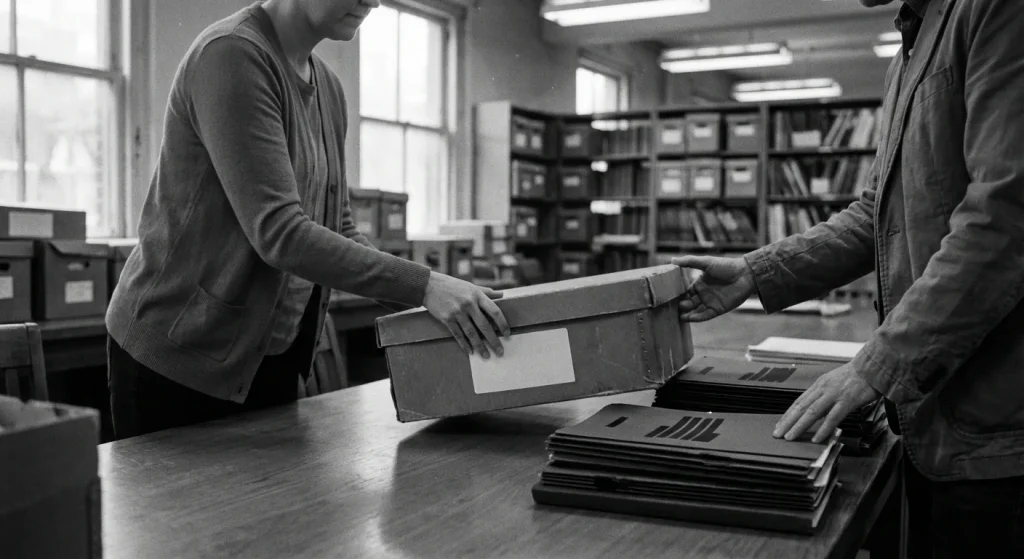
Once NARA stands up a dedicated collection, the work starts with records transfer and accessioning, meaning NARA accepts physical and legal custody and begins managing those records as archival holdings. That’s not a press-release moment; it’s the point where the material becomes something NARA can control administratively, track, and preserve.
The catch is that custody does not equal instant public access. After transfer, NARA has to confirm what it received, stabilize it (especially if it’s fragile or mixed media), and then describe it so people can actually find it. That “description” phase is why early rollouts often feel thin: you’ll see entries before you see the good stuff.
What “release in phases” looks like on the ground is usually this: basic catalog records appear, then more detailed descriptions, then selected digital items, then larger batches as processing and review catch up. The actionable way to read those early updates is: treat them like proof of intake and organization, not proof of full public availability.
This is where a finding aid becomes your map. NARA describes finding aids as tools that help a user find information in a specific record group, collection, or series of archival materials. In practice, that means you’ll often get structure and breadcrumbs first: the series title, date spans, the creating office, and notes about what the files cover, even if the underlying pages are not yet online.
You’ll also see metadata earlier than you’ll see documents. Metadata is the machine-readable “aboutness” of a record, and it matters because NARA requires security classification metadata to accompany transfers of permanent classified electronic records. Early entries can look boring, but classification markings, dates, and provenance make it much easier to track what exists and what’s still restricted.
One more piece of real-world friction: even if a record is physically at NARA, it can remain restricted. Restrictions on Federal records can be imposed by law, executive order, or the originating or transferring agency, so “it’s at NARA” and “it’s readable” are not the same claim.
Digitization is simply format conversion, not permission. NARA recognizes a “digitized record” as an electronic record created by converting paper or other media formats to a digital form that is sufficiently authentic and reliable. That definition is about authenticity and usability, not about whether the information is cleared for public release.
The complication is where UFO disclosure and UAP disclosure chatter tends to go off the rails: people see “scanned” and assume “declassified.” A file can be digitized and still locked down because the content is classified, privacy-protected, or otherwise restricted. Flip it around and you get the other common surprise: a record can be declassified and still be inconvenient to access if it hasn’t been digitized yet, meaning it’s effectively “public” but only on paper or only via on-site access.
Even the quality of what’s digitized can affect how “open” it feels. Agencies are not required to perform OCR when they digitize permanent records because NARA intends to OCR permanent records for consistent results. So an early scan might be viewable but not text-searchable yet, which makes discovery slower even though the record is technically online.
When people get impatient, they usually jump to requests, but the tool you choose changes the outcome. The Freedom of Information Act (FOIA) is one route for requesting federal records, and exemptions and redactions are part of the deal because FOIA balances disclosure against protected categories. Mandatory Declassification Review (MDR) is a separate declassification-review pathway focused specifically on challenging classification decisions, not a general “give me everything you have” mechanism.
Where this becomes practical: a record being “in the collection” doesn’t automatically tell you which process will move it. For Federal records in NARA’s physical and legal custody, MDR requests should be submitted to the National Archives at College Park, ANDC (Attn: MDR). If the record is still controlled elsewhere, the right destination and rules can change, and that’s why understanding the pathway keeps you from wasting months on the wrong door.
The other friction to keep in mind is that declassification is not the same as “no redactions.” Even after review, you can end up with partial releases where sensitive elements are withheld while the rest is opened.
Here’s the takeaway that keeps you from getting whiplash: read early “NARA opened it” updates as signals about collection-building and description, not as a promise of instant, unredacted content. If you’re seeing titles, dates, creators, short summaries, and other metadata first, that’s not a stall. That’s the workflow doing exactly what it’s designed to do.
Why 2025 Became the Inflection Point
Why 2025? Because the shift wasn’t a sudden change of heart inside government. It was policy design colliding with oversight pressure: deadlines, definitions, and transfer requirements got specific enough that agencies and NARA had to operationalize disclosure, not just argue about it.
Senators Chuck Schumer and Mike Rounds didn’t frame their push as a vibe shift. They introduced a “UAP Disclosure Act” as an NDAA amendment intended to accelerate disclosure of government records related to unidentified anomalous phenomena. The published amendment text put the intent in black and white: “To provide for the expeditious disclosure of unidentified anomalous phenomena records.” And it didn’t stop at aspiration. The proposed amendment included a presumption of immediate disclosure for federal government records concerning unidentified anomalous phenomena.
That presumption is the philosophical heart of modern UAP disclosure and it’s also where the real-world friction starts. “Disclose first” reads clean on paper, but agencies live inside classification rules, compartmented programs, and risk-averse clearance processes. Even when lawmakers want speed, the people holding the records have institutional incentives to slow-roll: protect sources and methods, avoid precedent, and minimize the chance of an accidental release that can’t be walked back.
Oversight pressure matters, but the lever that actually moves paper is structure: deadlines and mandated organizing work. Federal agencies were legally required to identify and organize UAP records by October 20, 2024, a statutory milestone that created an auditable “did you do it” moment rather than a hearing talking point.
Then the obligation gets even harder to dodge when it’s tied to a destination. Agencies were mandated to transfer digital UAP records to NARA by September 30, 2025, into a defined UAP Records Collection that the statute describes in terms of federal records relating to unidentified anomalous phenomena; transfers and reviews may be phased, and receipt and publication remain subject to statutory exemptions and agency review processes. That’s the pivot from rhetoric to workflow: once records are organized and slated for transfer, disclosure becomes a production problem, not a philosophical argument.
You can see the impact in 2025’s public-facing cadence. NARA issued a press release announcing new UAP records on April 24, 2025, and a formal determination posted in NARA’s Catalog on July 16, 2025 disclosed a specific batch totaling 72 pages. Those are incremental releases, not a Hollywood “UFO disclosure” moment, but they’re exactly what structured mandates produce: measurable outputs on a schedule.
The nuance that keeps people from misreading the moment is the difference between proposed language and enacted requirements. Drafts like the Schumer-Rounds amendment show you the direction of travel and the pressure lawmakers want to apply, but the text that survives negotiation is what determines what NARA can actually receive and publish. If you want leading indicators, read future NDAA committee drafts the way agencies do: look for hard definitions, fixed dates, and transfer or reporting obligations that can be audited. That’s where the next step in UAP disclosure will come from.
Those deadlines and outputs don’t just explain why the archive exists; they also shape what surfaces first, because records still have to be reviewed, described, and cleared before they look like “disclosure” to the public.
What Records Could Roll Out First
If you’re waiting for the first public drops to read like “alien disclosure,” you’ll probably be disappointed. Early rollouts usually prioritize safer, easier-to-process material: summaries, routing paperwork, and administrative artifacts that can be reviewed quickly and released with fewer high-risk details.
The first wave tends to be context-heavy and procedural, because that’s where reviewers can separate “what happened” from “how we know.” A good mental model is: the paperwork that proves a process existed often comes out before the raw inputs that fed it.
- Correspondence: emails and letters about tasking, follow-ups, and “please provide records” requests, often with distribution lists and office symbols.
- Memos and briefings: one to two page leadership updates that summarize open questions, known timelines, and recommended next steps.
- Policy guidance: internal “how to categorize and route this” notes that explain what gets logged, who reviews it, and what systems get updated.
- Interagency coordination notes: meeting readouts and action-item trackers showing which offices owned which pieces of a case.
- References to imagery or sensor data: not the video itself, but lines like “see attached imagery” or “sensor package referenced in Annex,” with the attachment withheld or separated.
- Case tracking summaries: spreadsheet-like entries, short narratives, or database exports that show dates, locations generalized to a region, and status fields.
- Contractor-facing communications: statements of work language, data handling instructions, or deliverable checklists that show what was asked for and when.
That’s also why UAP sightings can be documented without confirming anything extraordinary. “UFO sightings 2025” can show up as airspace safety incidents, flight hazard reports, intelligence process notes, or risk assessments about unidentified objects, with the emphasis on identification and mitigation rather than conclusions about origin.
Redactions are the default, not the exception, because the sensitive parts of a UAP file usually aren’t the headline claims. They’re the operational details: who collected what, how it was collected, and what the collection can do. Federal FOIA releases commonly include redaction codes that signal why information is withheld, and DOJ’s Office of Information Policy has long pushed consistent coding approaches so readers can see the stated basis at a glance. Treat the code as a map legend: it won’t tell you what’s missing, but it tells you what category of sensitivity drove the cut.
Rolling releases are real, and the early cadence often favors “front matter” before deep attachments. NARA’s 2025 announcements and determinations are a good example of that incremental rhythm: summary-heavy releases first, deeper bundles later as processing and review catch up.
In practice, that means you’ll sometimes see metadata, indexes, and cover sheets land before the attachments those indexes point to.
The practical read is simple: track dates (when something moved), office names (who touched it), routing (who briefed whom), case identifiers (how the same incident reappears across systems), references to annexes or attachments (what still hasn’t surfaced), and repeat actors (units or desks that show up again and again). Those “boring” breadcrumbs are how you learn who knew what, when, and how it moved.
One-sentence takeaway: in the earliest documents, ignore the hype and read for the routing trail: dates, offices, case IDs, and attachment references are where the real story starts.
Who Controls the Release Pipeline
Here’s the part that surprises people: the release pipeline is governed by authority, not curiosity. You can have a record physically sitting at NARA and still not get a clean, fast public release if the agency that created it has not cleared it for declassification or public access.
Under the classification system established by Executive Order 12958 (and successors), the originating agency generally has authority over classification and declassification of national security information it created. In plain terms, “originating agency” means the agency that created the record and originally classified the information, and that upstream ownership is why the bottleneck usually follows the creator, not the archive.
That authority shows up in how restrictions actually get imposed. NARA explicitly recognizes that access limits can come from law, executive order, or the originating or transferring agency, which is another way of saying the archive doesn’t get to wave a wand over someone else’s equities.
Even when records move into NARA’s legal custody, declassification responsibilities are shared and structured across NARA and the agencies that generated the classified content. That’s why “it’s in the archives” is not the same thing as “it’s cleared for release.”
AARO sits inside the Department of Defense and operates as a processing hub for UAP reporting: it receives, processes, and adjudicates UAP reports, routinely accesses classified information, and publishes formal products, including the Historical Record Report (Volume I). That positioning matters because AARO can aggregate inputs across military components, run them through formal review, and publish what its classification posture allows.
The friction is that AARO is not a master declassification authority for everything it touches. AARO can write a report about an incident while key underlying artifacts stay controlled elsewhere: a sensor system’s details might be owned by one program office, a platform’s operational context by a combatant command, and intelligence sources and methods by the Intelligence Community. That’s how you end up with uneven clarity even when everyone is looking at “the same case.”
When classification decisions get disputed, there is a pressure valve: the Interagency Security Classification Appeals Panel (ISCAP), created under Executive Order 12958, provides a forum for appeals of classification decisions. It’s real leverage, but it’s not a fast lane. Appeals still have to be staffed, argued, and decided, and they don’t erase the underlying requirement to protect legitimately classified information.
NARA’s role is still powerful: it maintains and publishes legally authentic authoritative federal records. But on classified content, NARA is usually the custodian and publisher, not the ultimate decider on what can be exposed and how quickly.
So when releases feel delayed, patchy, or overly redacted, skip the “government UFO cover-up” reflex and ask a more useful question: who originated this record? Once you identify the originating agency, you can usually predict where the review is happening, whose risk tolerance is driving the redactions, and why the faucet isn’t fully open yet.
That’s also why the same kind of document can show up quickly in one series and crawl in another: it’s less about interest level and more about who owns the sensitive parts.
How to Track and Use the Archive
You can track this like a researcher. The whole advantage of a centralized NARA collection is that ordinary readers can audit the drip, but only if you use a repeatable method that survives rolling uploads, re-scans, and occasional re-redactions.
Rolling releases get messy because “new” doesn’t always look new. Start by bookmarking the collection’s landing pages on NARA’s site and the specific Catalog results pages you care about, then check them on a fixed cadence (weekly beats hourly). What you’re looking for is plain: item counts changing, newly posted PDFs, updated “date added” or “last updated” fields, and fresh entries that suddenly have downloadable files where they didn’t before.
When you spot something that looks newly added, click through to the Catalog description and capture the stable identifiers the page gives you (record group and series context, and the Catalog’s own ID fields). That small habit prevents the common failure mode where you remember a headline but can’t reconstruct what you actually saw.
Catalog search works best when you treat it like link analysis, not word-matching. Start with two or three keyword clusters and rotate them: “UAP” and “unidentified aerial,” legacy terms like “UFO” and “flying saucer,” and program-adjacent phrases you’ve seen in the collection itself. Then tighten the net with filters you can defend: date ranges that match an incident window, agency names that plausibly owned the record, and any case identifiers that appear on the document (message numbers, report numbers, tasking references).
Use record groups and finding aids as your map, not your homework assignment. If a document sits inside a series that already fits your question, stay inside that neighborhood and search within it; you’ll surface related memos, attachments, and routing paperwork that never mention your keyword but share the same unit, timeframe, or file plan. That’s how you build continuity instead of chasing UAP news from one isolated PDF to the next.
If the archive points to something that exists but isn’t posted, file a request. NARA operational records requests can be submitted and tracked through NARA’s FOIA portal (National Archives). Note that FOIA and operational request submission systems vary across agencies, so if a record is controlled by another department you should check that agency’s FOIA page for its preferred portal. Use FOIA when you’re seeking agency records that haven’t been released; use MDR when you’re asking for declassification review of specific classified information.
MDR lives or dies on specificity. Your request must describe the information sought clearly enough that the agency can locate the document, and MDR eligibility isn’t limited by a record’s age or origin. Include every locator you have: titles, offices, date ranges, report numbers, record group or series references, and any Catalog identifiers you captured.
Treat citations as part of the collection work, not a finishing touch. NARA’s GIL 17 pamphlet provides guidelines and a basic model for citing unpublished records held by NARA, and that model works across NARA textual record types.
In practice, your citation note can be short but complete: creating office or agency, series or collection title, record group (if listed), item description, Catalog identifier (NAID), repository (NARA), and the date you accessed the Catalog page. If the PDF changes later, that “accessed” date is what lets you prove which version you relied on.
This week’s routine: check your bookmarked NARA pages once a week, run two saved Catalog searches with date and agency filters, log any new NAIDs you touch with an “accessed” date and a GIL 17 style citation note, and file a targeted FOIA or MDR request the moment you can name what’s missing.
What This Signals for Disclosure Next
The biggest disclosure win here is infrastructure: putting UAP records into a NARA-centered collection shifts “disclosure” from scattered, one-off headlines into an accumulating record you can actually verify, cite, and revisit as it grows. That matters because accessioning is a real transfer of custody, not a press-cycle event, and NARA’s job is to maintain and publish legally authentic, authoritative federal records. Pair that with a stable citation model for unpublished records, and you get something the old drip of agency-by-agency releases never gave you: a paper trail that can be tested, not just argued about.
If the first public drops feel modest, that’s baked into the pipeline. “Opening” still doesn’t guarantee immediate, unredacted public access, and the gap between “digitized” and “cleared for release” is where a lot of expectations go to die. Declassification responsibilities still sit with the originating agencies, and access limits can be imposed by law, executive order, or the originating or transferring agency. Combine that with the reality that early releases tend to skew administrative and contextual, and you get progress that looks incremental even when the underlying system is finally getting centralized.
Keep your eye on a few concrete indicators, not vibes:
- NDAA language drift: A Senate or House committee draft of the fiscal 2026 NDAA included proposed reforms related to UAP disclosure; watch committee drafts and markups on Congress.gov to see whether those ideas survive markup into statute.
- AARO cadence: AARO (the All-domain Anomaly Resolution Office) is expected to produce regular reporting; as of recent public reporting its 2025 annual report and a potential Historical Record Report Volume II had not appeared on AARO’s official site (Aaro), which is a concrete signal to watch.
- Archive momentum: visible catalog growth and regular transfers, not one “big drop,” is what sustained disclosure looks like in practice.
- Oversight stamina: hearings are a tell. Representative Jack Bergman posted public materials and remarks related to oversight activities on his official site around the Feb 24, 2026 hearing date; check his official House page for posted opening remarks and hearing documents (U.S. House).
- Whistleblower pathways: statutory whistleblower protections, including the Whistleblower Protection Act of 1989 (as amended) and related protections, generally prohibit retaliation against federal employees who make protected disclosures in good faith and based on a reasonable belief of wrongdoing. These protections are applied under specific statutory and regulatory standards; for official guidance see the Office of Special Counsel (Osc) and the Office of Personnel Management’s overview of whistleblower protections (Opm).
Pick one thread to follow and stick to the receipts: watch for steady NARA postings and transfer signals, track NDAA text as it hardens into law, and note whether AARO’s reporting commitments are actually met. Cite what you find and save the citations, because a verifiable record beats a screenshot every time. The fastest way to get lost in UFO disclosure is to treat gaps as answers; the smarter move is to treat gaps as open questions and let the accumulating archive, plus policy signals, tell you what’s changing.
Frequently Asked Questions
-
What is the NARA Unidentified Anomalous Phenomena (UAP) Records Collection?
It’s a centralized National Archives collection created to receive and organize UAP-related records submitted by federal agencies. The goal is to make UAP records locatable and trackable in one place instead of scattered across individual agency sites.
-
Does NARA opening the UAP archive mean everything is declassified and readable right away?
No-“opening” involves separate tracks that move at different speeds: building the collection, digitizing materials, and declassifying information. Records can be in NARA’s custody and still remain restricted by law, executive order, or the originating/transferring agency.
-
What’s the difference between a digitized UAP record and a declassified UAP record?
Digitization is format conversion (paper or other media converted to a digital form that’s sufficiently authentic and reliable), not permission to read the content. A digitized file can still be locked down for classification, privacy, or other restrictions, and a declassified record may still be hard to access if it hasn’t been digitized.
-
Why did 2025 become the turning point for UAP disclosure and releases at NARA?
New legislation mandated a governmentwide UAP records repository and imposed auditable deadlines, including agencies identifying and organizing UAP records by October 20, 2024 and transferring digital UAP records to NARA by September 30, 2025. NARA then issued a press release on April 24, 2025 and a July 16, 2025 determination fully disclosing 72 pages of UAP records.
-
What kinds of UAP documents are likely to be released first in the NARA collection?
Early releases tend to be lower-risk administrative and contextual material such as correspondence, memos/briefings, policy guidance, interagency coordination notes, and case tracking summaries. The article notes you may see references to imagery or sensor data (like “see attached imagery”) before the actual attachments are released.
-
Who controls how fast UAP records get declassified and why redactions happen?
The originating agency generally retains authority over classification and declassification decisions under the Executive Order 12958 system (and successors). Even when records are at NARA, releases can stay delayed or heavily redacted because restrictions can be imposed by law, executive order, or the originating/transferring agency.
-
How should I track new UAP record drops in the NARA Catalog without getting misled by headlines?
Check bookmarked collection landing pages and specific Catalog results on a weekly cadence, watching for item-count changes, new PDFs, and updated “date added” or “last updated” fields. When something changes, capture stable identifiers like record group/series context and the Catalog’s ID fields (NAID) so you can cite and revisit the exact record later.
