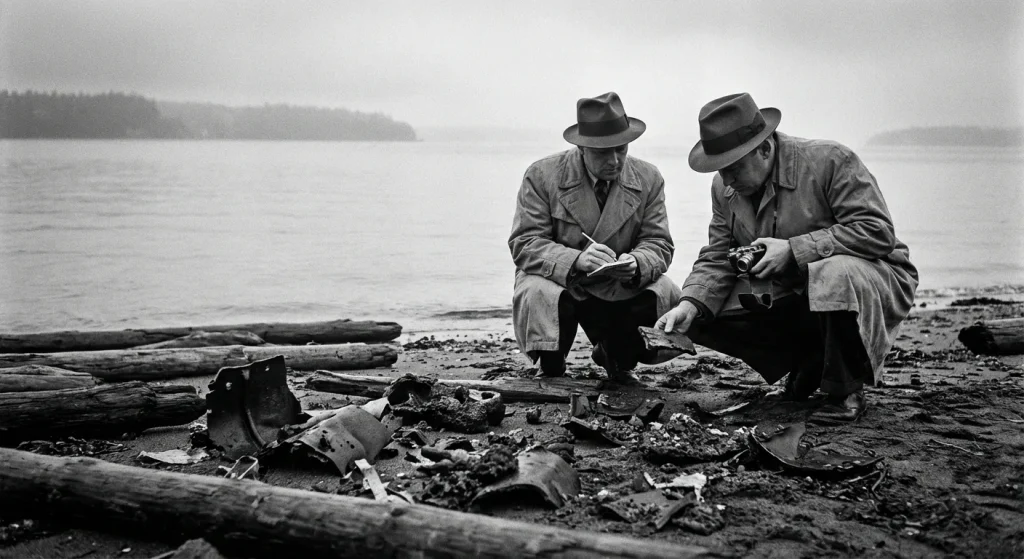
Every week, UFO news and UAP news serves up “new wreckage” and “suppressed files” chatter, yet the paper trail collapses the moment you ask for dates, documents, and chain of custody. The Maury Island incident is the classic example of why that mismatch matters: a case widely treated as fabricated still ended with a fatal military aircraft crash connected to the claims.
The record problem shows up immediately. Multiple contemporaneous 1947 channels treated the Maury Island matter as a hoax early, including newspaper coverage, FBI communications, and Air Force intelligence summaries, as later summarized by reputable local-history style sources such as HistoryLink. That early labeling did not stop the story from spreading. It hardened into lore because rumors travel faster than records, and because “debris” narratives feel concrete even when the sourcing is not.
Keep the minimal timeline straight and the entire episode becomes easier to judge. Harold Dahl and his son allegedly reported a sighting near Vashon-Maury in Puget Sound on June 21, 1947. The claim then drew investigative attention, and on August 1, 1947 a B-25 crash occurred that triggered FBI attention connected to the Maury Island matter. Those are fixed points you can anchor to, even when the surrounding retellings drift.
The guiding question is simple: how did a weak-evidence debris story become enduring lore, and what does that imply for evaluating “wreckage” claims in today’s UFO disclosure and UAP disclosure conversations? The aim is to pressure-test debris and record claims with basic timeline discipline and evidence-handling rules, so rumor never outruns the actual file trail.
1947 panic and press incentives
After real-world consequences from a single claim, the bigger lesson is structural: summer 1947 produced an information environment where unverified aerial reports amplified themselves. That amplification is the real prerequisite for hoaxes to matter, because once a dramatic “disc” narrative becomes easy to repeat and hard to check, it spreads faster than any correction.
The spark was specific and widely documented. Civilian pilot Kenneth Arnold’s June 24, 1947 sighting reported seeing nine objects and is widely credited with igniting the 1947 craze. Contemporary summaries describe the objects as bright or shiny and reported them flying in a loose formation; contemporary coverage and later histories provide the standard account of Arnold’s sighting and its role in starting the “flying saucer” wave (see Air and Space and related summaries).
Three forces pulled in the same direction. First, newspapers had a clean incentive: novelty sells, and “disc” stories were cheap to run because they relied on eyewitness narratives instead of hard documentation. Second, early Cold War habits pushed officials toward nontransparency. Postwar anxiety and a fast-hardening security culture made “we can’t comment” a default stance, which functions like oxygen for rumors because it leaves the public with only the most dramatic version of events.
Third, the public had almost no tools for rapid verification. There was no consumer radar, no flight-tracking apps, and no instant access to primary records. In that gap, mistaken identifications were common, and the label traveled faster than the evidence. A concrete example sits in 1947 itself: an Air and Space discussion of the period documents how Arnold’s account and the press coverage created a template for subsequent reports.
The “signal vs noise” split shows up in the counts. During the 1947 flying disc craze, more than 800 reports were collected publicly during the summer wave. The longer institutional response became formalized: the U.S. Air Force later investigated 12,618 reported UFO sightings between 1948 and 1969 (Project Blue Book statistics as summarized by the National Archives and Air Force fact sheets). See sources below for the specific references.
- Audit the incentives first. Ask what the information channels rewarded in that moment: attention, secrecy, and speed, or documentation and accountability.
- Separate labels from objects. Treat “disc,” “UFO,” or “UAP” as a filing term, not an explanation.
- Go to primary records. Look for contemporaneous logs, memos, weather data, and recovery determinations before you rank the story as evidence.
In 1947, dramatic claims moved instantly and slow verification arrived late, if it arrived at all. That is why the environment, not just the story, determines how far a bad claim can travel. It also explains why a local Puget Sound report could be received as part of a wider pattern long before anyone could lock down what, if anything, was actually recovered.
The Maury Island story takes shape
Maury Island became influential less because the initial claim arrived with strong, checkable evidence and more because the cast around it and the distribution network they tapped turned a dockside story into a traveling narrative. Once the account moved from a single claimant to intermediaries, then into a ready-made “strange stories” pipeline, the tale stopped behaving like a report and started behaving like a rumor that could be repeated, tightened, and improved for impact.
In the version that first circulated, Harold Dahl reported an alleged sighting on June 21, 1947 near Maury Island in Puget Sound, near Vashon. Dahl’s core description was concrete enough to retell: while boating, he said he observed six large, doughnut-shaped or disc-shaped objects. The debris premise was the hook that separated this story from “lights in the sky” accounts. Dahl claimed the objects produced falling material, and that fragments struck the water and the boat area, leaving him with pieces he could show to others.
That combination, a countable set of objects (six), a memorable shape (doughnut-like), and alleged physical debris, is exactly what made the story portable. It also created the first friction point: once “something fell” becomes the centerpiece, every retelling has an incentive to specify the debris more confidently than the earliest teller could verify, because physicality sounds like proof even when it is only described secondhand.
The fastest way to understand Maury Island’s reach is to treat it as an information chain, not a mystery with a single narrator.
Harold Dahl functioned as the originating witness: he supplied the date, the place, the number and shape of the objects, and the debris premise. His role in the chain is simple: without Dahl’s claim, there is nothing to transmit.
Fred Crisman functioned as the first local amplifier and gatekeeper. Dahl took his story to Fred Crisman before it traveled beyond the local level. That matters because the moment a claim leaves the person who says he saw it and enters an associate’s hands, it becomes easier to merge observation, interpretation, and embellishment into a single confident-sounding package.
Kenneth Arnold functioned as the credibility bridge. As a pilot already entangled in the wider 1947 conversation, Arnold served as a person the network could route information through so it would look less like a neighborhood anecdote and more like a case worth repeating.
Ray Palmer functioned as the publicity switchboard. Palmer, as editor of the pulp magazine Amazing Stories, contacted pilot Kenneth Arnold among other correspondents, and Fred Lee Crisman already had a track record in that same channel, with a Crisman letter published there in the June 1946 issue. In practice, Palmer’s role was not to verify the Maury Island claim, but to connect claimants and intermediaries to an audience trained to treat “mystery correspondence” as a form of content.
Once the story entered that correspondence-driven ecosystem, the travel path itself became the pressure point. Each hop, witness to associate, associate to editor, editor to a known name, rewarded the same moves: compress the timeline so it reads cleanly, smooth out uncertainty so it sounds definitive, and treat hearsay as a usable substitute for direct observation. The result is a narrative that feels increasingly documented precisely because it is increasingly networked.
- List the exact claim elements (date, location, count, shape, debris premise) as one bundle.
- Identify the conduit at each handoff (witness, associate, credibility bridge, publisher).
- Locate the first publication or mass-circulation relay, then treat everything before it as “claim,” not “established detail.”
On Maury Island, the fastest way to stay oriented is to track “claim -> conduit -> publication” before treating any detail as fixed, because the story’s influence came from the chain that carried it, not from evidence that stopped the chain. And because debris is the centerpiece here, the case ultimately rises or falls on whether those pieces can be accounted for like evidence rather than handled like props.
Debris, interviews, and early skepticism
The Maury Island case did not collapse because investigators lacked imagination. It collapsed under ordinary investigative pressure because the evidence trail was weak and the story kept shifting. Once federal investigators treated the alleged debris like evidence instead of a prop, gaps in possession records and timeline contradictions became more important than the most dramatic retellings.
Investigators evaluate physical claims by pinning them to an auditable record-what evidence handlers call a chain of custody-rather than debating what an object “looks like.” Any gap reduces evidentiary value because it breaks the link between the object in hand and the event it is supposed to prove. In practice, chain-of-custody work means writing down the order of possession and naming the person who physically held the evidence at each transfer, with dates, locations, and a description that uniquely identifies the item.
Federal investigators treated the debris claim as an evidence-handling problem from the start: the FBI conducted a formal investigation, interviewed the key witnesses, and examined the physical evidence, with the investigation occurring after the B-25 fatalities.
The handling problem was not abstract. Contemporary reporting tied the fallen officers directly to the claimed materials, stating that two crewmen who had transported material associated with the Maury Island reports were killed when their aircraft crashed. Those links made documentation more, not less, important. If you cannot show who possessed each piece, when it was collected, and whether it was altered or mixed with look-alike material during informal transfers, the debris cannot carry the story on its own.
Investigators also pressure-test credibility by tracking contradictions across statements, drafts, and retellings. The Maury Island record contains a clean example: some accounts place the “explosion/damaged craft” claim on June 21, 1947, while others shift the key event to June 26 or later. That is not a trivial discrepancy. It changes the window for corroboration, who can be placed where, and what independent records could exist.
In a real interview, a date shift like that triggers straightforward follow-ups: which statement was made first, what notes were taken contemporaneously, and whether later versions were influenced by publicity, coaching, or simple backfilling. Investigators privilege the earliest, most constrained account because it has fewer opportunities for retroactive editing. When the anchor date slides, the narrative stops behaving like a memory of an event and starts behaving like a story being revised to fit friction encountered along the way.
Once the debris was treated as a material-identification problem, the mundane explanation dominated. Investigators and later summaries described the material as “slag,” a smelting by-product, and contemporaneous FBI and Air Force documents and later historical accounts note that the samples resembled industrial slag associated with local smelting operations (see the FBI file excerpts and the HistoryLink summary in the Sources section below). That matters because fill material moves around, breaks apart, and shows up as irregular fragments in exactly the places people later point to as “mystery fragments.”
Cleanup and remediation records in the Tacoma area tie contamination to historical smelter operations and document ongoing response work rooted in that industrial legacy. In other words, investigators had a regionally grounded, paper-trailed source for odd, hardy industrial material appearing on the ground, without requiring any extraordinary event to explain it.
The broader context reinforces why this fit: environmental and historical sources describe a Tacoma smelter plume mechanism that spread lead and arsenic into surrounding areas, and scholarly work places Tacoma’s non-ferrous smelting impacts within a well-understood pattern. Against that backdrop, “smelting slag” is not an exotic substance. It is exactly the kind of ordinary industrial material that can masquerade as “wreckage” when the chain of custody is loose and the story is elastic.
- Require an itemized evidence log: unique descriptions, photos, collection location, collector identity, and the date and time each item entered custody.
- Verify a continuous chain of custody: every handoff documented, with names and signatures, so you can account for who physically held the evidence at each step.
- Lock the timeline: one date for the core event, reconciled against first statements and any independent records, with every later version explained as a revision.
- Insist on independent material identification: testing and interpretation by a qualified lab, tied back to the logged items, not to a narrative summary.
Those procedural gaps also explain why later events did not clarify the underlying claim: without a clean evidence trail, subsequent attention can raise the temperature without raising the quality of what can be verified.
The B-25 crash that sealed the legend
The Maury Island debris tale was already struggling under basic scrutiny, but the North American B-25 Mitchell crash is where it became culturally sticky: a rumor fused to a real death event. Once two people die in the orbit of a contested claim, audiences stop treating it as a question of sourcing and start treating it as a question of meaning. That emotional gravity is the “durability engine” of the Maury Island story, even when the underlying evidentiary base remains thin.
A B-25 crash occurred on August 1, 1947 near Kelso, Washington, and contemporary reporting and later historical summaries link the crash to investigators who had been handling material and testimony connected to the Maury Island reports. Multiple secondary accounts and contemporary newspaper reports identify two fatalities associated with the Kelso crash; several contemporaneous reports name the dead crew members as Capt. Davidson and First Lieutenant Frank M. Brown (see the newspaper reporting and the HistoryLink summary cited below). The aircraft was described in accident summaries as being destroyed by post-crash fire, a detail that narrows what can be verified afterward because fire destroys potential physical evidence and paperwork.
That crash intensified public attention and prompted additional investigative steps, including FBI follow-up. The presence of the crash in the timeline helps explain why the story achieved national visibility, but it does not by itself provide documentary proof that the aircraft was carrying unique “alien” material. As with the debris claim, what matters is auditable custody and contemporaneous documentation.
Fatalities invite overinterpretation. In this case, people commonly jump from coincidence to intent: sabotage, “mysterious cargo,” or certainty that the aircraft was carrying decisive debris. This article does not adopt those claims because the method fails at the starting line. Without contemporaneous documentation, you cannot responsibly convert proximity into causation.
To move from “connected in time” to “connected by evidence,” you need records that can be audited: cargo documentation and chain-of-custody, handling logs, witness statements taken close to the event, and clear accident-investigation findings that support an intentional act. Absent that, the crash remains what it is in the documented core: a deadly aviation event that intensified attention and helped trigger FBI interest.
That mix-high emotional gravity paired with incomplete records-is also the raw material later retellings reshape into cover-up claims.
How hoaxes feed cover-up narratives
The lasting influence of Maury Island is structural, not evidentiary. It taught later storytellers what a cover-up-shaped narrative looks like: physical debris, “official interest,” intimidation, and a final frame where the absence of clean proof gets recast as proof of suppression. Once you have that template, even a weak case can travel for decades because each retelling tightens the story into the shape audiences already recognize.
The Air Force did not need to “confirm” a story for it to gain institutional afterlife. The U.S. Air Force’s official UFO investigation began in 1948 as Project Sign, later renamed Project Grudge, and subsequently Project Blue Book. Project Blue Book was the longest-running Air Force program dedicated to investigating UFO sightings. The practical effect of these programs was durable paperwork: cases get logged, summarized, and cross-referenced. Later authors then cite that existence of a file as if it upgrades the underlying claims, even when the file is simply an administrative container for allegations and interviews.
Maury Island also shows how a case can be “officially touched” without becoming stronger. The FBI investigated and interviewed Harold Dahl and Fred Crisman, and Dahl and Crisman later signed statements recanting or revising portions of their accounts, according to contemporary summaries and later historical treatments (see the HistoryLink entry and archival FBI materials listed below). The presence of investigators is a historical fact, but it is not a quality stamp on the narrative itself.
One reason Maury Island stays legible is that later summaries stabilize a single, repeatable sentence. A common later summary repeats that Dahl and Crisman reported an “explosion” of a doughnut-shaped object near Maury Island on June 21, 1947. That phrasing survives because it is compact, cinematic, and easy to quote, even though compression always trims away uncertainty, contradictions, and mundane explanations that do not fit the arc.
Intimidation claims often arrive the same way: as add-ons that feel “obvious” once the cover-up frame is in place. Some later accounts indicate intimidation and “men in black” style claims are late additions often sourced to secondary venues such as blogs and social posts rather than to contemporaneous 1947 documentation. Once inserted, those elements tend to get backdated in retellings, as if they were part of the original record.
A weak case dressed in cover-up motifs does real damage: it trains readers to treat drama as corroboration and paperwork as confirmation. That muddies the water for any genuine, evidence-based investigation because the loudest version of the story becomes the default baseline.
The sourcing rule is simple: if a dramatic element appears only in late retellings, treat it as a motif until a contemporaneous document is produced. That same drama-first, documentation-later pattern is why disclosure debates keep replaying the same failure mode in a new vocabulary.
What it teaches today’s UAP debate
Modern UAP disclosure debates collapse for the same reason Maury Island did: people argue from conclusions while the documentation stays thin. Oversight can exist and still produce the same outcome if evidence is not logged, sourced, and preserved in a way that lets other people verify what they are being asked to believe.
The modern bridge is AARO, the All-domain Anomaly Resolution Office, because an office that publishes summaries and reports does more than investigate; it curates the public version of the historical record. AARO released its unclassified Historical Record Report Volume 1 in March 2024; the report and public materials are available from DoD-hosted and AARO-hosted resources (links in the Sources / Further Reading block below). That matters because a historical summary becomes the default citation for journalists, policymakers, and the public, even when the underlying primary records are not packaged alongside it.
Congress has also pushed record-handling as a disclosure lever. The FY2024 National Defense Authorization Act was enacted as Public Law 118-31 and includes UAP-related provisions; see the enacted law text and bill materials for the specific sections and legislative language. These are mechanisms for collection, routing, and accountability, not automatic proof of any specific claim.
The failure mode is predictable: assumption cascades. A partial release becomes “the whole file.” A historical summary becomes “the final verdict.” Attention becomes “verification.” None of those steps are evidentiary. The only thing that converts disclosure into knowledge is documentation you can trace: what was collected, by whom, when, under what authority, stored where, and handled how.
- Demand primary records by default: source documents, attachments, exhibits, and metadata, not just narrative conclusions.
- Insist on custody statements in every official release: who held the material, how it was logged, and what chain-of-custody breaks exist.
- Track assertions versus documentation line by line: what an office or law says exists, versus what has been produced, identified, and preserved for independent review.
Those expectations are not new standards invented for modern politics; they are the same basic record disciplines the Maury Island story could not satisfy when it mattered most.
A cautionary tale for disclosure era
When narrative speed beats evidentiary rigor, a hoax can outlive the facts and still inflict real harm. Maury Island is the template: a claim anchored to June 21, 1947, amplified fast enough to feel “confirmed,” then hardened by a real-world tragedy on August 1, 1947.
The ingredients were all in place. The 1947 context rewarded sensational copy and rumor loops, so weak claims moved faster than verification. Evidence handling never kept pace: provenance and chain-of-custody discipline lagged, contradictions weren’t tracked to resolution, and later embellishments faced too little resistance once the story had momentum. Then the B-25 crash gave the narrative something it didn’t earn on the merits: durability. A deadly, emotionally gripping event made the broader “wreckage” storyline feel consequential, even as early records already treated the Maury Island matter as a hoax in multiple channels documented below.
For modern UAP debates, historical reviews and official summaries matter, and readers should demand documentation before accepting “recovered debris” headlines. Use this checklist:
- Pull contemporaneous reporting (dated articles, wire copy, station logs).
- Locate official memos or summaries (FBI/Air Force/AARO where applicable) with dates and sign-offs.
- Require documented evidence logs (intake records, transfers, receipts, photo inventories).
- Insist on independent material analysis with traceable lab documentation and methods.
In a field crowded with “new wreckage” chatter, the Maury Island record is the reminder to ask for dates, documents, and custody before the story hardens into lore.
Sources / Further Reading
- HistoryLink entry: The Maury Island UFO incident
- FBI Vault (FOIA Reading Room)
- National Archives: Project Blue Book and USAF UAP records (Project Blue Book statistics)
- AARO Historical Record Report, Volume 1 (DOD PDF, March 2024)
- Public Law 118-31, National Defense Authorization Act for FY2024 (enacted text)
- Scanned FBI/related documents on Maury Island (archival excerpt)
- Table of reports during the 1947 flying disc craze (compilation of contemporaneous reports)
- Museum of Flight: The Maury Island Incident (museum summary)
Frequently Asked Questions
-
What was the Maury Island incident in 1947?
It was a Puget Sound UFO “wreckage” story centered on Harold Dahl’s claim of seeing six doughnut-shaped objects near Vashon-Maury on June 21, 1947 and collecting alleged debris. Contemporaneous channels-including newspapers, FBI communications, and Air Force intelligence summaries-treated it as a hoax early.
-
When did the key events in the Maury Island UFO case happen?
The alleged sighting is dated to June 21, 1947, and the fatal B-25 crash tied to the story’s fallout occurred on August 1, 1947. The article treats these as the fixed timeline anchors even as later retellings drift.
-
Who were the main people involved in spreading the Maury Island UFO wreckage story?
Harold Dahl is presented as the originating witness, with Fred Crisman as an early local amplifier, Kenneth Arnold as a credibility bridge, and Ray Palmer (Amazing Stories editor) as a publicity switchboard. The narrative spread through this “claim → conduit → publication” chain rather than through strong physical documentation.
-
What did investigators say the Maury Island debris actually was?
Federal documentation identified the alleged debris as “slag,” a smelting by-product used as fill by the Asarco Tacoma Smelter. The article notes this provides a mundane, regionally grounded source for odd industrial fragments without requiring an extraordinary event.
-
Why does chain of custody matter for UFO debris claims like Maury Island?
The article explains that physical evidence only has value if you can document who held each item at every transfer, with dates, locations, and unique descriptions. In the Maury Island case, gaps in possession records and shifting accounts undermined the debris claim under basic investigative scrutiny.
-
What happened in the B-25 crash connected to the Maury Island story?
A North American B-25 Mitchell crashed on August 1, 1947 in Washington State, killing two officers (often reported as Capt. Davidson and Lt. Brown in connection with the claimed materials). One crash summary says the aircraft was destroyed by a post-crash fire, and a separate note describes Captain Jamieson surviving in the water until rescued.
-
What should you look for before believing modern “recovered UFO/UAP wreckage” headlines?
The article’s checklist is to demand primary records, chain-of-custody logs (intake records, transfers, receipts, photo inventories), and independent lab analysis tied to the logged items. It also stresses locking the timeline to dated contemporaneous reporting and official memos rather than relying on later summaries or dramatic motifs.
