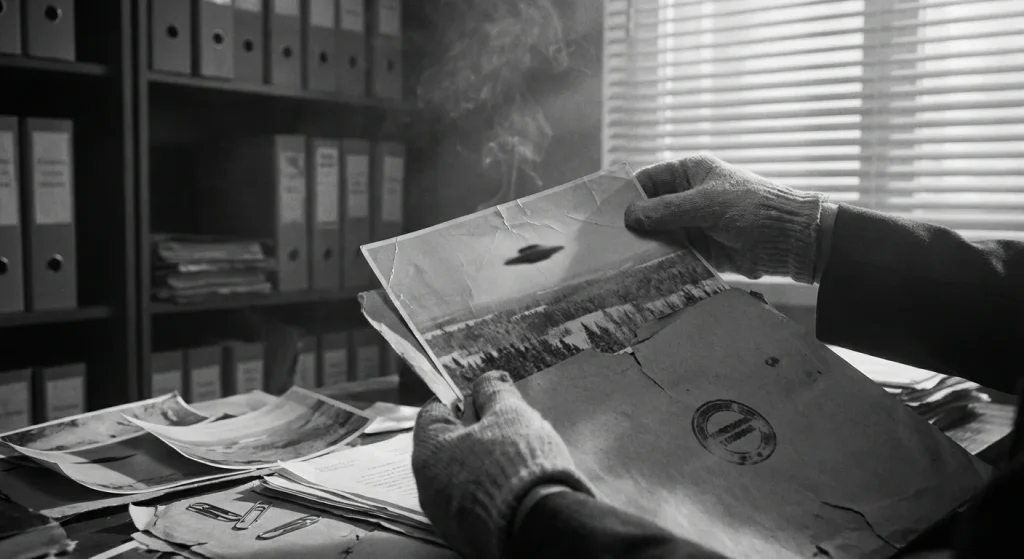
The “KGB UFO files” story keeps resurfacing because the label is persuasive, but the label is not the evidence. If you follow UFO disclosure or UAP disclosure headlines, you have seen the pattern: a cropped “KGB” stamp, a dramatic paragraph, and a claim that something was “declassified” decades ago. Then you try to trace it back to an original release, an archive reference, or even a clear chain of custody, and the trail turns into reposts of reposts.
That ambiguity creates a trap with real stakes. If you dismiss every “KGB declassified UFO files” claim as a hoax, you miss the cases where authentic Soviet-era material did surface in the early post-Soviet period. If you accept the packaging at face value, you let other people’s framing do your thinking for you, and you end up arguing about “what the KGB admitted” when the underlying documents may not even be KGB records.
Start with the claim as it actually exists in the public record: “KGB UFO files” is a catch-all label applied to materials that surfaced publicly around 1991-1992, and those references often name other plausible sources in the same breath, including the Soviet Ministry of Defense and the Academy of Sciences. That is attribution ambiguity, not a technicality. Two people can cite “KGB files” and be talking about completely different things: an intelligence service case file, a military memo, an academic compilation, or a later bundle assembled from multiple origins.
Terminology adds another layer of noise. UFO is an acronym for Unidentified Flying Object, a phrase that invites people to smuggle conclusions in with the mystery. UAP is an acronym for Unidentified Aerial Phenomena, a modern, non-presumptive framing used by official bodies because it keeps the focus on observation and data rather than story. In Soviet and post-Soviet discourse you will also see NLO, a Russian-language abbreviation commonly used for “unidentified flying object,” and that translation choice affects what a reader expects the document to be claiming.
The Mitrokhin Archive is the cautionary example that keeps this grounded: it consists of handwritten notes compiled by a KGB archivist about secret KGB operations spanning the 1930s-1980s, and it has been publicly presented as “KGB files” despite not being original case files. Treat “KGB UFO files” as a hypothesis about source and custody, not a conclusion, and you will be able to separate post-1991 surfacing from true declassification by applying the same tests this article uses: institutional context, document type, and provenance.
Why 1991 changed everything
The chaos of 1991 is the reason the KGB label became both plausible and unreliable. In 1991, the KGB label stopped being a clear chain-of-command and became a floating signifier, attached to whatever a seller, editor, or even an official clerk said it was attached to.
By spring 1991, even the word “KGB” had stopped pointing to one stable institution. On 5 May 1991, a Russian-level KGB was established for the first time in Soviet history, creating overlapping “KGB” structures inside a state already fracturing (DTIC report, RAND monograph). After the failed August 19 to 21, 1991 coup attempt, hard-liners were detained and Gorbachev’s authority was sharply weakened, accelerating the break-up of central institutions that had controlled classification, filing, and access for decades.
The personnel change at the top made the chain even less legible. Vadim Bakatin replaced Vladimir Kryuchkov as head of the KGB in late August 1991 (commonly given as 23 August 1991) (DTIC, RAND). On 24 October 1991, the president issued measures that began reorganizing and transferring many KGB functions as part of a breakup and reallocation of security responsibilities rather than a single clear-cut liquidation of all records and duties on that day (FAS overview of post-USSR KGB changes, KGB, historical summary). The formal legal winding down of Soviet KGB structures occurred in the weeks that followed under State Council and later legislative actions during the union’s dissolution process in late 1991 (Dissolution of the Soviet Union).
From that point forward, “KGB files” could mean records in transit, records being re-registered under successor bodies, or records sitting in place while the institution that “owned” them no longer existed as a legal entity.
The state context also matters for how believable, and how hard to verify, any “1991 KGB declassification” claim is. The Soviet Union collapsed on December 25, 1991, followed immediately by a scramble to stand up new authorities, rewrite rules, and decide what would be retained, transferred, or sealed.
In that moment, “declassified” was not a synonym for “public.” Declassification is a formal administrative act: an authorized body removes secrecy controls under a defined process, which is fundamentally different from an unauthorized disclosure or a commercial release. In early post-Soviet reality, “KGB declassified” could plausibly mean three different things that often got blurred together: (1) official declassification through an empowered state body, (2) unauthorized disclosure or leakage during transfer and rehousing of records, and (3) media or publisher packaging that implies official status without proving it.
The practical effect is simple: a document can be real and still be mislabeled. A file created under one Soviet agency can be re-foldered under another, excerpted without its cover sheets, or circulated as a “KGB archive” artifact because the KGB name is the most marketable tag available to a non-specialist audience.
The early 1990s also produced a narrow access window that made material surfacing feel normal, then abruptly risky. In 1992, foreign-sponsored collaborative archival work, including IREX-linked initiatives, enabled researcher access to Soviet-era records (Library of Congress IREX collection summary, Cambridge review of archival access). That widening was not stable: many archives were closed indefinitely by summer 1993, and the 1993 Law on State Secrets reshaped the environment shortly after the 1991 to 1992 media surge by tightening how sensitive holdings were handled and what could be released (WIPO text of Federal Law No. 5485-1, WTO compilation).
Those opening and closing cycles created perfect conditions for confusion. Material could be viewed, copied, summarized, or selectively shared during a permissive phase, then later become non-checkable once repositories shut their doors or classification rules hardened, leaving the public with claims but no straightforward verification path.
Layer real-world incentives on top of that turbulence and the “KGB files” narrative gets even messier. Post-1991 information markets rewarded sensational “archival” material, and Russia’s early-1990s PR environment is documented for paid media placement during corporate wars. Even without forging anything, relabeling, selective excerpting, and strategic framing turned obscure records into profitable, attention-winning products.
Operational takeaway: when a claim says “declassified in 1991,” treat it as a process-and-custody question, not a credibility stamp. Ask which body held the file at the time, what formal process opened it, and exactly how it entered public circulation.
That institutional turbulence is also why the same “KGB” tag can attach to very different kinds of material. Before credibility can be assessed, the first job is to identify what type of document you are actually looking at.
What the KGB UFO records claimed
The most important fact about the “KGB UFO files” is that they’re not a single file. What circulates under that label is an ecosystem of materials with different origin stories, then flattened into one phrase once it hits UFO media, forums, and repost chains. If you treat every “KGB document” as if it came from the same pipeline, you end up arguing the wrong question, because the pipeline often determines what the document actually is.
The closest thing to an institutional core behind the “KGB” label is Soviet state research into anomalous phenomena. The USSR ran a program codenamed Setka (“Grid”) investigating anomalous atmospheric and space phenomena, and at the end of 1978 the USSR Academy of Sciences initiated a special scientific research program to study anomalous phenomena with the Ministry of Defense participating (Skeptical Inquirer history, declassified CIA memorandum references). That scientific-plus-defense structure matters because later summaries often slide from “state program” to “KGB,” even when the underlying material reads like aerospace occurrence handling rather than intelligence tradecraft.
What typically travels from this bucket is administrative and technical in tone: memos and summaries of sightings, screening notes that qualify or discard reports, and investigatory write-ups organized like other aviation and aerospace anomaly workflows. The friction is obvious once you see it. “KGB file” suggests a single security service archive; “Soviet military/scientific” describes a cross-institution reporting process where many reports are filtered out as misidentifications or natural phenomena. The actionable read is to tag these items as “Soviet military/scientific” or “KGB-linked at most,” unless the reproduction shows a clear KGB provenance in its own markings.
A second reason this bucket keeps getting pulled into the KGB orbit is that descriptions of these research efforts, along with personal and secondary accounts of interviews and witness work, have been published or discussed outside the USSR and later repackaged. Once fragments are detached from the institutional context that produced them, the repackaging tends to default to the best-known Soviet acronym in the Western imagination. Your working assumption should be simple: state research products exist, but “KGB” is often an after-the-fact wrapper, not a document header.
The second bucket is incident narratives and compilations: packages that read like case files because they bundle witness claims, brief investigative notes, and occasional photographs into a single downloadable “dossier.” The complication is that many of the most shared cases enter these packages through press circulation and secondary summaries, not through a clean, traceable KGB archival release. Voronezh is the template. It is frequently repeated as an alleged UFO and extra-terrestrial sighting reported in Voronezh on September 27, 1989, then reprinted until it feels “archival” even when you are actually reading a later collage.
Once a case becomes a known reference point, it attracts neighboring material and turns into a compilation page or PDF that looks official because it is organized like a catalog. Voronezh commonly appears alongside other “Russia UFO” entries in compiled lists, where the formatting does the persuasive work. That is how “KGB file” becomes a genre label: a bundle of headline cases presented with just enough structure to resemble an internal dossier, regardless of where the text originally appeared.
Petrozavodsk (1977), Dalnegorsk (1986), and Voronezh (reported Sept 27, 1989) show up repeatedly in these bundles for a reason: they are memorable, nameable, and easy to compress into a paragraph. The catch is that repetition is not provenance. In this bucket, “KGB” usually means “Soviet-era case packet,” not “KGB archive pull.” Treat the bundle as a later compilation until it demonstrates otherwise, and read it as a map of what stories traveled widely, not as a receipt for where they came from.
Document types in this bucket are consistent even when the sourcing is not: short reports and memos (often rewritten as narrative), witness statements or paraphrases of witness statements, a small number of photographs reproduced and re-reproduced, and investigatory write-ups that summarize alleged traces, timelines, and official responses. The practical takeaway is to separate the format from the origin. A document can look like a file because someone compiled it into file shape.
The third bucket is the most predictable failure mode: Western-hosted “declassified” repositories whose documents get re-circulated as if they were Soviet or KGB releases. Mechanism matters here. A U.S.-hosted document gets posted as a PDF, a blogger summarizes it as a “KGB report,” the summary outranks the source in search results, and the claim gets re-imported into UFO news cycles as a Soviet disclosure story.
The FBI Vault is a clean example of how the confusion starts. It hosts a file titled “UFO Part 01” available as a PDF. That is an American repository holding an American file, but it routinely gets pulled into broader “government UFO files” roundups where the national and institutional labels blur. Once that happens, the next repost can easily mis-state it as “KGB declassified.”
The CIA Reading Room plays a similar role, with an extra layer of modern framing. CIA-hosted documents are sometimes summarized in modern media as a 250-page “Soviet/UFO” narrative, and that framing is regularly repeated as if the narrative itself were the primary document. Media have described such a document as what is claimed to be a 250-page KGB report detailing a UFO incident, but the claim is a characterization, not a substitute for provenance. The correct label for material coming through this route is “U.S.-hosted declassified” unless the document itself establishes a Soviet origin within the text and metadata you can actually see.
Here is the decision rule that prevents most category errors: when you encounter a “KGB file,” classify it first. Is it Soviet military/scientific material tied to Setka-era research pathways, a later compilation of famous cases like Petrozavodsk, Dalnegorsk, and Voronezh, or a U.S.-hosted declassified document that got relabeled in retellings? Only after you put it in the right bucket does it make sense to debate what it means.
Once those buckets are clear, the remaining question is credibility. Mixed origins are manageable; untested provenance is where the story usually collapses.
How credible were these files
If a document can’t be sourced, it can’t carry extraordinary conclusions. Treat “KGB file” as a sourcing claim that must be proven, not a credibility badge you grant because the story is dramatic.
Start from a hard reality: public accounts of where “archival” material came from, or how it moved into circulation, are often unreliable. If the chain from an archive (or private holder) to a TV segment, book, or website is fuzzy, you are evaluating an internet artifact, not an archival record.
Credibility rises or collapses on provenance, meaning the documented origin and handling history of a document. Provenance is the difference between “this existed in a specific Soviet institution’s files” and “someone posted a scan.” The practical job is to reconstruct chain-of-custody: who held it, where, under what authority, and how it was reproduced at each step.
- Identify the claimed issuing body. “KGB” is not interchangeable with the Ministry of Defense, an Academy of Sciences institute, or a newspaper compilation. The issuing body determines what formats, headers, and filing conventions you should expect, and it immediately exposes prestige relabeling (a Defense or Academy document described as “KGB” because it sells better).
- Demand archival identifiers and handling notes. A credible claim includes an archival reference number and enough description to locate the item inside a fonds, opis, and delo structure (or an equivalent catalog system), plus a clear explanation of how the copy was produced (photocopy, microfilm, scan) and by whom.
- Trace the custody path into the modern market. Post-1991 conditions created direct financial incentives for sensational “archival” material. That incentive shows up as convenient origin stories, missing intermediate holders, and sudden appearances of “exclusive files” with no archival trail.
- Cross-check for independent corroboration. Look for parallel references: separate catalog listings, multiple independent scans, consistent translations by different translators, or citations that converge on the same archival call number. One isolated image with no parallel footprint is not a record you can lean on.
Real Soviet-era paperwork is boring in a specific way: it carries administrative friction. You expect a date, an office header, a registration or dispatch number, and evidence the document traveled through an internal workflow (routing marks, stamps, signatures, and sometimes distribution lists). For “KGB file” claims, those basics matter more than any headline content because they anchor the paper to an institution and a process.
Those same markers are also the first things that get removed in viral reproductions. If a scan hides the top margin where letterhead and registration numbers usually sit, or crops off stamps and signatures, you are being denied the exact features that let you test the claim.
When the document contains personal details, check them. Many documents include personal data such as a date of birth and personal identification numbers, which are key metadata points to validate against other records. A “file” that names a person but avoids any verifiable identifiers is harder to audit and easier to fabricate.
Where verification is possible, it is procedural: investigators confirm identities and service histories by consulting service records, awards, passports (including pseudonymous ones), and ID cards. The same mindset applies here. If a claimed file cannot be anchored to verifiable identifiers or cross-referenced administrative records, it is a story, not a source.
Also separate archival reality from publication reality. Many documents sit in archives unpublished, while only a subset appears in memoirs or autobiographies. “It was printed somewhere” is not the same as “it is cataloged and retrievable as an archival item.”
Misattribution to “KGB” as a prestige label. The fastest way to inflate perceived importance is to swap the issuer in the retelling. Ministry of Defense paperwork, Academy of Sciences material, and press compilations routinely get repackaged under a single, more marketable banner. Your defense is simple: force the claim back to an issuing body, then check whether the document’s visible metadata matches that institution’s expected format.
Translation drift and context loss. Small translation errors change meaning: “report” becomes “confirmed,” “observed” becomes “established,” “unverified information” disappears entirely. Context loss does similar damage when a page is excerpted without the covering memo, routing sheet, or classification line that explains what the document is and what it is not. If the translation is not paired with the original-language scan, treat conclusions drawn from phrasing as ungrounded.
Photocopy and scan artifacts. Reproduction artifacts can mimic authenticity (a smudged stamp that looks “official”) or erase it (washed-out registration numbers, missing embossing, cropped headers). A single low-resolution photocopy is a weak foundation because it blocks the very checks you need: ink continuity, stamp geometry, signature placement, and whether the paper shows signs of being assembled from parts.
Sensational repackaging incentives. Post-1991 media economics rewarded maximal claims and minimal auditability. That environment does not only produce outright fakes; it also produces selective excerpts, retitled documents, and “best-of” compilations presented as direct security-service outputs.
A useful analogy comes from routine forgery detection: when a fake item circulated, Ukraine’s Deputy Minister of Defense Hanna Maliar publicly denied a forged document and pointed to specific mistakes as evidence of fabrication. Her denial appeared on social channels and was summarized by fact-checkers noting date and content errors and inconsistent provenance claims (Myth Detector summary, disinfo.detector.media tracking). The principle is the same here: authenticity disputes are won on concrete errors and missing process markers, not on arguments about how believable the underlying story feels.
The key nuance that keeps you honest: even authentic intelligence or security-service files can contain rumors, secondhand reporting, and unverified collection. Authenticity of the paper is not truth of the content. A real document can still be wrong, exaggerated, or incomplete because that is how raw reporting works.
Actionable rule: no issuing body, no metadata, and no custody path means treat it as entertainment, not evidence.
Those standards are not just for Soviet-era claims. They map directly onto modern UAP discourse, where the same confusion between “official” and “viral” keeps reappearing.
Parallels to today’s UAP disclosure
Modern UAP disclosure fights are about governance as much as mysteries. Today’s UAP disclosure is contested, but it is not structurally identical to 1991. The trust problem repeats because institutions still manage stigma, sensitive reporting, and reputational risk, but modern debates run through formal intake, oversight, and classification pipelines that the post-Soviet archival scramble simply did not have.
A key structural difference is that the U.S. system has a designated processing node: AARO, the U.S. All-domain Anomaly Resolution Office, built into statute as a collection, analysis, and reporting function. Section 1683 of the FY23 National Defense Authorization Act directs AARO’s collection and reporting functions and explicitly ties the office to supporting authorized reporting, which means claims can be routed into a defined workflow rather than surfacing as ad hoc document dumps. That pipeline does not guarantee clarity for the public. It does guarantee something 1991 lacked: a durable place where data is supposed to land, be triaged, and be turned into reportable outputs under congressional direction.
Even inside a formal pipeline, who can safely speak, and how, remains the friction point. The Whistleblower Protection Act covers many federal employees, but Intelligence Community employees are excluded. For IC personnel, the Intelligence Community Whistleblower Protection Act of 1998 provides a secure means to report allegations to Congress, which channels disclosures into cleared, need-to-know processes rather than public release. This is where public expectations collide with legal architecture: the system is designed to move sensitive allegations to inspectors general and oversight committees, not to social media or open press. Classification rules and compartmented programs then shape what can be confirmed in public without exposing sources, methods, or restricted data.
Statutes and offices reduce chaos, but they do not eliminate incentive conflicts. Agencies have strong reasons to limit public discussion of sensitive materials, and governments enforce those boundaries when disclosures cross into protected information.
Example prosecutions illustrate the enforcement side of that incentive structure. In Russia, journalist Ivan Safronov was convicted of treason and sentenced to a lengthy term, a case often cited as demonstrating how treason/exposure cases in that jurisdiction are handled in closed proceedings (Safronov case summary, CPJ, Amnesty International). Another recent example is the prosecution and conviction in Russia of Wall Street Journal reporter Evan Gershkovich on espionage charges, which observers have cited as illustrating secretive trials and the political risks for foreign reporters in that jurisdiction (AP News on Gershkovich, NPR summary). These are jurisdiction-specific examples and are not general statements about all disclosure or reporting worldwide, but they show how legal regimes shape what can be said publicly and what risks speakers face.
In the U.S. disclosure debate, the recurring flashpoint is not only what exists, but what the legislative process allows to be released. Transparency proposals can be narrowed, reshaped, or removed during negotiations, including provisions modified or deleted before final passage. That is why “disclosure” often lands as partial and contested: the public hears maximal claims during proposal stages, then sees narrower statutory language, slower implementation, and heavily scoped public reporting constrained by classification review.
The practical takeaway for interpreting UAP news now is simple: weight claims by their proximity to primary-source outputs. Official reports issued under statutory direction, transcripted testimony, and documented oversight correspondence deserve more credence than viral summaries that cannot be traced back to the reporting pipeline that law actually established.
But even when modern processes exist, public understanding still gets shaped by packaging. The same kind of narrative compression that turned mixed Soviet-era material into “KGB files” continues to influence how UAP material is consumed.
Media myths and lasting influence
The medium, not the memo, is often what made ‘KGB UFO files’ feel definitive. The ‘KGB files’ story survived because it fits the disclosure genre perfectly: official-sounding paperwork, a hidden bureaucracy, and a promise that the real story was almost released.
Once a claim is wrapped in the phrase “KGB files,” it inherits the prestige of intelligence archives even when the underlying material is mixed. Media treatment has done this before: the Mitrokhin Archive was repeatedly characterized in coverage as “KGB files,” showing how a label can become a credibility shortcut that travels farther than the sourcing context.
That shortcut is easier to sell than a provenance discussion, and commercialization rewards whatever packages cleanly. Analysts have documented how 1990s information ecosystems monetized attention, including paid placements in newspapers, which is the same economic incentive media formats still follow: tidy story beats outperform messy documentation.
A titled media product, “Secret KGB UFO Files,” is listed in commercial catalogs. That kind of packaging standardizes the narrative into a single, rewatchable object: a name, a cover, a runtime, a promise of revelation. The product becomes the reference point, not the archival chain of custody.
Online, the story scales through reposted scans and translations with thin provenance: unclear origin, uncertain date trails, and missing context about who compiled what. Each reupload looks like independent confirmation, even when it is the same file passed hand to hand.
Removals intensify that effect. A deleted video or a Wayback Machine snapshot routinely gets framed as “suppression evidence,” even though disappearance does not add metadata, signatures, or archival controls. The absence becomes part of the plot, which keeps the claim alive while leaving the documentation unchanged.
Three motifs persist regardless of evidentiary quality because they are reusable templates: crash retrievals, secret units, and non-human intelligence. They create instant stakes, they explain why proof is scarce, and they let any new “leak” snap into a familiar storyboard.
Mainstream coverage of reputable aggregators such as the 1990 Belgian UFO wave shows the parallel dynamic: declassified-document collections can inform public debate, but presentation choices can blur primary versus secondary material. The format can clarify, or it can quietly merge commentary and source.
- Separate motif from documentation in “UFO sightings 2025” and “UFO sightings 2026” coverage.
- Demand primary-source anchors: stable archives, catalog entries, and clear document lineage.
- Treat motif-heavy retellings as prompts for sourcing, not evidence.
That is the through-line from print catalogs to repost chains: once the label does the persuasive work, the underlying documentation tends to get treated as optional. The final step is to bring the argument back to what 1991 actually did-and did not-put into the public record.
What to conclude from 1991
1991 did not deliver a clean “alien disclosure”; it delivered an information environment where labels outran documentation. The most defensible reading of “1991 KGB declassifies UFO files” is that it became a compressed label for mixed-origin material that circulated during a chaotic transition: some potentially real documents, many repackagings, and persistent attribution drift. In practice, the bundle typically combines (a) post-Soviet access, leaks, and compilations, (b) mislabeling of non-KGB Soviet military or scientific materials as “KGB,” and (c) later Western-hosted “declassified” documents that get reinterpreted as if they were Soviet archives.
What remains unverified is not the public appetite for the story, but the chain of proof behind specific pages. Sensational “KGB file” claims routinely collapse because the documents lack basic authenticity hooks: a date, the issuing body, a registration number, and an archival reference you can actually track. Custody paths are the other recurring failure point, because public stories about how material was transferred or “found” are frequently unreliable and need independent verification. When a document cannot be anchored to corroborating records (service files, awards, passports including pseudonymous ones, and identification cards) and consistent personal metadata, it is not evidence, it is a citation loop. Many relevant records are still archival and unpublished, which creates the perfect vacuum for repackaging to masquerade as declassification.
Use a primary-source-first rubric before treating any viral “government UFO cover-up” claim as established: demand the metadata (date, issuing body, registration number, archival reference), map custody from origin to publication, and prefer official outputs over summaries. For where to look next, prioritize official reports, legislation text, hearing transcripts, and carefully cataloged archival collections, while assuming many pertinent documents remain unpublished. If a claim cannot be traced back to those source types, treat it as unproven and move on until someone can show the paperwork.
Frequently Asked Questions
-
What does “KGB declassified UFO files in 1991” actually refer to?
It’s a catch-all label applied to mixed-origin materials that surfaced publicly around 1991-1992, not a single confirmed KGB archive release. The article notes the same “KGB files” tag often gets used for Ministry of Defense or Academy of Sciences material, later compilations, or even Western-hosted documents.
-
What’s the difference between UFO, UAP, and the Russian term NLO?
UFO means Unidentified Flying Object, while UAP means Unidentified Aerial Phenomena and is used as a more observation-focused, non-presumptive framing. In Russian-language sources you may see NLO as the common abbreviation for “unidentified flying object,” and translation choices can change what readers think the document claims.
-
Why did 1991 make “KGB UFO files” claims both plausible and hard to verify?
In 1991 the KGB’s institutional structure fractured, with a Russian-level KGB created on 5 May 1991 and the KGB formally abolished by Gorbachev’s decree on 24 October 1991. The Soviet Union then collapsed on 25 December 1991, creating record-transfer chaos where “declassified” could be confused with leaks or media repackaging.
-
Does “declassified” in 1991 mean the files were officially made public?
No-declassification is a formal administrative act, and the article stresses it is different from unauthorized disclosure or commercial/media release. It lists three blurred meanings for “KGB declassified” in that era: official declassification, leakage during transfers, and publisher packaging that implies official status without proving it.
-
What kinds of documents get lumped together as “KGB UFO files”?
The article describes three main buckets: (1) Soviet military/scientific material tied to anomalous-phenomena research such as the Setka (“Grid”) program and a 1978 Academy of Sciences initiative with Ministry of Defense participation, (2) later incident compilations that bundle famous cases, and (3) U.S.-hosted declassified documents (like FBI Vault or CIA Reading Room items) that get relabeled as Soviet/KGB in retellings.
-
Which Soviet UFO cases are most commonly repeated in these “KGB file” compilations?
The article says Petrozavodsk (1977), Dalnegorsk (1986), and Voronezh (reported September 27, 1989) appear repeatedly because they are easy to summarize and widely reprinted. It emphasizes repetition is not provenance, and these bundles often read like “dossiers” even when assembled later from press and secondary summaries.
-
How can you check whether a “KGB UFO file” scan is credible before sharing it?
Use the article’s sourcing checklist: identify the issuing body (KGB vs Ministry of Defense vs Academy), demand archival identifiers (fonds/opis/delo-style references) and visible workflow metadata like date, header, and registration/dispatch numbers, and trace chain-of-custody into modern circulation. If key authenticity markers are cropped or missing and no custody path exists, the article’s rule is to treat it as entertainment, not evidence.
