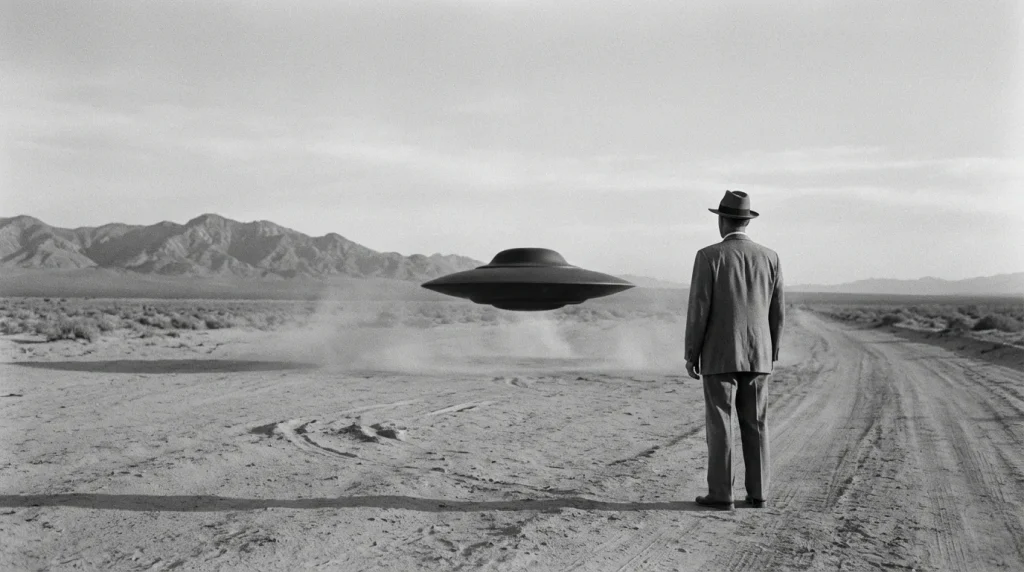
George Adamski’s 1952 contact claim—his assertion that he met a humanoid “Venusian” in the California desert—became one of the most widely publicized stories of the early UFO era and helped define what “contactee” UFO culture looked like in the 1950s. This article outlines what Adamski said happened in 1952, what evidence he offered (and what can and cannot be corroborated), and how his narrative influenced early UFO groups, media coverage, and later “space brother” contact stories.
Who Was George Adamski?
George Adamski (1891–1965) was a Polish-born American who lived for many years in Southern California and became involved in alternative religious and metaphysical circles. Before he was famous for UFO contact claims, he operated a small roadside restaurant near Palomar Mountain in San Diego County, California, and gave lectures on philosophy and spirituality. He also founded a small group sometimes referred to as the “Royal Order of Tibet,” a name associated with his earlier esoteric teachings.
Adamski entered the public UFO conversation at a time when the subject was already prominent. The modern UFO “wave” is often dated to 1947 (after pilot Kenneth Arnold’s sighting and the subsequent spread of the term “flying saucer”). By the early 1950s, the U.S. Air Force was investigating reports through projects that included Project Sign (1948), Project Grudge (1949), and later Project Blue Book (1952–1969). In that environment, Adamski’s story resonated with an audience interested not only in “mystery lights” but in messages from advanced beings.
Background: Early 1950s UFO Culture and the Rise of “Contactees”
In the first years of the 1950s, UFO reporting was becoming both a news topic and an emerging subculture. Organizations and publications formed to exchange sightings and theories; one of the most prominent civilian groups in the United States was the National Investigations Committee on Aerial Phenomena (NICAP), founded in 1956, which later took a strongly investigative and often skeptical view of “contactee” claims.
At the same time, a distinct genre of UFO experience emerged: the “contactee” narrative. Unlike reports focused on distant lights or radar tracks, contactee accounts typically described friendly, humanlike visitors who delivered moral or spiritual messages—often emphasizing peace, nuclear disarmament, and a warning about humanity’s destructive tendencies. Scholars of the UFO movement have treated this as an intersection of Cold War anxiety, popular spirituality, and the expanding mass media marketplace for extraordinary claims. One widely cited academic overview is historian David M. Jacobs’s study The UFO Controversy in America (1975), which discusses the contactee wave and its relationship to broader social currents.
The 1952 Contact Claim: What He Said Happened
The Desert Meeting Near Desert Center, California (November 20, 1952)
Adamski’s central claim is tied to a specific date and place: November 20, 1952, near Desert Center in Riverside County, California (in the Colorado Desert). In his later published account, he wrote that he traveled with companions into the desert after receiving what he framed as a kind of “invitation” or intuition that he would witness something unusual. According to Adamski, a craft landed and he met a human-looking being he later identified as coming from Venus.
Adamski named the being “Orthon” and described him as tall, youthful, and physically attractive, with long hair and distinctive clothing. The communication, Adamski claimed, took place via gestures and a form of telepathic understanding rather than spoken language. The message Adamski reported was consistent with early contactee themes: warnings about nuclear weapons, concern about human aggression, and an insistence that advanced “Space Brothers” wanted humanity to develop spiritually.
How He Published the Story: Flying Saucers Have Landed (1953)
Adamski’s account reached a mass readership through the book Flying Saucers Have Landed , published in 1953 and credited to George Adamski and Desmond Leslie. This book presented the 1952 encounter as a factual narrative and included photographs Adamski said showed saucer-like craft. The book also framed the visitors in a quasi-philosophical way, blending a “cosmic” moral message with purportedly eyewitness-level detail.
As a primary source, Flying Saucers Have Landed is indispensable for understanding what Adamski claimed. It is not, by itself, corroborating evidence; rather, it is the core record of his own version of events. Later, Adamski expanded his narrative in additional publications, including Inside the Space Ships (1955), which described further travel and meetings aboard spacecraft—claims that go significantly beyond the verifiable.
What Can Be Corroborated vs. What Remains Claim
Some basic elements of the 1952 story can be checked in a limited sense: Adamski was a real person in Southern California; he did have a circle of acquaintances; and he did publicize his account quickly. However, the extraordinary components—an actual landing near Desert Center, a meeting with a Venusian named Orthon, and the telepathic exchange—are not independently corroborated by neutral contemporaneous documentation.
Adamski stated that companions were present in the area, but accounts of who saw what, from what distance, and how much detail they observed have been debated in later UFO literature. This is an important distinction for readers: the presence of fellow travelers does not automatically verify the content of a claimed encounter, especially when the most critical portions (close contact and communication) depend on Adamski’s own testimony.
Public Reaction and Media Coverage
Why His Story Drew Attention
Adamski’s story arrived at a moment when the public was primed for UFO tales and publishers were eager for them. His narrative offered more than a “light in the sky”: it provided a protagonist, a named visitor, a moral message, and—crucially—photographs. These features made it easy to retell in newspapers, magazines, radio segments, and public lectures.
Although media coverage varied from credulous to mocking, the contactee claim itself became part of the broader early-1950s UFO conversation. The launch of Project Blue Book in 1952 and prominent UFO reporting during that period added to the sense that something important might be occurring—even though U.S. Air Force investigations did not validate Adamski’s specific claims.
Lectures, Networks, and the “Contactee Circuit”
Adamski became a popular lecturer, and his presentations helped create a template for later contactees: an eyewitness with an uplifting warning, a story that blended spiritual themes with technological wonder, and a recurring cast of extraterrestrial figures. This helped establish a “contactee circuit” in which speakers toured, sold books, and built followings. The pattern would reappear across the decade with other figures who presented similarly structured accounts.
The Adamski Photos and Controversy
What He Claimed the Photographs Showed
Adamski is closely associated with photographs of saucer-shaped objects, some of which were presented as having been taken in the early 1950s. In his books and lectures, he argued that these images supported the reality of his claims—tangible evidence that he had observed structured craft at relatively close range.
Photographs were central to his influence because they were reproducible, dramatic, and persuasive to audiences seeking concrete proof. They also became central to criticism, because photographic claims can be assessed for consistency, provenance, and signs of fabrication.
Major Criticisms and Named Investigators
Criticism of Adamski’s photographs and stories came from multiple directions: skeptical writers, investigators within the UFO community, and scientific-minded commentators. Some critics argued the images resembled small models photographed at close range, citing similarities between the “saucer” design and common household objects. Others questioned the chain of custody: when and where particular photos were taken, and whether witnesses could reliably confirm the circumstances.
Within UFO research organizations, Adamski’s claims were frequently treated with caution or outright rejection. NICAP, for example, became known for preferring cases with multiple independent witnesses, radar confirmation, or other forms of corroboration, and many NICAP-affiliated investigators were critical of contactee accounts that relied heavily on a single narrator and unverifiable messages.
It is important to attribute conclusions rather than present them as settled fact. While many investigators have argued Adamski’s photos were hoaxed, the strongest historically grounded statement is that the photographs and claimed encounter have not been validated by independent evidence to a standard that would satisfy scientific or forensic scrutiny, and they have been disputed by named organizations and researchers for decades.
Why the Photo Debate Mattered for UFO Culture
The photo controversy helped shape a lasting split in UFO culture: one side emphasizing spiritual meaning and personal testimony, the other emphasizing investigation and evidentiary standards. Adamski became an early symbol of that divide. Later debates about abductees, channeling, and “experiencer” testimony would echo the same tension—what counts as evidence, and what role belief should play.
Influence on Contactee Narratives and UFO Groups
Creating the “Space Brothers” Template
Adamski’s influence is clearest in the narrative template he popularized. Key components included:
- Humanlike extraterrestrials who look largely indistinguishable from humans.
- A moral message focused on peace, nuclear warning, and spiritual growth.
- Personal selection : the contactee is “chosen” or invited for contact.
- Repeat encounters that expand from a single meeting to ongoing communication, sometimes including travel aboard craft.
This structure became common in 1950s contactee lore. Even when later figures differed in details, Adamski’s approach established expectations for how a contact story could be told and marketed.
Publishing, Lecturing, and the Growth of a UFO Marketplace
Adamski’s books—especially Flying Saucers Have Landed (1953) and Inside the Space Ships (1955)—were widely circulated and translated, helping to internationalize a particular style of UFO belief. His work demonstrated that UFO narratives could be packaged as mass-market nonfiction, supported by photographs, and sustained by public appearances.
This helped shape early UFO culture in practical terms: it encouraged the formation of clubs, discussion groups, and newsletters organized around contactee teachings as much as around sightings. It also contributed to the broader Cold War-era blending of popular science imagery (rockets, space travel) with metaphysical messaging.
Influence on Later UFO Religions and Spiritual Movements
Scholars of new religious movements and UFO belief have often noted that contactee themes can function similarly to modern revelation narratives: a messenger brings guidance from a higher authority, framed in contemporary language (in this case, space and technology). Adamski’s stories provided an early and influential model for this kind of belief system within the UFO milieu.
For broader context on how Adamski fits into the larger history of UFO belief and its cultural impact, readers may consult reputable overviews such as the Encyclopaedia Britannica article on UFOs, which summarizes the topic and its historical development (while not endorsing specific claims).
Skeptical Responses and Legacy
Scientific and Investigative Skepticism
From a scientific standpoint, Adamski’s claims face basic challenges: Venus is not a habitable world in the way contactee stories implied, and the core events—landing, meeting, and message—lack independent documentation. As planetary science advanced through the 1950s and 1960s, the notion of humanlike Venusians became increasingly implausible, further eroding the literal credibility of the claim for many observers.
Investigative skepticism focused not only on planetary habitability but on methodology: the need for verifiable photographs with clear provenance, consistent witness testimony, and contemporaneous records. Critics argued that Adamski’s accounts expanded over time in ways that resembled mythmaking rather than reporting, particularly as later stories added more travel, more meetings, and more elaborate cosmic politics.
How UFO Researchers Differed in Their Assessment
Adamski’s legacy within UFO research is mixed. Some early enthusiasts treated him as a pioneering witness who had the courage to speak publicly. Others—especially those who wanted UFO studies to be taken seriously by scientists and government agencies—saw Adamski as damaging to credibility. This divide shaped how organizations and investigators positioned themselves: whether to include contactee accounts as data, exclude them as unverifiable, or treat them as cultural phenomena rather than literal events.
For readers interested in how government-facing investigation was structured (and how it differed from contactee literature), Project Blue Book provides a useful point of comparison, and many summaries and archived materials are discussed in public resources linked from major historical references, including the Project Blue Book overview.
Enduring Cultural Impact
Whether or not Adamski’s 1952 story is accepted as factual, its influence on early UFO culture is well documented: it helped define the “contactee” genre, pushed UFO belief toward spiritual-moral interpretation, and demonstrated the power of books and photos to build a movement. The Adamski case also became a long-running lesson inside UFO communities about standards of evidence—fueling debates that continue in modern discussions of sightings, whistleblowers, and “experiencer” testimony.
Key Takeaways: What He Claimed in 1952 and Why It Mattered
- What Adamski claimed (1952): On November 20, 1952, near Desert Center, California, he said he met a humanoid visitor he called “Orthon,” allegedly from Venus, and received a message warning humanity about violence and nuclear danger.
- How he spread it: He publicized the account primarily through Flying Saucers Have Landed (1953) and later Inside the Space Ships (1955), reinforced by lectures and circulated photographs.
- What’s disputed: Independent corroboration is limited; major UFO investigation circles and skeptical commentators have challenged the photos and the plausibility of the Venus origin claim, emphasizing evidentiary gaps.
- How it influenced early UFO culture: Adamski popularized a “Space Brothers” contactee template that shaped UFO groups, publishing, and the spiritual framing of UFO encounters throughout the 1950s and beyond.
