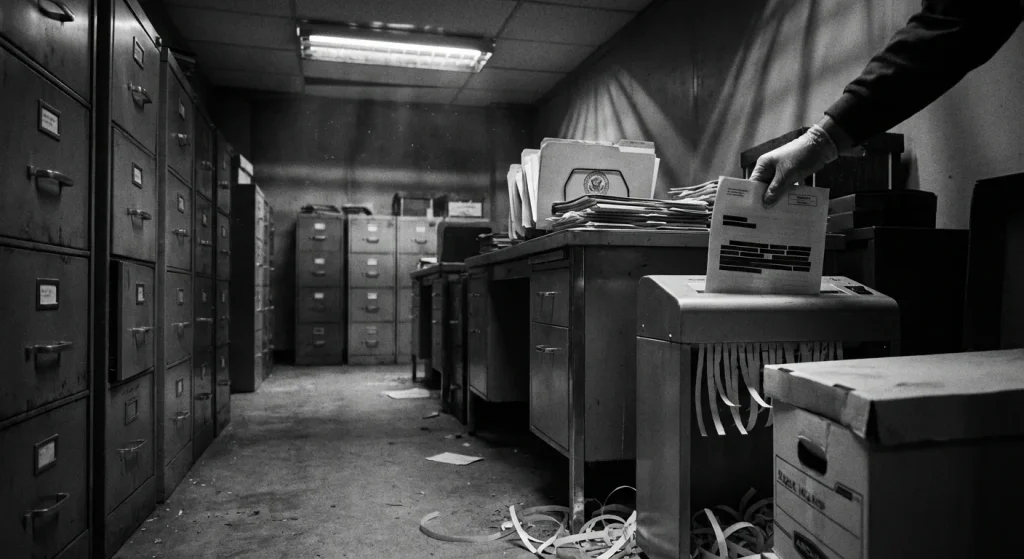
Roswell sits at the center of almost every UFO disclosure or UAP disclosure headline, but when you go looking for the kind of primary paperwork that should settle basic questions, the file trail keeps collapsing. People cite “the records” with confidence, then you discover the records are missing, were destroyed, or only exist as secondhand summaries that can’t be authenticated.
You are making a practical judgment, not a philosophical one: do you treat Roswell and today’s UAP news as an evidence problem, where claims rise or fall on documents you can verify, or as a narrative problem, where the loudest retelling wins? That choice matters, because Roswell is the template both sides keep using to frame what “government transparency” looks like.
Here is the anchor point that stops the discussion from drifting: when the GAO (Government Accountability Office), Congress’s watchdog for audits and investigations, went looking for Roswell-era answers, it ran into missing and destroyed Army Air Forces records. The GAO wrote up what it could actually document in a report titled “Records Concerning the 1947 Crash Near Roswell, New Mexico.” (NSIAD-95-187), released July 28, 1995. That gap in the paper trail is still the load-bearing beam in today’s argument, because missing federal records can be routine disposal, or they can signal concealment. The responsible place to start is what the GAO report says, not what later commentators wish it said.
Even the shorthand around Roswell shows how easily discussions slip from verifiable detail into ambiguous lore. “RAAF” in this context commonly means Roswell Army Air Field, not the Royal Australian Air Force, and the same installation later shows up in records and histories as Walker Field and Walker Air Force Base. If you do not pin the name to the place and the era, you cannot reliably pin documents to the event.
Modern UFO news cycles tend to reward testimony, insinuation, and recycled summaries, but the decisive battleground is documentary integrity: what exists, what is missing, what can be authenticated, and what an official inquiry explicitly did and did not claim. GAO reports are built to frame and limit what can responsibly be concluded from the available record, and that discipline is exactly what Roswell debates usually lack.
You will leave able to separate GAO-documented facts from later UFO disclosure interpretations, and to judge new UAP claims against a higher, document-first evidence bar.
What The GAO Actually Investigated
The GAO’s Roswell report is best read as a stress test of federal recordkeeping, not as an adjudication of non-human intelligence and not as a scientific determination about crash materials. Congressman Steven Schiff requested the review decades after the 1947 incident, and that framing matters: GAO was not commissioned to prove or disprove extraordinary claims, but to determine what the government’s official record systems could still produce, where those records should reside, and whether they were properly controlled.
That timeline boundary is the point. The inquiry runs from the 1947 context that generated the alleged paper trail, to Schiff’s 1994 request that forced agencies to account for it, to GAO’s findings released on July 28, 1995. Read through that lens, the report’s authority is institutional: it can say what was located, what was not located, and what the recordkeeping environment allowed GAO to verify.
Schiff’s request put GAO in a procedural lane: identify which offices would reasonably have created or received relevant federal records, determine where those records were supposed to be maintained, and verify what could be found through official channels. In practice, that means GAO’s questions are custody questions: Which agency owned the records? Which office held them? Were they in current files, sent to offsite storage, transferred to archival custody, or otherwise unavailable to retrieve and authenticate?
That narrow scope maps directly onto how federal recordkeeping works: both NARA and the agencies themselves share responsibility for managing federal records. GAO’s Roswell exercise sits inside that shared-responsibility model, so its findings rise or fall on what agencies could document and what NARA’s systems could confirm.
Because NARA (National Archives and Records Administration) sets the rules for federal records retention and approves what can be destroyed through its review and approval of agency disposition schedules, any Roswell search inevitably runs through its policies and holdings.
That immediately expands the coordination environment beyond a single base or a single service branch. A plausible paper trail can pass through operational units, headquarters staff offices, legal and investigative channels, and later records custodians. It can also migrate as agencies reorganize, installations change names, and functions move between commands. By the time Congress asked questions in 1994, GAO was working across a decades-long gap where continuity is the exception, not the default.
Functionally, GAO would expect potentially relevant materials to be dispersed across current agency files, NARA archival custody, and NARA’s Federal Records Centers, which are part of NARA’s storage and preservation program for federal records that are no longer needed for day-to-day operations but have not yet moved into permanent archival holdings.
GAO’s broader body of work underscores why this friction matters: GAO has pressed NARA to maintain complete data on where agencies store records and to remediate noncompliant storage areas. That same practical problem, knowing where records are and whether they are being stored and tracked correctly, is the gating factor in any retrospective accountability review.
Treat the GAO’s Roswell conclusions as bounded to what could be located and verified inside official record systems as of July 1995. That boundary is not a loophole; it is the entire point of a records-accountability inquiry. Commentators who cite GAO as if it “proved” an alien event are misusing the document, because GAO was never chartered to deliver that kind of determination. What GAO can legitimately support is a much stricter claim: what the government could document, through identifiable custodians and controlled repositories, when Congress demanded an answer.
Which Records Were Destroyed
Once you keep GAO’s scope fixed on custody and retrievability, the most consequential part of the report is not a verdict about 1947. It is the set of record series GAO could not locate because they were already destroyed or partially missing.
The 1995 GAO report did not uncover a neat Roswell archive. It documented gaps in the exact administrative and communications layers that normally anchor basic facts: who knew what, when they knew it, what they ordered, and how the story moved up and down the chain of command. Those missing categories are why the Roswell controversy persists; when the primary records that settle routing, tasking, and command decisions are gone, the argument shifts from documentation to inference, and the “government UFO cover-up” debate never reaches closure.
GAO reported that Roswell Army Air Field (RAAF) outgoing messages covering October 1946 through December 1949 were destroyed. In practical terms, that is the period’s outward-facing message traffic: the base telling someone else what happened, what it needed, what it was doing next, and who was notified. Outgoing traffic is where you expect to see incident reporting and higher-headquarters notification because it captures the act of escalation, not just the recollection of it.
The friction is that message traffic is also the kind of routine operational record that often sits on a short retention clock. Once a records disposition schedule (the approved rules that set retention periods and authorize destruction or permanent preservation) runs its course, a historically significant event can lose its best timestamped narrative if nobody flagged that message series for long-term retention. The actionable implication is simple: any Roswell timeline that leans on “someone must have notified headquarters” without the outbound record copy is arguing from what should exist, not from what does.
GAO reported that RAAF administrative records covering March 1945 through December 1949 were destroyed. Administrative records are not glamorous, but they are how a base proves what it actually did: orders, logistics coordination, personnel actions, routine incident documentation, and the paper trail that connects an unusual event to normal base operations. If a recovery operation required vehicles, manpower, temporary duty, storage space, or coordination with other commands, the administrative layer is where those demands typically leave traces.
The complication is that administrative series are often managed as “standard admin” rather than “historical evidence,” which makes them vulnerable to routine disposal. This is exactly where General Records Schedules (GRS) matter: GRS are standardized, NARA-issued disposition authorities for common administrative records, designed to keep the government from reinventing schedules for routine files. That standardization is efficient, but it collides with extraordinary events because “routine” retention logic can erase the context you later need to reconstruct what happened on a specific week in 1947.
GAO also reported a small amount of missing “decimal files” from the 509th Bomb Group at Roswell covering 1945 to 1949. Decimal files are subject-based filing systems; they are the drawers where units file correspondence and documents by topic rather than by date alone. That structure is exactly why they matter for Roswell: subject files are where you expect to see investigations, security matters, unusual incidents, policy guidance, and follow-up correspondence that does not fit neatly into a single operational log.
The nuance is that GAO described this portion as missing, not as a fully accounted-for disposal. “Small amount” does not mean “small significance.” A thin slice of missing subject files can remove the only documentary bridge between a local incident and higher-level direction, especially for sensitive categories that units might segregate or handle differently.
Destruction in federal records management often means “destroyed per schedule”: disposed of under an approved disposition authority after a retention period expires. NARA’s role includes reviewing and approving agency records schedules for disposition, and those approvals are what make some destruction authorized even when historians later view the loss as catastrophic.
That authorized pathway is distinct from “missing with no documentation,” where the absence cannot be reconciled to a documented disposal and may reflect misplacement, incomplete transfers, or other custody failures. NARA policy changes, including changes to GRS, must be disseminated, but dissemination and compliance are not the same thing over long time horizons and repeated reorganizations.
None of that adjudicates motive. It draws a hard boundary between two claims: GAO reporting that specific series were destroyed, and any separate assertion about why they were destroyed. The Roswell problem is that either outcome, scheduled destruction or undocumented loss, removes the exact contemporaneous records that typically settle disputes.
Treat any Roswell narrative that claims certainty as incomplete unless it can show primary records, authenticated copies, or a documented chain that explains why the relevant series are absent. If the argument cannot point to surviving message traffic, administrative documentation, or subject-file traces, it is not a reconstruction from the record. It is a reconstruction around the holes GAO documented.
Cover Up Or Bureaucratic Decay
The missing series GAO identified create a vacuum, and vacuums invite motive stories. The record shows absence; it doesn’t, by itself, show motive.
That distinction matters because nothing in the provided GAO excerpts characterizes the destruction and gaps as “routine” or “suspicious,” and GAO publications routinely draw tight boundaries around what a report does and does not resolve. The shared premise is narrower: GAO documented that gaps exist, but the report does not establish why they exist.
Missing archives are a predictable outcome of ordinary government recordkeeping over long time horizons. Administrative records and day-to-day message traffic are exactly the categories most exposed to routine disposal, re-filing, and loss because they are high-volume, distributed across offices, and often treated as operational “working papers” rather than permanent historical artifacts.
The friction is time. From the late 1940s into the 1990s, a file has to survive unit redesignations, personnel turnover, moves between bases, media changes, and shifting filing schemes. Every handoff is a chance for records to be boxed under the wrong series, indexed inconsistently, or separated from related material. Even when destruction is authorized, the documentation proving it was authorized can be filed elsewhere, retired under a different series, or lost first, leaving later investigators with the worst possible combination: proof that something is missing and no surviving paperwork explaining why.
This is not a Roswell-specific phenomenon. Historians of other Cold War era conflicts have had to “excavate alternative archives” when conventional collections are incomplete or inaccessible, which is exactly what you expect when record survival is shaped by institutional churn rather than a single, clean custodial chain.
The cover-up interpretation does not depend on proving every missing folder was destroyed with malicious intent. It depends on a narrower claim: if incident communications were highly sensitive, then deliberate suppression would target the very categories that later show gaps, like outbound messaging and administrative coordination, because those are the channels that reveal who knew what, when, and where it moved.
That plausibility is reinforced by two real institutional behaviors that are well documented outside the Roswell question: governments produce some materials primarily for internal officials with controlled dissemination, and they operate formal processes that remove classified content before public release. Those practices demonstrate capability and precedent for restricting information flows, which is why modern debates about a “government UFO cover-up” or “non-human intelligence” quickly gravitate toward the paper trail, not just the story.
The complicating nuance is that “withheld” and “destroyed” are different actions with different evidentiary footprints. Cold War era release battles show that governments can delay disclosure without physically erasing records, which raises the bar for anyone claiming intentional destruction rather than ordinary loss or controlled access.
Because GAO did not adjudicate intent in the excerpts provided, motive claims have to earn their way in through traceable documentation or clear process anomalies. “It feels sensitive” is not a recordkeeping argument; an irregularity in the record system is.
Concrete examples of what counts:
- Documented deviation from approved disposal practice: an order directing destruction outside normal records channels, especially if it overrides standard sign-off, timing, or series controls.
- Chain-of-custody contradictions: custody logs, transmittal sheets, or registry entries that conflict on where the same record series was stored, who held it, or when it transferred.
- Classification anomalies tied to the record system: a file series whose classification markings, downgrading history, or access controls do not match adjacent series, paired with documentation showing a targeted exception rather than a blanket policy.
Those are the kinds of artifacts that separate “records decayed” from “records were managed to disappear.” Without them, the only honest conclusion is that the gaps are real and the motive remains unproven.
Talk about Roswell the same way you would brief any contested administrative history. State what is documented (GAO found gaps). Label motive claims as hypotheses, not conclusions. If someone cites David Grusch, Christopher Mellon, Lue Elizondo, or George Knapp, treat that as today’s discourse, not evidence about 1947 record handling. Strong claims about deliberate concealment require provenance, a traceable record trail, or a process anomaly that can be checked against how the system was supposed to work.
How This Shapes UAP Disclosure Now
Roswell matters in 2025 discussions because it demonstrates how quickly “answers” collapse when records are not captured, retained, and findable decades later. Modern UAP disclosure fights are fundamentally record-collection and classification-governance fights, because without durable retention rules, tomorrow’s investigators repeat Roswell’s dead ends. The GAO lesson from 1995 was brutal and simple: if the underlying files were never captured, were misfiled, or were lawfully destroyed, “answers” degrade into competing memories and secondhand summaries. The current UAP oversight environment has better committee attention and better branding, but it still lives or dies on the same two controls: what gets recorded, and what gets locked behind classification rules.
The UAP Disclosure Act proposals, introduced as a Senate amendment in the 118th Congress, frames the problem the right way at altitude: it aims to provide for the expeditious disclosure of unidentified anomalous phenomena records and a structured review approach. That architecture matters because “disclosure” is not a single act; it is a pipeline. A pipeline only works when agencies consistently capture UAP-related reporting and investigative artifacts as records in the first place, preserve them long enough to be reviewed, and can prove completeness later through auditable systems.
The friction is predictable: disclosure frameworks create incentives to argue about what exists, what counts as “UAP-related,” and what sits in unofficial channels. The operational takeaway for readers tracking UAP disclosure and UFO disclosure is to treat every new process announcement as a records integrity question: does it force systematic capture and durable retention, or does it just promise future publication?
The National Defense Authorization Act for Fiscal Year 2024 is enacted law, and it ties the oversight problem to a concrete mechanism: it requires AARO to account for all security classification guides that govern UAP-related reporting and investigations. That is the right chokepoint because classification guides, not press statements, decide what investigators can copy, brief, or release without triggering security violations.
The catch is that “account for” cannot be a rhetorical exercise. If classification guides are numerous, inconsistent across components, or written so broadly that UAP-adjacent material defaults to higher classification, public-facing UAP news will stay thin even when internal activity is real. The practical resolution is straightforward: the public signal to watch is whether AARO can demonstrate that its guide accounting is comprehensive, current, and used to standardize how incidents are marked and routed.
Congressional hearings generate pressure, but pressure is not the same thing as preservation. One verifiable data point: the House Oversight Committee has a hearing listed as “Restoring Public Trust Through UAP Transparency and Whistleblower Protection.” scheduled for September 9, 2025 at 10:00 am in HVC-210. A hearing like that can surface discrepancies, force sworn statements, and put agencies on a clock. It cannot reconstruct missing files or validate claims that were never recorded in a retrievable system.
Use two tests. First, check whether the mandate behind the claim specifies record capture, retention duration, and auditability, meaning an inspector can verify completeness without relying on memory. Second, demand evidence of compliance with classification-guide accounting: which guides govern UAP reporting, how conflicts are resolved, and whether classification decisions are consistent across investigations. If a report cannot answer those governance questions, treat its conclusions as provisional, no matter how confident the language sounds.
A Reader Toolkit For Verification
Those tests only help if you can trace claims back to original documents rather than recycled summaries. Most misinformation in UAP news survives through citation laundering and missing provenance, not through persuasive storytelling. Without provenance, the documented chain of custody showing where a record came from and how it was handled, “leaked memos” are just screenshots with a story attached. The failure mode is predictable: secondary citations replace primary documents, selective quoting replaces full context, and “someone said GAO proved it” becomes a substitute for reading what the report actually says.
GAO writing is scoped and explicit about what it did and did not evaluate; summaries that ignore those limits are where the distortion starts.
- Identify the document’s exact title, report number, issuing body, and date, then verify those fields match the PDF you are reading (not a repost or screenshot).
- Open the original file from an authoritative host (agency, NARA, or a known archival repository) and confirm the cited sentence appears on the cited page.
- Separate Roswell-era records questions from modern “UFO sightings 2025” or “UFO sightings 2026” narratives; a sighting claim citing Roswell is already blending two different evidence tracks.
“Destroyed,” “missing,” and “no records” are not interchangeable, and each dictates a different follow-up. The legal baseline is simple: agencies are prohibited from destroying records until approved for destruction on an approved records schedule (44 U.S.C. 3314).
- Ask “Destroyed under what schedule?” because a lawful disposition should trace to a schedule item and retention period.
- Probe “Missing from where?” because “missing” often means “not located in the searched file system,” not “never existed.”
- Clarify “No records” as a search result: it can mean the agency found nothing responsive, not that the event did not happen.
Baseline your search against what archives say they hold, not what social posts claim exists. Army Air Forces records sit in NARA’s Record Group 18, and researchers can use the NARA Catalog and Record Group Explorer to confirm series descriptions and availability, including what is digitized versus only described.
- Locate the relevant series description first, then decide if you need a digitized item or an on-site pull.
- Record the series title, dates, and arrangement notes so you can detect later when a claim cites the wrong series.
FOIA (Freedom of Information Act) only reaches records an agency actually has; it can’t resurrect files that were lawfully destroyed decades earlier. FOIA enables written requests for agency records, and DoD and the Air Force have implementing guidance for handling classified records requests; common exemptions you will see cited include b(1) and b(3).
- Scope requests to a specific office, date range, and record type so the agency can run a targeted search.
- Expect exemption language in the response and treat it as a status signal to refine your next request, not as proof of the underlying claim.
When multiple posts repeat the same dramatic line but never link the same underlying document, you are watching a claim “gain credibility” without gaining evidence.
- Map every citation back one hop at a time until you hit a primary document, an archival description, or nothing.
- Reject chains that end at screenshots, paraphrases, or “trust me” summaries.
Use this 3-question filter next time “UFO sightings 2025” or “UFO sightings 2026” content cites Roswell or “the GAO report”: What’s the primary document? What’s its provenance? What does the record status actually mean?
What We Can And Cannot Conclude
The GAO report strengthens the case for missing documentation, not the case for a solved Roswell mystery.
GAO NSIAD-95-187 is a records-tracing exercise, not a crash-investigation verdict: it documents that key Roswell Army Air Field records were destroyed and some files were missing, leaving an incomplete paper trail for 1947-era questions. That boundary matters because it limits what any honest reader can extract from the report. The GAO confirms a gap in documentation; it does not supply new primary records that settle what happened.
That returns you to the choice in the opening: treat Roswell as an evidence problem or a narrative problem. Once records are gone, interpretation outruns evidence. The absence can be read as deliberate suppression or ordinary administrative decay, but neither story is proven by the gap itself. The discipline is simple: treat missing files as an evidentiary constraint, not as affirmative proof of non-human intelligence, intent, or a coordinated cover-up.
The forward-looking lesson lives in retention and accountability. Modern disclosure mechanisms rise or fall on whether agencies actually preserve what they create, and whether NARA can enforce schedules and electronic records controls across the government. NARA’s records management guidance continues evolving, including explicit attention to digital communications like text messages, precisely to reduce the kind of archival void that Roswell invites.
Watch next: audit trails you can test, retention compliance you can measure, and classification-guide accounting that explains what stayed restricted and why. The Air Force also generated an official report in response to the GAO to document its efforts, underscoring that process documentation exists even when historical records do not. If you want ongoing, evidence-led tracking of UAP disclosure, follow our newsletter for updates focused on records integrity.
Frequently Asked Questions
-
What is the GAO Roswell report (NSIAD-95-187) from 1995?
It is a Government Accountability Office report titled “Records Concerning the 1947 Crash Near Roswell, New Mexico” (NSIAD-95-187), released July 28, 1995. The report focuses on what Roswell-era federal records could be located and verified through official record systems, not on proving or disproving alien claims.
-
In the Roswell context, what does “RAAF” mean?
In this context, “RAAF” commonly means Roswell Army Air Field, not the Royal Australian Air Force. The same installation later appears in records and histories as Walker Field and Walker Air Force Base.
-
Which Roswell Army Air Field records did the GAO say were destroyed?
GAO reported that RAAF outgoing messages covering October 1946 through December 1949 were destroyed. GAO also reported that RAAF administrative records covering March 1945 through December 1949 were destroyed.
-
Did the GAO report find any missing 509th Bomb Group files related to Roswell?
Yes, GAO reported a small amount of missing “decimal files” from the 509th Bomb Group at Roswell covering 1945 to 1949. Decimal files are subject-based files where correspondence and documents are organized by topic rather than date alone.
-
Did the GAO Roswell report conclude there was a government UFO cover-up or non-human intelligence?
No, the report is a records-tracing and custody exercise and does not adjudicate motive or make a crash-materials determination. It documents that key record series were destroyed or missing and that the paper trail was incomplete as of July 1995.
-
What’s the difference between “destroyed,” “missing,” and “no records” in the Roswell paperwork discussion?
“Destroyed” refers to records that were disposed of, often under an approved records disposition schedule after a retention period. “Missing” means records were not located in the searched systems, and “no records” can mean the agency found nothing responsive rather than proving an event did not happen.
-
What should you look for to judge new UAP disclosure claims using the Roswell/GAO lesson?
Use two tests: whether the mandate requires record capture, retention duration, and auditability, and whether classification-guide accounting is comprehensive and consistent across investigations. The article flags the NDAA for FY2024 requirement that AARO account for all UAP-related security classification guides as a concrete governance checkpoint.
