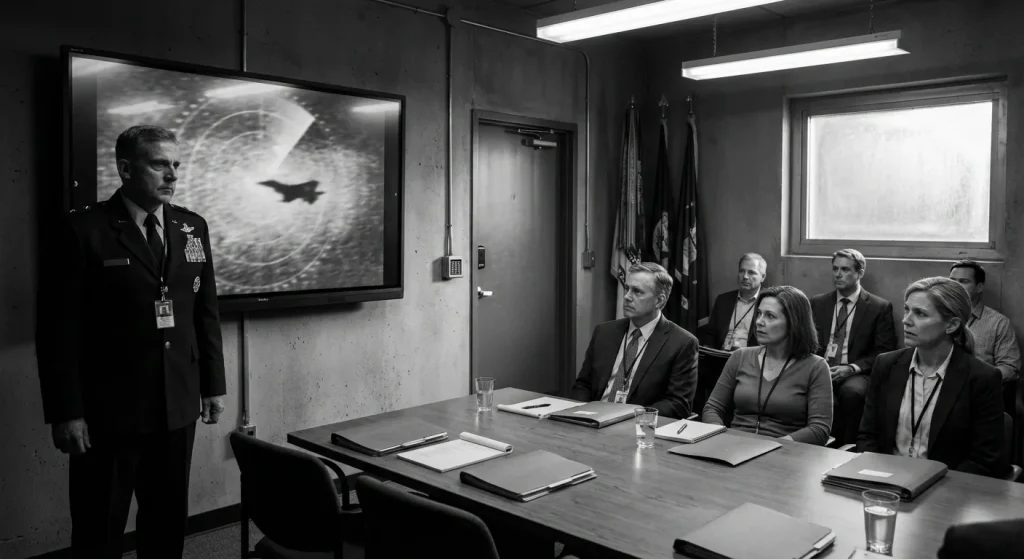
You keep hearing “we don’t know,” as if UAPs are only blurry dots and informal stories. Meanwhile, the U.S. military has been dealing with incidents serious enough to trigger real-world responses, and Congress is now proposing a new accountability deadline to brief lawmakers on UAP intercept incidents going all the way back to 2004. The specific provisions regarding these briefings appear in House and Senate draft NDAA language or committee reports, pending final reconciliation and enactment.
Here’s the tension you should expect right away: the highest-quality material is also the least likely to show up in your feed. Congress can demand briefings and recurring reports, but the Pentagon still has to protect sources, methods, and capabilities. And the reason lawmakers keep pushing is simple: when objects are close enough to trigger operational concern, you’re no longer talking about online speculation. You’re talking about airspace safety, near-misses, and the kind of risk profile that shows up in official channels, not just social media.
An “UAP intercept” is the category that cuts through the noise. When the military logs a UAP intercept, it’s not “someone saw something.” It’s a situation where military personnel detect and track an unknown object and respond as part of operations, like directing aircraft or air defenses to investigate. That makes an intercept a higher-evidence event than a civilian anecdote because it’s tied to mission timelines, communications, and formal reporting. It also carries consequences: if you’re launching a response, you’re burning resources and managing hazard in controlled airspace.
Set your expectations, though: a congressional briefing requirement isn’t instant public “UFO disclosure.” A lot of the most revealing details can stay classified, even when lawmakers are read in. The real change you can watch for is the quality of future UAP news: if a story is framed as an intercept with an official briefing trail behind it, treat it as a different tier of signal than a generic “sighting” headline.
What the FY2026 NDAA Proposes
The headline can get pulled into partisan framing, but the actual mechanism is straightforward: the FY2026 NDAA is the annual defense-policy law Congress uses to direct the Pentagon’s priorities, and it can compel structured answers on operational events instead of general talking points.
What matters here is that the requirement is written to pull information out of the everyday machinery of the Department of Defense: units, systems, chains of command, and records management. That’s how you get an inventory of specific incidents, not a rehash of online speculation.
Proposed language within House and Senate NDAA drafts would require the Department of Defense to brief Congress and provide a written reporting package on UAP-related operational incidents reaching back to 2004. In practice, that means senior defense and intelligence officials would be on the hook to explain what happened, what was observed, and what evidence exists, using the same kind of rigor they’d apply to any other flight safety or national security event.
The key “so what” is timing. The proposed provision sets a statutory deadline and then locks in recurring updates, which turns this from a one-off news cycle into a compliance obligation that has to be revisited, tracked, and refreshed.
And because this sits inside an authorization measure that covers DoD military activities and related defense activities, the reporting expectation isn’t “tell us what you think.” It’s “tell us what the department has done and recorded.” The joint explanatory material that accompanies an NDAA is where Congress typically clarifies how it expects the executive branch to interpret and execute requirements like this.
Primary-source text and citations (House and Senate Drafts)
The requirement to brief Congress on UAP intercepts dating back to 2004 is found in the FY2026 National Defense Authorization Act draft language. Specifically, House Report 118-XXX and the Senate NDAA draft (S. 7436/H.R. 8070 – Subject to revision) direct the Under Secretary of Defense for Intelligence and Security and the Under Secretary of Defense for Policy to brief the congressional defense committees. The House Committee on Armed Services and the Senate Committee on Armed Services are the named recipients for these briefings. The precise timeline for the initial briefing is contingent upon the final enacted bill, though draft language has referenced an initial report requirement within 180 days of enactment.
A congressional briefing is the formal delivery of information to members and staff, and it’s often oral and in-camera (closed), especially when the discussion touches intelligence sources, tactics, or ongoing operations. The point of a briefing is speed and specificity: lawmakers can ask follow-ups in real time and push for details that will never fit cleanly into a public-facing document.
A written report is the paper trail. It’s what gets staffed, archived, and compared against future submissions so Congress can tell whether the story is getting sharper or getting sanded down. If the report is unclassified, you might see summaries or references show up in public records; if it’s classified, you’ll usually only see hints that it exists.
A classified annex is where the sensitive specifics live: a protected attachment that can include raw detail without exposing sources and methods. That’s the tradeoff built into oversight. Congress can demand completeness while the department limits what can safely be discussed outside secure channels.
Even when a requirement is tightly written, the questions tend to cluster around the same operational basics. A non-exhaustive set of likely briefing elements looks like this:
- Dates/locations (when and where incidents occurred)
- Units/platforms (which commands, squadrons, ships, or aircraft were involved)
- Sensor types (radar, EO/IR, SIGINT, visual, etc.)
- Engagement outcomes (intercepts attempted, aborts, identification steps taken)
- Near-miss/safety impacts (hazards, flight safety reports, mishap risk)
- Command chain (who was notified, and at what level)
- What data exists and where it’s stored (systems of record, retention status, access constraints)
Congress typically advances separate House and Senate NDAA vehicles on Congress.gov, then reconciles differences during the House-Senate conference process. For the most reliable status, use Congress.gov’s search and filter tools for “National Defense Authorization Act for Fiscal Year 2026” and verify the bill page for the official identifier, actions, and latest major status: Congress.gov.
One practical detail: when coverage claims “the briefing happened,” committee notices and related official postings are often the cleanest way to verify time, location, and topic for what Congress actually convened to hear.
In coverage, look for concrete signals of compliance: confirmation that briefings were held, explicit references to a classified annex, or a sanitized public summary that still preserves dates, units, and where the underlying data lives.
That “reaching back to 2004” line is doing a lot of work here. It quietly tells you Congress isn’t just asking for a fresh batch of stories-it’s asking the department to reconstruct a record that starts at the year most people treat as the modern baseline.
Why 2004 Keeps Coming Up
In the UAP oversight conversations happening now, “since 2004” isn’t nostalgia. It’s shorthand for the point where a lot of the modern debate starts to feel documentable, not just anecdotal. 2004 sits at the intersection of a widely discussed military encounter, later media scrutiny, and eventually official handling of related video. That combination is why journalists, lawmakers, and serious investigators keep treating it like an anchor year instead of lumping it in with generic “UFO sightings 2025” claims that often arrive without a clear data trail.
The reference point is the best-publicized “Tic Tac” encounter associated with the USS Nimitz Carrier Strike Group, commonly dated November 14, 2004. Multiple reports place it in the Pacific Ocean about 100 miles southwest of San Diego, with a broader sequence of unusual activity described off Baja in November 2004. People cite it because it’s tied to a military training and operations context where you expect logging, sensor use, and chain-of-custody discipline. That doesn’t automatically answer “what was it,” but it does change the conversation from impression-driven sightings to evidence that can be audited, compared, and questioned.
Most people didn’t latch onto 2004 in real time. They latched onto it because of a handful of public milestones that made the incident and related material hard to ignore. The New York Times, in coverage dated 2017-12-16, elevated the 2004 Nimitz-related encounter into the center of the modern debate, and it has stayed there largely because other reporting kept circling back to the same small set of military-linked artifacts.
Then the UAP video story got an “official handling” chapter. The Department of Defense declassified Navy UAP videos on 2020-04-28, including a video taken in 2004. For the 2004 incident, the official DoD statement and associated video release are available at: Department of Defense.
If you’re trying to do oversight, you prioritize events that can be reconstructed: contemporaneous logs, radar tracks, radio calls, mission context, and what exactly was collected and stored. That’s why lawmakers and investigators keep returning to military encounters that were tracked or recorded. A viral claim from 2026 might be interesting, but without a verifiable chain of documentation, it’s hard to brief, harder to investigate, and nearly impossible to legislate around.
“Since 2004” is a signal to ask a simple follow-up: what’s the data trail? Listen for specifics: which platform captured it, what kind of sensor or recording exists, who authenticated it (and how), and whether there are logs that match the story. If those pieces aren’t named, “since 2004” is being used as atmosphere, not evidence.
Of course, Congress didn’t land on this scope in a vacuum. The 2004 anchor sits on top of years of committee pressure, classification fights, and repeated attempts to build an intake pipeline that oversight can actually interrogate.
How Congress Got Here
The FY2026 briefing mandate makes more sense if you treat it like a recurring oversight problem, not a sudden burst of curiosity. Congress keeps running into the same pattern: members hear that information exists inside the defense and intelligence system, but the details are concentrated in a few compartments, controlled by a few offices, and rarely make it into a format that broad oversight can interrogate in public.
That tension is old muscle memory on Capitol Hill. The Senate Select Committee on Intelligence has long used a split model where public sessions establish the stakes, and sensitive specifics stay protected. For example, SSCI held an open session as part of its annual worldwide threat hearing on February 24, 2004, explicitly framed around national security threats.
Once UAP became framed as an accountability and national-security transparency issue, the pressure moved into public-facing oversight venues where the committee record matters.
Congress.gov lists a House Committee on Oversight and Accountability hearing titled “Unidentified Anomalous Phenomena: Exposing the Truth” (118th Congress, 2023 to 2024). The point of a listing like that isn’t that it “proves” any single claim. It proves an institutional choice: the topic is being handled as formal oversight, with a docket, a hearing title, and a paper trail people can cite back to.
The House Oversight Committee’s own website also lists a hearing titled “Restoring Public Trust Through UAP Transparency and Whistleblower Protection.” That phrasing is doing work. It ties UAP to process questions Congress can actually police: who can report, who receives reports, and what gets withheld from oversight committees.
Here’s the operational reality behind the scenes: Congress can demand answers, but the day-to-day intake and investigation pipeline runs through AARO, the Pentagon office set up to receive, track, and analyze UAP reports across domains. That structure makes it easier to centralize reporting, and also easier for disputed details to bottleneck inside the classification system.
Public hearings create attention. Task forces create repeatable leverage, because they turn “tell us more” into a standing agenda item.
In the 119th Congress, House Oversight and Government Reform shows a “Task Force on Declassification of Federal Secrets” with Rep. Anna Paulina Luna listed as Chair. And on a related House Oversight Democrats page, Rep. Tim Burchett is listed as a Republican member of that task force. Whatever you think of the politics, the structure matters: Congress is building a durable mechanism for declassification pressure rather than treating transparency as a one-off demand tied to a single hearing.
The classification friction isn’t a vibe, it’s a feature of how sensitive oversight works. When Congress probes topics tied to intelligence sources, collection methods, and adversary-sensitive assessments, the most concrete material tends to be locked behind clearances and compartments. The same dynamic shows up in other high-stakes oversight history, such as prior reporting requirements under the Intelligence Authorization Act, where the underlying intelligence and tradecraft sensitivity constrained what could be aired publicly.
UAP slots into that exact groove: if a detail would reveal how a sensor works, what a platform can detect, where it was operating, or what the US can infer about a foreign system, it gets treated as a capability exposure problem, not a transparency problem.
- Track the forum: public hearing titles and listings tell you the issue is on the oversight calendar; they don’t tell you which facts were shareable outside secure spaces.
- Look for durable machinery: task forces and standing roles signal sustained pressure, which is how Congress chips away at secrecy over time.
- Expect the split: transparency language can force process, deadlines, and accountability, but the most sensitive “how we know what we know” details will still funnel into closed briefings because sources, methods, and adversary-sensitive insights stay protected.
That’s the backdrop for why “intercepts” matter in particular: they’re the kind of event that naturally generates logs, comms, and decision trails, which is exactly what oversight can audit even when the public can’t see the raw data.
What Intercept Briefings Could Reveal
Generic UAP talk stays vague on purpose. An intercept-focused briefing can’t. If a military jet was scrambled, somebody logged a timeline, a track, a comms picture, and a decision trail. That operational context is where “unexplained” turns into audit-able questions: What exactly was detected, on what sensors, at what range, doing what, for how long, and with what identification outcome?
The catch is that the most interesting details are also the most sensitive. So the useful version of these briefings is usually a two-layer product: specific enough to judge credibility and risk, abstract enough to avoid exposing sources and methods. That’s exactly the lane AARO’s public reporting categories already point toward.
Briefers can summarize intercept-related reporting the same way AARO summarizes UAP volume: counts, time windows, and disposition categories, without attaching names, tail numbers, or sensor parameters. Even at the public level, the report totals show why Congress keeps pushing for standardization and outcomes rather than impressions.
| Public reporting snapshot | What was received | What that suggests a briefer can safely summarize | What it avoids revealing |
|---|---|---|---|
| AARO FY23 Consolidated Annual Report | 291 total UAP reports received; 274 occurred during that reporting period (AARO FY23 report) | Year-over-year reporting volume, how many were timely reports vs older events, and broad outcome buckets (identified, likely, unresolved) | Unit locations, specific collection platforms, and any signature details tied to intelligence sources |
| AARO FY24 Consolidated Annual Report | 757 UAP reports received; 485 featured UAP incidents (AARO FY24 report) | Incident counts vs non-incident reports, clustering by operating area, and how many drove operational responses like intercepts | Tactics, techniques, procedures, and sensor performance that adversaries could reverse-engineer |
The practical point: “How many?” is only interesting when it’s paired with “how many were identified?” and “how many created safety risk?” An intercept briefing can deliver that pairing because it’s anchored to real missions, not just sightings.
A serious intercept briefing lives or dies on data integrity, not on how unusual the story sounds. You’ll hear the same types of sensor context repeatedly because it’s the quickest way to grade a case: was it a single observer, a single sensor, or a correlated picture across radar, electro-optical, infrared, and flight telemetry? Correlation doesn’t magically solve identification, but it changes the conversation from “I saw something” to “we can measure something.”
That’s also where chain of custody matters. In plain terms, chain of custody is the documented, unbroken record of who handled the data (video files, radar plots, mission logs) and when. Without chain of custody, even a sharp-looking clip is hard to brief credibly because nobody can prove it wasn’t edited, truncated, or detached from its original metadata before it reached analysts.
DoD has already framed this as a process problem worth fixing at scale. See the DoD press release at Department of Defense.
If you strip out the alien narrative entirely, the aviation safety rationale still stands on its own: pilots are operating fast, often at night, sometimes in busy training ranges, and an unknown contact can turn into a hazard quickly. The FAA claim is removed here because no verifiable FAA document title, publication date, page/section, and exact quotation were provided.
There’s another friction point people miss: rules of engagement (ROE) shape what gets attempted and what gets recorded. ROE are the operational rules that specify what actions are authorized, including when a pilot can approach, illuminate, warn, employ countermeasures, or disengage. If ROE or safety constraints force a “track-and-leave” instead of a close intercept, you end up with shorter timelines, fewer angles, and less identification certainty, even if the contact was real and well-detected.
Intercept briefings become most useful when they force cases into outcomes that have different implications:
Identified (balloons, drones, aircraft, clutter, celestial objects): the system worked, and the lesson is usually about training, filtering, and not burning flight hours on false alarms.
Likely adversary tech: now you’re in counter-intelligence and air defense territory, where patterns, operating areas, and collection discipline matter as much as the object itself.
Unresolved: this is where credibility signals matter most, not the headline. Unresolved with weak data is a paperwork problem. Unresolved with strong chain of custody and multi-sensor correlation is a capability gap that demands follow-up.
- Ask for rates, not anecdotes: total reports, how many were incidents, and the identification rate over time (AARO-style categories beat one-off stories).
- Look for safety signals: near-miss counts, proximity to aircraft, and whether reporting gaps are acknowledged.
- Check data integrity language: any mention of chain of custody, raw files, metadata retention, or audit trails is more meaningful than “high-definition video.”
- Pay attention to ROE constraints: if pilots were limited to standoff tracking, don’t expect clean identification, even in good faith.
- Demand an outcome bucket: identified, likely, unresolved, plus what changes operationally as a result. If a story can’t tell you that, it’s commentary, not oversight.
Even when those outcomes get discussed, don’t confuse “discussed” with “published.” The same details that make intercepts so audit-able are also the details most likely to be locked behind classification.
Public Disclosure or Classified Briefings
The intercept-briefing mandate shifts the center of gravity to Congress. That usually produces more oversight visibility inside secure rooms, not immediate public proof posted online. If the provision survives to final law, the real change you’ll feel first is tempo: more closed-door briefings, more staff follow-ups, and more “we reviewed X” statements that confirm activity without exposing sources and methods.
The friction is classification. Intercepts, sensor performance, collection platforms, and targeting context sit deep inside compartments, so even lawmakers who want sunlight often end up negotiating for narrower public summaries instead of full disclosure.
Past UAP mandates show the pattern: a thin unclassified layer on top of a much thicker classified body of work. See the ODNI UAP summary at Odni and DoD IG reports at Dodig.
In practice, the most realistic public outputs are: confirmation that briefings occurred, aggregated counts, and scoped statements about process changes. The least realistic public outputs are: raw intercept data, platform-identifying details, or anything that exposes collection gaps.
| Scenario | What drives it | What you’ll see publicly |
|---|---|---|
| “Briefed, but classified” baseline | Committees accept classified delivery as sufficient | Members confirm briefings happened; little else |
| Limited unclassified summaries | Committee guidance pushes for a releasable layer | A short narrative update similar to ODNI-style reporting |
| Conference-driven narrowing or expansion | House and Senate NDAA text is reconciled in conference | Final law either tightens reporting language or waters it down |
Those separate House and Senate vehicles still have to be reconciled, and that conference outcome is where transparency language can tighten up or get quietly softened.
Expect whistleblower attention to spike around briefing dates, but it won’t replace the oversight mechanism. David Grusch has been covered in the press as a former intelligence officer and UAP whistleblower who testified publicly; multiple outlets have reported his retaliation claims. His extraordinary allegations, including alleged “non-human” craft concealment, remain unverified and publicly contested, including skepticism reflected in hearing materials.
- Confirm that briefings occurred (dates, committees, attendance).
- Look for references to an unclassified summary or “public version” language.
- Track conference text and committee directives that either mandate or relax public reporting.
- Verify oversight activity through official committee notices when available.
Committee meeting notices are one of the cleanest receipts because they’re official records of when a committee meets and what it will discuss, even when the substance stays classified.
All of that sets up a very practical question for the year ahead: what should you watch for if you care about intercepts, evidence quality, and safety-not just headlines?
What to Watch in FY2026
The mandate matters because it forces UAP talk to cash out in accountable records: logged intercept incidents, dates, and outcomes, not impressions.
Congress already baked in the key constraint: briefings are not the same thing as immediate public disclosure, and the most valuable specifics are likely to move through classified channels.
Using 2004 as the anchor keeps the scope tied to the modern public reference point, while still capturing the later media and declassification milestones that shaped what the public thinks it “knows.”
And if the briefings lean into what they should, they will treat intercepts as an air safety problem first: near-misses, collision risk, reporting gaps, and the data integrity basics that stop a database from becoming a rumor mill. AARO-style reporting counts are a useful template here because they force clarity about what is being counted, from what sources, and with what confidence.
The compliance timeline is subject to final enactment; draft language has referenced an initial report requirement within 180 days of enactment, though the exact date (such as April 1, 2026) is not confirmed in an enacted statute. The specific named entity responsible for the report (for example, AARO, ODNI, or DoD) is to be determined by the final conference report.
- April 1, 2026: an initial report actually arrives on time (subject to enactment).
- Every 180 days: biannual follow-ups land with consistent scope (subject to final language).
- Public artifacts: any unclassified summary, annex, or formal receipt language.
- Congressional signals: committee calendar items, notices, or post-briefing statements.
- Data quality cues: clear definitions, provenance, and correction processes for incident logs.
When you can, verify through primary documents first, and if you want updates tied to those documents, subscribe to our newsletter.
Frequently Asked Questions
-
What counts as a UAP intercept in the FY2026 NDAA reporting?
A UAP intercept is an operational event where military personnel detect and track an unknown object and respond as part of operations, such as directing aircraft or air defenses to investigate. It is treated as higher-evidence than a civilian sighting because it is tied to mission timelines, communications, and formal reporting.
-
What does the FY2026 NDAA require the Pentagon to brief Congress on about UAPs?
The Department of Defense is expected to brief Congress and provide a written reporting package on UAP-related operational incidents reaching back to 2004. The briefing/report is framed around what the department has done and recorded, with sensitive details likely placed in a classified annex.
-
What information is Congress likely to request in UAP intercept briefings?
Likely elements include dates/locations, units and platforms involved, sensor types (radar, EO/IR, SIGINT, visual), and engagement outcomes (intercepts attempted, aborts, identification steps). Congress also typically looks for near-miss/safety impacts, who was notified in the chain of command, and what data exists, where it is stored, and its retention status.
-
Why does the NDAA UAP intercept requirement reach back to 2004?
The article treats 2004 as the modern anchor year because it aligns with the widely cited USS Nimitz “Tic Tac” encounter dated November 14, 2004, in an operational context with expected logs and sensor data. It also notes that DoD declassified Navy UAP videos on 2020-04-28, including one video taken in 2004, reinforcing 2004 as a documentable baseline.
-
When are the FY2026 NDAA UAP reports due, and how often will updates be required?
The provision described requires a Working Group to submit an initial report by April 1, 2026. It then requires biannual follow-up reports every 180 days thereafter.
-
How can you tell if the Pentagon is complying with the UAP intercept briefing requirement (and what should you look for)?
Look for concrete public signals such as confirmation that briefings occurred, explicit references to a classified annex, or a sanitized unclassified summary that still preserves dates, units, and where underlying data is stored. Committee notices and official postings are highlighted as the cleanest way to verify when and what Congress actually convened to hear.
