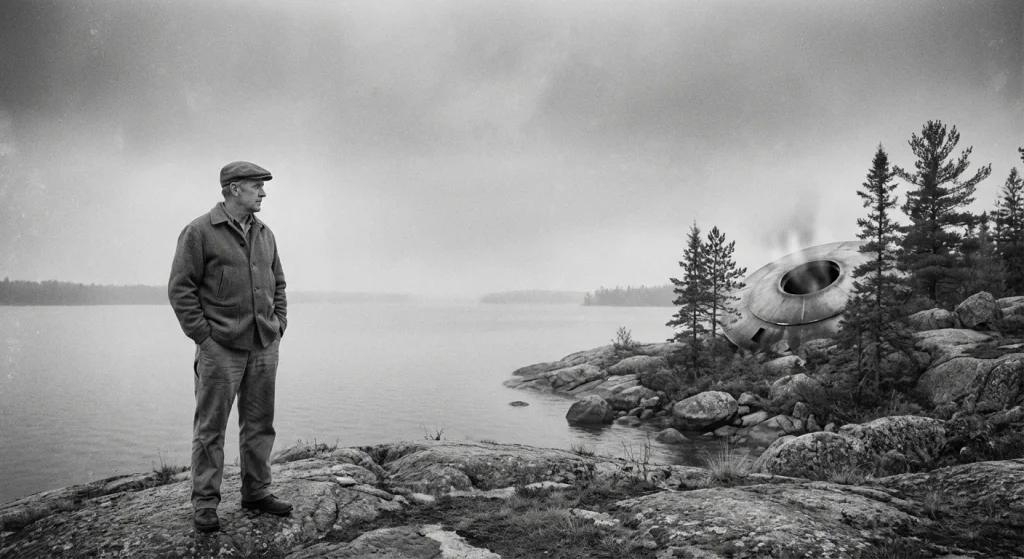
You keep seeing “UFO disclosure” and “UAP news” headlines, and the problem is simple: most of what circulates is either spectacle or speculation, not a case you can pressure-test against reality. If you want one legacy incident with tangible stakes, the Falcon Lake case forces the issue because it sits where claims stop being abstract and start being bodily: a witness who said he was burned, including a grid-like pattern that keeps the story lodged in public memory.
The decision you face is not “believe or debunk.” It is deciding what standard of proof you will use when a modern disclosure conversation asks you to treat an extraordinary claim as evidence. If you accept vibes and viral retellings, every week produces a new “bombshell.” If you demand documentation, the list of serious cases shrinks fast.
Start with the identifiers that do not move. The witness is commonly identified as Stefan Michalak, a name frequently misspelled as Stephen or Stephan in secondary sources. The incident date is May 20, 1967. The location is Falcon Lake in Whiteshell Provincial Park, Manitoba, Canada. Those anchors matter because Unidentified Anomalous Phenomena (UAP) is the government and policy label for observations that remain unidentified after initial review, and Falcon Lake keeps returning precisely because it is argued as more than an observation: it is framed as an alleged physical interaction with consequences.
The friction is that the story’s most vivid element, injury, travels farther than its paperwork. Secondary sources amplify and remix details, while primary sources are the contemporaneous records that let you separate what was recorded at the time from what was added later. An evidence-first read does not reward the most cinematic version; it rewards the version you can trace back to a document, a date, and an originating record.
You will walk away with a practical, evidence-first lens for tracking what is verified versus merely repeated by following the chain from timeline to injuries to investigations to explanations to modern relevance. That lens starts with the least glamorous step: reconstructing what can be anchored, then marking what cannot.
Note on sources used: this article draws on primary and secondary material available from Library and Archives Canada holdings and programs, contemporary and retrospective reporting, and public online repositories. Where relevant and available I link to archival finding aids, government repositories, and reputable summaries. See the “Sources and where to find them” section below for direct links to the principal repositories and summaries referenced here.
What happened at Falcon Lake
Commonly reported account
- May 20, 1967: Stefan Michalak reports seeing two aerial objects near Falcon Lake, Whiteshell Provincial Park, Manitoba (date and place consistently reported). Wikipedia summary
- One object departs; the other descends and lands or settles near the shoreline. Wikipedia
- Michalak approaches the grounded object and inspects an area described as a hatch or vent. Library and Archives Canada podcast
- The witness reports an emission or sudden effect from that vent area, followed by immediate disorientation and burns to the chest and abdomen. CBC retrospective
- Clothing is reported to have been damaged or singed; gloves and hat are later described as affected. CBC
- The Royal Canadian Mounted Police and Royal Canadian Air Force are reported to have been involved in follow-up inquiries; records and reports are referenced in archival holdings. Library and Archives Canada
- Medical attention was sought for burns that later developed into raised sores; the clinical trail is referenced in later accounts. Wikipedia
- The case has been repeatedly discussed in media, archival podcasts, and retrospective books and articles as one of Canada’s best-known UFO incidents. CBC
What is best-attested / what is weakest
- Best-attested: the date (May 20, 1967), the witness identity (Stefan Michalak), and that the incident has generated RCMP and RCAF records now referenced in archival holdings. Library and Archives Canada, Wikipedia
- Best-attested: the case’s continued prominence in Canadian media and archival discussion, including LAC-produced podcast episodes and CBC retrospectives. LAC episode 054, CBC
- Weakest: precise contemporaneous clinical documentation and complete photo provenance available in the public record for independent measurement of the alleged grid-pattern burns; accessible primary clinical notes and original dated lab outputs are not available from the public sources cited below. LAC
- Weakest: definitive, published lab reports with chain-of-custody metadata for claimed environmental or radiation testing; references to testing appear in summaries but full original reports and sample logs are not presented in the public summaries. Library and Archives Canada Collection Search
The reason the May 20, 1967 sequence stays compelling is also the reason it stays messy: the timeline most readers know is reconstructed, not time-stamped end to end in a single contemporaneous statement. A primary source, meaning an original record created close to the event itself, is what normally anchors minutes, distances, and exact wording. In the sources cited below, there is no single closest-to-contemporaneous RCMP statement or witness affidavit publicly available that reconstructs the day with timestamps, so the chronology below is a clean reconstruction from later narratives, with the predictable drift that comes with retelling.
Across the sources cited below, the stable anchor points are basic: the date is reported as May 20, 1967; the witness is identified as Stefan (also spelled Stephan) Michalak; and the setting is Whiteshell Provincial Park near Falcon Lake, Manitoba. What changes from version to version is the clock, with later accounts often supplying departure times, lengths of the walk, and how long the witness remained near the object; without a time-stamped, contemporaneous statement in the accessible sources, those numbers should be treated as narrative scaffolding rather than a verified schedule.
Consistently reported in later retellings is a two-object sequence: while outdoors, the witness notices two aerial objects moving together; one departs, while the other descends toward the ground. That “two objects, then one” structure is one of the few elements that remains intact even when other details drift. Wikipedia
Variable details usually cluster around geometry and motion: some versions emphasize a more elongated silhouette at distance, while others frame the objects as more rounded. The altitude of the descent, how abruptly the second object drops, and how far away the witness is when he first registers it are also commonly reported but not consistently fixed.
Quoted lines are unstable here. Some narratives place shouted words at the moment the witness first decides to move closer, while others delay any dialogue until he is near the object. Without a contemporaneous transcript in the public sources, those placements are version-dependent.
Later narratives converge on a grounded-object scene with several recurring descriptive elements: a metallic-looking body; a defined surface with panels or seams; and a localized area described as an opening, hatch, or door. The object is commonly described as having external features that drew the witness’s attention at close range, including markings and a patterned vent or grille-like area on the exterior.
The friction point in the reconstruction is sequencing: some accounts have the witness observe markings first, then notice vents; others reverse that order. The descriptions of the markings themselves are usually kept simple in the reporting, presented as symbol-like characters rather than readable text, but their placement and clarity vary depending on the source.
The sensory layer is one of the most repeated components of the story: a loud mechanical sound (often described as a hum or whir), a sharp odor (frequently likened to sulfur or something acrid), and a sense of heat near the surface. Those details are widely repeated, but the intensity and exact timing relative to the approach are not consistently pinned down in the public summaries and secondary accounts.
In the commonly reported sequence, the turning point is a brief contact moment at close range that immediately precedes the onset of symptoms. The description typically places the witness within arm’s length of the object, focused on the hatch area, then shifting attention to an exterior vent or exhaust-like feature.
From there, later narratives often describe a sudden emission from that vent area, followed by immediate disorientation. Nausea is frequently included in popular retellings as part of the immediate aftermath, but the accessible public summaries do not include contemporaneous documentation of nausea or generalized weakness in the immediate aftermath, so those symptom details should be treated as reported elements of later narratives rather than confirmed from a contemporaneous record. LAC
What holds steady in later accounts is the exit: after the close-range incident and the onset of acute distress, the witness breaks off the approach, leaves the immediate area, and heads back toward people and assistance rather than remaining on scene. The direction of travel is typically described as returning along the route he used to reach the site.
What remains least stable is the “who first” and “where first.” The sources cited below do not document who he contacted first or list individual names and locations he contacted, and they do not supply a contemporaneous, time-stamped chain of help-seeking steps. As a result, many later narratives supply a sequence of contacts, but the public sources cannot confirm those particulars.
The actionable way to read the reconstructed day is to lock onto a few timeline nodes and treat everything else as lower-confidence color: the moment of close-range contact near the object’s vented area, the immediate onset of disorientation and other acute symptoms as reported, and the decision to leave the site to seek help. The least documented nodes, in the public summaries and archival finding aids cited below, are precise timestamps, exact durations at the site, and any purported verbatim dialogue.
That reconstructed sequence matters because the case’s staying power is tied to what is said to happen next: injuries that appear soon after the close-range encounter, and a downstream trail of claims about treatment and investigation.
Burns, illness, and documented aftermath
The case’s most “physical” hook is not the story of what was seen; it is the injury pattern that later accounts describe as a grid-like, stamped-looking set of burns on the torso. In the commonly repeated version, the marks appear soon after the brief contact point in the encounter, followed by systemic symptoms described as nausea and weakness. Secondary retellings also frequently add a practical detail that makes the scene feel real: claims that clothing was damaged in a way consistent with heat or a caustic source, not just reddened skin.
Those elements matter because they convert an extraordinary narrative into a testable one. A patterned burn, rapid-onset illness, and alleged garment damage are the kinds of claims that contemporaneous medical notes, dated photographs, and preserved clothing could anchor with measurements, timelines, and objective descriptors. Without that paper trail, the “physical” feel remains mostly rhetorical, not evidentiary.
The public sources cited below do not supply Falcon Lake-specific contemporaneous medical documentation in the form that would normally carry weight: provider names, visit dates, verbatim diagnosis wording, or treatment notes. What the publicly available material shows are references to medical attention and to items later held by repositories, but not the full clinical records accessible in the public domain. That means you cannot verify what a clinician actually wrote at the time, when they saw the patient, or what differential diagnosis was considered from the publicly available summaries. CBC, LAC
The same gap shows up in the burn pattern itself. The accessible public materials do not include verifiable, specific burn-pattern characteristics such as exact torso location, measured grid dimensions or spacing, blistering timeline, or documented clothing damage with preserved exhibits and published measurement metadata. A “grid” is a measurable claim, and the public summaries and secondary literature cited below do not present original-photo specifications needed to treat it as a quantified observation rather than a repeated description. CBC
This is the fault line between what is broadly reported in secondary accounts and what is actually evidenced in publicly available records. Secondary sources can faithfully repeat a story, but they remain interpretation layered over missing primary artifacts, and the injury claims in the public summaries currently sit in that secondary layer.
Radiation language often appears in discussions of Falcon Lake because “burns” and “sickness” can evoke exposure, but authoritative guidance on dose limits should be anchored to named regulators and units when it is invoked. For Canadian jurisdictional context, the Canadian Nuclear Safety Commission (CNSC) sets public-facing dose limits used in regulation and guidance: the annual effective dose limit for the general public is 1 mSv per calendar year, and the regulatory guidance for nuclear energy workers is 50 mSv in any one year with a cumulative limit of 100 mSv over five years (an average of 20 mSv per year) for workers. See CNSC guidance for these numeric thresholds. CNSC – Radiation doses
ICRP recommendations are commonly referenced by national regulators; for example, ICRP Publication 103 reaffirmed the public effective dose recommendation of 1 mSv per year and recommended occupational limits that are used as a basis for national regulation. For unit conversions and definitions, the sievert (Sv) is the SI unit commonly used for effective dose and equivalent dose (1 rem = 0.01 Sv). For background on ICRP position and unit definitions, see ICRP Publication 103 and standard radiation-terms references. ICRP Publication 103, EPA – Radiation terms and units
Two practical implications follow. First, any claim that radiation was measured at Falcon Lake should state the measurement, the units, the instrument model and calibration, the distance and geometry of measurement, and the time window relative to the event; without that metadata a number is not interpretable. Second, background-level comparisons matter: a single indicated reading is only meaningful if tied to a baseline background measurement and to detector response characteristics.
A patterned injury changes the evidentiary conversation because it invites mechanistic hypotheses that can be checked against dimensions and materials. A uniform red patch can come from many sources; a repeated grid implies contact with a structured surface, a vent, a mesh, a patterned heat source, or a chemical transfer through fabric. The pattern is the reason the aftermath has stayed central for decades, but it also raises the bar: once you claim geometry, you need measurements.
That is where the public record, as available through the repositories and summaries cited below, leaves the reader with friction. Dramatic claims about a grid, nausea, weakness, and clothing damage are easy to repeat and hard to validate without contemporaneous clinical notes, photo provenance, and quantified readings above background.
- Demand dated clinical records that identify the provider, visit date, diagnosis wording, and treatment, not just later summaries.
- Insist on objective measurements of the injury (dimensions, spacing, location mapping, and timeline of blistering or healing).
- Verify photo provenance by confirming when and by whom images were taken, plus scale references that allow the “grid” to be measured.
- Require above-background comparisons for any radiation claim, including instrument type, calibration context, distance, and units, and cite the relevant regulator or standard used for interpretation (for Canada, see CNSC guidance above).
Once you frame the aftermath as a documentation problem rather than a folklore problem, the next question is predictable: what, exactly, was investigated, recorded, and preserved as an official matter?
Investigations, files, and official reactions
Investigations only strengthen extraordinary claims when evidence handling and records are auditable. The moment a report includes medically treated burns and a claimed exposure at a specific outdoor site, the practical priorities get boring fast: identify the witness, lock down a timeline, locate the scene, and check for hazards that could injure responders or contaminate later findings. That is why official attention is so often tied to injury cases. Even if an agency has no view on exotic explanations, it still has a duty-of-care reason to ask: is there a continuing risk to the public, and is there anything measurable left on the ground that explains the harm?
The complication is that “official interest” is not a single switch that flips from off to on. It can be an interview note, a detachment log entry, a phone call to a specialist, a quick site look, or a lab query that never becomes a neat, public-facing case package. The actionable way to read any claim about “an investigation” is to ask what was documented at the time, and whether that documentation can be traced today.
In Falcon Lake discussions, the reported touchpoints usually cluster into four buckets: interviews with the injured witness and close contacts, site visits to the reported location, some form of photography or sketching of the area, and mention of checking for radiation or collecting material. Those are sensible steps, but they are not equally confirmable in retrospect.
Interviews and site attendance can be corroborated if dated notes, occurrence logs, or correspondence survive. Sampling and radiation surveying are more demanding, because they should leave a paper trail that includes exactly what was collected or measured, with what instrument, under what conditions, and where the outputs were stored. Public claims often skip that friction and jump straight from “someone checked” to “therefore a definitive result exists.” Process-wise, that leap is unjustified unless the underlying documentation is produced.
One category of “official reaction” that is confirmable in principle, but easy to over-read, is parliamentary mention. When a statement appears in the House of Commons Debates (Hansard), the key fact it establishes is that the words were spoken in the chamber and transcribed in the official record; it does not establish that an investigative conclusion was reached, or that underlying exhibits are contained in the transcript.
If environmental samples were collected, the credibility hinge is chain of custody, the documented record of who collected, handled, stored, transferred, and tested each item. Without that record, later claims about trace evidence cannot be weighed, because the reader cannot rule out contamination, mix-ups, or undocumented storage conditions.
Use basic sampling best practice as the yardstick: field bottles must be immediately capped and labeled with the sample site, date/time, cross-section location, and total depth. That is the minimum needed to make a sample intelligible to a lab and defensible later, because it ties the material to a place, a moment, and a collection geometry. A serious package would also include a field log, unique sample IDs, who collected each sample, where it was kept, who it was released to, and what method and instrument were used for any radiation survey, including calibration and background notes. If someone asserts “samples were tested” but cannot point to at least the sample log and transfer chain, they are asserting an outcome without the support structure that makes the outcome meaningful.
The “missing file” narrative persists because people imagine one definitive folder with one definitive answer. Modern records systems often do not work that way. Record systems can produce class codes or flat lists of items rather than a distinct “file,” which means relevant documents can exist without ever having been grouped under a single, obvious case jacket. That reality complicates public claims that a single definitive file must exist, or that the absence of one named file proves suppression.
It also complicates assumptions about inter-agency involvement. The Canadian Forces Liaison Office (CFLO RCMP) is described in some summaries as a liaison concept attached to RCMP Headquarters, but any claim of military-to-RCMP coordination for Falcon Lake needs a specific document that actually connects the liaison function to this incident. Do not infer it.
A responsible reader should demand documentation that can be audited, not just retold: dated interview notes, a site-visit record, sample logs with chain of custody, instrument model and calibration notes for any radiation survey, lab accession numbers and reports if testing occurred, and repository references showing where each record lives today. That shortlist, not a louder rumor cycle, is what materially changes evidentiary status.
Even when you establish that some level of attention occurred, the central dispute remains: how should the gaps in the surviving record be interpreted, and what alternative mechanisms can plausibly fit what is actually documented?
Competing explanations and sticking points
The Falcon Lake dispute persists because the argument turns on evidence quality, not story vividness. Both sides can tell a coherent narrative, but coherence is cheap when the documentation people want most is missing: dated clinical notes, original lab reports, verified quotations, and a clean evidence trail from collection to analysis.
The sources cited below do not always yield attributable Falcon Lake-specific proponent arguments tied to named investigators or authors and primary evidence available online, so what follows reflects commonly argued patterns rather than single-source primary claims. The same constraint applies to skepticism: publicly available summaries do not always present contemporaneous skeptical analyses tied to named authors and dated publications, so skeptical points here are hypotheses rather than sourced conclusions. This distinction matters because secondary retellings, by definition, are not substitutes for contemporaneous records when you are trying to decide what actually happened.
Skeptical pressure points cluster around mechanism and motive. First is misidentification: a person encounters something real but mundane, then memory and inference fill in disputed nodes like duration, distance to the object, number of objects, and the exact sequence of approach and retreat. In this frame, the injury becomes a separate question: an authentic injury, but not necessarily from an anomalous cause.
Second is conventional heat or industrial sources. Skeptics focus on plausibility: what nearby equipment, exhaust, flame, hot surfaces, or chemical exposure could create an abrupt injury without requiring a craft. This is where the “geometric burns” sticking point lives. A grid-like pattern sounds distinctive, but skeptics ask what physical process, contact surface, or perforated barrier could imprint repeated shapes on skin or clothing.
Third is environmental hazards. The skeptical hypothesis is not “no injury,” but “wrong attribution”: exposure to irritants, contamination, or an unrelated accident on site gets interpreted through a dramatic encounter narrative.
Fourth is hoax or motive. The argument is straightforward: if documentation is thin and the story travels faster than verifiable records, incentives like attention, money, or grievance can explain why a claim persists even when adjudication is difficult.
Proponent arguments also fall into recognizable buckets, and they carry their own evidentiary burden. The first is consistency of testimony: a witness who keeps telling the same core account over time is treated as probative, especially when the claim is socially costly. The friction is that “consistent” has to be anchored to dated, verbatim statements, not summaries and not later paraphrases that can smooth over earlier uncertainty.
Second is the injury pattern as atypical. Proponents argue that a structured, localized pattern is hard to explain with ordinary mishaps. The limitation, based on the public sources cited below, is that they do not include specific, verifiable burn-pattern documentation that would allow an independent mechanism analysis, such as precise spacing, blister timing, clothing damage mapping, or high-quality original photos. CBC
Third are alleged trace-evidence claims: soil effects, residues, or radiation-like readings. This is where proponent arguments often sound most decisive, because trace data feels objective. The catch is provenance: without original lab outputs, method details, and sample handling records, “tested” becomes a claim about a claim.
Fourth is lack of clear motive. If there is no obvious financial payoff or strategic benefit, proponents treat fabrication as less likely. Skeptics counter that motive is not required for error, and weak motive does not authenticate specific physical claims.
The disagreement stays alive because a few questions remain under-documented: which timeline nodes are anchored to contemporaneous, verbatim records rather than later retellings; what specific mechanism could plausibly create repeated geometric burns given the available burn documentation; and whether any claimed measurements or test results exist in original form, with enough detail to be re-interpreted by a third party.
- Produce primary materials (contemporaneous notes, originals, or certified copies) rather than relying on secondary summaries, and cite where they are held so others can verify them. Primary sources are the contemporaneous record, and repositories matter because they are where unique items can be checked.
- Document the chain of custody (evidence handling record) for any physical samples or artifacts, from collection through storage and transfer to analysis. Without a documented handling trail, even a real lab result cannot be cleanly tied to the claimed origin.
- Release complete lab reports, including methods, detection limits, controls, and analyst identifiers, so competent reviewers can evaluate whether results support the claim being made. Environmental sampling and analysis only becomes persuasive when collection and analytical procedures are transparent and reproducible.
- Corroborate disputed nodes with independent records: timestamped photographs with provenance, third-party witness statements captured contemporaneously, or verified site documentation that constrains distance, duration, and sequence. Verification starts with locating what exists, where it resides, and how it can be accessed for independent checking.
Apply this adjudication standard to any UAP claim: vivid narratives and repeated retellings are suggestive; primary documents, traceable samples, and reproducible analysis are decisive.
That standard is not just a way to referee old arguments. It is the same standard modern disclosure debates claim to be building into policy and public accountability.
Falcon Lake in today’s disclosure era
The modern disclosure fight is about record integrity and public standards, not winning arguments about any single 1960s incident. Legacy cases like Falcon Lake stay relevant because they expose a recurring problem: the public often gets interpretation before it gets contemporaneous evidence. Primary sources are the baseline for accountability because they are the closest thing to a timestamped record of what officials observed, collected, and concluded at the time.
The friction is that the older the case, the easier it is for the evidentiary trail to fragment across institutions, formats, and decades of retellings. Digitization improves access and long-term availability, but the physical original still matters as the authentic reference point when questions arise about accuracy, provenance, or alteration.
The actionable takeaway is procedural: treat Falcon Lake less like a verdict and more like a stress-test for how governments and repositories help people find, access, and verify the underlying record.
Historical legacy cases are often cited in contemporary UAP debates because they provide named witnesses, specific places, and archival traces that can be located and examined. Media narratives sometimes overextend that usefulness by treating legacy cases as proof of broader claims rather than as prompts to demand better documentation standards today. When modern coverage asserts specific congressional actions, agency reports, or named witnesses in hearings, check the cited official records rather than assuming those procedural details are confirmed in public archives. For authoritative texts on recent UAP-related legislation and amendments, see the linked congressional sources in the Sources section below. Congress.gov – amendment example
- Demand a release mechanism: cite the actual framework being invoked (for example, bill text or committee report language), not a vague promise of “transparency.” Congress.gov – H.R.1187
- Check for auditable sourcing: primary documents, repository holdings, or official publications beat summaries and secondhand threads.
- Separate allegation, investigation, and verified record: treat each as a different evidentiary category, even when headlines blur them together.
- Notice what is not confirmed: dates, witness lists, and report titles that are asserted without an official record are not facts.
Those disclosure-era habits are the practical extension of the same problem Falcon Lake illustrates: the difference between a story that sounds testable and a record that is actually testable.
What the Falcon Lake case teaches
Falcon Lake endures because it pairs an extraordinary claim, tied to a specific person, place, and date, with a reported physical aftermath, but the case still turns on documentation quality.
What’s solid is the case’s basic frame: a named witness in Canada in 1967, a consistent injury claim in multiple later accounts, and sustained investigative interest that treated the report as something to be checked rather than simply repeated. The most reliable anchors are the items that can be examined directly instead of reconstructed from memory, because secondary narratives interpret events rather than establish them.
That evidence-first posture is the only way to keep a compelling story from outrunning what the record can actually support.
What remains unresolved is narrower, but decisive: timeline precision across retellings, the availability and completeness of medical records in the set of materials readers typically see, and evidentiary handling for any physical or photographic items (provenance, custody, and whether the same artifacts are being referenced across sources). Those gaps persist because evidence-weighing routinely has to combine heterogeneous data formats, including analogue archival records alongside modern reproductions and summaries.
Primary sources span printed, manuscript and archival, audio and visual, and born-digital materials, and libraries and archives are typically cited when unique primary materials are referenced, so “where is this held” is part of the claim.
- Rank sources by proximity: favor contemporaneous notes, filings, and original media over later interpretations.
- Interrogate testimony: track internal consistency, date of first account, and whether details accrete only in later tellings.
- Validate photos and copies: demand provenance, reproduction history, and access to originals when possible.
- Read medical notes narrowly: confirm dates, authorship, and what is explicitly recorded versus inferred; don’t turn a record into a narrative.
- Use official records as scope, not verdict: they show attention and process; they do not, by themselves, establish what happened.
Meaningful transparency in serious UAP reporting looks like standards that require primary-source capture, traceable chain-of-custody, and searchable repositories (including electronic archives), with mediated access through libraries and long-term digital preservation so claims can be audited rather than endlessly re-litigated.
Sources and where to find them
- Library and Archives Canada (LAC) – LAC has produced a two-part podcast on the Falcon Lake incident (episodes 053 and 054) and maintains a Collection Search for transferred government records. See LAC podcasts and the Collection Search for holdings and finding aids. LAC podcast episode 053, LAC podcast episode 054, LAC Collection Search
- Contemporary and retrospective reporting – CBC retrospective reporting and archival segments summarize the case and reference materials and interviews. CBC retrospective
- Online general summary – Encyclopedic overview with references to primary documents and further reading. Falcon Lake Incident – Wikipedia
- Declassified RCMP report referenced online – an RCMP UFO report regarding a reported landing place at Falcon Beach / Falcon Lake is available in some online declassification archives; see the example reference below. ExperiencerSupport – RCMP report reference
- Regulatory and technical references for radiation – Canadian Nuclear Safety Commission (CNSC) radiation dose guidance and ICRP publication referenced for international recommendations. CNSC – Radiation doses, ICRP Publication 103, EPA – units and definitions
- UAP legislation and oversight (congressional texts) – for readers seeking the text of UAP-related congressional amendments and bills referenced in contemporary disclosure discussions, see examples on Congress.gov. Congress.gov – Senate amendment text example, Congress.gov – H.R.1187 text
- Hansard / Parliamentary records – references to statements in the House of Commons Debates (Hansard) should be checked in the official Hansard repository; a direct link to a specific Hansard entry for Falcon Lake is not available here. House of Commons Debates (Hansard) entry – specific URL not found
Where I could not identify a direct public URL for a named repository item or parliamentary entry, I flagged the absence above rather than invent one. Use the LAC Collection Search and repository finding aids to request or confirm specific accession numbers and files held in archives.
Frequently Asked Questions
-
What is the Falcon Lake incident (1967)?
The Falcon Lake incident is a reported close-range UAP encounter on May 20, 1967 near Falcon Lake in Whiteshell Provincial Park, Manitoba, Canada. The witness is commonly identified as Stefan Michalak, and later accounts frame it as an alleged physical interaction that led to reported injuries.
-
Who was the witness in the Falcon Lake UFO case, and how is his name often misspelled?
The article identifies the witness as Stefan Michalak. It notes his name is frequently misspelled as “Stephen” or “Stephan” in secondary sources.
-
What did Stefan Michalak reportedly see and do at Falcon Lake on May 20, 1967?
Later narratives consistently report he saw two objects traveling together, with one leaving and the other descending and landing. The story then centers on him approaching a metallic-looking object with panels/seams and an opening or hatch, plus an exterior vent or grille-like area.
-
What injuries and symptoms are most often reported after the Falcon Lake encounter?
Secondary retellings commonly describe grid-like burns on the torso and sometimes add nausea, weakness, and heat- or caustic-like clothing damage. The article emphasizes that, in the provided research set, those injury details are repeated claims without Falcon Lake-specific contemporaneous medical notes or quantified burn measurements.
-
What key medical and physical evidence does the article say is missing for the Falcon Lake burns claim?
The article says the provided research set lacks Falcon Lake-specific dated clinical records (provider names, visit dates, diagnosis wording, and treatment notes). It also lacks verifiable burn-pattern specs such as exact location on the torso, measured grid dimensions/spacing, blistering timeline, and documented clothing damage with preserved exhibits.
-
What radiation thresholds and instrument numbers are mentioned, and what do they represent?
The article cites reference benchmarks of 500 mrem above background per year (general-population guidance) and 100 mrem above background for long-term multi-year exposure, plus an example phrasing of “less than 14 mrem/hr” for how a Geiger-counter-type reading can appear in court records. It states these are context numbers, not Falcon Lake field measurements, and that any meaningful claim needs above-background readings with instrument, distance, time window, and calibration details.
-
What should you look for to judge whether a UAP case like Falcon Lake is actually evidence-based?
The article’s checklist is to demand dated primary documents (clinical notes, interview logs, site-visit records), verify photo provenance with scale so the “grid” can be measured, and require above-background radiation comparisons with instrument model and calibration. For any samples, it says chain-of-custody records (who collected, labeled, stored, transferred, and tested items) and complete lab reports are the decision-making hinge.
