The fastest way to get misled by current-year UAP headlines is to assume the most repeated detail is the best documented detail. The reported Edwards Air Force Base incident dated October 7, 1965 still matters because it sits exactly where modern disclosure arguments get slippery: military reporting under pressure, later retellings that harden into “facts,” and today’s push to treat historical patterns as proof.
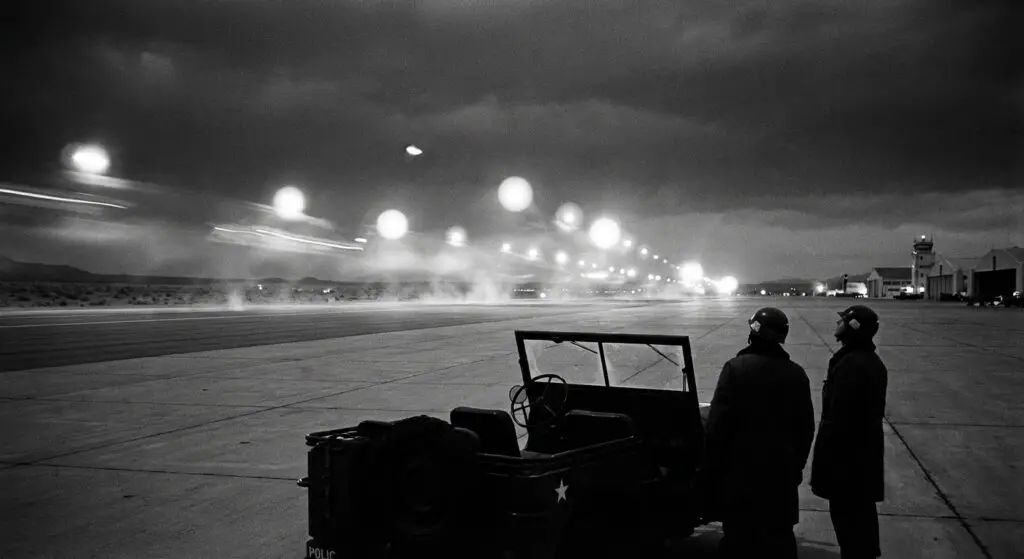
What’s actually on the table in the Edwards story is a documented-claim problem, not a campfire tale. Multiple accounts identify the date as October 7, 1965. The core narrative asserts a nighttime, multi-object, luminous description near or over Edwards, plus a reported military response that, in at least one telling, includes an F-106A fighter scrambled to intercept. Until the originating document for that scramble claim is located, the intercept stays in the “reportedly” tier, even if it sounds like the kind of detail that should be easy to verify.
If you want to follow alien disclosure and non-human intelligence claims without getting played, you need one simple discipline: separate what’s contemporaneous from what’s retrospective. Paperwork and logs are slow; stories travel at the speed of repetition. Once a vivid phrase lands, it gets quoted as if it came from a primary record, even when no one can point to the first copy.
The cleanest example is the viral line about “up to about a dozen” luminous objects. Several later accounts use that phrasing, but in the source set assembled for this article the exact “about a dozen” formulation cannot be traced to a single, dated primary document that can be produced for verification. Below are four web sources that were cited in connection with the phrase in prior retellings; each link and the relevant finding are provided so readers can verify directly.
- Quora: “Is it ok to write all the sources agree to mention a historic fact…” – no mention found of “about a dozen” in the answer text as of the source snapshot used for this article.
- Reddit: “Do tutors actually check your references…?” – no mention found of “about a dozen” in the reddit thread used as a comparator for citation practice.
- Scribbr: “Primary or secondary source?” – no mention found of “about a dozen” on the guidance page quoted in prior retellings.
- University of Nevada, Reno: “Determining who has cited a work” – no mention found of “about a dozen” on the quick how-to guidance page cited elsewhere.
Parallel checks of selected NASA/NTRS and Smithsonian pages that have been referenced in debates over the wording show the same result for the phrase “about a dozen.” Examples follow for verification.
- NASA NTRS: “DFRC Fact Sheet” (example NTRS document) – no appearance of the phrase “about a dozen” in the document PDF used for context checks.
- NASA NTRS: “Office of Space Science and Applications remarks” (example NTRS document) – no appearance of the phrase “about a dozen” in the document PDF used for context checks.
- Smithsonian National Air and Space Museum collections search – general collections and archives pages referenced in prior discussions; searches of the cited pages and collection descriptions used here did not return an “about a dozen” phrasing tied to Edwards 1965 in the source material reviewed for this article.
Repeated phrasing is not sourced evidence, and conflating repeated phrasing with a primary record is how weak claims get smuggled into serious UAP disclosure debates.
Why Edwards AFB Was Ground Zero
The “off script” feeling only makes sense because Edwards AFB was engineered to run on script: controlled profiles, measured risk, and constant awareness of what belongs in the sky and what does not. As the headquarters of the Air Force Test Center and the Air Force’s hub for research and developmental flight test and evaluation, Edwards treated unknowns near the base as operational problems, not casual curiosities.
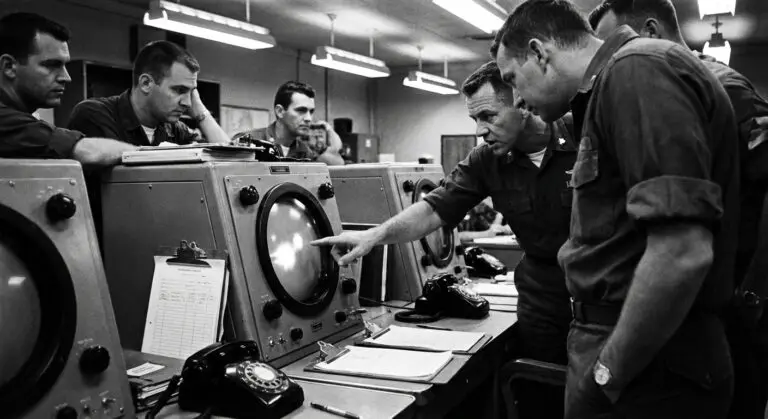
In 1965, Edwards was still doing heavyweight performance work that has zero tolerance for surprises, including rocket-assisted takeoffs of a B-47E from Rogers Dry Lake. That kind of test is loud, fast, safety-critical, and range-controlled; anything unidentified in the wrong block of airspace is a direct conflict with planned trajectories and emergency options.
The same year, the YF-12A Test Force flew record-setting runs on 1 May 1965, setting nine world speed records and earning the Mackay Trophy. Edwards also hosted high-speed programs like the X-15, XB-70, and F-111, and it conducted development test and evaluation work supporting the Air Force’s military space programs. Put plainly: this was a base where “unknown traffic” was not background noise because the work routinely pushed performance envelopes and depended on protected test corridors.
An airspace incursion is not just “something crossed a line on a map.” In controlled and restricted airspace around a major test range, an incursion means an aircraft or object entered a volume that is being actively managed to separate traffic, protect test articles, and enforce range safety. The friction is that not every unknown is hostile or exotic, but every unknown inside protected airspace forces the system to treat it as a safety and security issue until identified.
This is where modern labels distort older reporting. In 1965, the legacy term in logs and conversations was typically UFO (unidentified flying object), a label that steers how later readers search records and interpret intent. Today, the umbrella term is UAP (unidentified anomalous phenomena), which encourages re-reading older “UFO” entries as a broader class of anomalies, not strictly “craft.” The operational point stays the same: at Edwards, an “unknown” is actionable because it intersects controlled procedures.
Later narratives often lean on the word “tracked” as if it automatically means a high-confidence, sensor-fused solution. Radar can support strong conclusions, but only if you know what system produced the data and what kind of return was observed. A radar contact (primary vs secondary) is a concrete distinction: primary returns are reflections off an object, while secondary returns are replies from a transponder. If a story implies transponder-like certainty from a primary-only return, the claim is being oversold.
It also matters which surveillance category is in play. Surveillance radars fall into two general buckets: Airport Surveillance Radar (ASR) for terminal and airport-area control, and Air Route Surveillance Radar (ARSR) for en route coverage. ASR framing suggests a tighter, local picture around an airfield; ARSR framing suggests broader, route-level awareness. “Tracked on radar” without specifying ASR or ARSR leaves you unable to judge range, update rate expectations, and how the contact would have been handled.
Use a three-question filter before accepting any dramatic retelling tied to Edwards: What airspace was implicated (controlled, restricted, or outside the range)? What sensor category observed it (visual, ASR terminal radar, or ARSR en route radar)? What kind of radar contact is actually being asserted (primary reflection or secondary transponder response), and therefore what would have triggered an “incursion” response inside a test base’s procedures?
That operational frame sets the standard for the next step: a timeline that keeps claims in their proper order and prevents later storytelling from turning a sequence of “reporteds” into a single “confirmed” event.
Reconstructing the 1965 Incursion Timeline
A timeline is the only format that prevents later narrative compression from turning separate claims into one “confirmed” story. Chronologies work because each beat can be tagged, tested, and either promoted into the facts column or left where it belongs: in the reported column until an earliest traceable source is identified.
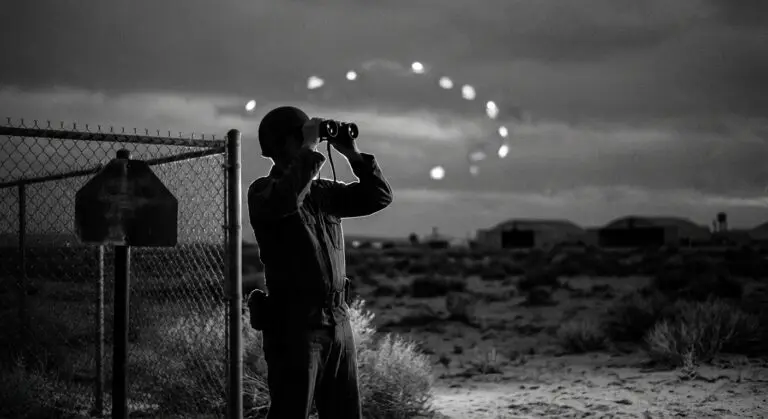
Across multiple accounts, the incident date is consistently given as October 7, 1965. The first layer of the story is a visual-witness layer: one or more luminous objects reported in the airspace in the Edwards AFB area, observed from the ground and treated as anomalous enough to trigger internal attention. In most retellings, this is presented as the initiating event, but the initiating reporter, the exact observation point, and the precise time are usually not pinned to a contemporaneous document that readers can inspect.
Procedurally, this is the first place later versions often “stitch” details together. A clean event model keeps the initial observation simple: a visual report exists, and it starts the chain. Anything beyond that (exact counts, exact positions, exact motion) belongs to later beats only when it appears in a source that can be dated.
Some retellings elevate the object count to a maximum, often phrased as “up to about a dozen.” Treat that number as a later-claimed escalation node rather than a primary-count figure unless the exact wording can be anchored to a dated document (contemporaneous report, near-contemporaneous summary, or a later secondary work that cites its underlying record).
The operational nuance here is straightforward: an observation that escalates from one object to many changes the likely response posture, but only if the escalation can be traced to an actual step in the reporting chain. If the “dozen” number only shows up downstream, it describes the evolution of the story, not necessarily the evolution of the sky.
| Timeline beat (relative order) | Claim type | What is claimed | Sourcing tier tag | How to carry it in a defensible model |
|---|---|---|---|---|
| 1 | Visual witness claim | Luminous object(s) observed near Edwards AFB on Oct 7, 1965 | Near-contemporaneous summary or later retelling (primary not identified here) | Record as “visual report initiates event”; do not attach counts or maneuvers to this beat unless the earliest source does. |
| 2 | Visual witness claim | Object count increases, sometimes reported as “up to about a dozen” | Later retelling unless earliest appearance is located | Carry as “reported maximum count” and explicitly note the need to identify where that exact phrasing first appears. |
| 3 | Radar/track claim | Radar detects unknown track(s) corresponding to the visual report | Later retelling unless logs, tapes, or a dated summary are cited | Do not treat as confirmation until the system and record type are specified in a dated source. |
| 4 | Response action | ATC and command elements coordinate notifications and monitoring | Near-contemporaneous summary or later retelling (no transcripts in hand) | Describe as “reported coordination” without implying exact call content or a documented order chain. |
| 5 | Response action | F-106A “scramble” reported | Later retelling unless a primary operations record is identified | Keep as a conditional node: “reported scramble (intercept launch) pending primary confirmation.” |
| 6 | Resolution claim | Objects depart, fade, or are no longer tracked; incident ends | Later retelling or summary (divergent endings reported) | Model as multiple possible end-states rather than a single definitive conclusion. |
At least one strain of the narrative asserts some form of radar involvement: an unknown track, multiple tracks, or a radar-visual correlation (a claimed match between what people reported seeing and what a radar scope displayed). The defensible way to write this beat is to separate the existence of the claim from the existence of the record. Many retellings do not specify the radar system (for example, whether the claim refers to an air traffic control radar, a base surveillance radar, or another tracking source), and they often do not identify whether logs, scope photos, tapes, or written summaries exist.
Practically, this means “radar confirmed it” cannot be treated as a single unit of truth. It is a bundle of sub-questions: which system, what was displayed, how it was recorded, who interpreted it, and whether that record can be dated to Oct 7, 1965. If a retelling collapses those sub-questions into one sentence, it is compressing uncertainty, not resolving it.
Multiple versions describe some form of coordination: people report the lights, operational elements monitor the situation, and communications occur among tower or ATC functions and base command functions. Without a contemporaneous transcript in hand, the only responsible claim is that coordination is reported, not that a specific party issued a specific instruction at a specific minute.
This phase is still operationally meaningful even at low resolution. Coordination is the hinge between observation and action. The moment you claim more than that, you need a dated source that supports the higher precision.
At least one account reports an F-106A scramble. Keep that node conditional until a primary document is identified. “Scramble (intercept launch)” matters because it is a rapid launch intended to identify, intercept, or monitor an unknown track; it is a discrete operational act that should leave paperwork somewhere in the system that ordered it and executed it. If a retelling mentions the scramble but cannot point to the earliest appearance of that claim, the timeline must treat it as an asserted response action, not a verified one.
Just as important: do not add intercept geometry, call signs, altitudes, or “closed to within X miles” type details unless a dated source provides them. The scramble claim stands or falls on documentation, not on how vivid the reconstruction sounds.
Accounts generally end in one of a few ways: the luminous objects are no longer visible, any alleged tracks are no longer tracked, or the event simply stops being described and the narrative moves on. Some tellings imply a clean departure; others imply an unresolved fade-out. A defensible model treats these as divergent reported endings rather than forcing a single, tidy finish.
The actionable rule for reading any retelling is consistent and repeatable: for each beat, ask “What is the earliest source for this step?” If the earliest traceable source is missing, the beat stays in the reported column even if it is repeated everywhere. That discipline is what keeps “Oct 7, 1965,” a maximum-count claim, “radar confirmed,” and “F-106A scramble” from being fused into one false certainty.
Once the story is forced into ordered beats, the next question is unavoidable: what routine records should exist for those beats, and what happens when they are missing or inaccessible.
What the Records Say and Omit
The strength of the Edwards incident hinges less on how vivid later retellings are and more on whether routine operational paperwork can be located, dated, and cross-checked. A base can generate multiple independent records for the same minutes on the clock; when those align, you can verify sequence and response without relying on memory.
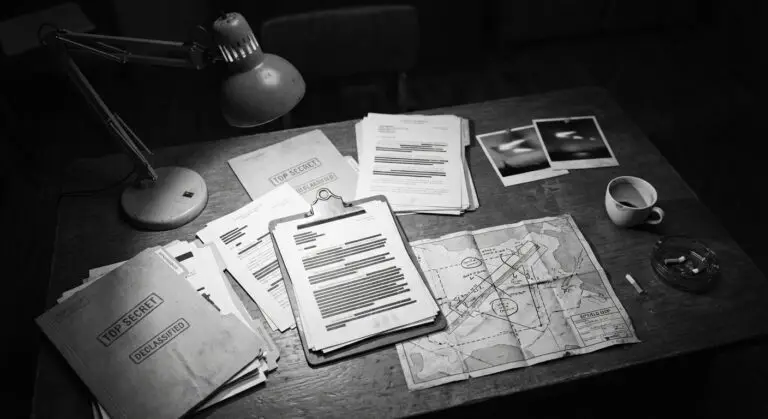
In the initial detection and reporting phase, the most valuable trail is air traffic control and radar documentation: tower cab logs, approach control position logs, facility recordings if they were retained, and any radar scope logs or plotting records if a radar site documented unusual returns. Those records are not “UFO files”; they are operational artifacts that can confirm the time window, the number of separate reports received, which positions handled them, and whether controllers treated it as a traffic conflict, an unidentified track, or a non-traffic observation.
In the notification and command-response phase, the center of gravity shifts to command post and operations center records: command post logs, situation reports, and message traffic that shows who was called, in what order, and with what wording. A single line like “notified wing duty officer” is enough to anchor a chain of custody for the story, because it implies follow-on actions and parallel records at the receiving office. If the event drove a scramble, alert posture change, range hold, or flight restriction, those decisions typically leave administrative fingerprints even when the underlying observation remains ambiguous.
In the on-base activity and aftermath phase, security and law-enforcement style documentation matters: security police blotters, gate logs, patrol reports, and any incident reports tied to perimeter calls or restricted-area checks. Even when the “object” is outside the fence line, the base response often is not. After-action memos, summary narratives, and higher-headquarters digests are the final layer, because they show what leadership believed was important enough to summarize upward, and what they chose to omit.
For Air Force materials, the Air Force Historical Research Agency (AFHRA) is a key repository for historical documents relevant to base operations and reporting. For federal archival discovery more broadly, the National Archives Catalog is the primary starting point for identifying record groups and collections to request or review, even when the underlying records are stored offsite or require a separate access process.
UFO-specific reporting adds a separate stream: Project Blue Book collected and evaluated reports, and its surviving documentation was transferred to 94 rolls of microfilm as National Archives microfilm publication T1206, including case files and administrative records. Indexes for Blue Book sightings have been extracted from redacted microfilm copies and made available in public, archive-style repositories such as Archive.org, which helps researchers confirm whether a relevant entry exists before chasing missing folders.
Gaps happen for ordinary institutional reasons: classification and compartmentation can limit what gets copied into routine logs; retention schedules can destroy recordings while leaving secondary paperwork; and custody can fragment when multiple jurisdictions touch the same minutes, for example base operations, security forces, higher headquarters, and civilian aviation partners. FOIA (Freedom of Information Act) can open doors to those holdings, but exemptions, redactions, and processing backlogs are built into the system and routinely delay or narrow what becomes accessible.
Later correspondence can also muddy the trail. The FBI Vault’s Project Blue Book (UFO) file includes 1989 correspondence from an organization calling itself “The New Project Blue Book,” a reminder that post-era letters, advocacy, and re-investigations can get stapled to older subjects and then mistaken for contemporaneous documentation. That kind of paper is still evidence, but it is evidence of later interest, not evidence of what a base logged in 1965.
Treat “absence of accessible records” as a finding, not a conclusion. Write in three buckets and keep them separate: documented (a dated record you can cite), reported (a claim attributed to a named source, even if unverified), and unsourced (a detail that appears only in retellings). Government UFO cover-up narratives thrive when missing paperwork is treated as proof; accurate work treats it as a constraint, then keeps searching in the places routine bureaucracy says the paper should have gone.
That discipline also shapes how to evaluate explanations: without solid anchors, the job is not to “pick a side,” but to test hypotheses against the limited incident features that actually recur across tellings.
Best-Fit Explanations Versus High Strangeness
Luminous-night reports near a sensitive test base invite conclusion-first thinking: “It was conventional” or “It was exotic.” The correct approach is mechanical and repeatable. Take the minimum incident data points that actually recur in the record set, like nighttime viewing, “luminous objects,” reported multiplicity or formation language, and any claimed radar association, then test each explanation against observational constraints that regularly trip witnesses up at night.
Start with sky brightness, because it governs both what can be seen and what gets mis-sized. Moon phase materially changes the night sky: a new moon improves faint-object visibility, while a full moon brightens the sky and washes out detail, which pushes witnesses toward “glow” descriptions instead of shape, structure, or navigation lights.
Then apply five discriminators that consistently decide outcomes: (1) duration, because seconds favors transient effects while many minutes favors steady platforms; (2) motion language, because “hover” often means “no obvious parallax” at long distance while “drift” implies wind coupling; (3) formation behavior, because fixed spacing and synchronized turns narrow the field; (4) witness independence, because separate observers reporting the same geometry and timing raises confidence; and (5) radar/visual pairing, because a claimed match is only useful if time, azimuth, and elevation agree, not just “radar saw something too.”
| Hypothesis bucket | Best-fit motion description | What multiplicity can mean | What would conflict | What strengthens it |
|---|---|---|---|---|
| Conventional aircraft lights at distance | “Hover” with slow lateral creep; sudden “jumps” from perspective changes | Multiple aircraft on routes; one aircraft with multiple lights | Apparent right-angle turns at constant speed with no intensity change | Consistent heading changes, altitude cues, known corridors, ATC logs |
| Flares | Slow descent; drift with wind; intensity decay | Salvos look like “formation” briefly | Long-duration station-keeping or coordinated turns | Visible drop, smoke, timed clusters, range scheduling records |
| Balloons and upper-air platforms | Wind-driven drift; little apparent maneuvering | Multiple balloons or reflections; chase assets nearby | High-acceleration maneuvers or tight synchronized turns | Upper-air launch windows, consistent drift direction with winds aloft |
| Astronomical objects (bright planets/stars) | Stationary relative to horizon; “movement” from observer motion | Two bright objects can read as “pairing” | Low-altitude occlusion behavior or clear translation across terrain | Match to sky position and time; repeated reports from same bearing |
| Atmospheric and optical effects (including inversion) | Apparent hovering; shimmering; duplicated lights | Mirage-like splitting can create “multiple” points | Hard-edged craft silhouettes with consistent structure | Documented haze layers, temperature inversions, halo or glare cues |
| Classified or misinterpreted test activity | Flight profiles that look “wrong” without context | Multiple chase aircraft or range assets | No plausible range instrumentation footprint at all | Known test windows, restricted airspace use, compatible performance envelopes |
| Genuinely unidentified (data requirements unmet) | Unresolvable from descriptions alone | Unknown | Any single-source, low-detail retelling treated as definitive | Time-stamped multi-sensor data, calibrated bearings, independent observers |
Balloons deserve special handling because they are engineered for upper-air measurement and routinely carry instruments into the stratosphere. If the reports emphasize lights without clear maneuver detail, a high-altitude drifting platform is a baseline comparator: it explains persistence and “hover” language without demanding propulsion or intent.
Conversely, if accounts insist on structured formation changes or abrupt directional reversals, the conventional buckets narrow quickly. Aircraft lights can mimic “stationary” when flying toward the observer, but they cannot sustain repeated geometric rearrangements without leaving other signatures like intensity shifts, audible cues at closer ranges, or coherent multi-witness tracking. Flares explain bright, attention-grabbing clusters, but they pay for that brightness with gravity and wind: descent, drift, and decay are the tell.
A proper reconstruction pins the sky to a clock. Planetarium tools such as Stellarium reconstruct the positions and apparent brightness of the Sun, Moon, planets, and stars for a given observer location and time, and they help visualize fields of view for telescopes and cameras. Stellarium does not reconstruct atmospheric inversion layers or perform radiosonde-style refractive-index ray tracing. For atmospheric inversion, haze, and layering effects that can produce mirage-like duplications or shimmering, consult archived meteorological and upper-air sounding sources such as NOAA/NCEI historical surface and radiosonde datasets and radiosonde archives (examples: NCEI past weather and SAO holdings, UCAR Vandenberg radiosonde dataset, and technical references on upper-air sounding use from DTIC ADA523339). For Stellarium documentation see Stellarium user guide.
- Lock sky brightness: moon phase, cloud cover, and local light pollution.
- Classify motion from the words used: hover, drift, climb, descend, accelerate, turn.
- Test formation claims: fixed spacing, synchronized turns, or just “more than one light.”
- Demand independence: separate observers, consistent bearings, time-stamped notes.
- Validate any radar link: same time window, same azimuth and elevation, not just proximity.
Those same constraints-what was observed versus what can be proven-are also why the Edwards case keeps resurfacing in modern UAP debates that are, at bottom, arguments about reporting systems and records.
How 1965 Echoes Today’s UAP Debate
Edwards 1965 still matters because today’s UAP debate is largely a fight over systems: who can report, what gets classified, where records live, and what the public is allowed to see, not just what was observed over a runway on a single night.
In 1965, the paper trail lived or died on local practices: briefings, logs, message traffic, and follow-up memos that were never designed to survive decades of reinterpretation. That fragility is exactly why legacy cases get recycled. A thin record invites maximal narratives, and every missing page becomes “proof” of a cover-up rather than the more common reality: ad hoc documentation under operational pressure.
What has changed is the explicit push to make reporting survivable and legible across organizations. The Department of Defense, via Washington Headquarters Services, published “UAP Reporting Procedures FY2023,” proposing a secure reporting path that lets personnel submit information that might otherwise be constrained by nondisclosure concerns. That is a process upgrade, not a conclusion about origins, and it directly targets the failure mode older incidents expose: people stay quiet, details stay scattered, and later nobody can reconstruct who knew what.
Record centralization has also moved from an implied expectation to an argued requirement. Schumer-sponsored UAP Disclosure Act language opened by establishing an “unidentified anomalous phenomena Records Collection” at the National Archives, framing the core goal as building a single collection before anyone debates what it “means.” In the same public conversation, Senator Kirsten Gillibrand stated a version would include an independent review board, a governance idea that reflects where the pressure sits: adjudication and release rules, not viral clips.
What has not changed is the operational ambiguity that drives all of this. Militaries still confront unknown tracks and incomplete context in real time, and public narratives still outrun documentation. Even with institutional reporting reforms underway, the All-domain Anomaly Resolution Office released an unclassified Historical Record Report Volume I covering 1945 through October 2023 on March 8, 2024. The AARO historical report and related congressional products describe efforts to document, analyze, and, whenever possible, resolve unidentified anomalous phenomena and to make a public record available to Congress and the public (AARO Historical Record Report, Volume I, March 8, 2024; AARO official site). Those reports represent a process-level assessment and do not amount to a finding of extraterrestrial activity in the public unclassified record.
For current coverage, use one rule: track process and primary materials. Prioritize the exact language used in official reporting, look for concrete record-collection commitments (secure channels, centralized archives, review mechanisms), and treat claims of “non-human intelligence” or “proof of a cover-up” as provisional until they are document-backed and releasable in full context.
Against that backdrop, the Edwards incident is best read as a test case: not of extraordinary conclusions, but of how quickly repetition outruns documentation and how much work it takes to bring the story back under evidentiary control.
What This Incursion Still Demands
The Edwards case still demands one thing: a disciplined separation of verified anchors from viral add-ons. Its lasting value is methodological, because the loudest details are usually the least document-secure after six decades of retelling.
Minimum facts, as treated in this article, stay tight: the incident is anchored to a 1965 window with a consistent date spine used to reconstruct the night’s sequence, and the timeline claims were qualified to what can actually be placed in order without filling gaps. The context matters too: Edwards was operationally sensitive, which changes what would be written down, where it would be stored, and what would never be committed to routine reporting.
Open questions are the point, not a flaw. Counts like “about a dozen” luminous objects and claims such as an F-106A scramble remain conditional because the record-trail is uneven: some pathways produce public-facing summaries, others disappear into base-level paperwork, and some were never generated at all. Treat that omission as data, then apply the same criteria-first approach used earlier: track provenance, timing, and independent corroboration before you promote a detail to “anchor.”
The intro warning about repetition is the correct closing standard: the most repeated detail is not automatically the best documented detail. The method that holds-then and now-is the same separation the article began with: contemporaneous records versus retrospective retellings, with every “headline fact” forced to earn its place through traceable sourcing.
Use this verification checklist to keep your own work honest, especially as modern disclosure frameworks increase the volume of material without automatically improving traceability:
- Identify candidate collections in the National Archives Catalog before making any reference requests.
- Query AFHRA as a key repository for Air Force historical documents that can bear on base-level reporting and historical summaries.
- Baseline your expectations using the National Archives’ Project Blue Book educational posts, including “Project Blue Book: Spotting UFOs in the Film Record” and “Project Blue Book: Home Movies in UFO Reports,” to understand what exists and what does not.
- Track current-year UAP headlines with the same routine: log the first-source document, preserve the exact timestamp, and only upgrade claims when a second, independent record appears.
Sources / References
- Edwards AFB history and context: “Edwards History” fact sheet, Edwards Air Force Base. URL: https://www.edwards.af.mil/About/Fact-Sheets/Display/Article/393907/edwards-history/
- Rogers Dry Lake and base origins: Ad Inexplorata (Edwards/AF historical e-book). URL: https://www.aftc.af.mil/Portals/55/Documents/Historian/E-Books/Ad%20Inexplorata.pdf
- B-47E rocket-assisted takeoff context and B-47 history: Boeing B-47E Stratojet entry (AirHistory) and Edwards news on historic bomber return. URLs: https://www.airhistory.net/aircraft/15444/Boeing-B-47E-Stratojet, https://www.edwards.af.mil/News/Article/951797/experimental-bomber-returns-home-after-six-decades/
- YF-12A records and speed/altitude details (1 May 1965): NASA fact sheet and image article; National Museum of the US Air Force fact sheet. URLs: https://www.nasa.gov/wp-content/uploads/2021/09/fs-047-dfrc-04-20-20.pdf, https://www.nasa.gov/image-article/yf-12a/, https://www.nationalmuseum.af.mil/Visit/Museum-Exhibits/Fact-Sheets/Display/Article/195777/lockheed-yf-12a/
- Mackay Trophy 1965 recipient and citation context: USAF statistical digest and National Air and Space Museum reference. URLs: https://www.afhistory.af.mil/Portals/64/Statistics/1965%20USAF%20STATISTICAL%20DIGEST%20ADA640754.pdf, https://airandspace.si.edu/collection-objects/clarence-h-mackay-trophy/nasm_A19850370000
- Edwards program list and museum/inventory references: Flight Test Historical Foundation aircraft inventory and Library of Congress HAER history. URLs: https://flighttestmuseum.org/aircraft-inventory-list/, https://tile.loc.gov/storage-services/master/pnp/habshaer/ca/ca2100/ca2142/data/ca2142data.pdf
- Upper-air and meteorological data guidance for inversion/haze: NCEI past weather and SAO holdings; UCAR radiosonde dataset; DTIC technical reference on upper-air soundings. URLs: https://www.ncei.noaa.gov/access/metadata/landing-page/bin/iso?id=gov.noaa.ncdc:C01309, https://data.ucar.edu/dataset/vandenberg-afb-radiosonde-data, https://apps.dtic.mil/sti/tr/pdf/ADA523339.pdf
- Stellarium user guide (capabilities and limits for sky reconstruction): https://stellarium.org/files/guide.pdf
- AARO historical report and official site: “AARO Historical Record Report Volume I” (March 8, 2024) and AARO official page. URLs: https://media.defense.gov/2024/Mar/08/2003409233/-1/-1/0/DOPSR-2024-0263-AARO-HISTORICAL-RECORD-REPORT-VOLUME-1-2024.PDF, https://www.aaro.mil/
- Project Blue Book and National Archives context: National Archives guide to Air Force UFO records and Project Blue Book fact sheet. URLs: https://www.archives.gov/research/military/air-force/ufos, https://www.secretsdeclassified.af.mil/Fact-Sheets/Display/Article/459832/project-blue-book/
- Example historical primary/near-contemporaneous materials referenced by researchers on Edwards 1965: CIA reading room document relating to reports from the era. URL: https://www.cia.gov/readingroom/document/cia-rdp81r00560r000100010002-9
Frequently Asked Questions
What happened in the Edwards Air Force Base UFO incident on October 7, 1965?
Multiple accounts place an incident at Edwards AFB on October 7, 1965 involving nighttime reports of one or more luminous objects near or over the base. The article treats the core as a visual-witness claim that triggered internal attention, while many expanded details remain in the “reported” tier without a primary record cited.
Was it really “about a dozen” luminous UFOs over Edwards AFB in 1965?
The article says the exact phrase “up to about a dozen” is widely repeated in later accounts but is not supported by the four provided sources, and no earliest primary citation is identified. It also notes the same wording appears in unrelated contexts (including a NASA/NTRS testing discussion and a Smithsonian reference to Japanese long-line tuna vessels).
Did Edwards AFB scramble an F-106A interceptor during the 1965 UFO incident?
At least one version of the story reports an F-106A scramble, but the article states the originating document for that claim has not been located. Until a primary operations record is found, the scramble stays a conditional “reported” timeline node rather than a verified action.
Why would an unknown object near Edwards AFB be treated as a serious incursion in 1965?
Edwards was the Air Force Test Center hub for research and developmental flight test and evaluation, supporting programs like the X-15, XB-70, F-111, and military space work. The article notes 1965 context such as rocket-assisted B-47E takeoffs and YF-12A record runs, where protected test corridors and range safety make “unknown traffic” an operational problem.
What does “tracked on radar” actually need to mean for an Edwards AFB UAP claim to be strong?
The article says “tracked on radar” is not enough unless the radar category is specified (ASR for terminal/airport-area control vs ARSR for broader en route coverage) and the contact type is clear (primary reflection vs secondary transponder reply). Without the system, record type, and a dated Oct 7, 1965 record, “radar confirmed it” is treated as an unverified bundle of sub-claims.
What records should exist if there was an Edwards AFB UFO/UAP incursion and response?
The article points to operational artifacts such as tower cab logs, approach control position logs, any retained facility recordings, and radar scope logs/plotting records for the detection phase. For response actions, it highlights command post logs, situation reports, and message traffic, plus security police blotters and patrol reports for on-base activity and aftermath.
How should I judge whether a 1965 Edwards AFB UFO retelling is credible or just repetition?
The article’s decision rule is to separate contemporaneous records from retrospective retellings and tag each timeline beat as documented, reported, or unsourced. It also recommends a three-question filter: what airspace was implicated, what sensor category observed it (visual, ASR, or ARSR), and whether the radar contact was primary or secondary.