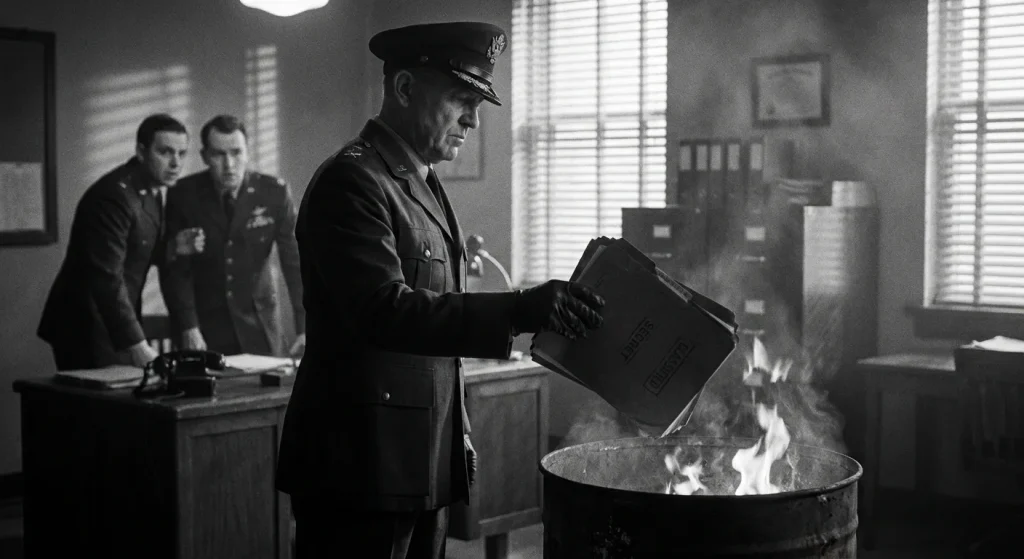
Claims that Gen. Hoyt S. Vandenberg ordered a UFO-related report burned in 1948 have circulated for decades; this article examines what the surviving record shows and what kind of evidence would be needed to move the allegation from rumor to documented history.
Smart people disagree because they are arguing from different kinds of material: what the surviving record actually contains versus what later retellings insist once existed. The stakes are practical, not theatrical. A destruction order attributed to the Air Force Chief of Staff, a post Vandenberg assumed on April 30, 1948, is a test of record-keeping integrity, chain-of-custody discipline, and the credibility of any official history built on whatever files remain.
One reason the argument keeps resurfacing is terminology: Unidentified Anomalous Phenomena (UAP) is the government’s umbrella label for unresolved observations across domains, which means yesterday’s “UFO” folders get re-litigated inside today’s UAP disclosure debates using a broader, more institutionally standardized frame.
There is a documented modern reference point: the All-domain Anomaly Resolution Office published Report on the Historical Record of U.S. Government Involvement with Unidentified Anomalous Phenomena, Volume 1 (2024). AARO, AARO Historical Record Report: Volume 1 (2024) [PDF]. There is also a scale problem that makes “missing paperwork” matter: the U.S. Air Force investigated 12,618 reported UFO sightings between 1948 and 1969 (USAF fact sheet, Unidentified Flying Objects and Air Force Project Blue Book). And the timeline is not speculative: Project SIGN is widely described as the Air Force’s first formal UFO investigation effort beginning in late 1947 and operating into 1948, later renamed Project GRUDGE (Air Force historical document summarizing Project SIGN/HT-304).
This article runs on one operating rule: separate what is documented in the historical record from what is alleged in later accounts, then judge the burn-order story by the kind of evidence that would actually verify an order and its execution. You will leave able to name the documented baseline, state what the burn-story alleges, and recognize what proof would move it from allegation to history.
1948 Pressure, Power, and Priorities
Senior attention to UFO reports in 1947-1948 was a rational outcome of Cold War threat-assessment incentives, not a shortcut to “aliens.” A brand-new independent Air Force was building air defense warning, intelligence filters, and message discipline while facing a live possibility that an unknown airborne object could be foreign technology, a misidentified U.S. program, or a reporting artifact that still signaled a vulnerability. In that environment, leadership could not afford to treat a high-volume stream of anomalous reports as entertainment; it was a potential national-security signal that had to be triaged, reduced, and either explained or escalated.
Hoyt S. Vandenberg sat squarely in that decision path: when the Air Force became independent in September 1947, he was Vice Chief of Staff, and on April 30, 1948, he became Chief of Staff of the U.S. Air Force, succeeding Gen. Carl Spaatz. Those roles put him at the junction where sensitive assessments, intelligence judgments, and policy priorities were reconciled before becoming institutional decisions.
The most telling contemporaneous signal is the September 23, 1947 Twining memo (Twining memo of Sept. 23, 1947, Air Materiel Command), which described the “flying disc” phenomenon as “something real and not visionary or fictitious.” Twining memo scan, Wikimedia Commons. That line is often misunderstood. It did not settle cause; it asserted that enough reports had consistent characteristics to justify formal handling inside a threat-driven bureaucracy. The practical implication is that the Air Force posture was: collect first, evaluate rigorously, and keep conclusions aligned with defense priorities, even if the end state was “unresolved.”
That posture quickly produced structure. Project SIGN was established on Dec. 30, 1947 as Special Project HT-304, initially associated with Project SAUCER, to collect, collate, evaluate, and investigate sightings after the 1947 wave. See Air Force history summary of SIGN/HT-304. The early operational window was 1948, when reports were being centralized, compared across cases, and packaged into products that could move upward through intelligence channels, especially when a report implicated air defense risk or potential foreign capability. Project SIGN later evolved into Project GRUDGE, reflecting the same institutional need: impose order on noisy data without overstating conclusions.
The key takeaway for any later claim about a disputed “high-level estimate” is procedural, not sensational: 1948 created exactly the kind of routing, review, and prioritization pipeline where an extraordinary assessment could be drafted, briefed upward, and then judged against threat priorities, messaging risk, and evidentiary standards. That same pipeline is also where the burn-order story places its pivotal moment: an alleged senior-level decision about what should and what should not remain in circulation.
What Was Supposedly Burned
The “burned report” claim endures because it compresses a messy record problem into a single, satisfying act of suppression: one decisive order that supposedly explains why the early Air Force inquiry never left behind a definitive, high-level conclusion. It is the simplest narrative that accounts for an absence, and that simplicity is exactly what makes it so sticky.
Secondary accounts describe Project SIGN personnel producing a major written assessment, briefing it up the chain to senior Air Force leadership (most commonly tied to Gen. Hoyt Vandenberg), and then seeing it rejected. In the same retellings, the rejection is paired with an instruction to remove the document from circulation, described variously as a recall or outright destruction, and commonly paraphrased as the report being “burned,” “destroyed,” or “recalled.”
Those same secondary UFO histories commonly give the purported product a name: Estimate of the Situation, framed as a substantial Project SIGN-era report repeatedly described as stamped “TOP SECRET” (a reported descriptor, not a verified surviving marking). The controversy hinges on that gap: despite decades of repetition, there is no publicly verified surviving copy to examine, which keeps the claim permanently in the realm of reconstruction rather than document-based adjudication.
In AARO’s historical framing, Project SIGN runs from January 1948 to February 1949 and later evolves into Project GRUDGE. The “burned report” allegation is anchored to that 1948 to early 1949 period: it is not a later-era rumor about Blue Book, and it is not a generic claim about decades of UAP paperwork. It is a specific story about what SIGN allegedly produced and what happened to it inside that narrow operational window.
| Category | Consistent across retellings | Varies across retellings |
|---|---|---|
| Document identity | Project SIGN allegedly produced an “Estimate of the Situation,” often characterized in secondary accounts as a thick, “TOP SECRET” report. | Whether the “estimate” was a single discrete report versus a compiled briefing package, and how definitively it is framed as endorsing non-human intelligence versus cataloging unresolved phenomena. |
| Handling path | A briefing to senior Air Force leadership is central, followed by rejection. | Exact date of the briefing, who physically carried or presented the material, who else saw it, and how widely it was distributed before the decision. |
| Destruction language | A directive to remove it from circulation is a core element. | The verb set and procedure: “burn,” “destroy,” “recall,” and the implied mechanics of how that instruction was executed. |
Modern document-destruction disputes show the same dynamic in real time: one directive gets paraphrased across tellings as “burn,” “shred,” or “destroy,” even when people are pointing at the same underlying instruction. That verb drift is a normal artifact of repetition, not proof of either wrongdoing or fabrication.
Taken literally, the “burned report” claim asserts three concrete things: a real SIGN-era report (often labeled Estimate of the Situation), a real routing path culminating in a rejection decision, and a real destruction or recall directive tied to that decision. If it happened, it leaves a paper trail in the kinds of places agency history reviews and operational memoranda typically capture: internal memoranda, disposition-related paperwork, and memo-for-record style documentation that reflects who ordered what, and when.
Tracing the Source Trail
You cannot “believe” a burn order into existence; you can only document it. A claim tied to the Air Force Chief of Staff in 1948 has to resolve to paper that can be independently located, dated, and cross-checked against other records. If it does not, it stays in the category of an anecdote, no matter how often it gets repeated. Gen. Hoyt S. Vandenberg became Chief of Staff on April 30, 1948, which is exactly why senior-level record trails are the credibility floor for any order attributed to him, and why an official USAF biography reference is only a starting point rather than proof of any specific directive.
UFO history is crowded with citations that look like documentation but do not cash out into a retrievable record. The simplest way to keep your footing is to rank sources by two variables: proximity to 1948 and traceability.
Top rung: contemporaneous records include dated memos, routing slips, message traffic, registers, and file copies created inside government offices at the time. These can be checked for originating office, distribution, and file location. Middle rung: later recollections include memoir passages and retrospective interviews, which can be valuable but have to be anchored to an underlying file, a document number, or a specific repository holding. Bottom rung: tertiary internet summaries recycle the claim without adding a stable citation, often swapping “a document existed” for “a document is findable.” The burn-order story lives or dies on whether it clears the top rung.
A real destruction directive does not present as a floating sentence in a book excerpt. It shows up as an artifact of administration: a memo-for-record (a short internal memo written to capture a decision), an outgoing correspondence register entry, a routing log showing who received and returned a document, or a records disposition note that identifies what was destroyed, by whom, and under what authority. Strong support is also redundant: the same action echoes across multiple files because the same document was moved, logged, summarized, and acknowledged by more than one office. If a burn order is real, the record trail has edges you can grab, not just a narrative center.
For any 1948 claim tied to senior Air Force leadership, a relevant starting point is the U.S. National Archives and Records Administration: NARA Record Group 340, the Records of the Office of the Secretary of the Air Force (OSAF). RG 340 matters because it is where senior-level Air Force records are organized as an archival series, which is the difference between “someone said it happened” and “this office created and filed something about it.”
CIA CREST matters for a different reason: it proves inter-agency handling can be visible, including declassification traffic. CREST includes material titled “AIR FORCE REQUEST TO DECLASSIFY CIA MATERIAL ON UNIDENTIFIED FLYING OBJECTS (UFO),” which demonstrates that requests and responses between agencies can survive as discrete, retrievable records.
AARO’s historical report is a benchmark for what official sourcing looks like under pressure. AARO’s mandate, created through National Defense Authorization Act requirements, included producing a comprehensive historical report on UAP-related data. Readers can argue with conclusions; the sourcing standard is still the point. FRUS (Foreign Relations of the United States) is another example of an official documentary series, even though its existence does not imply it contains anything about a specific burn-order claim.
The Freedom of Information Act (FOIA) is how the public requests federal agency records, converting “there was an order” into “produce the dated document or the file entry that reflects it,” even though exemptions and redactions can limit what comes back.
Publicly available documents currently do not show a contemporaneous, attributable destruction order signed by Gen. Vandenberg that meets archival provenance standards. A fragmented excerpt that references “an order” without attributing it to Vandenberg is not the same thing as a sourced directive; a Roswell summary that does not cite a 1948 destruction instruction is not relevant proof. More importantly, absence in a fragment is not absence in the archive. Fragments are pieces; archives are systems. Credibility attaches to record-group identifiers, document dates, and independent corroboration. If the next viral version cannot supply those three, treat it as unproven.
How Records Vanish in Practice
Even when a dramatic destruction order cannot be documented, the underlying question remains the same: what mechanisms plausibly separate an event from an auditable paper trail. That requires looking at how bureaucracies actually handle sensitive material when priorities shift, offices move, and files are carved up by access rules.
“Vanished” documents usually disappear the boring way: they get restricted, split across compartments, retired under a retention rule, or quietly “cleaned up” during a move. Deliberate erasure is the exception because it requires coordination. A claim like “burned on order” describes a managed action with an originator, recipients, and compliance. “Lost, misfiled, never archived” describes friction inside normal systems, especially when those systems were built to limit visibility in the first place.
Classification is the access and handling regime that determines who can lawfully see, copy, file, transmit, or destroy a document based on its sensitivity and need-to-know, and compartmentalization narrows that circle further by slicing information into controlled channels. Executive Order 10290 later formalized this logic across the executive branch by establishing minimum standards for classification, transmission, and handling of security information. The operational effect is straightforward: the more restricted the channel, the fewer clerks, registries, and archives ever touch the paper, which makes later retrieval harder even without a conspiracy.
A records disposition schedule is the rulebook that says how long a record is kept, where it goes, and when it is destroyed under authority. Modern Air Force Records Disposition Schedules make the authorization chain explicit: organizations are required to contact an Agency Records Officer to obtain disposition authority for records. Procedures have evolved since the late 1940s, but the core concept, retention rules paired with authorized destruction, did not appear out of nowhere; large bureaucracies do not store everything forever, and they do not destroy everything at whim.
Routine cleanup is people reducing clutter inside allowed rules: duplicative copies tossed, drafts consolidated, working files reorganized, and sensitive annexes kept separate. Oversight evasion is different because it requires intent plus a traceable path: someone decides something must not be findable and acts to break the normal chain of custody. When that happens, the best-confirming artifacts are often indirect, including disposition forms, internal memoranda, and history files that preserve how decisions were processed.
Conceptually, “burned on order” implies minimum administrative exhaust: a directive (written, verbal with a memo-for-record, or routed instruction), identified recipients, and some record that the instruction moved through channels, such as registers, routing slips, or logs that later surface through FOIA releases and document repositories. “Lost/misfiled/never archived” implies the opposite: no single point of control, fragmented filing across offices, and eventual non-transfer into an archival series.
- Identify who had original authority to order destruction and who received the instruction.
- Locate the authorizing framework, a schedule, directive, or delegated records authority, not just a story.
- Check archival pathways: NARA maintains guides for Air Force command records (for example, Record Group 342), proving formal retention and transfer processes exist even when gaps occur.
Congress Tries to Close the Loopholes
The unresolved mechanics of record survival are not just a historian’s problem; they are a governance problem. Modern UAP disclosure policy aims to reduce the chance that UAP-related material can quietly fall into disconnected filing systems or program-specific channels with no durable audit trail. One concrete statutory requirement was that federal agencies review, identify, and organize UAP records by Oct. 20, 2024 and prepare for transfer obligations. See the FY2024 National Defense Authorization Act (H.R. 2670) and NARA guidance on implementation: FY2024 NDAA (H.R. 2670) and NARA guidance on UAP records collection and transfer. NARA required agencies to transfer digital copies of identified UAP records by Sept. 30, 2025 where they can be publicly released.
The All-domain Anomaly Resolution Office is Congress’s statutory answer to fragmented handling: a single office meant to receive, correlate, and analyze UAP-related inputs across defense and intelligence equities. Centralizing intake and requiring inventories increases the odds that disposition paperwork, routing logs, and registers that would corroborate or contradict a 1948 destruction instruction are identified as records rather than treated as ephemeral working material.
Whistleblowers, Media, and Momentum
Public attention shapes how claims get treated, but media amplification does not substitute for archival proof. Sworn testimony and oversight events are important because they create formal, attributable records that can be cross-checked against contemporaneous files. For example, David Grusch testified under oath on July 26, 2023 before a House Oversight and Accountability subcommittee; sworn oversight testimony is a preserved public record with a clear procedural context.
That said, headlines and social posts can conflate oversight allegations with documentary proof. A protected disclosure is a procedural protection for the reporter; it is not an archival verification of the underlying allegation. Researchers should prioritize contemporaneous administrative artifacts over media summaries when assessing whether a 1948 order left an auditable trail.
The House Oversight and Accountability Committee has published materials addressing UAP topics; see, for example, committee documents and hearing records including “UNIDENTIFIED ANOMALOUS PHENOMENA: IMPLICATIONS ON NATIONAL SECURITY, PUBLIC SAFETY, AND GOVERNMENT TRANSPARENCY” (House Oversight and Accountability Committee, HHRG-118-GO12-20241113-SD003, Nov. 13, 2024): HHRG-118-GO12-20241113-SD003.pdf. Such materials can reference historical claims without themselves providing contemporaneous archival corroboration for a specific 1948 destruction order.
- Separate sworn, on-the-record statements from everything else.
- Classify protected allegations as protected allegations, not verified findings.
- Quarantine retrospective lore until it is supported by primary documentation.
What the Burn Story Really Means
The Vandenberg burn allegation is best understood as a test of institutional record integrity under 1948-era pressure, not a standalone proof of non-human intelligence. That framing keeps the claim in the only place it can be responsibly evaluated: records, routing, and provenance, rather than narrative force.
The most plausible takeaway, given the institutional incentives described earlier, is that classification, reputation-management, and bureaucratic triage can narrow what gets written down, widely distributed, or retained. The complication is that mundane bureaucracy and deliberate suppression produce the same public-facing outcome: a missing paper trail.
The unproven core remains narrow: the claim alleges an Estimate of the Situation as a purported, non-verified surviving document, and the source trail does not yet meet the provenance standards that separate “circulating story” from “auditable record.” Benchmark that uncertainty against the current official baseline: DoD/AARO has produced a historical-volume report documenting UAP records work in 2024 (AARO Historical Record Report: Volume 1 (2024) [PDF]), and the USAF Project Blue Book records show the scale of the program that generated thousands of case files between 1948 and 1969 (USAF fact sheet).
Resolution evidence is contemporaneous paperwork: Chief of Staff routing logs, ATIC outgoing registers, memos-for-record, or disposition forms showing recall or destruction instructions and recipients. Monitor future releases for routing logs, registers, memo-for-record indexes, and disposition schedules, then follow the leads into FOIA repositories such as GovernmentAttic and archival research guides.
Hold the line on documentation: treat disclosure headlines as prompts to demand specific, cross-checkable records, and update beliefs only when the paper trail becomes auditable. That is the only standard that can relieve the 2026 cycle described at the outset: fewer recycled certainties, and more claims that can actually be located, dated, and verified.
Frequently Asked Questions
-
What does UAP mean, and how is it different from UFO?
UAP (Unidentified Anomalous Phenomena) is the government’s umbrella label for unresolved observations “across domains,” while “UFO” is the older term most associated with aerial sightings. The article notes that today’s UAP framework causes older UFO files to be re-litigated in modern disclosure debates.
-
Who was Gen. Hoyt S. Vandenberg in 1948, and why does his role matter to the burn-order claim?
Vandenberg became Chief of Staff of the U.S. Air Force on April 30, 1948, after serving as Vice Chief of Staff when the Air Force became independent in September 1947. Because the allegation attributes a destruction order to the Chief of Staff, his position implies any real order should leave a senior-level record trail.
-
What was Project SIGN, and when did it operate?
Project SIGN was the Air Force’s first formal UFO investigation effort, established on Dec. 30, 1947 as Special Project HT-304, with its main operational window in 1948. AARO’s historical framing places SIGN from January 1948 to February 1949, later evolving into Project GRUDGE.
-
How many UFO sightings did the U.S. Air Force investigate between 1948 and 1969?
The article states the U.S. Air Force investigated 12,618 reported UFO sightings from 1948 to 1969. That scale is presented as a reason missing or disputed paperwork matters for historical accountability.
-
What is the ‘Estimate of the Situation’ and what does the 1948 burned-report story claim happened to it?
Secondary accounts describe a Project SIGN-era written assessment often labeled the “Estimate of the Situation,” sometimes described as a thick report stamped “TOP SECRET.” The claim is that it was briefed up to senior Air Force leadership, rejected, and then removed from circulation via a recall or destruction directive commonly paraphrased as being “burned.”
-
What kind of evidence would actually verify that a Vandenberg burn order happened in 1948?
The article says verification requires contemporaneous administrative artifacts such as memos-for-record, routing slips/logs, outgoing correspondence registers, or disposition paperwork showing what was destroyed or recalled, by whom, and under what authority. It adds that strong support would be redundant-echoing across multiple files because the same action was logged in more than one office.
-
Where should researchers look first for records that could confirm or refute the 1948 burn-order claim?
The article points to NARA record systems as a starting point, including Record Group 340 (Records of the Office of the Secretary of the Air Force) for senior-level Air Force documentation. It also highlights CIA CREST as proof that inter-agency request/response records can survive as retrievable documents, and suggests using FOIA and repositories like GovernmentAttic to search for routing logs, registers, and indexes.

