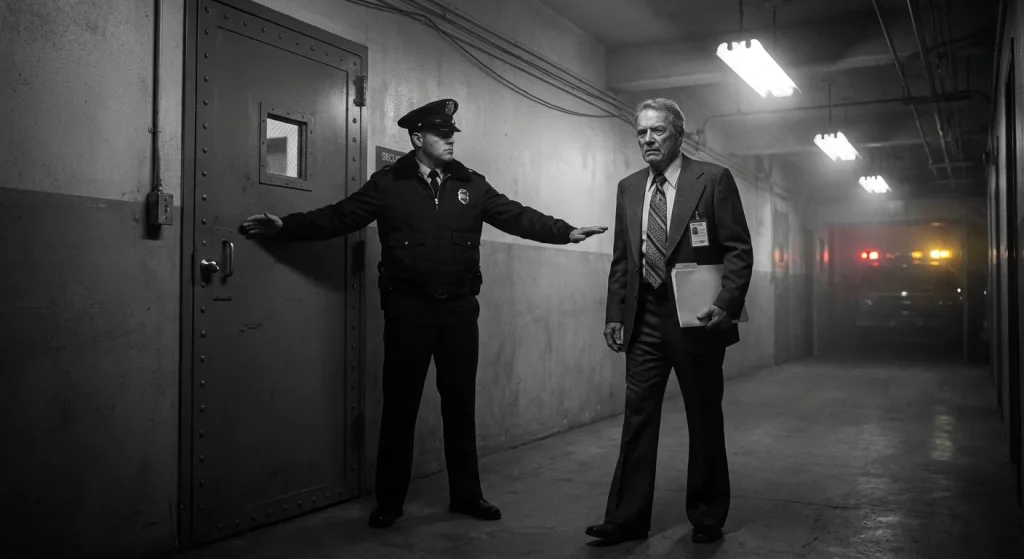
UFO disclosure and UAP disclosure headlines recycle fast, but the most viral versions usually hinge on a single claimed moment of secrecy: Sen. Barry Goldwater asking for access at Wright-Patterson Air Force Base and being told “no.” Everyone cites Goldwater, the receipts are often fuzzy, and the story keeps getting treated like a settled datapoint instead of a disputed anecdote.
The enduring claim is straightforward. Goldwater, widely regarded as a national-security heavyweight and an Air Force Reserve major general, is widely reported to have sought access to a rumored UFO-related area at Wright-Patterson AFB and to have been refused. In online retellings, that refusal becomes a proxy for everything people mean by “government cover-up,” because it implies a boundary even a senior insider could not cross.
Your decision point is simple: treat the Goldwater refusal story as meaningful evidence of a government UFO cover-up, or treat it as a narrative inflated by repetition. This article takes the story as a case study in how secrecy narratives persist, separating what is consistently claimed from what is actually documented.
The terminology itself shows how these debates straddle eras. Scholarly and policy analyses describe a progression in terminology from “UFO” to “UAP (Unidentified Anomalous Phenomena),” and congressional and task-force documents use both terms when discussing unexplained sightings. In other words, “UFO (Unidentified Flying Object)” is the public and historical label most people recognize, while “UAP (Unidentified Anomalous Phenomena)” reflects the modern, official framing you will see in government-facing discussions.
Here is the key sourcing limitation up front: publicly available sources reviewed for this article do not include a primary-source, first-hand statement from Barry Goldwater that definitively pins any access denial to the year 1975. Publicly available sources reviewed for this article include the House Oversight Committee hearing page and transcript for the July 26, 2023 UAP hearing, official Project Blue Book references, Wright-Patterson and Air Force fact sheets, a Senate biography of Goldwater, a GAO report on access disputes involving SAP and SCI, DoD SAP policy, and AARO material and reports. Representative samples of those sources are linked below for readers and researchers.
- House Committee on Oversight and Accountability hearing page – “Unidentified Anomalous Phenomena” (July 26, 2023)
- Official transcript: House Oversight subcommittee hearing transcript (PDF, July 26, 2023)
- U.S. Air Force fact sheet: Unidentified Flying Objects and Project Blue Book
- National Archives: Air Force UFO records, Project Blue Book material
- Wright-Patterson AFB – Air Force Materiel Command fact sheet
- U.S. Senate biography: Barry Goldwater
- GAO report NSIAD-93-162 – review of due process practices for SCI and SAP access disputes
- DoD SAP policy reference (DoD Directive 5205.07 and related policy)
- All-domain Anomaly Resolution Office – official site and AARO historical record report (March 2024)
- Rep. Burlison press release – UAP Disclosure Act 2025 amendment
Goldwater’s Security Credibility
The “a senator was denied” hook works because Barry Goldwater was not a fringe figure lobbing accusations from the outside. He spent decades inside the system that writes defense policy, questions generals under oath, and demands answers from the Pentagon. That proximity to national-security oversight raises the rhetorical stakes of any denial account, even before you argue about what, exactly, was being denied.
Goldwater served in the U.S. Senate across two long tenures, first from 1953 to 1965 and then from 1969 to 1987. He did not just “sit on committees”; he chaired the Senate Armed Services Committee in the 99th Congress, from 1985 to 1987, placing him at the center of the chamber’s formal defense oversight machinery. See the Senate biography for details of his service and roles.
Washington status is not an all-access badge. Classified access has two gates: a favorable eligibility determination (a clearance) and a specific need-to-know, meaning the information is required to perform a defined oversight or official function. That second gate is where friction lives: departments and executive agencies grant access case-by-case based on their judgment of need-to-know, and the executive branch decides which Members “need to know” a given compartment to carry out oversight.
Goldwater’s stature increases the credibility of the claim that a denial could happen; it does not turn an anecdote into proof of crashed craft or non-human intelligence (UFO/UAP). The useful inference is narrower and more disciplined: if someone of his profile hit a wall, the story is really about what mechanism, policy, or internal decision rule could block access despite high-level oversight credentials. One caution up front: the “1975” date is widely attached in retellings, but publicly available sources reviewed for this article do not establish that date as a documented fact.
Why Wright-Patterson Became a Magnet
The Goldwater-style “I tried to get in and was told no” story persists for one simple reason: Wright-Patterson already looks like the kind of place where secrets would live. Its documented mission history centers on advanced materiel, acquisition, and evaluation work, the exact ingredients that make “back room” UFO (UAP) claims feel plausible to outsiders even when the specific allegations are unproven.
Wright-Patterson’s reputation for guarded programs did not appear out of thin air. In March 1946, the Army Air Forces created Air Materiel Command (AMC) and placed its headquarters at Wright Field, which later became Wright-Patterson AFB. That matters because AMC was built around the hard, unglamorous business of materiel: the systems, supply chains, testing, modification, and logistics that turn a new aircraft from an idea into a fielded capability. See the Wright-Patterson fact sheet for background.
That institutional “materiel brain” never really left the installation. Today, the base remains organizationally dense, with host units and alignment under Air Force Materiel Command structures that exist to equip the service with advanced weapon systems and technology. The friction is obvious: real classified work and compartmented access controls are normal in this environment, but normal secrecy is exactly what rumor culture needs to dress speculation as inside knowledge.
Wright-Patterson’s name keeps reappearing in UFO (UAP) lore for a second, more specific reason: Project Blue Book, the Air Force’s named UFO investigation program, was headquartered at Wright-Patterson Air Force Base. The Air Force investigated UFO reports from 1947 to 1969 under several programs that culminated in Project Blue Book, and official fact sheets and archives note that Project Blue Book investigated 12,618 reports and listed 701 as “unidentified.” Those two numbers create a durable public hook: most cases were resolved, but a meaningful remainder was not, which invites endless reinterpretation of what “unidentified” meant in practice and what, if anything, sat behind closed doors. See the Air Force fact sheet and National Archives material for Project Blue Book documentation.
Once a place has both sensitive mission associations and a documented investigative role, mythology spreads efficiently. Veteran anecdotes amplify the aura of restricted areas. Researchers gravitate toward the best-known address tied to official investigation. Media shorthand, especially “Hangar 18,” turns a complex institutional history into a single, repeatable image. None of that requires recovered-material facts, only a believable setting where access is limited and records once existed.
The takeaway is straightforward: treat “Wright-Patterson is involved” as a prompt to ask “in what documented way?” Headquarters functions, materiel-command lineage, and archived case administration are real. Specific claims of stored non-human technology are not established by those facts, even if the setting remains plausibly secrecy-adjacent.
The 1975 Denial Story
After Wright-Patterson becomes the focal point in these accounts, the Goldwater story stays memorable for a simple reason: across retellings, the same two beats keep landing even while the surrounding details drift. Goldwater is said to have sought access to a rumored “Blue Room” or restricted hangar at Wright-Patterson alleged to hold UFO (UAP) related material, and he was refused. The repetition makes the story feel time-stamped and fully sourced. Publicly available sources reviewed for this article do not support that level of specificity or document the 1975 date.
- Identify a rumored restricted space at Wright-Patterson, commonly labeled the “Blue Room” and described as a hangar or facility tied to alleged recovered material.
- Seek access, framed in popular accounts as a senator using his stature and defense connections to get in.
- Receive a refusal, treated as the punchline that confirms the room’s existence in the folklore.
- The request is consistently described as access to a “Blue Room” hangar at Wright-Patterson where alleged Roswell-related material or bodies were believed to be stored. That “hangar called the Blue Room” phrasing is a stable element in popular summaries, even when nothing else matches perfectly.
- Multiple secondary retellings state that Goldwater was refused access, and some versions explicitly associate Gen. Curtis LeMay with the denial. The name also appears with spelling variation (LeMay and Lemay) across the same cluster of retellings.
- Some archival folder descriptions and later secondary accounts use “Blue Room” in ways that show the phrase circulates in documentary contexts. The existence of the phrase in archival descriptions does not, by itself, establish what Goldwater asked for, who denied him, or when.
The sourcing in many public retellings is second-hand: it points back to other writers and researchers rather than reproducing Goldwater’s own words. One prominent route of transmission runs through popular authors and oral histories, signaling how the claim often travels: writer-to-writer, not document-to-reader.
The gatekeeper identity is also unstable. Some retellings name Curtis LeMay or place his name adjacent to the refusal, but the reviewed public materials do not include a verbatim, first-hand Goldwater quote that identifies who delivered the “no.” That distinction matters because “LeMay denied him” is a stronger claim than “some accounts connect LeMay to the denial.”
The “1975” timestamp is the thinnest part of the package. The publicly available materials examined here do not contain a first-hand statement establishing the timing as 1975, and they do not provide a dated Goldwater letter or interview excerpt that pins the denial to that year. Within the accessible evidence, “1975” functions as a label attached to the story, not as a demonstrated date of the underlying event.
Even the form of the request varies: some versions imply a formal ask routed through channels; others read like an informal inquiry leveraging relationships. The available materials do not resolve which it was, or whether intermediaries carried the request.
Secondary accounts report that Sen. Barry Goldwater sought access to a rumored “Blue Room” hangar at Wright-Patterson AFB tied to alleged UFO (UAP) material and was refused; some retellings connect the refusal to Gen. Curtis LeMay. However, the publicly available sources reviewed for this article do not include a first-hand Goldwater quote naming the gatekeeper or establishing the date as 1975.
Need-to-Know Versus Cover-Up
“Access denied” is one outward behavior with at least two radically different causes. It can be the mundane output of classification governance doing exactly what it was built to do, or it can be framed as the telltale seam of an extraordinary concealment. Without understanding the mechanics that produce a denial, readers end up treating a process artifact as proof of a particular story.
A denial is procedurally normal inside Special Access Program (SAP) and Sensitive Compartmented Information (SCI) systems because those frameworks are designed to restrict distribution even among cleared people. Special Access Programs are DoD-managed or agency-managed initiatives that impose additional controls beyond normal classification protections to protect especially sensitive information and activities. Access is governed by program-specific policies, indoctrination requirements, and need-to-know rules. For Department of Defense SAPs, current authoritative policy is codified in DoD issuances implementing SAP policy and procedures; for intelligence community controlled-access programs, ICD 906 and related DNI guidance define oversight and access rules. See the DoD SAP policy reference and the ODNI controlled access guidance for authoritative descriptions.
In plain terms: clearance gets you into a realm of access; SAP access is the locked room inside it. The most common non-sensational pathways to “no” are administrative, not cinematic. First is compartment boundaries: a person can be cleared at a high level and still be outside a compartment because they lack the specific indoctrination and justification for that program. Second is jurisdiction: the official being asked may not be the cognizant authority, meaning they cannot grant access even if they want to. Third is program sensitivity: some efforts are structured so that only a tightly bounded roster can even be told the program exists, let alone read into it. Fourth is the simplest explanation that still fits the behavior: the rumored program, room, or archive never existed as described, so there is nothing to access, and the institution defaults to denial rather than validating a rumor.
That friction is exactly why compartmentalization creates “cover-up optics.” The system is supposed to look opaque from the outside, because opacity is part of the protection model.
In alien disclosure discourse, denial carries symbolic weight because it appears to contradict rank, oversight, and common sense. The cover-up interpretation reads the same event as a sign of hidden evidence of non-human intelligence and a government UFO cover-up capable of blocking even senior officials. Within that framing, SAP and SCI are not neutral governance tools; they are the mechanism that allows retrieval programs, materials, or analyses to be walled off from conventional accountability.
The interpretive trap is that the rhetoric of compartmentation and the rhetoric of secrecy are almost identical. “Need-to-know” (task-based access rule) sounds indistinguishable from “they are hiding it” if you do not have the paperwork trail showing who owned the program, what authorities controlled it, and why access was denied.
Access disputes are not a UFO-only curiosity; they are a documented governance problem. The Government Accountability Office has reviewed due process practices for individuals whose access to SAP and Sensitive Compartmented Information (SCI) was at issue, illustrating that conflicts over compartmented access exist as an administrative reality. See GAO report NSIAD-93-162 for the review. That matters because it anchors denial in bureaucratic process: access can be limited, contested, reviewed, and adjudicated without implying anything about aliens, crash retrieval, or covert biology.
The logical takeaway is strict: a denial is evidence that restricted-access practices are in play, not evidence of alien technology. Treat “access denied” as a prompt for corroboration, not a conclusion. The only move that upgrades denial into a claim about non-human intelligence is independent, traceable documentation or testimony with provenance that ties the restriction to a specific program, authority, and set of records.
How It Echoes in Today’s Hearings
The Goldwater-style stonewalling story persists because the underlying fight never changed: who gets to see which records, under what legal authority, and with what oversight. The difference now is that the argument has moved out of rumor and into governance mechanisms that create durable paper trails: statutory records mandates, Inspector General pathways, and sworn testimony that can be cross-checked against documents.
Congressional proposals have included creating a National Archives “UAP Records Collection” or similar centralized repositories to collect and preserve records related to UAP. Such proposals appear in amendment and bill filings so that disclosure becomes a process of record collection and review rather than an ad hoc briefing. See congressional amendment records and committee resources for examples of how lawmakers have tried to structure records collection and oversight.
Hearings are the public-facing pressure point for that machinery. A House Oversight subcommittee held a UAP-related hearing on July 26, 2023; the committee hearing page and the official transcript document the public testimony and questions from members. See the House Oversight Committee hearing page and the official transcript for the July 26, 2023 hearing for primary-source material on those proceedings.
The complication is that high-profile testimony can increase public certainty faster than it increases verified evidence. Public summaries of whistleblower statements emphasize limits that are often lost in headlines: some witnesses have said they have not personally seen alien vehicles or bodies, and many of the claims publicly reported are based on accounts from multiple witnesses. Those summaries also note the claims are not independently verified there, which matters because oversight runs on documents, access determinations, and corroboration, not on viral certainty.
This is also why “UAP news” keeps circling back to reporting channels and statutory language: members publicly push to strengthen whistleblower protections and to legislate disclosure frameworks, precisely because those tools create survivable records beyond a single news cycle. When lawmakers talk about protections and amendments, they are talking about whether potential witnesses can speak without losing careers, clearances, or legal standing, and whether their information can be compelled into an accountable process.
AARO activity and recurring NDAA attention reinforce the same theme: Congress keeps trying to turn an opaque topic into a governed one, with defined duties and repeatable reporting requirements. See AARO materials and the AARO historical record report for recent departmental-level work and public statements on anomaly reporting and records handling.
The practical takeaway is simple: hearings generate attention, but statutes and archives generate receipts. The modern reforms are trying to ensure that a “no” like Goldwater’s does not end the inquiry at a locked door, but instead triggers a traceable oversight process that leaves a legislative and archival trail behind it.
Signals to Watch in 2025 and 2026
The next phase of UAP disclosure gets won or lost in documentation, audit trails, and oversight follow-through. High-profile sightings and viral clips will continue, but the information environment rewards volume and repetition. Credible confirmation moves at the speed of staff work: amendments, hearings, subpoenas, classified briefings, IG work, and the records those processes force into existence.
First, Rep. Eric Burlison submitted a “UAP Disclosure Act 2025” amendment to the NDAA and has publicly pushed to pass it alongside stronger whistleblower protections. See Rep. Burlison’s press release and the corresponding amendment text for the filing. That is a process signal: it creates a paper trail, votes, committee actions, and compliance tasks that can be checked.
Second, reporting indicates that the FY2026 NDAA negotiations and committee work included UAP-related provisions in various drafts and markups. Draft language and committee explanatory material can change through negotiation; treat reporting about drafts as a tracking trigger and verify final text against official committee releases and the joint explanatory statement. See House Armed Services Committee resources and contemporary coverage for tracking and context.
When UAP-related language is written to enable expeditious disclosure of records, the measurable outcome is records movement, not louder stories.
- Inspector General findings: IG products force scoped questions, methods, and conclusions into a durable record you can quote and compare over time.
- Signed affidavits: sworn statements raise legal stakes and lock specific claims to names, dates, and responsibilities.
- Program budget lines: money trails constrain fantasy, if a claim is real at scale, it leaves budget fingerprints somewhere.
- Contracting artifacts: solicitations, award notices, modifications, and CDRLs map who built what, for whom, and under what deliverables.
- Declassification memoranda: these show what was reviewed, what standards were applied, and what was released or withheld.
- Chain-of-custody records: this is the difference between an object story and an evidentiary object, it documents control, transfers, and integrity.
- Search for bill text, amendments, committee reports, IG announcements, and official release pages before you watch clips.
- Save primary documents as PDFs with dates and URLs, plus screenshots of docket pages that show version history.
- Classify each new sighting: confirmation means a document type above plus traceable provenance; repetition is the same claim reposted by new accounts without chain-of-custody, budget, or contracting traces.
The Power of a Closed Door
Goldwater’s closed door endures because it exposes a real governance problem: access can be denied even to high-status actors, but the denial itself does not establish non-human intelligence or recovered technology.
The story’s evidentiary ceiling is the same one it has always had. The chain of sourcing is thin, and the popular “1975” timestamp remains an unsupported pin rather than a documented date. That matters because official reviews judge claims on records and corroboration, not on how long a narrative has circulated. The All-domain Anomaly Resolution Office has published materials and a historical record report that describe anomaly reporting, records practices, and program findings; those public documents state there is no verified evidence that the U.S. government or private companies have reverse-engineered extraterrestrial technology. See AARO publications and historical record report for the office’s summaries and conclusions.
The closed door still lands because it feels procedurally true: restricted programs can refuse briefings, and “credible person gets denied” reads like proof even when no documentation follows. That is why the center of gravity has shifted toward mechanisms that create paper trails and enforce accountability, not toward retelling the same denial. Meaningful transparency looks like durable records, accountable access decisions, and verifiable documentation: IG findings, sworn affidavits, budget and contract traces, declassification memos, and chain-of-custody for any claimed materials.
Frequently Asked Questions
-
What does UAP mean, and how is it different from UFO?
UFO means “Unidentified Flying Object,” the older public label. UAP means “Unidentified Anomalous Phenomena,” the modern official framing used in government-facing discussions, and both terms appear in policy and task-force contexts.
-
Why is Wright-Patterson AFB so central to UFO and UAP lore?
Wright-Patterson is tied to classified materiel work through Air Materiel Command, headquartered there in March 1946. It also hosted Project Blue Book headquarters starting in March 1952, linking the base to the Air Force’s UFO investigations (1947-1969).
-
How many cases did Project Blue Book investigate, and how many were listed as unidentified?
Project Blue Book investigated 12,618 reports. It listed 701 as “unidentified,” a statistic frequently cited in ongoing UFO/UAP debates.
-
What is the Barry Goldwater “Blue Room” access-denied story supposed to be about?
Secondary accounts say Sen. Barry Goldwater sought access to a rumored restricted “Blue Room” hangar at Wright-Patterson allegedly tied to UFO/UAP material and was refused. Some retellings connect the refusal to Gen. Curtis LeMay, but the article notes the evidence set is second-hand and not supported by a first-hand Goldwater quote.
-
Is there solid documentation that Goldwater was denied UFO access at Wright-Patterson in 1975?
No-within the provided research set, there is no primary-source, first-hand statement from Goldwater that definitively pins the denial to 1975. The article says the “1975” timestamp functions as a repeated label rather than a demonstrated date.
-
How can a high-level official be denied access even with a security clearance?
The article explains access requires both clearance eligibility and “need-to-know,” and compartmented systems like SAP and SCI can restrict access even among cleared people. It also lists common reasons for denial, including compartment boundaries, jurisdiction limits, extreme program sensitivity, or that the rumored program/room may not exist as described.
-
What should you look for in 2025-2026 to evaluate UAP disclosure claims instead of relying on viral stories?
The article says credible confirmation should show durable documentation such as Inspector General findings, signed affidavits, program budget lines, contracting artifacts, declassification memoranda, and chain-of-custody records. It advises tracking bill text and amendments (including proposed UAP disclosure language and a National Archives “UAP Records Collection” concept) because statutes and archives create verifiable receipts.
