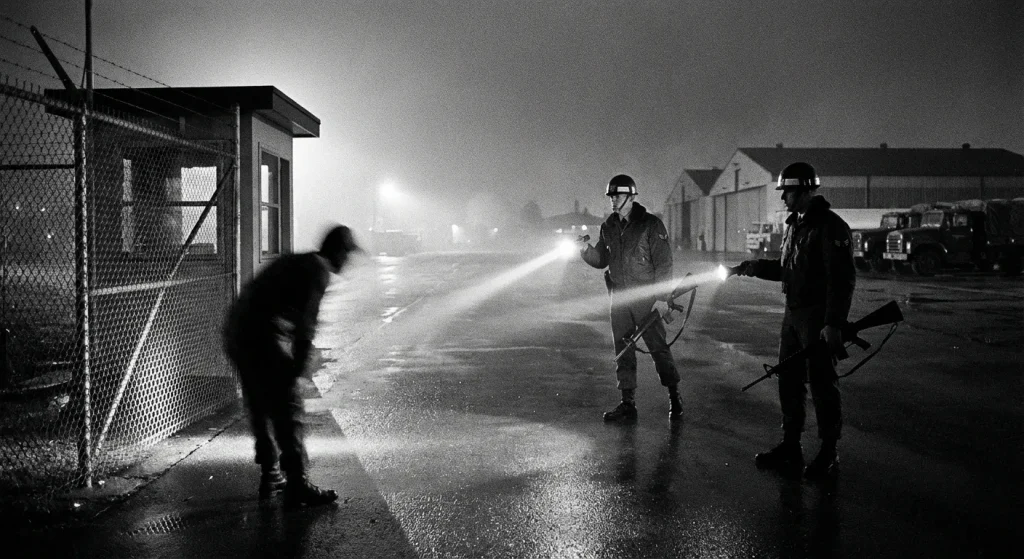
You keep seeing the same headline-grade claim resurface in UFO news and UAP news feeds: a clean, high-stakes “base incident” that sounds settled because it’s told with absolute certainty. The problem is the certainty isn’t matched by basic identifiers. The versions that travel farthest rarely include a verifiable name, a unit designation you can check, or a contemporaneous document number you can trace.
The timing of this resurgence is not accidental. July 2023 congressional UAP hearings pushed the topic back into mainstream attention, and the current disclosure-era framing encourages older military-base stories to be reread as evidence rather than folklore.
The same shift shows up in how the government labels reports: Unidentified Anomalous Phenomena (UAP) is a category that allows official collection and analysis of sightings without asserting what the object was. That bureaucratic framing pulls older “something happened on a base” narratives into the same mental bucket as formally logged reports, even when the older story has no comparable paper trail.
Before the claim can be evaluated, the geography has to be un-muddied. Fort Dix is an Army installation, and the nearby Air Force presence attached to the story comes from McGuire Air Force Base, which traces its origin to the Fort Dix Army airfield established in 1941 (jbmdl.jb.mil — Joint Base McGuire-Dix-Lakehurst: Dix).
Naming drift adds another layer of confusion. BRAC recommended merging Fort Dix, McGuire AFB, and NAES Lakehurst in 2005, and they were administratively consolidated as Joint Base McGuire-Dix-Lakehurst in 2009 in Central New Jersey. Retellings routinely retro-apply the joint-base name and “AFB” language to earlier decades, which makes the story sound more specific than it is.
Here, “verifiable vs. rumor” is not a vibe check. Verifiable means anchoring what can be confirmed in public record, including correct installation names and timelines, and then tracking how the claim’s wording changes as it gets recycled. Read the rest of this post the same way: treat the dramatic statement as a claim, then follow what’s actually sourced, what’s merely repeated, and what disappears when you ask for names and documents.
That approach matters because the Fort Dix/McGuire story is usually presented as a complete narrative when, in practice, it is mostly a stable outline missing the identifiers that would attach it to an actual case file.
What Allegedly Happened in 1978
Across the versions that circulate, the outline is remarkably stable: a January 18, 1978 incident framed as Fort Dix and/or McGuire AFB, an alleged encounter on or near the installation, a military response described as MPs or base security, a claim that the entity was shot and killed, and a claim that the body was recovered or otherwise contained. What does not stabilize is the identifying detail that would let a reader tie the story to a specific report, patrol, or individual.
- Date and base framing: Claims consistently anchor the story to January 18, 1978, commonly labeled as a Fort Dix / McGuire AFB incident, with the location sometimes presented as a combined “Fort Dix and McGuire” setting rather than one discrete site.
- General time window (when provided): One frequently repeated retelling places the activity between 03:00 and 05:00, described as UFOs sighted over Fort Dix and McGuire during that period.
- Setting and initial contact: The encounter is usually described as occurring on a military installation or its controlled areas (the story rarely specifies a named gate, road, range, or facility). The “what happened first” portion is typically a brief escalation from observation to confrontation, without a documented chain of events.
- Responder identity: The responding force is described in two overlapping ways: Fort Dix MPs in some tellings, and McGuire AFB as the incident site in others, which implicitly shifts the “security” identity toward base security forces rather than Army MPs.
- Alleged shooting: The core claim is that responders shot and killed a non-human entity. One retelling goes further on mechanics, asserting a Fort Dix MP fired five bullets into a “gray-type” being and then fired an additional round.
- Alleged recovery or containment: The end-state is usually framed as the body being taken under control by authorities. One prominent version states the Air Force disposed of the body, which functions as the “closure” beat in that retelling even when intermediate steps are not described.
Where the outline stays consistent, the divergence shows up in the points that would normally carry accountability: location labels, who actually responded, and what “recovery” is claimed to mean.
- Location label (Fort Dix vs McGuire AFB vs “Fort Dix/McGuire AFB”): Some accounts place the incident at McGuire AFB; others assert Fort Dix specifically; many collapse the distinction into a single combined label. This matters because the location label also implicitly determines which organization is being accused of the shooting (Army MP framing versus Air Force base security framing).
- Witness count and vantage point: Retellings often imply “multiple people” by describing a response, a shooting, and a recovery, but the count of direct witnesses is typically not stable in the way the date is. In this source set, witness numbers are not pinned to named individuals, and many versions function without a concrete witness roster.
- Entity description: Some tellings keep the entity generic (“alien”); others specify a type, such as a “gray-type” description. Once a retelling adds morphology, it becomes a distinct branch of the narrative even if every other beat stays the same.
- Recovery narrative (contained vs removed vs disposed): The “what happened to the body” beat is one of the biggest divergence points. Some versions stop at “recovered” or “taken away,” while at least one states a concrete outcome: disposed of by the Air Force. Those are materially different claims, because “disposed” implies a specific decision and chain of custody rather than vague containment.
Consistency shows up in a narrow band of repeated elements: the January 18, 1978 anchor, the Fort Dix and/or McGuire AFB framing (often merged as “Fort Dix/McGuire”), and the assertion that MPs or security shot and killed an “alien.” Contradictions cluster where the story needs precision: which installation name is used, how the responders are labeled, whether the entity is described generically or as a “gray-type,” and whether the endpoint is framed as recovery, containment, or disposal.
Within the provided material, the retellings do not supply individual names, MP unit identifiers, or shift or patrol identifiers. That absence is not a minor omission; it is the core verification bottleneck. A story can travel indefinitely on a stable date and a familiar base label, but without names and unit level identifiers, it cannot be cleanly attached to a particular duty roster, incident report, or chain of command. The result is predictable: the outline remains repeatable, while the accountable details remain untestable.
If a post or article only repeats “Jan 18, 1978, Fort Dix/McGuire, MPs or security shot and killed an alien, body taken,” it is almost always a re-phrase of the same minimal outline. Treat it as duplication, not independent detail. A retelling becomes meaningfully different only when it commits to checkable specifics already seen in the variants, such as a named installation label (Fort Dix versus McGuire AFB), a concrete time window (03:00 to 05:00), a mechanical shooting detail (the “five bullets” claim), or an explicit end-state (“disposed of” rather than “recovered”). Those are the inflection points where the story stops being pure repetition and starts making assertions that can be compared for internal consistency.
Cold War Security and Reporting Reality
The gap between a repeatable outline and a verifiable incident is largely a records problem, not a storytelling problem. That is why the most practical check is to compare the allegation to what serious on-base events normally generate in real time.
Late Cold War-era posts were built to control access, radio traffic, and information release. That controlled environment can make dramatic “cover-up” narratives feel plausible from the outside, because outsiders do not see the internal traffic. Inside the wire, a weapons discharge or serious injury creates immediate command attention, creates immediate coordination demands, and creates paperwork that has to reconcile who did what, when, and under what authority.
On an installation, an MP response typically escalates fast because the first priority is scene control: stop the threat, secure weapons, establish an inner and outer perimeter, and keep uninvolved personnel out. Once the scene is stabilized, the response shifts to accountability and coordination: identifying involved personnel, separating witnesses, and ensuring the chain of custody for any weapons and physical evidence that will matter later.
Notification follows a predictable chain-of-command logic. Desk personnel notify the on-duty supervisor, who drives notifications up to the provost marshal operations channel and the installation command channel, with parallel notification to investigative elements when the facts cross a seriousness threshold. That threshold is not rhetorical. A discharge tied to serious personal injury or death is the kind of event that forces formal reporting, because it triggers command risk, legal exposure, and potential claims processing.
In practice, the first administrative artifact is the desk blotter, meaning the MP desk duty log that captures time-stamped calls, unit actions, and key decisions as they unfold. A major response does not live only in memory; it is usually anchored to entries that show when units were dispatched, when supervisors were notified, and when scenes were secured.
From there, the paperwork thickens. Incident reports, witness statements, and use-of-force documentation are compiled and checked because internal consistency matters. Historically, MP desk functions included coordinating patrol activity, documenting those activities, and reviewing incident reports for accuracy and completeness. That review function is exactly where gaps get flagged, timelines get tightened, and missing attachments get demanded, because incomplete reporting creates downstream problems for commanders and investigators.
For serious outcomes, the reporting escalates beyond routine incident narratives. Regulations governing serious-incident reporting and law-enforcement reporting in the Army include AR 190-40 (Serious Incident Report) and the DA PAM/AR 190-45 family of guidance; DA PAM 27-162 is a Judge Advocate General publication covering legal services and claims procedures, not the primary regulation that defines the Army’s Serious Incident Report process (AR 190-40 (SIR) reference, AR 190-45 / DA PAM guidance (law enforcement reporting), DA PAM 27-162 (legal services/claims procedures)).
Once the event crosses into serious injury, death, or other high-risk territory, it sits in an investigative environment that is not improvised. FM 19-20 served as a guide for military police investigators (MPI) and U.S. Army Criminal Investigation Command (USACIDC) special agents, which matters here for one reason: investigators are operating in a standardized process culture. Scenes get processed, statements get collected, and follow-up actions get documented because cases have to survive internal review and, when applicable, coordination with other authorities.
If a serious on-base shooting occurred anywhere in that era, the baseline expectation is not a single file. It is a cluster of artifacts created by dispatch, patrol supervision, medical response, and investigators. Use this as a concrete checklist of what would normally exist, even if not publicly released:
- MP desk blotter entries and shift duty logs (time-stamped call and response trail)
- Dispatch notes and radio traffic summaries tied to unit dispatch and on-scene updates
- Patrol and supervisor incident reports, including attachments and corrections from desk review
- Command notifications, including a serious incident report when thresholds are met
- Medical response entries (aid station or ambulance run documentation) and any transfer notes
- Investigative case paperwork in the MPI and/or USACIDC workflow (scene processing, statements, evidence custody, follow-up)
Restricted areas and controlled communications can limit what outsiders see, but shootings carry administrative gravity. The normal result is not silence. It is records.
Evidence Check and Source Trail
The paperwork expectation is only useful if the public trail can be traced back toward it. In this case, the public trail that gets cited most often begins well after 1978, which is why the sourcing matters as much as the story.
The Fort Dix “alien shot by an MP” story circulates online as settled history, but its public evidence chain does not begin in 1978. In the material surfaced here, the first durable, quotable touchpoints arrive decades later through media write-ups and then get recycled into posts, videos, and “explainer” threads that cite one another instead of producing new, checkable records.
The first spine item frequently cited in retellings is a Trentonian article dated June 6, 2007 (outlet: The Trentonian; headline and author not consistently provided in later citations). Link: [Trentonian — June 6, 2007 — article link not located in provided sources].
The 2019 resurgence is tied to contemporary media coverage of a new book. Concrete spine items in that 2019 cycle (as surfaced in this collection) include:
- WFTV coverage — “US Air Force disposed of alien body in 1978, retired major claims in new book” (outlet: WFTV). Link: Wftv. (Author and publication date not provided in the source list.)
- Asbury Park Press / app.com coverage — cited in media chains as reporting on the same book-driven claim. Link: [Asbury Park Press article — link not located in provided sources].
- The 2019 book tied to the cycle is listed as “Strange Craft: The Story of Intelligence Officers” by John L. Guerra (2019) in the surfaced materials. Link to commercial listing: Amazon.
In the provided material, none of the sources are contemporaneous local or regional 1978 New Jersey newspapers, police blotters, or radio/TV archives. No surfaced local clip, no dated broadcast transcript, no wire-service brief, no “here’s the page” artifact that pins the claim to the month and the jurisdiction where it allegedly occurred.
The other missing anchor is documentation with internal identifiers. When an incident is treated as an official matter, the paperwork is built to be auditable: case reports are expected to list witnesses and physical evidence, because the point is traceability, not storytelling. Without those basics in the public chain, readers are left evaluating narration instead of evaluating records.
That absence also blocks routine verification steps that standard investigative procedure relies on, such as identity checks and background vetting tied to named parties. With no names, unit designations, responding office, or case number in the public chain, there is nothing to run through the normal machinery that separates “someone said” from “we can locate the file.”
The core concept this case teaches is source provenance: the traceable origin and custody chain of a claim or document. A cited news article has provenance in the narrow sense that it can be located and dated; it still does not establish provenance for the underlying event unless it points to traceable records (a desk blotter (duty log) entry number, an incident report identifier, a named responding agency, or an archive reference).
Applied here, the 2007 Trentonian item and the 2019 book-coverage items are easy to repeat and hard to corroborate. The repetition creates a false sense of accumulation: dozens of posts can exist while still resting on the same small set of late, secondary touchpoints. Treat “widely repeated” as a distribution fact, not an evidence upgrade.
Consistency matters too, but only after provenance. If retellings converge on a few motifs (MP, “gray-type” figure, multiple shots, disposal), that shows a stable legend structure. It does not show a stable record trail. When the public chain lacks identifiers, the story’s internal consistency becomes a substitute for external confirmation, and that is where online certainty is manufactured.
Freedom of Information Act (FOIA) is the practical lever for requesting existing federal records, but it only yields records if they exist, can be found, and are releasable under exemptions. FOIA does not force an agency to create a record that was never generated, and it does not guarantee release of sensitive law-enforcement, medical, or security material.
| Expected evidence if it happened | Evidence currently in the public chain presented here |
|---|---|
| Installation law-enforcement documentation: desk blotter (duty log) entries, incident logs, serious-incident routing, investigative case numbers | 2007 Trentonian write-up describing an MP shooting a “gray-type space alien” and firing multiple rounds |
| Medical response traces: ambulance run sheets, base clinic or hospital intake/admission registers, coroner interface if applicable | 2019 WFTV coverage tied to a retired Air Force officer’s book claim of a 1978 killing and body disposal |
| Command and security traffic: situation reports, message traffic, shift-change notes, guard-mount paperwork, range or weapons discharge reporting | 2019 Asbury Park Press (app.com) coverage tied to the same book-driven claim |
| Contemporaneous media: local NJ newspapers, radio logs, TV assignment desks, wire briefs dated to the alleged window | Online retellings that largely cite the 2007 and 2019 items, often without adding primary documents or identifiers |
A final reality check belongs in the evidence locker: AARO’s consolidated annual report documents what the office received during its most recent reporting window. The DOD-AARO Consolidated Annual Report on UAP (Nov 2024) states, in exact wording from the report, “AARO received 757 UAP reports during the reporting period” and identifies that reporting period as “May 1, 2023 to June 1, 2024” (DOD-AARO Consolidated Annual Report on UAP — Nov 2024). If no primary records related to a historical claim have been submitted to AARO or located by oversight, the office’s public statements reflect that input set rather than an ability to adjudicate every legacy allegation from internet-era retellings.
- Pin the claims to exact quotations and dates: June 6, 2007 for the Trentonian wording; 2019 for the book-coverage cycle (WFTV and app.com).
- Demand identifiers before belief: report numbers, named responding office, unit/shift information, or any scanable contemporaneous document reference.
- File FOIA requests that ask for record categories tied to a specific installation and time window (duty logs, incident logs, investigative case indexes), understanding that FOIA only returns records that exist and are releasable.
- Work local archives like a historian, not a fan: search 1978 NJ newspaper reels and broadcast archives for short briefs, not just “alien” keywords, and save images or citations that can be independently retrieved.
- Track provenance on every new “source”: if it ultimately points back to the 2007 article or the 2019 book coverage without adding a primary record, treat it as redistribution, not confirmation.
Why It Matters in Disclosure Era
Thin documentation is not just an archival annoyance; it changes how old stories behave in the modern UAP information environment. A 1978-style base legend can keep reappearing because newer phrases and incentives encourage audiences to retrofit older “recovery” and “containment” rumors into today’s dominant template, even when the original story never contained the identifiers that would let anyone verify it.
In July 2023 congressional testimony, David Grusch alleged that “non-human” or “nonhuman biologics” were recovered from some alleged UFO crash sites. Multiple media outlets then quoted and highlighted the phrase “non-human biologics” in coverage and headlines. That repetition matters because it functions like a tag: once a term is elevated into a headline-ready hook, it primes pattern-matching across unrelated legacy stories that were never documented as crash retrievals in the first place.
Media headlines that repeat a distinctive phrase reliably drive search demand around that exact wording. When “non-human biologics” becomes the clickable summary of UFO news, older base incidents that can be narrated as rapid containment or secret handling suddenly feel newly relevant, regardless of whether their sourcing improves. The result is a feedback loop: keyword-heavy posts get surfaced, readers connect dots, and “government UFO cover-up” narratives intensify because the framing feels consistent, not because the evidence got stronger.
You can see this packaging effect in how legacy claims are periodically re-launched through fresh media pegs. WFTV and other outlets attribute a modern resurgence of the 1978 “alien killed” claim to a retired USAF officer’s new book, pointing to a 2019 retelling as the sourcing base for the renewed wave of attention.
AARO’s public stance draws a bright line between lore and investigable history: “determinations are made on the information that has been provided to the office to date.” In practical terms, that standard pushes older stories toward the same question raised earlier: do they produce names, units, dates, sites, logs, medical or forensic workups, chain-of-custody, or testable artifacts?
Treat confident repetition as an attention mechanic, not corroboration. During spikes in UAP sightings coverage, give extra weight to versions that surface checkable identifiers, and downgrade versions that only map modern disclosure phrases onto old, poorly sourced accounts.
Congress, Laws, and Transparency Pressure
Those disclosure-era incentives also collide with a second reality: oversight today is trying to make claims auditable. That matters because the Fort Dix/McGuire story is strong on narration and weak on identifiers, and modern transparency mechanisms are designed to force the opposite.
Modern UAP transparency fights are being won or lost on plumbing: who can report, who must receive it, what gets logged, and what can be released on the record. Older “Fort Dix-type” legends spread through informal channels by design, like secondhand retellings, anonymous tips, and missing paperwork claims that were impossible to audit. Today, Congress is trying to force claims into durable, inspectable pathways where a real case file either exists or it doesn’t, and where oversight can ask for the receipts.
The All-domain Anomaly Resolution Office (AARO) was established by law to handle UAP-related matters, which operationally means a standing office is tasked to take in reports, investigate, and brief across domains rather than leaving incidents to die inside isolated commands. Laws establishing AARO also mandated secure reporting channels for whistleblowers, a direct response to the historic problem that people with access to classified programs had no trusted way to provide information without burning their careers. Since 2017, Congress has enacted new UAP oversight laws that include AARO investigations, whistleblower protections, and a public records mandate, shifting future allegations away from “trust me” and toward “file it, brief it, track it.”
That formal posture is already visible in how major claims enter the public conversation: NPR tied prominent allegations to sworn congressional testimony from three military veterans, including a former Air Force intelligence officer, not to an anonymous chain of reposts.
The Schumer-Rounds proposal was submitted as Senate Amendment 2610 in the 118th Congress, and its mechanism matters even where outcomes remain uncertain. S.A. 2610 proposed an “unidentified anomalous phenomena Records Collection” at the National Archives, a structure designed to centralize records requests, indexing, and review pressure so material does not stay scattered across agencies as orphaned “special access” fragments. That approach can surface records if they exist and are reachable under law, but it cannot conjure documents that were never created or were never retained.
This is also why wording matters in hearings and reporting: TIME’s coverage echoed the phrase “nonhuman biologics” as a claim presented to Congress, illustrating how testimony-driven pathways create quotable, attributable statements that can be pursued through oversight rather than rumor.
Pressure is not only coming from the Senate side. The House Oversight Committee’s Task Force on the Declassification of Federal Secrets is a live forum for public accountability, and chairwoman Anna Paulina Luna announced a hearing on transparency relating to UAP. Hearings do one concrete thing well: they put agencies on a timetable to answer, in public or in classified session, with members positioned to demand follow-up documents, briefings, and compliance narratives.
These mechanisms can protect testimony, standardize new reporting, and create a clearer trail for inspectors general, auditors, and committees to pull on. For an older Fort Dix-era story, the best-case outcome is straightforward: records surface if they exist in retrievable form, and witnesses can provide information through protected channels. The worst-case outcome is also clarifying: no discoverable file, no corroborating documentation, and no verified chain of custody, which is still a more accountable endpoint than endless hearsay.
What We Can Say Responsibly Now
The Fort Dix 1978 “MPs shot a non-human entity” story remains a claim, not a documented case, on the public trail discussed here. The version most often repeated pins it to January 18, 1978 and frames it as Fort Dix and McGuire security personnel shooting a “non-human entity,” but it still arrives without the basic identifiers that make incidents verifiable: names, units, shift details, and a retrievable record hook.
A serious weapons discharge and death allegation on a Cold War era installation normally produces paperwork: logs, reports, and an investigation that documents witnesses and physical evidence. Standard investigative practice is built around identity verification and traceable documentation; absent names, dates, and record identifiers, claims remain difficult to verify beyond repetition.
Any of the following would move this from folklore to a checkable event:
- Authenticated MP desk blotter entries
- A CID/OSI case number with retrievable investigative documents
- Contemporaneous medical/EMS records
- Dated local news reporting
Use primary documents as your filter. The DOD-AARO Consolidated Annual Report on UAP (Nov 2024) states in exact wording that “AARO received 757 UAP reports during the reporting period” and identifies that reporting period as “May 1, 2023 to June 1, 2024” (DOD-AARO Consolidated Annual Report on UAP — Nov 2024). Pair those with official congressional document repositories, hearing transcripts, and named, dated records you can request or archive-search. If a post cannot point to a record you can pull, treat it as a repost, not an update.
Frequently Asked Questions
-
What is the Fort Dix alien incident (1978) claim?
It’s an allegation that on January 18, 1978, military police or base security at Fort Dix and/or nearby McGuire AFB encountered a non-human entity, shot and killed it, and authorities recovered or contained the body. The story circulates with a stable outline but lacks verifiable identifiers like names, units, or report numbers.
-
Was Fort Dix an Air Force base in 1978, and why does “McGuire AFB” get mentioned?
Fort Dix is an Army installation, and the Air Force base tied to the story is McGuire Air Force Base, which traces its origin to the Fort Dix Army Air Base established in 1945. Retellings often blur the locations or retro-apply later “joint base” wording, which makes the incident sound more specific than it is.
-
What date and time window do retellings give for the Fort Dix/McGuire incident?
Most versions anchor the claim to January 18, 1978. One commonly repeated retelling places activity between 03:00 and 05:00 with UFOs sighted over Fort Dix and McGuire during that period.
-
How many shots were allegedly fired in the Fort Dix alien shooting story?
One prominent retelling claims a Fort Dix MP fired five bullets into a “gray-type” being and then fired an additional round. Other versions only say “multiple rounds” without consistent mechanical detail.
-
What records should exist if a serious on-base shooting happened in 1978?
The article lists expected artifacts such as MP desk blotter entries and shift duty logs, dispatch notes or radio-traffic summaries, incident reports and witness statements, and serious-incident reporting. It also notes likely medical response entries and investigative case paperwork in MPI and/or USACIDC workflows.
-
What are the earliest sources commonly cited for the Fort Dix alien incident, and what years are they from?
The public chain cited in the article starts decades later, with a Trentonian article dated June 6, 2007 describing an MP shooting something that looked like a “gray-type space alien.” It then resurged in 2019 through coverage tied to a retired U.S. Air Force officer’s book, including KIRO7 and Asbury Park Press (app.com).
-
How can you evaluate or verify a Fort Dix/McGuire “alien shot” retelling before believing it?
Look for checkable identifiers such as report numbers, named responding offices, unit/shift info, or authenticated documents like desk blotter entries or a CID/OSI case number. If a post only repeats “Jan 18, 1978, Fort Dix/McGuire, MPs shot an alien, body taken” and ultimately cites the 2007 or 2019 media items, treat it as redistribution rather than new evidence.
