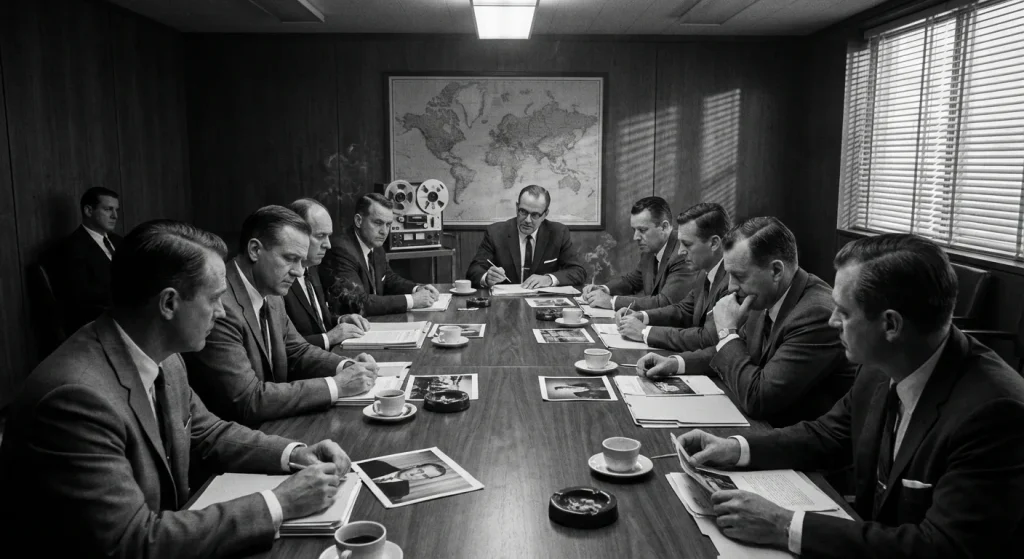
On January 14 to 17, 1953, the CIA convened its Scientific Advisory Panel on Unidentified Flying Objects, better known as the Robertson Panel, and the follow-on CIA paperwork treated “flying saucer” reports as an information-management and security problem rather than a public mystery to litigate in headlines. That pivot mattered because it hardened an institutional reflex: unexplained sightings were processed first as signal-to-noise and readiness risk, with public attention itself treated as a variable that could be exploited. The 1952 to 1953 context was pure Cold War triage: jet-age aviation, radar-driven air defense, and intelligence agencies built to assume adversaries probe seams, including by flooding reporting channels with confusion.
Language tracks the bureaucracy. In 1950s “flying saucer/UFO” talk, “UFO” is “Unidentified Flying Object,” a label that sits comfortably beside tabloid “saucers” because the emphasis is the object and the sighting. Modern DoD and Intelligence Community shorthand flips the center of gravity toward incidents and instrumentation: “UAP” is “Unidentified Aerial Phenomena,” a term built for sensor tracks, reporting pipelines, and analytic triage rather than pop-culture craft. Even the older naming cycles show the same pattern: labels change with the era’s technology and anxieties, not just with what witnesses claim they saw.
The evidentiary boundary is straightforward: these records do not prove aliens; they document how institutions handle perception and security exposure around anomalous reports. In other documented government contexts, perception-related monitoring is explicit and procedural, with surveys used to shape focus-group topics and focus groups used to generate new topics and questions, a workflow that shows how “public reaction” becomes something you measure and manage rather than simply endure.
That boundary is also where the tension lives: contemporaneous files show a security-minded framing, while later narratives escalate that posture into claims of coordinated debunking and mass “public education” tactics designed to suppress belief. Modern writers have gone further still, arguing that some UFO reports map to deception operations or structured deception narratives, which is a different claim than what a 1953 CIA panel record can prove. What follows is a document-first timeline that separates what the record shows from what later interpretations insist it must have meant.
Cold War triggers behind the panel
That memo-driven skepticism only makes sense in a Cold War system where early warning lived or died on signal-to-noise ratio. The CIA’s interest in UFO reporting intensified because mass reporting could degrade early-warning reliability, swamp identification channels, and hand an adversary a ready-made way to generate confusion on demand. When your alert posture depends on fast discrimination between routine clutter and real penetrations, a surge of “unknowns” is not a sidebar. It is an operational weakness.
The Washington, D.C. flap put that weakness on display over two consecutive weekends: July 19 to 20 and July 26 to 27, 1952. The reporting channels that mattered were not rumor mills. They were operational nodes, including Washington National Airport and Andrews AFB, where radar and visual reports could move quickly into military decision loops.
On July 19, 1952, Washington National Airport controllers detected multiple unknown radar contacts starting around 11:40 p.m. (sources: National Archives Prologue blog on Project Blue Book and contemporaneous summaries; see https://prologue.blogs.archives.gov/2019/12/19/saucers-over-washington-the-history-of-project-blue-book/ and https://en.wikipedia.org/wiki/1952_Washington,_D.C._UFO_incident). Those detections and associated sightings were recorded by controllers at Washington National Airport, and the crew there reported seeing something unusual. That radar-plus-visual pairing is what created urgency. A single ambiguous blip is manageable; multiple tracks, correlated with human observation, forces commanders to treat the situation as time-sensitive until proven otherwise. The same ambiguity that drives public fascination is exactly what drives operational friction, because it compresses decision time while expanding uncertainty.
By the following weekend, July 26 to 27, the pattern persisted. Reports again flowed through serious aviation and military channels in the capital area, including Washington National Airport and Andrews AFB. From an early-warning perspective, the lesson was blunt: whatever the underlying cause, clustered “unknowns” in protected airspace regions pull attention, generate escalatory pressure, and consume the bandwidth that early warning requires for the next event.
| Cold War driver | What it threatened operationally | Why it mattered to CIA and USAF |
|---|---|---|
| Early-warning limits under Soviet bomber anxiety | Slow or wrong identification when unknown tracks appear near high-value areas | Ambiguity forces costly “treat as real until disproven” decisions |
| Reporting and communications overload | High-volume calls, plots, and follow-ups create noise and divert resources | Overload strains alert channels and reduces responsiveness to genuine incursions |
| Information operations and psychological warfare risk | Hoaxes, panic, and adversary mimicry become easier in a saturated environment | Confusion is exploitable; the system becomes more vulnerable to deception |
Inside that matrix sits the motive layer the public often misses: information operations. Contemporaneous framing held that the U.S. Air Force viewed the “saucer” problem primarily in terms of its psychological warfare implications, and a CIA/USAF memo recommended discussing possible offensive and defensive utilization of UFO phenomena for psychological warfare. In that framing, psychological warfare – the planned use of propaganda and other psychological actions to influence the opinions, emotions, attitudes, and behavior of enemy, neutral, and friendly groups – made hoaxes, panic, and adversary exploitation the first-order concern rather than treating every report as a purely scientific puzzle.
The simplest way to read the record is to treat CIA and Air Force actions as risk-management unless documents show a different intent. When the phenomenon is unresolved but the reporting load is real, national security agencies default to controlling narratives because narrative control is an operational tool: it reduces noise, dampens panic, and narrows the adversary’s room to weaponize uncertainty.
Those pressures explain why the CIA treated the topic as something to be managed, and they also explain the form the response took: a short, high-level scientific review designed to assess the reporting problem as much as the reports themselves.
Who ran it and what they reviewed
The credibility and the limits of the 1953 outcome flow directly from how the CIA convened the review: who was in the room, what channel it ran through, and what evidence the members were actually shown. Treat it as a case study in intelligence-adjacent scientific triage, not as a full scientific adjudication of every report ever filed.
The Robertson Panel was a CIA-sponsored Scientific Advisory Panel on Unidentified Flying Objects chaired by physicist H.P. Robertson in January 1953, and it operated via CIA/OSI channels. That routing matters because OSI (the Office of Scientific Intelligence) was built to translate technical questions into actionable intelligence judgments, which gives the panel institutional weight even before a single case is reviewed. See the CIA Reading Room report “Report of Meetings of Scientific Advisory Panel on Unidentified Flying Objects convened by Office of Scientific Intelligence, CIA January 14 – 18, 1953” for the formal title and meeting dates (https://www.cia.gov/readingroom/docs/CIA-RDP79B00752A000300100010-4.pdf and https://www.cia.gov/readingroom/docs/DOC_0005516124.pdf).
This was not a random academic seminar. Published historical scholarship documents sustained CIA interest and involvement in the UFO issue across decades, making the panel consistent with an established intelligence workflow rather than an isolated curiosity.
In 1952, the U.S. Air Force was the agency officially charged with investigating UFO reports. That single jurisdictional fact is the practical reason Project Blue Book and Air Force intelligence became the principal pipelines of case material and context into the panel’s briefing stack.
Project Blue Book was the U.S. Air Force program responsible for collecting and investigating UFO reports starting in 1952, and that filing system shaped what “the evidence” looked like in government hands: case synopses, supporting documents, and whatever imagery or instrumentation records had been preserved and forwarded. Air Force intelligence added its own interpretive layer, especially on incidents with radar components, pilot reports, or air defense relevance. See National Archives Project Blue Book guidance and finding aid for U.S. Air Force records (https://www.archives.gov/research/military/air-force/ufos).
The panel reviewed a selected, curated set of materials rather than the full universe of reports. The core dossier was drawn from Project Blue Book case files and specific media, including films and radar-visual incidents, and that curated subset constraint is central to later critiques: selection determines what patterns are even visible to an expert committee.
That selectivity also intersected with a known statistical reality inside Air Force files. CIA-documented figures show the Air Force labeled 26% of reports from January to July 1952 as “unexplained,” a reminder that the underlying pipeline contained a meaningful remainder that resisted quick classification (see CIA document DOC_0005517565, CIA Reading Room PDF documenting charted 1952 data, including unexplained-sighting plots and related graphics: https://www.cia.gov/readingroom/docs/DOC_0005517565.pdf).
The other structural limiter was time. The panel’s short timeframe is repeatedly cited because a few days of briefings cannot support deep reinvestigation, replication of observations, extended field inquiry, or forensic re-interviews. Under those constraints, the panel could only assess what the packet captured, not what a reopened investigation might have uncovered.
Use the panel to understand how government evaluated the issue: a CIA/OSI-mediated review of a limited dossier assembled primarily from Project Blue Book and Air Force intelligence. Do not treat it as a definitive scientific verdict on the phenomenon as a whole. The broader ecosystem of UFO evidence discussions illustrates why: NICAP’s The UFO Evidence, for example, compiles reports and describes “multiple visual and multiple radar” sightings suggesting controlled flight, underscoring how much relevant argumentation can sit outside any single curated briefing packet.
Those limits did not stop the panel from producing a clear set of practical recommendations. They were aimed less at solving the puzzle in public than at reducing the operational drag created by the reporting surge.
Debunking recommendations and public messaging
The most consequential output of the 1953 review was not a definitive explanation of every reported object. It was a recommended communications strategy: shape how the public, the press, and frontline observers interpret reports so the topic generates less attention and fewer false alarms. Declassified handling summaries are clear about intent: reduce the volume and impact of reports by standardizing recognition and by actively driving interest down. Later writers interpret that posture as suppression; the document-based record reads like risk management.
Declassified summaries attribute two major aims to follow-on handling: (1) training for proper recognition of common misidentifications, and (2) “debunking” to reduce public interest. In practice, the first aim targets familiar error patterns, not exotic craft: balloons, aircraft, and unusually illuminated objects that look uncanny under specific lighting and viewing angles. The logic is straightforward: if observers and screeners correctly identify the mundane early, the system spends less time chasing noise.
Here, “debunking” is treated as a behavioral objective: publicly refuting claims by presenting evidence and a more accurate explanation, with the operational goal of depressing demand for sensational interpretations. That framing turns “public education” into an operational lever: if you can normalize prosaic explanations, you can depress demand for extraordinary ones, which reduces tips, calls, and headline cycles.
The nuance critics focus on is that both aims can look identical from the outside. A training slide that teaches “this is how balloons look at dusk” and a press segment that emphasizes “it was a balloon” can both be honest. They also both function to steer attention away from the unresolved remainder. That dual-use character is why the recommendations have stayed controversial.
At the strategic level, the recommendations described in declassified summaries rely on two mechanisms: reach and credibility. Reach comes from mass communications, described in broad, period-appropriate terms such as press, television, and films. Credibility comes from intermediaries who can carry a skeptical, technically grounded message without sounding like an agency script, commonly paraphrased as scientists and other trusted communicators. Treated strictly as document-based paraphrase, this is not “proof of censorship.” It is a plan to saturate the information environment with ordinary explanations so the extraordinary interpretation loses oxygen.
This is also why so many modern searches for “government UFO cover-up” trace back to Robertson-era recommendations: the paper trail people cite is not a memo that “explains” UFOs, but guidance on how to talk the public out of caring about them.
References to “civilian UFO groups” sit at the fault line between what declassified summaries say and what later secondary literature alleges. The document-level summaries support a general posture of managing public interest and reducing the social amplification that organized groups can create. From that foundation, a stronger allegation often appears in later accounts: that monitoring or infiltration of civilian groups was recommended or executed as a deliberate manipulation campaign.
Jacques Vallée’s Messengers of Deception (1979) is an example of secondary-claim literature that treats the UFO subculture as a venue for deception, arguing that UFO narratives can operate as a “deception” through staged-seeming themes like “occupants.”
The problem is evidentiary, not rhetorical. Monitoring or infiltration claims remain contentious because they require primary documentation that shows tasking, authorities, and operations, plus corroboration from independent records. A persuasive substantiation would include, at minimum: (1) contemporaneous agency memos or directives naming civilian groups as targets, (2) budget or personnel records tying specific units to the activity, and (3) corroborating third-party documentation such as parallel files, FOIA releases from multiple agencies, or contemporaneous correspondence from the groups themselves that matches known tradecraft. Without that chain, “the panel recommended education” can be documented, while “education was cover for covert manipulation of groups” stays an interpretation.
The clean way to evaluate these recommendations is to treat them like any other state communication program: judge them by objectives, intermediaries, and how success is measured. The same “education” label can describe benign literacy efforts, routine public safety messaging, or an effort to reduce attention to a sensitive topic. The differentiator is what the documents say the program is trying to accomplish.
| Element to check | What declassified summaries emphasize | What would confirm deeper operations |
|---|---|---|
| Objective | Training for correct recognition; debunking to reduce public interest | Explicit language about targeting groups, shaping belief, or suppressing specific categories of claims |
| Intermediaries | Credible public messengers (scientists and communicators) | Tasking orders, cover relationships, or controlled messaging pipelines |
| Measurement | Reduced volume and salience of reports as an implied outcome | Documented metrics, tracking plans, or perception studies tied to the program |
- Trace each claim back to a declassified summary or primary document, and separate paraphrase from speculation.
- Identify the stated objective in plain language: recognition training, public interest reduction, or something more coercive.
- Demand operational proof for infiltration allegations: tasking, resourcing, and corroboration, not just thematic similarity.
When governments want to know whether messaging is working, they commonly use perception-tracking tools such as surveys and focus groups to map reaction and adjust communication tactics.
That is the practical lens for this episode: the recommendations read like an early blueprint for shaping attention, not a solved case file, and the burden of proof rises sharply when the claim shifts from “public messaging” to “covert manipulation.”
Once you accept that the program logic was to reduce attention and reporting volume, the next question is what that does to the reporting culture itself. The record is thin on individual careers and incentives, but the downstream institutional effect is easy to describe: stigma becomes part of the machinery.
How stigma became an operational outcome
Stigma around UFO reporting is not just cultural theater. It becomes operational when institutions structure incentives so that speaking up creates downside for the reporter, while staying quiet carries little or no penalty. Once that incentive gradient exists, you can keep “channels” on paper and still watch the data collapse in practice.
That dynamic is the downstream effect of the earlier Robertson-era “public education” posture: ridicule becomes normalized as a management tool, not a side effect. In a system like aviation or military operations, where credibility is a form of currency, normalized ridicule changes behavior fast. Pilots and service members learn that filing a report can get them labeled as unreliable, distractible, or publicity-seeking, and the safe career move becomes silence. Over time, that same stigma hardens into an academic and media taboo: serious people avoid the topic because the professional return is negative.
Soft suppression does not require explicit censorship. It works as a feedback loop: ridicule makes reporting socially costly; that social cost creates career risk; career risk drives underreporting; underreporting produces thinner, lower-quality datasets; and thin datasets make dismissal easier, which reinforces the ridicule. The loop is self-sealing because each step supplies “proof” for the next. If leadership can point to a shrinking stack of reports, they can claim the problem is evaporating, even if the real change is that people stopped raising their hands.
Blue Book sits in this story as the public-facing interface. When an institution projects confidence that most cases are explained away, while internal culture treats reports as a reputational hazard, the external message and internal incentives align toward minimization. That alignment matters more than any single press line because it shapes what gets recorded in the first place.
AFR 200-2 was issued in versions dated in the 1950s, including an August 12, 1954 version and a later February 5, 1958 text; the regulation established procedures for reporting information and evidence pertaining to unidentified flying objects and directed base commanders to report sightings while restricting uncontrolled public release (see the AFR 200-2 texts and transcriptions: https://en.wikisource.org/wiki/Air_Force_Regulation_200-2,_Unidentified_Flying_Objects_Reporting and https://sacred-texts.com/ufo/afr200-2.htm and the later Feb 5, 1958 copy: http://www.nicap.org/directives/AFR%20200-2,%20Feb%205,%201958.pdf). A CIA Reading Room document notes the effect of release restrictions on reporting volume, connecting the regulation to observed downstream declines in public report counts (see CIA document DOC_0005517565: https://www.cia.gov/readingroom/docs/DOC_0005517565.pdf).
That is the concrete lever that turns stigma into process. Restricting release does more than manage public messaging; it narrows legitimate pathways for a sighting to become an official, shareable fact. When a base cannot release information, the reporter’s upside disappears: the organization cannot publicly validate that the report was responsibly handled, and the individual cannot point to a transparent outcome. The only thing left is the personal risk of being the person who reported “a UFO.”
- Verify retaliation protections that are specific, written, and enforceable, not cultural assurances.
- Demand transparent release rules that spell out what can be shared, by whom, and on what timeline.
- Track consistent public metrics such as report counts, disposition categories, and processing times, published on a stable cadence.
That long arc – from risk-management messaging to restricted release and chilled reporting – is part of what modern disclosure politics is reacting against. The present-day shift is not just rhetorical; it produces a different kind of record.
Disclosure politics and the new paper trail
The modern “disclosure era” is best understood as a new paper trail: videos formally released by the government, offices created with written charters, reports published under statutory direction, sworn testimony transcribed into the Congressional Record, and legislative proposals that can be tracked line by line. Those artifacts turn “someone said” into auditable claims with dates, jurisdictions, and responsible officials.
After decades where the practical effect of stigma was fewer durable records and less institutional appetite to handle reports in the open, modern efforts sell themselves as a corrective: move the conversation from rumor and ridicule to documented processes that leave receipts.
- Release three Navy UAP videos through the Department of Defense, creating a baseline set of officially acknowledged media (see Navy FOIA pages and public reporting: https://www.navair.navy.mil/foia/documents and contemporary coverage).
- Brief Congress in ways that catalyzed the establishment of the UAP Task Force (UAPTF), shifting the topic from ad hoc attention to a named unit with a reporting mandate.
- Publish the UAPTF report on June 25, 2021, which matters less for any single conclusion than for the fact that it is a dated, government-authored document intended for oversight consumption (see ODNI “Preliminary Assessment: Unidentified Aerial Phenomena”, June 25, 2021: https://www.dni.gov/files/ODNI/documents/assessments/Prelimary-Assessment-UAP-20210625.pdf).
- Transition ownership from UAPTF to AOIMSG, then to AARO, a straight bureaucratic lineage that signals continuity: the same problem set, moved across offices as mandates and leadership structures changed.
- Maintain an ongoing annual/periodic reporting cadence through ODNI and AARO outputs rather than rely on ad hoc releases; these periodic reports and information papers reflect statutory and interagency reporting practices (see AARO publications and information papers and ODNI reporting pages: https://www.aaro.mil/UAP-Records/ and https://www.aaro.mil/Portals/136/PDFs/Information%20Papers/AARO_Declassification_Info_Paper_2025.pdf and https://www.dni.gov/index.php/newsroom/reports-publications/reports-publications-2024/4020-uap-2024).
Congressional oversight creates heat, but the evidentiary value depends on what is under oath, what is documented, and which office has jurisdiction to investigate. David Grusch’s public testimony is on the record, and the existence of an Intelligence Community Inspector General (ICIG) complaint is part of the documented discourse. The key distinction is internal to his own statements: some assertions are framed as firsthand, while major allegations about programs and materials are described as secondhand, relayed from other officials.
There is also FOIA-reported context. The Intercept has reported, based on FOIA-obtained documents, that Grusch retained his clearance despite alleged substance abuse issues; that is documentation about administrative handling, not a character verdict and not corroboration of his substantive claims. Separately, the House Oversight Committee’s public UFO hearing remains a durable reference point because it produced sworn transcripts and exhibits. Ongoing search interest in “UAP congressional hearing 2025” reflects continued oversight pressure, even when specific, dated hearings are not the real story.
Formal channels exist for protected disclosures. The House Whistleblower Ombuds resource points whistleblowers to pathways referenced in the FY2023 NDAA, which is exactly the sort of procedural infrastructure that turns allegations into reviewable cases.
Most UAP-related legislation clusters into three functions. Transparency and records review proposals, including named disclosure and transparency acts, focus on forcing classification decisions into structured workflows. NDAA UAP provisions emphasize recurring briefings, definitions, and reporting obligations. Whistleblower protection proposals aim to harden the pipeline for authorized disclosures. See enacted and pending NDAA text and congressional bill pages for statutory language and reporting deadlines (for example H.R. 2670, the NDAA for FY2024, and related congressional records: https://www.congress.gov/bill/118th-congress/house-bill/2670).
- Start with primary artifacts: DoD releases, ODNI products, AARO publications, and enacted NDAA text.
- Read sworn testimony in transcript form, then separate firsthand statements from secondhand sourcing.
- Follow inspector general processes, because IG jurisdiction and findings are designed to be auditable.
- Sort “introduced” versus “enacted” legislation, and treat proposals as intent signals until they become binding law.
That modern paper trail is often described as a break with the Robertson-era impulse to manage attention. It is also, in practice, a test of whether institutional incentives have shifted enough that reporting can happen without the same stigma and bottlenecks.
What the Robertson Panel really proves
The Robertson-era record matters because it captures an institutional posture: UFO reports were handled as an information and security-management problem, not as a mystery to be solved in public. That posture plausibly seeded a stigma that outlived the Cold War because it trained both officials and civilians to treat reporting as noise, not signal.
What the documents support is blunt. The Panel concluded, “No evidence is available to indicate any physical threat” (Report of Meetings of Scientific Advisory Panel on Unidentified Flying Objects, Office of Scientific Intelligence, CIA, January 14-18, 1953, Conclusions; https://www.cia.gov/readingroom/docs/CIA-RDP79B00752A000300100010-4.pdf), and it also stated, “The subject ‘UFO’ is not of direct intelligence interest” (same report, Conclusions section; https://www.cia.gov/readingroom/docs/CIA-RDP79B00752A000300100010-4.pdf) which still leaves an indirect pathway where mishandled reports can degrade warning systems and expose vulnerabilities. In that frame, the defensible through-line is consistent: agencies prioritized early-warning integrity and vulnerability management; “training” plus debunking-style public messaging aimed at shrinking public interest; and later, formal release restrictions in AFR 200-2 plausibly chilled reporting by making the administrative and career costs feel one-way.
What this record does not prove is equally clear. The Robertson Panel report is not evidence of non-human intelligence, and it is not, by itself, proof of a comprehensive government UFO cover-up.
- Pull the primary documents from CIA FOIA and the CREST reading room entries (see CIA Reading Room Robertson Panel documents: https://www.cia.gov/readingroom/docs/CIA-RDP79B00752A000300100010-4.pdf and https://www.cia.gov/readingroom/docs/DOC_0005516124.pdf and related files such as DOC_0005517565: https://www.cia.gov/readingroom/docs/DOC_0005517565.pdf).
- Cross-check case files against Project Blue Book holdings in NARA, using the correct National Archives pointers: Project Blue Book and related USAF records are in NARA Record Group 342, Records of the United States Air Force; consult the NARA Project Blue Book guidance and finding aid for locations and procedures (https://www.archives.gov/research/military/air-force/ufos and https://www.archives.gov/research/topics/uaps). Keep Record Group 263 as the relevant NARA grouping for CIA records when searching CIA-origin files (see NARA RG-263 guidance and CIA declassified records listings: https://www.archives.gov/files/iwg/declassified-records/rg-263-cia-records/ and CIA reading room entries).
- Anchor modern claims to auditable releases: ODNI and AARO reports, plus congressional hearing transcripts that preserve sworn statements and exhibits (see ODNI and AARO publication pages and ODNI UAP reports: https://www.dni.gov/index.php/newsroom/reports-publications/reports-publications-2024/4020-uap-2024 and https://www.aaro.mil/UAP-Records/).
- Grade new “UFO news” with one standard: documented chain of custody, specific dates and offices, and a paper trail that survives redactions and repeats across independent channels.
Sources / Further reading
- Report of Meetings of Scientific Advisory Panel on Unidentified Flying Objects convened by Office of Scientific Intelligence, CIA January 14 – 18, 1953 (CIA Reading Room PDF)
- CIA Reading Room: Robertson Panel related document (DOC_0005516124.pdf)
- CIA Reading Room: DOC_0005517565 (charts of 1952 unexplained sightings and related graphics)
- National Archives – Project Blue Book and U.S. Air Force UFO records (NARA guidance and finding aid)
- National Archives – Topics: Unidentified Anomalous Phenomena (UAP) resources
- ODNI – Preliminary Assessment: Unidentified Aerial Phenomena, June 25, 2021 (PDF)
- NAVAIR FOIA page – DoD Navy UAP video and related FOIA documents
- AARO – All-domain Anomaly Resolution Office official website
- AARO – UAP Records and publications
- AARO – Declassification Information Paper (2025) and information papers
- Congress.gov – H.R. 2670, National Defense Authorization Act for Fiscal Year 2024 (text and legislative history)
- National Archives Prologue blog – Saucers over Washington: The history of Project Blue Book
Frequently Asked Questions
-
What was the CIA Robertson Panel in 1953?
The Robertson Panel was a CIA-sponsored Scientific Advisory Panel on Unidentified Flying Objects chaired by physicist H.P. Robertson and held January 14-17, 1953. It operated through CIA Office of Scientific Intelligence (OSI) channels and treated UFO reports primarily as an information-management and security problem.
-
Why did the CIA care about UFO reports during the Cold War?
The article says the CIA focused on UFO reports because mass reporting could degrade early-warning reliability, swamp identification channels, and be exploited for confusion or psychological warfare. The concern was operational: too many “unknowns” near high-value areas could slow or distort air-defense decisions.
-
What happened during the 1952 Washington, D.C. UFO flap that helped trigger the panel?
Over two weekends (July 19-20 and July 26-27, 1952), Washington National Airport controllers detected multiple unknown radar contacts starting around 11:40 p.m., paired with visual sightings. Reports also flowed through serious military/aviation channels including Andrews AFB, highlighting how clustered “unknowns” could stress early-warning systems.
-
What evidence did the Robertson Panel actually review?
The panel reviewed a selected, curated set of materials drawn mainly from U.S. Air Force Project Blue Book case files and Air Force intelligence, including films and radar-visual incidents. The article notes the panel’s timeframe was only a few days, limiting deep reinvestigation.
-
How many UFO reports were labeled “unexplained” in early 1952 Air Force files?
A CIA-documented figure in the article states the Air Force labeled 26% of reports from January to July 1952 as “unexplained.” This indicates a substantial remainder that resisted quick classification in the official pipeline.
-
What did the Robertson Panel recommend for “debunking” and public messaging?
Declassified summaries described two aims: train observers to recognize common misidentifications (like balloons and aircraft) and use “debunking” to reduce public interest. The suggested channels included mass media such as press, television, and films, using credible intermediaries like scientists.
-
What should you look for to verify claims of CIA monitoring or infiltration of civilian UFO groups?
The article says strong proof would include contemporaneous memos/directives naming civilian groups as targets, budget or personnel records tying units to the activity, and corroborating third-party documentation such as FOIA releases from multiple agencies. Without that chain, “public education to reduce interest” is documented but covert manipulation remains an interpretation.
