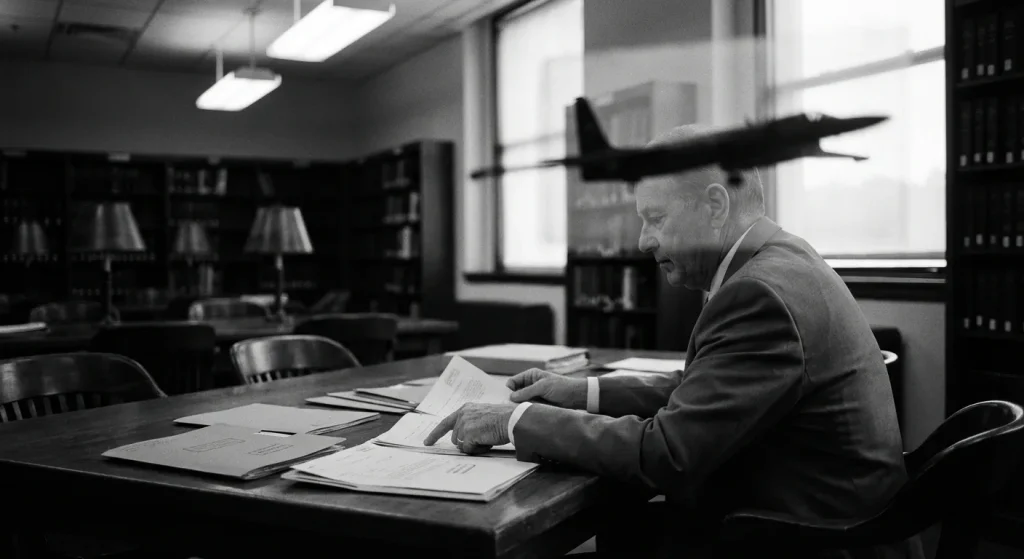
A key slice of classic UFO lore was shaped as much by classified flight testing as by official misdirection, and 1997 is the year that admission finally hit the record. In a 1997 historical paper for the CIA’s Studies of Intelligence, CIA historian Gerald K. Haines documented how secrecy around sensitive aviation programs fed public confusion (Haines, 1997). The New York Times then reported on Aug. 3, 1997 that the CIA acknowledged it had misled the public about some UFO sightings, and it explicitly cited that CIA historical study (New York Times, Aug. 3, 1997). For anyone who has watched “government cover-up” claims collide with mundane explanations, this is a documented point where both dynamics appear in the same story.
The stakes are not academic. You are making a real call, in real time, about whether today’s UFO disclosure news should be treated as evidence of non-human technology, or as a repeatable pattern where secrecy plus misidentification produces confident but wrong conclusions. That is the trust versus skepticism decision, and it determines how you weigh every new headline.
The tension this post resolves is straightforward: sincere witnesses can report what they truly saw, and the public can still receive answers constrained by classification, and that gap is where lasting mystery narratives take root. Mystery narratives thrive when the true explanation is classified, but mundane explanations do not automatically solve every report. The mid-century emotional anchor is familiar: a bright, reflective object near dusk or dawn, a silence that feels unnatural until sound arrives late, and an apparent altitude or behavior that looks impossible from the ground. Put a real aircraft at the kinds of high-altitude operating ranges described in official technical literature, and you get a sight picture that ordinary observers were never equipped to contextualize.
This article provides a historically grounded method for pressure-testing future claims without defaulting to either reflexive belief or reflexive dismissal.
What the CIA actually said
To use the 1997 admission responsibly, it helps to pin down exactly what document is being referenced and what it was meant to do. The 1997 CIA record people cite is a retrospective acknowledgment that secret aviation programs contributed to a meaningful share of UFO reports.
The provenance is also the point: it is an official historical account written by CIA historian Gerald K. Haines for the agency’s in-house journal, Studies of Intelligence, titled “C.I.A.’s Role in the Study of U.F.O.’s. 1947-90,” covering CIA involvement in UFO-related matters from 1947 to 1990.
This is not a whistleblower confession, and it is not an operational memo about a specific incident. It is the agency putting a post hoc explanation on the record, in a controlled, institutional voice, about how UFO reporting intersected with intelligence equities across decades, including what the CIA chose to say publicly and what it chose not to say.
The “institutional history” framing matches the broader documentary pattern around these reconnaissance efforts. A 1971 OXCART publication, for example, was explicitly prepared primarily for use by U.S. government officials, reflecting restricted, internal distribution rather than a public-facing narrative.
It also fits how the government treated the subject historically: the National Archives describes a classified official study of OXCART and related reconnaissance programs. A record that begins life inside that kind of compartmented ecosystem is exactly the sort of activity that later shows up in a retrospective as a driver of public confusion.
“Admitted” gets used as if the CIA “confessed” to a single, sweeping deception about every UFO report. Haines’s 1997 account is narrower: it acknowledges that secret aircraft activity contributed to sightings in many cases, not that it served as a universal explanation for every report, in every year, across every reporting channel.
The second distortion is treating the acknowledgment as case closure. A retrospective can explain why a category of sightings spiked without resolving individual reports one by one. Historically, many reports were routed into Air Force-facing processes that the public associated with official answers (for example, Project Blue Book), but the CIA’s 1997 framing is about program-level context, not a docket of named incidents.
Finally, “admitted” is often framed as a moral “gotcha,” when the more precise takeaway is bureaucratic: secrecy around high-priority reconnaissance programs drove what the government could safely say in public. The record of a documented struggle between the CIA and the U.S. Air Force over control of the A-12 OXCART project underscores how tightly these capabilities were managed, and why public transparency was not the operating constraint.
Here is what the 1997 record amounts to in plain English: the CIA later said that a meaningful portion of UFO reports were misidentifications of secret U.S. aviation activity, and that this was true in many cases, not all cases.
Haines’s account explicitly points to OXCART (A-12), a top-secret CIA reconnaissance aircraft program, and treats its 1960s-era activity as one contributor to UFO reporting during that period. The claim is about contribution and context: the public was seeing something real in the sky, but it was not being told what the program was.
The contemporary media “admission” framing largely reflects how major outlets summarized the historical study. As reported by The New York Times (Aug. 3, 1997), the CIA acknowledged it had misled the public about some UFO sightings, citing Haines’s Studies of Intelligence study as the basis.
Why U-2 flights triggered UFO reports
Once the CIA’s 1997 framing is taken as a program-level explanation rather than a case file, the next question is mechanical: what, exactly, about these aircraft made sincere observers describe something that sounded impossible? The U-2, a high-altitude U.S. reconnaissance aircraft developed under Project AQUATONE, created a repeatable set of witness perceptions that reliably read as anomalous because it operated high enough to break the normal cues people used to judge aircraft in the 1950s and 1960s. Project AQUATONE was the CIA-led program that developed and fielded the U-2 reconnaissance aircraft, and it was nearing operational deployment by January 1956. The aircraft itself was designed for intelligence gathering at altitudes above 70,000 feet.
From the ground, that altitude compresses all the usual “distance math” into something the eye handles badly. A very high aircraft presents a small, steady point with little apparent motion, so observers often underestimate its range and overestimate its size or performance. Add the era’s limited public context about routine operations at those heights, and a normal overflight becomes, perceptually, a “thing” that doesn’t fly like anything else.
Even on paper, the U-2’s typical operating band sat in territory that was not part of everyday aviation awareness; a NASA document groups typical U-2 operating altitudes alongside a 59,000 to 65,000 foot range cited for proposed high-speed commercial passenger aircraft.
The biggest amplifier was time of day. High-altitude aircraft and contrails can stay illuminated by direct sunlight after local sunset because the aircraft is still “up in the sun” while the observer is already in twilight or darkness. To a witness on the ground, that produces an attention-grabbing contradiction: the sky around the object looks dim, the landscape is darkening, yet the object itself is bright and sometimes sharply outlined.
This geometry also scrambles intuitive direction and speed estimates. In twilight, the horizon reference fades and the remaining contrast is mostly between a lit object and a darkening sky. When that bright point tracks smoothly with no obvious change in brightness, many observers read it as hovering or moving “too steadily,” even though they’re simply watching a distant aircraft cruise at high altitude.
Contrails do most of the work in turning an airplane into a “UFO-like” sighting because they are made of water-ice crystals that reflect and scatter sunlight. In the same twilight setup, the trail can look brighter than the aircraft, so witnesses anchor on the luminous structure rather than the tiny airframe that created it.
Once the contrail becomes the main visual, it stops behaving like a familiar “smoke trail” in the way people expect. Ice-crystal shape and structure control how the trail interacts with light, which is why the same contrail can swing from faint to intensely bright as the viewing angle changes, even if the aircraft’s flight path is steady. From the ground, that reads as pulsing, shimmering, or “energized” motion.
The geometry also creates apparent shape changes that feel physical. A thin line can broaden into a glowing spindle, break into segments, or develop bright knots as different parts of the ice-crystal cloud catch sunlight at slightly different angles. If the trail persists and spreads, the object appears to “grow” or “transform” while the aircraft itself remains hard to resolve, which is exactly the pattern that produces reports of structured craft or multiple objects maneuvering together.
Sound timing is the final trap that makes otherwise careful observers feel certain something is off. Some reports describe a “dead silent” object, or sound arriving 10 to 20 seconds after the visual. At high altitude, that’s a straightforward perception mismatch: the aircraft is far away, sound travels much slower than light, and the noise is easily masked by wind, terrain, and everyday ambient sound until it arrives late and faint.
Radar could add a second mismatch rather than resolving the first. Period radar displays often gave controllers and operators a target return without an intuitive, modern “picture” that a layperson would recognize, and altitude and track interpretation depended on system capability and operator context. A high-altitude target seen visually in twilight can therefore be described with one set of cues (bright, stationary-looking, silent) while radar reports a different set (a moving return at range), and witnesses treat the discrepancy itself as evidence of anomaly.
The practical takeaway for historical UFO reports is mechanical, not mystical: before you argue about intent or secrecy, check whether the report’s time-of-day, sustained brightness after sunset, contrail-like persistence and shape changes, and silence or delayed sound match a high-altitude aircraft plus twilight illumination profile.
Secrecy, denials, and the cover-up narrative
The perception mechanics explain why witnesses reported what they reported; secrecy explains why the official story often failed to reduce public uncertainty. Cold War secrecy alone can generate a durable “government UFO cover-up” perception even when the underlying object is human technology. The mechanism is straightforward: the state conceals aircraft capabilities, basing, and mission profiles because those details are operational advantages. The public experiences that secrecy as denial, evasion, and missing records, which looks identical to a more exotic concealment claim from the outside.
The U-2 and OXCART (A-12) were top-secret programs with histories documented across declassified records and official studies spanning multiple parts of the U.S. government, including CIA, DoD, and White House-era documentation streams collected by archival projects. Those same records also show that some official treatments remained classified for years and later appeared in redacted, declassified form, which is exactly what you expect when the “secret” is aircraft performance and operations, not aliens.
The key distinction is the category of secrecy. (a) Concealment of technology and operations is historically documented and routine for national security programs. (b) Concealment of extraterrestrial or non-human intelligence claims is a different allegation entirely, and this section does not validate it. Treating both as the same “cover-up” collapses two very different hypotheses into one emotionally satisfying story.
Compartmentalization is not a vibe; it is an administrative design. Material is packaged for specific audiences, and distribution is intentionally narrow, including internal-use publications prepared primarily for government officials rather than the public.
That structure produces a complication that people underestimate: many officials and military personnel who get questioned are not “in on it.” Need-to-know access means the honest answer from a base public affairs officer, a local commander, a police dispatcher, or a mayor calling for clarification is often “we don’t know,” because they genuinely do not. Those sincere denials can sound coordinated and sinister when multiple offices deliver the same non-answer, but the sameness is a byproduct of compartmentalization, not proof of a shared alien secret.
Project Blue Book, the U.S. Air Force’s investigation into UFO reports, functioned as a public-facing intake and triage pipeline. Classified flight testing existed in parallel. That split creates information asymmetry: civilians submit sightings into a system that cannot publicly confirm classified explanations, so the official output skews toward ambiguity even when an internal explanation exists.
Blue Book’s end did not end public interest. The narrative persisted for decades because the incentives remain: sightings are public, while many sensitive explanations are not. Modern reports show the same pattern with different objects. Satellites have been identified as a major source of UFO reports, a mundane but surprising explanation that still feels uncanny when you do not know what you are looking at.
The actionable takeaway is a sorting question: when someone alleges a “government UFO cover-up,” first ask what kind of secret is being alleged, technology and operations or non-human intelligence, and whether known secrecy structures would have produced the same confusion even if the answer never left Earth.
What the U-2 explains and doesn’t
Those secrecy dynamics can make one historical mechanism sound larger than it is, so the next step is to draw boundaries around what the U-2/OXCART explanation can and cannot plausibly cover. The U-2 and OXCART (A-12) explanation is powerful, but only inside a narrow box: the right years, the right altitude cues, and the right kind of report. The recurring mistake in modern debate is treating one solved bucket as either total debunking or total confirmation. Both are category errors. A disciplined filter makes the historical record useful without pretending it answers every claim ever filed.
The sorting framework starts with timeline logic because the platforms have hard start dates. U-2-linked misidentifications only become plausible once the program is operating at scale, which is late-1950s onward in the public UFO-report timeline. OXCART (A-12) belongs to a later window: it is an early-1960s development program, with Lockheed selected and the OXCART program name assigned after Project GUSTO was terminated (a quick way to anchor that you are not talking about 1952-era waves).
The second filter is altitude and distance as described by the witness, not as inferred by later authors. The CIA’s framing is about high-altitude overhead collection aircraft being seen from the ground. Reports that read like distant, high-altitude visual observations belong in the “possible U-2/OXCART signature” bucket. Reports that read like near-field objects operating down in the environment do not.
The third filter is context: location near test corridors, strategic ranges, or periods of known flight activity helps, but context never overrides the first two filters. If the date is wrong for the platform, or the report is a close-range narrative, the match fails.
The CIA’s assessment is not subtle: U-2 flights and later OXCART flights accounted for more than one-half of all UFO reports, as a CIA judgment about the reporting environment those programs created. Read literally, that is a claim about volume and misattribution, not a claim that “all UFOs were U-2s,” and not a claim that every report shares the same cause.
That “more than half” framing fits best in a specific reporting shape: mid-century, high-altitude visual reports where the witness has no access to classified flight schedules and no way to verify what was overhead. It is a model that explains why a large number of otherwise sincere reports accumulated, and why official denials did not reduce the churn.
| Report category | Timeline fit (U-2 late-1950s+, OXCART early-1960s dev) | Report features | How far the CIA framing reaches |
|---|---|---|---|
| High-altitude visual sightings (mid-century) | Often fits | Distant lights or objects, limited detail, “overhead” framing | Directly addressed by the U-2/OXCART misidentification thesis |
| Close-range, low-altitude “landing” narratives | Usually does not fit | Near-field detail, ground interaction, occupants, traces | Not directly addressed by “high-altitude overhead aircraft” explanations |
| Later-era military incidents with multiple sensors | Often outside scope | Radar, IR, electro-optical, range gating, multiple platforms | Not resolved by a 1950s to 1960s reconnaissance-aircraft explanation |
| Claims with radically different timelines or performance | Fails by definition | Pre-U-2 waves, or capabilities that do not map to U-2/A-12 context | Out of bounds for this specific historical mechanism |
The U-2/OXCART account does not directly answer close-range, low-altitude landing stories because those narratives are not “high-altitude visual reports” in any meaningful sense. If a report centers on an object on or near the ground, sustained proximity, or detailed interactions, it is a different class of claim and must be evaluated with different tools.
It also does not resolve later-era incidents built around multiple sensors and military systems. Even if some modern cases eventually collapse into mundane explanations, that conclusion cannot be imported from a Cold War overhead-reconnaissance story. The mechanism, the era, and the evidentiary basis differ.
The historical record removes a large chunk of “mystery fuel” that modern non-human intelligence and “alien disclosure” narratives often draw from: a substantial fraction of mid-century UFO reporting can be explained by secret U-2 and OXCART operations, and the CIA itself framed it as more than half of all reports. What it does not do is logically settle every case, every decade, or every report type.
- Classify the claim by year first, then reject platform matches that fail the timeline (U-2 late-1950s onward; OXCART early-1960s development).
- Sort by report type: high-altitude visual observation versus close-range, low-altitude narrative.
- Weight the evidence by sensor stack: eyewitness-only accounts sit in a different evidentiary class than multi-sensor military tracks.
- Conclude only within the category you are actually analyzing, instead of letting one solved bucket stand in for the whole subject.
Disclosure politics in 2025 and 2026
The Cold War lesson is not only historical; it shapes what “disclosure” can realistically mean in the present. In 2025 and 2026, the real fight is not over a single smoking-gun photo. It is over whether institutions will produce verifiable data that an outsider can audit. The vocabulary shift signals that priority: UAP (unidentified anomalous phenomena) is the modern umbrella term used by U.S. government entities for sightings or incidents that cannot be immediately identified with available data. That framing pulls attention away from pop-culture “UFO” assumptions and toward an evidentiary question: what was observed, what was recorded, and what can be corroborated across sensors, logs, and chain of custody.
The catch is that “unidentified” is not a synonym for “extraordinary.” It often means the report is too thin to close, not too strange to explain. The practical implication is straightforward: the most consequential disclosure story is the one where documentation improves, because better documentation is what turns speculation into an accountable public record.
AARO, the All-domain Anomaly Resolution Office, is built around a basic workflow: take in cases, triage them based on what evidence exists, and publish summaries of what can responsibly be said in public. Its 2025 mission brief states many cases in its holdings remain unresolved because of a lack of verifiable data. That is not a rhetorical escape hatch; it is an operational constraint. If a report arrives without reliable time stamps, sensor provenance, raw files, or corroborating sources, “unresolved” frequently means “underspecified,” not “unexplainable.”
The intake scale explains why this constraint matters. AARO reported a cumulative total of 510 cases by the end of August 2022, including 144 cases noted in the first 2021 report. Later, AARO reported that between May 2023 and June 2024 it examined 757 reports. Those numbers are workload indicators. They show how quickly a queue can fill with mixed-quality inputs, and why a public-facing office ends up talking as much about data standards as it does about outcomes.
Read AARO’s public outputs with that in mind. The office can only be as definitive as the underlying evidentiary package allows. When you see “unresolved,” the disciplined interpretation is “not enough verifiable data to reach a confident identification,” not “confirmation of non-human technology.”
Congressional oversight is the public touchpoint that turns the data problem into a governance problem. House Oversight has explicitly argued that the Department of Defense needs greater accountability to share UAP information with Congress and the American public, making transparency itself a subject of institutional performance rather than rumor.
The hearing titled “Restoring Public Trust Through UAP Transparency and Whistleblower Protection” illustrates the process dimension of disclosure: public questioning, an on-the-record forum, and a visible demand for clearer pathways to report and evaluate claims. The named witnesses, Jeffrey Nuccetelli, Chief Alexandro Wiggins, George Knapp, and Dylan Borland, matter here as evidence that a formal process occurred, not as validators of any particular allegation. Hearings establish what was said under institutional auspices; they do not, by themselves, establish what is true.
Legislatively, the UAP Disclosure Act of 2023 was proposed to accelerate disclosure of U.S. government records associated with UAP reports. The policy intent is structural: create a more standardized records-review and disclosure mechanism, then push agencies toward timely decisions about what can be released, withheld, or deferred. The friction is political and procedural. Proposals evolve across iterations and National Defense Authorization Act negotiations, and outcomes vary as language is added, narrowed, or removed.
The actionable takeaway is simple: judge 2025 to 2026 UAP news by data standards and institutional outputs. What gets documented, what gets released, and what can be independently checked tells you far more than any single clip, quote, or headline.
A clearer lens for future UAP claims
The historical and modern sections converge on the same point: the decisive variable is evidentiary quality, not the intensity of the narrative. The best way to navigate UAP claims is to demand verifiable specifics, because history shows that secrecy and human perception can manufacture convincing mysteries. The 1997 retrospective’s linkage between many older reports and classified aviation, the U-2 era mechanics that made sincere witnesses report “impossible” performance, and the real confusion created by need-to-know denials all point to the same discipline: treat “unresolved” as a data state, not a conclusion. At the same time, the U-2 and OXCART frame has limits, and modern UAP policy keeps producing thin, bureaucratic outputs when the underlying inputs are thin.
Evaluate every new claim like an incident reconstruction, not an impression: lock down the exact time and location first, then identify the sensor modality (eyewitness, EO/IR video, radar, ELINT, satellite, ADS-B, etc.) and what that modality can and cannot measure. Demand the method used for altitude and speed estimates (triangulation, radar range-rate, parallax, known reference points, platform telemetry), because “fast” without methodology is just an adjective. For imagery, insist on chain-of-custody and original files with metadata, since reposted clips destroy provenance. Finally, ask what independent corroboration exists where applicable, especially corroborating radar tracks or platform telemetry that can be cross-checked against the narrative.
If you want records, pick the correct lane and stay in it: FOIA and MDR (Mandatory Declassification Review) are distinct processes for seeking federal records, but agencies can lawfully withhold material under exemptions, including national security classifications. FOIA and MDR are distinct processes, and you must choose either MDR or FOIA for the same records; you cannot pursue both simultaneously. Set expectations: material reviewed for declassification within the past two years can be exempt from another review. Start your primary-source work in official reading rooms, including the CIA Reading Room and the AARO eFOIA Reading Room, then use FOIA release aggregators only as secondary indexes to find documents you can verify at the source; for broader openings, watch for automatic declassification at the National Archives and for declassification directives that flow through executive or congressional procedures.
That discipline is the practical value of the 1997 CIA record highlighted in the introduction: it shows how a real, high-priority secret can generate sincere sightings, official evasions, and long-lived suspicion at the same time. Applied consistently, the same approach supports a clear trust-versus-skepticism posture grounded in what can be verified, rather than in what merely feels conclusive.
Frequently Asked Questions
-
What did the CIA admit in 1997 about UFO reports and secret aircraft?
A 1997 CIA historical paper by Gerald K. Haines stated that secret U.S. aviation programs contributed to many UFO reports, describing them as misidentifications of classified aircraft activity. The article summarizes this as the CIA later saying a meaningful portion of UFO reports were tied to programs like the U-2 and OXCART (A-12), not that every UFO report was explained.
-
What is the 1997 CIA document people cite about UFOs and the U-2?
It is a CIA in-house journal article in Studies of Intelligence titled “C.I.A.’s Role in the Study of U.F.O.’s. 1947-90,” written by CIA historian Gerald K. Haines. It covers CIA involvement in UFO-related matters from 1947 to 1990 and frames the issue at the program level rather than as a case-by-case incident file.
-
Did the CIA say all UFO sightings were U-2 flights?
No-Haines’s 1997 account is described as narrower, saying secret aircraft activity contributed to many sightings, not all of them. The article also notes the CIA judgment that U-2 and later OXCART flights accounted for “more than one-half of all UFO reports,” which is a volume claim, not a universal explanation.
-
What altitude did the U-2 fly at that made it look like a UFO?
The article states the U-2 was designed for intelligence-gathering at altitudes above 70,000 feet under the CIA-led Project AQUATONE. From the ground, that height makes a plane look like a small bright point with unusual apparent motion, especially when observers lack context for routine operations at those altitudes.
-
Why do U-2 contrails at dusk or dawn get reported as UFOs?
High-altitude aircraft and contrails can stay sunlit after local sunset, so witnesses in twilight may see a bright object against a darkening sky. The article explains contrails can appear to pulse, shimmer, or change shape as ice crystals reflect sunlight, producing reports of “transforming” or structured objects even when the aircraft is steady.
-
Why do some UFO reports describe silence or delayed sound from an aircraft?
The article says witnesses sometimes report “dead silent” objects or sound arriving 10 to 20 seconds late because the aircraft is far away and sound travels much slower than light. Wind, terrain, and ambient noise can mask the engine sound until it arrives faint and delayed.
-
How can I tell if a UAP report is likely a high-altitude aircraft misidentification or something else?
Use the article’s filters: check the year first (U-2 misidentifications are plausible late-1950s onward; OXCART fits early-1960s development), then sort by report type (distant high-altitude visual reports vs close-range low-altitude narratives). For modern claims, the article says to weight evidence by sensor stack and treat “unresolved” as “not enough verifiable data,” not confirmation of non-human technology.
