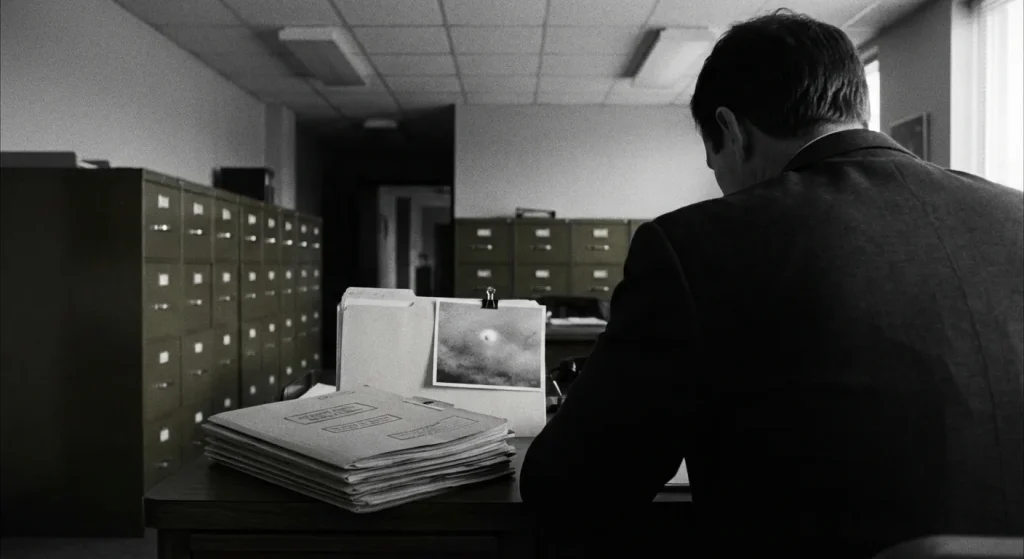
In 1993, CIA Director James Woolsey ordered a full review of UFO related CIA files, and the Agency later put that directive on the record. CIA’s own Studies in Intelligence (1997) piece “CIA’s Role in the Study of UFOs, 1947-1990” by Gerald K. Haines states that Woolsey “ordered a review of all Agency files on UFOs” (Gerald K. Haines, CIA’s Role in the Study of UFOs, 1947-1990). That matters in 2025 to 2026 because it gives the disclosure debate a hard anchor: a documented, director level tasking inside the CIA, not a secondhand anecdote. If a modern UAP headline claims “newly uncovered” government attention, 1993 is the benchmark for what top level attention already looked like inside the Agency.
Most readers are exhausted by the gap between rumor and record, and by the feeling that “disclosure” often means recycled ambiguity with updated vocabulary. The Woolsey review sits right in that tension, precisely because it is both specific in its existence and limited in what it necessarily yields. Public CIA summaries place the review in late 1993 and describe it as occurring after outside pressure from UFO researchers, a reminder that public demands can force internal checks without forcing public clarity (see the CIA Studies in Intelligence collection and the CIA declassified extract used in that study, Studies in Intelligence 1997 collection and declassified documents). The early 1990s also saw congressional pressure for stronger access to government records, including Senator Patrick Leahy’s late-1993 introduction of related legislation (S.1782) and the later Electronic Freedom of Information Act Amendments of 1996 (Public Law 104-231), which President Clinton signed in 1996 (S.1782, Congress.gov, and statement on signing, President Clinton), reinforcing that the period was defined by external scrutiny rather than quiet, voluntary transparency.
Director level attention is real, and it still does not guarantee definitive answers for the public. CIA Reading Room messaging highlights that the Agency has released a substantial tranche of UFO related material totaling 2,779 pages (CIA Reading Room UFOs collection). Page count proves volume, not resolution: a large release can document process, searches, and bureaucratic history while leaving the core question unresolved, which is exactly why the same set of documents can be cited as “proof of a cover up” and “proof of nothing” at the same time.
Use 1993 as your filter for every 2025 to 2026 disclosure claim. If someone says the government is “finally looking,” ask whether their claim reconciles with the CIA’s own record of a Woolsey ordered, Agency wide file review (as described in Studies in Intelligence, 1997), the CIA’s late 1993 timing in its public summaries, and the Reading Room’s 2,779 page release messaging. Document first, storyline second.
Why 1993 was a pivot year
The 1993 CIA-wide push to review sensitive legacy holdings landed in a Washington environment that made UFO-related transparency pressure harder for intelligence leadership to ignore. A “UFO” was, in practice, an observation that was not identified at the time of reporting, and that uncertainty reliably generated paperwork, routing, and follow-up questions. In early 1993, intelligence officials were already voicing public concern about potential “wholesale budget cutbacks,” while internal guidance explicitly recommended declassifying historical materials to increase openness and signal organizational change.
Tight budgets do not just shrink programs. They force agencies to justify missions, defend tradeoffs, and reduce self-inflicted controversies that drain credibility. The early-1993 talk of “wholesale budget cutbacks” put a premium on institutional legitimacy, especially around long-running public narratives like “government UFO cover-up” that did not go away on their own. Pair that with CIA guidance urging declassification of historical materials to demonstrate a change in how the organization conducts business, and you get a clear incentive: clean up the file rooms where low-security, high-visibility mysteries tend to accumulate.
The pressure was not only financial; it was structural. Congress established the Commission on the Roles and Capabilities of the U.S. Intelligence Community through the Intelligence Authorization Act for FY1995 (P.L. 103-359). That kind of formal roles-and-capabilities review changes what leadership optimizes for. When outsiders are empowered to ask what the intelligence community should do, why it should do it, and how it should be governed, unresolved legacy issues become liabilities, not curiosities.
The Clinton-era posture on disclosure was expressed in executable policy, not rhetorical mood music. Clinton-era declassification executive orders, including Executive Order 12958 (Classified National Security Information, 1995) and the imagery-specific Executive Order 12951 (Release of Imagery Acquired by Space-Based National Intelligence Reconnaissance Systems), are concrete examples of that direction of travel (EO 12958 text and citation and EO 12951 imagery declassification). The Department of Justice also reported that a new executive order on national security classification was expected to increase disclosure. Senior intelligence leaders had already been talking publicly about “openness in CIA” in 1992, which meant transparency was a leadership-level agenda item before 1993 turned it into an operational requirement.
FOIA, the Freedom of Information Act, is the mechanism that turns curiosity into mandatory record searches and release decisions. Once a first batch of “UFO files” is released, even partially, journalists and requesters can file narrower follow-ups, challenge redactions, and ask why similar items were withheld, producing a request cycle that feeds itself. The intelligence community had strong legal footing to protect sensitive content, including sources and methods, through FOIA exemptions and longstanding statutory duties. The net effect was predictable friction: the public treated UFO records as proof of hidden truths, while agencies treated them as records-management and risk-management problems.
Inside the intelligence community, the more durable framing was operational: airspace incursions, sensor misidentification, and ambiguity about foreign technology all demand disciplined analysis regardless of the headline label. That is why “UAP,” used as a broader, assumption-minimizing term for unidentified anomalous phenomena, fits how governments talk when the core question is not mystique but attribution and risk.
Read 1993 as a structural pivot, not a binary “disclose or cover up” moment. Those incentives-budgets, oversight, FOIA pressure, and a shift toward formal openness-set the conditions for why a director would demand an Agency-wide accounting of what actually sat in the files.
What Woolsey ordered and why
Woolsey’s 1993 instruction reads as a director-level governance move: it forces the Agency to reconcile what it believes exists with what it can actually locate and describe in its own record systems. The practical output of that kind of tasking is accountability and traceability inside the CIA, not a built-in promise that any review will end in dramatic public disclosures.
The surviving descriptions of the tasking are blunt: in 1993, CIA Director R. James Woolsey ordered a review of all Agency files on UFOs. The wording matters because “all Agency files” is a scope claim, and “ordered a review” is an internal directive that creates an obligation to search, compile, and report findings up the chain.
A “full review” functions as a forcing mechanism for inventory and control. In practice, it pushes the organization to answer concrete questions that a director can act on: what file series contain “UFO” material, which components hold the responsive records, and what the Agency can credibly say it has after a documented search.
The management value is clarity, even when the public outcome stays narrow. Woolsey already used classification-policy machinery to convert contested, sensitive holdings into a definitive, publishable answer elsewhere: the Woolsey-ordered Fundamental Classification Policy Review is characterized as a major success and is credited with declassifying the full list of U.S. nuclear explosive items. That track record makes a 1993 UFO-file review look like the same leadership instinct applied to a different bucket of records: get the facts on the table internally, then decide what can be acknowledged externally.
The Fundamental Classification Policy Review example also shows the boundary a director runs into: even a “major success” is described in terms of what can be declassified and published, not in terms of making every underlying record public. A UFO-file review can therefore be expansive as an internal search while still producing a controlled external result, because the core question is always what information can be affirmatively cleared for release without creating new exposure.
Woolsey’s incentives also favored documented record reality over informal assurances. A contemporaneous record states Woolsey was not told of any U.S. policy change in a meeting and therefore believed no policy change had occurred. That is the operational lesson a director cannot ignore: what is not surfaced, briefed, and recorded can drive decisions anyway, which makes a “find it, inventory it, and report it” order a rational control tool for any politically charged subject, including UFOs.
Four motivations fit what this kind of order accomplishes in 1993, without turning the directive into an “alien disclosure” stunt. First is reputational control: a director ordering an “all files” review is choosing the defensible posture of “we looked” over the brittle posture of “we assume.” Second is management pattern: Woolsey’s classification-policy record shows a preference for definitive answers that can withstand scrutiny and can be defended externally when a publishable conclusion exists.
Third is counterintelligence and security hygiene in a period that explicitly reprioritized those concerns. In that environment, “UFO” tagged holdings are not just a curiosity; they are a category a director would want scoped for sensitivity, rumor dynamics, and interagency friction.
Use Woolsey’s directive as a test for modern UAP disclosure claims: separate the searchable scope (“all Agency files” versus a narrow subset) from the deliverable (an internal inventory versus releasable records), and judge the outcome by what can be documented, not by what is implied.
What the CIA files actually showed
Woolsey’s 1993 push for a hard look at classified holdings did not produce a single “answer” about UFOs. It produced something more useful: a paper trail showing what the CIA thought the UFO problem actually was, what parts of it were later explained by secret aerospace programs, and why a residue of information stays withheld even after a review.
The most direct line in the CIA’s own historical accounting about early UFO attention is logistical, not speculative. In describing the surge of reports during the Korean War era, the CIA record uses the 1952 phrasing that UFO reports were “clogging” military channels. The point was operational: high volumes of ambiguous sightings and phone calls forced Air Force and air defense elements to spend time sorting signal from noise during a period when real incursions were a live national security concern. The practical takeaway is that the CIA’s early interest tracks workload, communications capacity, and vulnerability to exploitation, not fascination with extraordinary claims.
The friction is that “clogging” does not mean “false.” It means the reporting pipeline could be overwhelmed. That distinction matters, because it frames the 1953 Robertson Panel era response as an attempt to protect military readiness and communications, not a referendum on what every witness saw.
The CIA’s historical write-up goes further than “we looked and found nothing.” It explicitly ties a share of UFO reporting to classified reconnaissance flight testing and operations. The CIA account states that some sightings correlated with U-2 overflights, and later with A-12 testing under OXCART. This is the cleanest, evidence-led explanation inside the CIA narrative: civilians and even pilots reported unfamiliar, high-altitude, high-performance aircraft because they were not cleared to know those aircraft existed.
The nuance is that correlation is not a universal solvent. U-2 and A-12/OXCART only explain the slice of sightings that match the time, place, altitude, and performance envelope of those programs. The actionable insight for readers trying to interpret “CIA files” is simple: where a report’s details line up with known clandestine flight regimes, the CIA’s own history treats that as the default explanation category, not an afterthought.
A practical constraint on any “what did the CIA files show” question is that the public-facing collection is not a single, internally generated case file series. The record itself reflects compilation. One released document explicitly thanks Barry J. Greenwood for providing material from his extensive UFO collection, which signals that at least some items were gathered from outside holdings rather than produced end-to-end inside CIA channels.
That compilation reality shows up in the provenance trail as well. A separate, user-reported account describes Greenwood physically retrieving “half of a UFO collection” for a former researcher, with the remainder expected later. Treated as user-reported rather than official, it still reinforces the central point: the “UFO file” story often hinges on what was collected, copied, and curated, not just what was originally written inside Langley.
That distinction between internal casework and later compilation is also why an Agency-wide review can be meaningful without producing a single, self-contained public “case file” series. A review can confirm what exists, where it lives, and what can be released, while still leaving the public-facing record as a curated set of materials rather than a complete operational archive.
When the government withholds national security material under FOIA, the core legal hook is usually Exemption 1. The statutory definition is specific: Exemption 1 covers matters that are “(A) specifically authorized under criteria established by an Executive order to be kept secret in the interest of national defense or foreign policy and (B) are in fact properly classified pursuant to such Executive order.” That language explains why a review can acknowledge broad conclusions while still declining to publish operational detail.
DOJ guidance adds a second, less intuitive constraint: being overly granular about which exact exemption applies to which exact line item can itself disclose protected information. In intelligence cases, the government treats the pattern of what is withheld, and under what rationale, as potentially revealing. That is why FOIA responses often feel unsatisfying to lay readers even when they are legally and operationally coherent.
The third leg is not discretionary policy but statutory duty. The National Security Act imposes an affirmative obligation to “protect intelligence sources and methods from unauthorized disclosure.” That duty is the institutional reason agencies fight to preserve details that look trivial in isolation, including tradecraft, collection posture, and internal handling that would let an adversary map capabilities.
| Bucket | What the CIA record supports | What you should do with it |
|---|---|---|
| Confirmed | The CIA treated the 1952 surge as a national security burden, explicitly describing reports as “clogging” military channels. | Read early-era actions as workload and readiness protection, not a verdict on every report. |
| Explained | CIA historical accounting links some sightings to U-2 and later A-12/OXCART overflights. | Use time-place-performance matching as the first filter for Cold War era cases. |
| Withheld | Persistent redactions track Exemption 1 classification rules and the statutory duty to protect “sources and methods,” with DOJ warning that too-much specificity can be revealing. | Expect summary-level transparency without operational-level disclosure, even after a “full review.” |
How 1993 foreshadowed UAP disclosure
The 1993 episode is easier to interpret when you treat it as bureaucracy under pressure rather than a one-off UFO story. The modern UAP disclosure story runs on a familiar administrative cycle: public attention spikes, government formalizes how reports are collected, analysts review what exists, and leadership releases what can be released without compromising protected information. That rhythm is the real through-line from the 1993 review episode to today: the bureaucracy does not “admit” a single grand answer; it routinizes a messy topic into intake, assessment, and controlled disclosure.
The tell is not a viral clip or a dramatic claim. The tell is when the system builds a lane for the work: a budget line, a contract, a task force, a reporting standard. Those structures do two things at once. They improve collection and reduce noise, but they also impose classification rules and evidentiary thresholds that limit what can be released publicly.
AAWSAP/AATIP is the modern mirror of “standardize and assess” in program form: documented Pentagon-funded work beginning around 2008 and continuing to about 2012 under a Defense Department contract to study anomalous aerospace reports. That matters because it anchors the topic in procurement and analysis rather than folklore. Once the work is contractual, it generates artifacts: defined scope, deliverables, and an internal paper trail that can be audited even when details remain classified.
The same institutional instinct shows up in the Unidentified Aerial Phenomena Task Force (UAPTF). The Department of Defense established UAPTF in 2020 to standardize collection and reporting across the military. Standardization is not a headline-grabber, but it is the prerequisite for any serious adjudication: common terminology, consistent reporting channels, and comparable data across units.
A sighting is an event. Disclosure is a record that can survive review. Between those two points sits the hard part: corroboration, metadata, custody, and classification. Anecdotes can be sincere and still be non-actionable. Sensor data can be compelling and still be non-releasable if it exposes sources and methods. Even an internally resolved case can remain publicly opaque when the resolution itself reveals capabilities the government keeps properly classified.
Readers who want clarity should separate three layers in their head: (1) human testimony, (2) instrumented data (radar, IR, imagery), and (3) adjudicated, releasable government records. Only the third category is “disclosure” in any usable sense, because it is what the system is willing to stand behind on paper.
The center of gravity now is institutional, not personal. AARO, widely referred to in headlines as the “Pentagon UFO office,” is the focal node readers should watch because its job is process: collecting, analyzing, and reporting within the Defense Department’s lanes. Public voices will keep driving attention, including well-known commentators like Luis Elizondo, Christopher Mellon, and journalist George Knapp, but personalities do not create releasable records. Offices do.
Track outputs, not escalation: official reports, published data standards, formal directives that change how incidents are logged, and authorized releases of imagery or case summaries. When UAP chatter spikes, treat it as a signal to check for new deliverables. If the paperwork does not move, “disclosure” is not happening, no matter how loud the cycle gets.
Congress, laws, and whistleblower pressure
Congress is the enforcement mechanism that can turn “UAP disclosure” into auditable obligations. Viral clips create attention; statutes, subpoenas, and committee demands create paperwork: preserved records, fixed deadlines, and sworn statements that carry legal risk if falsified. The complication is that oversight can prove a complaint exists and that officials were notified without proving the extraordinary underlying allegations are true. The value is procedural: it forces a trail you can track.
Protected reporting channels turn “I heard something” into a document that the government has to route, log, and evaluate. David Grusch is the cleanest process example because his pathway is documented as procedural: he used a PPD-19 filing seeking an Intelligence Community Inspector General (ICIG) reprisal investigation tied to protected communications. That establishes a narrow, verifiable point: a protected-communications and retaliation process was invoked, regardless of whether any claims about non-human intelligence are correct.
A separate, documentable breadcrumb exists in FOIA material. A DNI FOIA release references whistleblower retaliation complaints in 2022 to 2023 and notes communications to the ICIG by David Charles Grusch. Read that for what it is: evidence that oversight communications occurred in official channels, not independent validation of the substance of the allegations discussed in public.
Hearings matter more than clips because the “deliverable” is the record. Testimony is a statement made under oath or formal procedures; exhibits are the materials entered alongside it; mandated reporting is the recurring paperwork Congress can require from agencies on a schedule. Each one creates different leverage. Testimony locks witnesses into a version of events. Exhibits anchor details that can be requested again. Mandated reporting forces agencies to keep producing updates that can be compared over time for inconsistencies.
For readers tracking what is actually scheduled and logged, committee paperwork is the starting point. House Oversight committee records list a hearing titled “Restoring Public Trust Through UAP Transparency and Whistleblower Protection” scheduled for September 9, 2025, as listed on the committee schedule (House Oversight hearing listing).
Most introduced UAP-related efforts share the same mechanical intent: force agencies to find records, standardize reporting, and run disclosure through controlled review. Names vary, including the Schumer UAP Disclosure Act, UAP Disclosure Act, UAP Transparency Act, NDAA UAP provisions, and proposed amendments like Burlison’s. The common aim is process, not narrative: centralized collection, a defined review mechanism, timelines, and guardrails that control what gets released and how exceptions are handled.
Public interest names like Burchett and Luna show up here as signals of oversight attention, but the real “pressure” is the statutory and committee machinery.
- Read the statutory language itself, not summaries, for deadlines, scope, and definitions that force agencies to act.
- Pull committee records: hearing listings, witness lists, written statements, and exhibits tied to UAP transparency.
- Verify inspector general documentation: filings, acknowledgments, and FOIA-released references that confirm a complaint or communication occurred.
- Compare released exhibits and mandated reports over time to spot what changed, what was added, and what was quietly narrowed.
What Woolsey’s review teaches now
Woolsey’s 1993 review proves the system can move, on purpose, at the director level, without producing the kind of definitive public answer the internet demands. Director-level reviews are governance acts with real consequences, but the public record that follows stays bounded by classification constraints that agencies are obligated to defend and that courts routinely defer to when properly invoked.
That split between internal action and external certainty is the through-line from 1993 to 2025. In 1993, incentives cut both ways: political pressure rewarded visible accountability, while national-security institutions still defaulted to protecting what they considered sensitive. The result is the pattern you still see in the Reading Room today: a documented leadership action, a sizeable body of released material, and persistent limits on what can be said publicly even after a search is conducted.
Today’s forcing function is different. Modern disclosure pressure is routed through programs, oversight, and mandated reporting, so progress shows up less as a single “answer” and more as auditable outputs: committee records, Inspector General documentation, formal responses, and repeatable publication patterns.
If you want a calendar you can actually hold agencies to, follow FOIA operations like a quarterly earnings cycle. The Department of Justice Office of Information Policy published guidance setting posting timelines for agencies’ quarterly FOIA data, which establishes predictable windows for public FOIA metrics and related postings (see DOJ OIP guidance on upcoming FOIA reporting deadlines, including the July 31, 2026 and October 30, 2026 windows referenced by OIP) (DOJ OIP FOIA reporting deadlines guidance). Those dates matter because they create predictable windows for new release artifacts, backlog movements, and disclosure signals you can verify without guessing.
Make “document-first” your default: prioritize primary sources, committee records, IG documentation, and official releases, then work backward to the claims. Treat viral UFO news and UAP news as leads, not conclusions, until they tie to something auditable. For more reporting built around records instead of rumor, follow our updates.
Frequently Asked Questions
-
Did CIA Director James Woolsey order a review of UFO files in 1993?
Yes. CIA’s own Studies in Intelligence (1997) states that in 1993 Director R. James Woolsey “ordered a review of all Agency files on UFOs,” and CIA public summaries place the review in late 1993.
-
What’s the most reliable source confirming the 1993 CIA UFO-file review?
CIA’s Studies in Intelligence (1997) is the key on-the-record source, quoting that Woolsey “ordered a review of all Agency files on UFOs.” CIA public summaries also describe the review as occurring in late 1993.
-
How many pages of UFO-related material has the CIA released?
The CIA Reading Room messaging cites a release totaling 2,779 pages of UFO-related material. The article notes the page count indicates volume of records, not definitive resolution of UFO claims.
-
Why was 1993 a pivot year for CIA UFO/UAP transparency issues?
The article ties 1993 to intensified outside scrutiny, including pressure from UFO researchers, FOIA-driven record searches, and a Clinton-era policy direction toward declassification. It also notes early-1993 budget-cutback talk and oversight pressure that made legacy issues like “UFO files” a leadership-level governance problem.
-
What did the CIA’s historical record say many early UFO sightings were actually tied to?
CIA historical accounting links some UFO reports to classified reconnaissance programs, including U-2 overflights and later A-12 testing under OXCART. The article emphasizes these programs explain a “slice” of sightings that match time, place, altitude, and performance details.
-
Why do CIA UFO documents still have redactions even after a full review?
The article explains that FOIA Exemption 1 protects properly classified national-security information and that the National Security Act requires protecting “intelligence sources and methods.” It also notes DOJ guidance that overly specific explanations of redactions can itself reveal protected information.
-
How should I evaluate 2025-2026 UAP disclosure claims using the Woolsey 1993 review as a filter?
Check whether a claim reconciles with the documented late-1993 CIA-wide review ordered by Woolsey, the Studies in Intelligence (1997) statement, and the CIA Reading Room’s 2,779-page release. Prioritize auditable outputs-official directives, IG documentation, committee records, and FOIA releases-over viral narratives.
