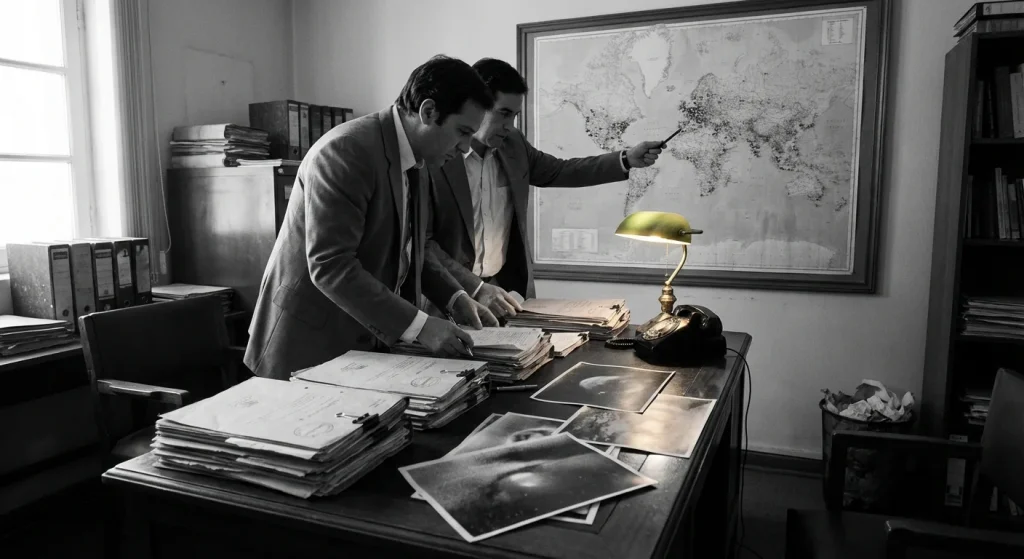
You are not lacking UFO news in 2025 and 2026. You are drowning in it: nonstop clips, recycled “UFO sightings 2025” roundups, and “UFO sightings 2026” threads that treat every light in the sky like breaking national security history. The real problem is simpler: you want to know what counts as real government infrastructure versus hype dressed up as authority.
If you want to separate signal from noise in UAP disclosure, follow the institutions. Disclosure talk obsessively centers on secrets and extraordinary claims, but the operational question decides whether anything durable happens: who receives reports, how those reports are evaluated, and what gets communicated publicly once the initial heat fades. The hard part is not the headline. The hard part is building a state-linked mechanism that can responsibly absorb uncertain information without turning it into instant mythology.
Chile built that kind of mechanism early. CEFAA was established in 1997, and it is described as Chile’s official UFO investigation agency. That matters because 1997 sits well before the current UAP disclosure cycle and its algorithm-driven churn. This is what institutionalization looks like: a standing, recognizable place in the state’s ecosystem where anomalous aerial reports can be routed, handled, and spoken about with discipline. The boundary is straightforward, too: the provided source set does not include an official decree or resolution number or an exact establishment date for CEFAA, so this article treats “1997” as the verified milestone, not a document-number trivia contest.
Language shapes what you think the government is doing. UAP (unidentified anomalous phenomena) is the modern label that aims to capture any anomalous observation in or near airspace that cannot be quickly identified with available data, which keeps the focus on reporting and resolution rather than storytelling. UFO (unidentified flying object) is the older label for something seen in the sky that the observer cannot identify at the time, a framing that often pulls attention toward the object’s nature instead of the system that processes the report.
Use Chile’s 1997 CEFAA milestone as your yardstick for evaluating any “official UAP office” claim. Look for what it is, where it sits in the state, and whether it supports rigorous intake, evaluation, and disciplined communication. That yardstick is easier to apply once you understand why an aviation system would formalize anomaly handling in the first place.
Why Chile moved in 1997
1997 makes sense if you treat anomaly reports as airspace incidents to be governed, not mysteries to be debated. Aviation regulators do not wait for philosophical certainty before acting. They build intake pipelines that turn messy observations into structured records because unclassified “unknowns” still create real operational questions: separation risk, cockpit workload, controller decision-making, and post-event accountability. Formalizing how these reports are received, triaged, and preserved is the predictable outcome of any system that takes airspace risk seriously.
Chile fits that regulatory logic. The Directorate General of Civil Aeronautics (DGAC) exists as the civil aviation authority, originally created in March 1930, which is the kind of long-lived institution that accumulates procedures over decades rather than improvising them. On July 11, 1997, the U.S. Federal Aviation Administration (FAA) and Chile’s DGAC signed a Memorandum of Cooperation/Understanding (MOC) concerning aviation assistance, a concrete marker that Chile was operating inside international aviation cooperation norms where common expectations around reporting discipline and safety management matter. What the provided sources do not document are Chile-specific late-1990s modernization milestones or any specific pre-1997 incidents that forced the creation of a dedicated office; that absence sets a hard boundary on causal storytelling here.
The friction is procedural, not sensational. Aviation reporting systems must balance speed (capture perishable details while memories and logs are fresh) against evidence quality (timestamps, locations, altitude, weather, radar and ATC context) while also managing reputational sensitivity for crews, airlines, airports, and the regulator itself. International aviation practice reinforces this: reporting guidance focuses on defined event types, consistent narratives, and usable operational detail, and global rulemaking bodies push toward standardized frameworks that make data comparable across borders. That tension is exactly what motivates formal channels: you want rapid intake without turning every report into a public spectacle or an accusation.
Use one heuristic to evaluate any official UAP handling: does it look like an aviation-safety reporting model, meaning a safety and incident-management pipeline designed to capture standardized data, protect the integrity of the record, and reduce operational risk? If the emphasis is disciplined intake, repeatable fields, careful triage, and lessons that can be fed back into procedures, you are looking at aviation governance doing what it always does. The durable objective is better data and lower risk in controlled airspace, not adjudicating extraordinary claims.
CEFAA’s mission and structure
CEFAA is best understood as an institutional node inside Chile’s aviation state, not a belief statement about what unusual reports “really are.” It mattered because it was positioned close to aviation authority, and aviation authority is what gives an anomalous-report office credibility, access to operational stakeholders, and relevance to real airspace decisions.
CEFAA, established in 1997, is Chile’s official office associated with receiving and examining reports of anomalous aerial phenomena, and it is routinely described as Chile’s official UFO investigation agency. “Official” is not a vibe; it changes the mechanics of how reports enter government. A named state-linked office centralizes intake instead of scattering it across ad hoc contacts, sets a standard expectation that reports are evaluated through a defined institutional lens, and creates a stable point of contact for pilots, controllers, and other aviation-facing actors who need to know where to route information when something in the air does not immediately resolve into a normal track, aircraft, or identifiable activity.
A printed or archived source expands CEFAA in Spanish as “Oficina de Investigacion de Fenomenos Aereos Anomalos” and provides an English rendering as “Office for the Investigation of Anomalous…” Those two details are more than trivia because they show the framing: the office is oriented around “anomalous aerial phenomena” as a reporting and examination problem, not around entertainment-era labels. The same source set does not settle an official DGAC or CEFAA English name beyond that rendering, so any longer English expansion is interpretation, not a confirmed institutional title.
CEFAA’s credibility comes from where it sits. The DGAC (Dirección General de Aeronáutica Civil) is Chile’s civil aviation authority responsible for supervising compliance with Chilean laws and regulations relating to air navigation, and it reports directly to the Chilean Air Force. That reporting line signals two realities at once. First, proximity to the body overseeing air navigation makes CEFAA operationally relevant: aviation stakeholders have a clear incentive to coordinate because the parent institution is tied to compliance, oversight, and the governance of air navigation itself. Second, the same proximity imposes constraints: information handling is naturally more controlled, and coordination with aviation stakeholders becomes a default posture, because the office exists inside an authority structure built to manage airspace, safety obligations, and formal reporting relationships.
In disclosure debates, “official” gets used loosely. You can evaluate any claimed “official UAP office” by tracing three concrete things, in order of decisiveness:
- Mandate: Does it have an explicit remit to receive and examine reports, or is it a loose committee, outreach project, or media-facing initiative?
- Institutional seat: Where does it live inside government, and is it positioned near aviation governance, defense governance, or neither?
- Parent-body authority: What powers does the parent actually hold in the domain that matters, such as supervising compliance with air navigation laws and regulations, and what reporting line does it answer to?
One final constraint keeps the analysis honest: the provided research set does not show CEFAA publications, routine case summaries, press releases, annual activity reports, or an official case database, so “official” here should be read as institutional placement and mandate, not as a guarantee of public-facing output. That constraint also shapes what can responsibly be said about how CEFAA evaluates individual reports.
How CEFAA evaluates UAP reports
The difference between serious UAP work and internet lore is evidence handling. Credible evaluation is an evidence-management discipline, not a debate about beliefs, and it stands or falls on whether the report can be reconstructed in time, space, and platform context.
The practical constraint is straightforward: the provided sources do not document CEFAA’s exact intake channels, internal workflow, case disposition taxonomy, or resolution statistics. What follows is a generic, aviation-aligned best-practice framework that fits incident-style evaluation, not a claim about CEFAA’s official procedures.
Most UAP reports fail for one boring reason: they are under-specified. If you cannot pin down when and where the observation occurred, you cannot check air traffic, weather, celestial objects, or radar coverage with any confidence, and identification collapses into guesswork.
- Capture a precise time window (start, end, time zone) and the location (lat/long if possible, or nearest fix, landmark, or nautical mile reference).
- Record observer context: role (pilot, controller, passenger, ground witness), experience level, and number of observers.
- Specify the platform: aircraft type, altitude, heading/track, groundspeed/airspeed, and phase of flight (climb, cruise, approach).
- Describe the geometry: relative bearing, elevation angle above the horizon, apparent motion, and duration of visual contact.
- Pull environmental context: cloud layers, visibility, winds aloft, turbulence, and any notable astronomical conditions (bright planet, moon phase, twilight).
- Preserve original media and sensor exports: raw photo/video files, unedited cockpit recordings, and any device metadata (EXIF, timestamps, lens data).
Triage is a separate decision gate from analysis. If the report implies an immediate collision risk, near-midair, or interference with flight operations, the priority is operational safety: notify appropriate aviation safety channels and secure perishable data. If it is retrospective, the priority is reconstruction: locking down time, position, and the original files before memory and metadata drift.
Reliable cases get simpler as independent sources converge. A single witness statement can be sincere and still be wrong on distance, speed, or size; two or three independent data streams anchored to the same time and place turn a story into an analyzable event.
- Corroborate with aviation records: pilot reports from other aircraft in the area, ATC communications and logs, and any available radar returns or tracking data.
- Cross-check meteorology: winds and temperature profiles (balloon drift, cloud motion), visibility, and the presence of inversions that can distort light.
- Validate against known traffic: scheduled flights, military training windows where public information exists, NOTAMs, and common transit corridors.
- Compute astronomical factors: bright planets low on the horizon, star fields, satellite passes, and re-entry events tied to the reported azimuth and time.
Once the event is pinned down, “elimination” becomes a disciplined series of checks rather than a debunking attitude. Common misidentifications in UAP reports often include balloons and drifting debris (especially when winds aloft match apparent motion), aircraft lights seen head-on (apparent hovering due to closure rate), bright planets near twilight (steady, low-elevation lights), re-entries (fragmenting, accelerating trails), parallax from a moving observer (rapid apparent lateral motion), and camera artifacts such as rolling shutter, autofocus hunting, and digital stabilization. The point is not that every case is mundane; it is that many become identifiable when time, location, and platform are non-negotiable inputs instead of vague anecdotes.
Serious investigations handle photos, video, and sensor exports as evidence, not content. That is where chain of custody matters: a documented record of how evidence is collected, handled, stored, and transferred to preserve integrity. If the “best clip” is a screen recording of a social-media repost, the analytical ceiling is low; if the original file is preserved, with metadata intact and transfers logged, analysts can test timestamps, lens parameters, compression history, and continuity with other records.
Documentation is the quiet backbone: a case file that links every claim to a source, keeps originals unchanged, notes every copy and export, and records who had access and when. That discipline prevents later disputes about tampering, selective editing, or accidental recompression, and it keeps the investigation auditable.
A practical disposition model uses generic categories such as “explained” and “unresolved (case status)”. “Explained” means the available evidence supports a specific identification consistent with the data. “Unresolved (case status)” is an outcome where the available information is insufficient for a confident identification, not a conclusion about extraordinary origin. Unresolved is a statement about the file’s limitations, not proof of non-human intelligence.
Because the provided sources do not document CEFAA’s exact disposition taxonomy, categories, channels, or statistics, any labels here are best-practice terminology only. Treat any article that presents an “official” breakdown without primary documentation as marketing, not method.
Use this checklist on any “UFO disclosure” or “UAP disclosure” story before you believe the framing: Do you have exact time and location, observer role, and platform data? Are there independent corroborations such as ATC logs, radar, meteorology, flight schedules, or astronomical checks? Were common misidentifications actively tested against the pinned-down geometry? Is evidence integrity documented through originals and a clear chain of custody? If the piece leans on an “unresolved” label, verify whether that status reflects disciplined uncertainty or simply missing data.
How CEFAA compares globally
The global question is not who saw what; it is what kind of office a state builds. Institutional design determines what “disclosure” can realistically deliver. In that frame, CEFAA’s early start matters less as a historical curiosity and more as a concrete design alternative to the politically saturated UAP offices that now sit under constant headline pressure. An office built for disciplined incident handling produces one kind of output; an office built inside a national-security media storm produces another, even if both use similar words to describe their case status.
Longevity is a design choice, not a vanity metric. Older, continuously operating efforts tend to accumulate routines: intake standards, investigation handoffs, and institutional memory about recurring misidentifications. Newer offices are often born from a spike in attention, and that origin story can hard-wire short timelines and public expectations into the mandate. Peru is a useful regional reminder that formalization was not limited to Chile: a department within the Peruvian Air Force devoted to UFO or UAP was reported created in December 2001. The actionable point for readers is simple: continuity usually signals an office built to outlast a news cycle, not just answer it.
High civilian reporting volume does not buy interpretive clarity. Analysts reported 986 UFO reports in Canada in 2011 and 1,981 reports in a later year, numbers that work as context for how much raw signal any country can receive once reporting channels are visible and socially reinforced. The complication is that volume expands triage load faster than it expands certainty: more cases mean more mundane explanations, more duplicates, and more low-information sightings that never reach a decisive disposition. A serious office design treats reporting volume as a staffing and process problem, not as proof of anything about the underlying phenomenon.
Political attention changes what the public thinks an office is for. An aviation-safety-adjacent framing anchors the work to incident handling: evaluate hazards, document anomalies, close cases when evidence supports it, and keep the rest in a holding pattern without theatrical conclusions. A defense-intelligence framing pulls the same fact pattern toward national-security storytelling, where “unresolved” becomes a rhetorical object that media cycles can inflate into insinuation. The practical effect is narrative capture: observers start judging offices by how well they feed suspense, not by whether they reduce uncertainty with disciplined methods.
A useful rubric for comparing any “official UAP office” that shows up in UFO news is structural, not emotional. Look for a stable mandate that survives leadership and election churn, a scope that is clearly bounded (airspace incidents versus broader collection), and insulation from headline incentives that reward ambiguity. If you can’t identify those constraints, you are not evaluating an institution; you are evaluating a storyline. Those institutional contrasts set up why Chile’s 1997 model matters in today’s disclosure arguments.
What CEFAA means for disclosure
Disclosure without an intake institution produces noise, not clarity. CEFAA’s existence shows that “disclosure” is not only about releasing secrets, it is about building institutions that can receive, triage, and responsibly communicate anomalous reports over time. That distinction matters because the public debate treats disclosure like a single event, while credible accountability is a sustained capability: someone has to accept reports, standardize what gets collected, decide what can be ruled out, and communicate outcomes without contaminating the record with hype.
Global search interest clusters around U.S. headlines because the U.S. security state is the loudest arena for disclosure politics: “UFO disclosure,” “UAP disclosure,” “alien disclosure,” and “government UFO cover-up” are all search-driven narratives that spike when Congress moves. Three current U.S. policy facts explain the heat. First, the NDAA contains whistleblower protection provisions for individuals working on federal contracts, referenced as Section 827 and codified at 10 U.S.C. § 2409. Second, a Senate amendment in the 118th Congress was filed with the stated purpose: “To provide for the expeditious disclosure of unidentified anomalous phenomena records.” Third, Rep. Eric Burlison announced he submitted a UAP Disclosure Act amendment to the National Defense Authorization Act process, with his press release framing it as a 2025 NDAA-related effort.
That legislative energy creates a predictable friction point: disclosure tools can surface claims faster than institutions can evaluate them. Legal pathways optimize for access, rights, and record movement, not for evidence quality. So the public gets a torrent of allegations, counter-allegations, and selective excerpts, then tries to adjudicate them through ideology and entertainment. The result is a discourse where “UAP news” competes with “UFO sightings 2025” and “UFO sightings 2026” style attention loops, and where the most shareable interpretation often outruns the most disciplined one.
Chile’s example stays distinct from U.S. disclosure politics, and it should be treated that way. CEFAA is useful here as a reference model for institutionalized reporting that predates the current news cycle: an enduring intake-and-evaluation function anchored in routine governance rather than in a one-time disclosure fight. That matters because “disclosure” is not a synonym for “truth arriving.” Truth, in the public sense, is what remains after standardized collection, repeatable evaluation, and careful communication remove the easy errors and the hard misinterpretations. CEFAA illustrates that second half as a standing capability, not as evidence of non-human intelligence.
Read modern UAP headlines with a two-part filter. First, identify the pathway: does the story describe testimony channels, whistleblower protections, subpoenas, or record-release mandates? Second, identify the capacity: who is actually staffed and authorized to intake, validate, and communicate findings under consistent standards? Demand both. Pathways without operational evaluation produce heat. Operational evaluation without pathways never sees the full record. CEFAA’s institutional logic is the benchmark: disclosure should be paired with durable intake, evidence discipline, and controlled public communication.
The takeaway from Chile’s example
Chile’s 1997 CEFAA milestone matters because it represents a sustainable governance pattern for anomalous aerial reporting: treat it as an aviation-safety problem that merits durable intake, disciplined review, and institutional continuity, not spectacle.
That durability comes from the same operational logic this article has emphasized from the start: when you are drowning in clips and roundups, the differentiator is whether an office behaves like real government infrastructure or like a headline amplifier. CEFAA’s state-linked placement through the DGAC is the credibility signal in that model, because parent-authority placement implies a real mandate, a defined scope, and accountability to an established aviation system. The model also depends on evidence discipline: preserving original files, documenting handling, and treating “unresolved” as a limit of the record rather than an invitation to mythology. Modern U.S. disclosure tools can increase attention and reporting pressure, but institutions either convert that pressure into evidence-quality outcomes or they turn into megaphones for noise.
- Scope: Does the office define what it accepts and what it does not, and stick to that boundary?
- Intake rigor: Is there a repeatable intake path that prioritizes safety-relevant details over story value?
- Evidence handling: Is evidence integrity treated as a requirement, not a talking point?
- Case discipline: Are “unresolved” outcomes presented as limits of evidence, not implied certainty?
- Public communication discipline: Do public statements match what the evidence can actually support?
If you want future UAP news covered with the same evidence-first lens, follow this publication.
Frequently Asked Questions
-
What is CEFAA in Chile?
CEFAA is described as Chile’s official UFO/UAP investigation office associated with receiving and examining reports of anomalous aerial phenomena. The article frames it as a state-linked intake-and-evaluation mechanism rather than a media-driven “disclosure” project.
-
When was CEFAA established?
CEFAA was established in 1997. The article treats “1997” as the verified milestone and notes the provided sources do not include an official decree/resolution number or an exact establishment date.
-
What does CEFAA stand for in Spanish?
A printed/archived source expands CEFAA as “Oficina de Investigacion de Fenomenos Aereos Anomalos.” The article also gives an English rendering as “Office for the Investigation of Anomalous…” and notes longer official English naming is not confirmed by the sources.
-
Which Chilean agency is CEFAA connected to, and who does it report to?
The article places CEFAA within Chile’s aviation state via the DGAC (Dirección General de Aeronáutica Civil), the civil aviation authority supervising compliance with air navigation laws and regulations. It states DGAC reports directly to the Chilean Air Force.
-
What’s the difference between UAP and UFO in government reporting terms?
UAP (unidentified anomalous phenomena) is described as a modern label focused on anomalous observations in or near airspace that can’t be quickly identified with available data, emphasizing reporting and resolution. UFO (unidentified flying object) is described as an older label centered on what an observer can’t identify, often pulling attention toward the object’s nature instead of the reporting system.
-
What details should a UAP report include for an aviation-style investigation?
The article’s best-practice checklist calls for a precise time window and location, observer role, and aircraft/platform data like type, altitude, heading/track, and phase of flight. It also lists geometry (bearing/elevation/duration), weather/visibility context, and preserving original media and metadata (EXIF/timestamps).
-
How can you tell if a claimed “official UAP office” is real government infrastructure?
The article’s rubric says to verify three things: a clear mandate to receive and examine reports, an institutional seat inside government (ideally near aviation or defense governance), and the parent body’s real authority over airspace compliance and reporting lines. It also recommends judging whether the office operates like an aviation-safety reporting model with disciplined intake, triage, and controlled communication.
